
It feels like eons since I previewed Towa and the Guardians of the Sacred Tree. Of course, it’s only been a month, and the time-limited gameplay that I experienced was enough to convince me that this game has some legs to stand on in a sea of roguelike titles. That’s not an easy thing to say, considering the sheer number of roguelikes in the world. There’s a lot.
What separates developer Brownies’ Towa and the Guardians of the Sacred Tree is its ability to bring a strong backend system that features a fair amount of good strategy, while also delivering beautifully creative visuals and story. Its only hiccup is the amount of enemy repetition that is rectified through mid-bosses and bosses…sorta.
Anyway, this game hits more than it misses, and it’s a fun, joyous journey to take.
On that note, let’s get this review going and break down why you want to give this game a hard look.
Story
The story revolves around a warrior named Towa, who is tasked with taking down Magatsu, giant creatures created by an evil God, who possess special abilities that they use to terrify the land and haunt the village of Shinju.
The story isn’t skimpy, which is surprising considering the construct of this title. Generally, when action/adventure leads the way, the story is glossed over and falls to the wayside. Not this one. The narrative feels urgent from beginning to end, and its simplicity helped me connect to it much more easily than I imagined. You will care about the village of Shinju and its residents. They’re good people toting genuine personalities, mostly thanks to good writing and superb acting. Buying into their predicament and seeing how they’re doing their best to maintain a normal life comes through quite strongly in the game’s tale.
Overall, this is a good story attached to solid gameplay. The world-building that went into this had to be methodically planned and meticulously executed. It’s quite good and entertaining.
Gameplay goes with the story.
The game is a roguelike, which means action is the name of the game. Towa and the Guardians of the Sacred Tree is a typical roguelike experience that throws the player into multiple linear levels of fighting with common enemies, where goals of survival and improving backend elements of the warriors you select lead the way. In this respect, the game excels. It does what you would think a roguelike would do, and it does it oh-so-well.
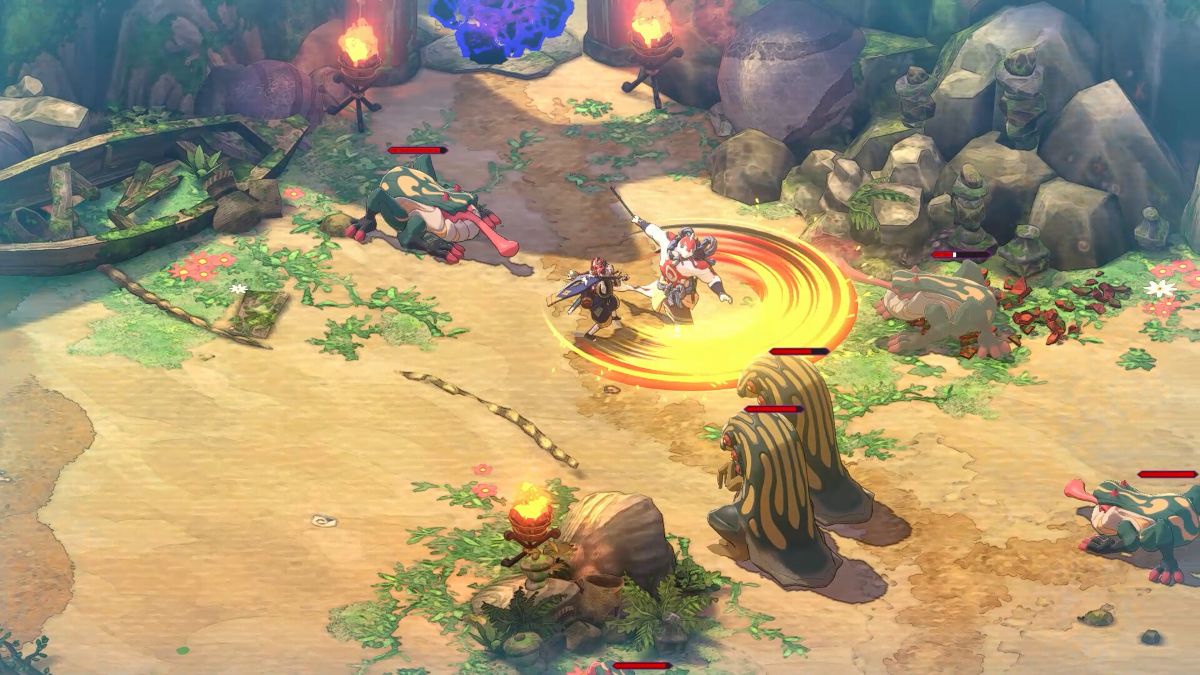
The fighting within Towa and the Guardians of the Sacred Tree is fast and furious, with little breaks in the action between enemy spawns. For every short level of common enemy fighting, your characters are rewarded with buffs and improvements. The buffs/improvements can affect health, defense, offense, and/or other small elements. The latter of the bunch can be used to improve weapons and snag inscriptions. Two gameplay elements that we will get into later.
Anyway, after completing each level, the game allows you to choose multiple paths to travel down next. Players can choose paths that take them to food, upgrades, more common enemies, or mid-boss battles. These are rolled randomly, so players are not going to get the same pattern each time. There are also timed attack events that put players against a countdown that forces them to survive a constant enemy barrage. There are a lot of different paths to take that bring variety and fun, while also dabbling in some slow repetition, which is a bit of a hiccup for the game.
Glitch in the Matrix
Enemy repetition is thick within Towa and the Guardians of the Sacred Tree. While it can be argued that the progression in the game opens newer enemies to the fight, players will still find many of the same faces showing up, with only the layout of the levels changed. There is no way to avoid noticing that aspect of the game.
In addition to the repetition, the game also feels slow. While my experience with roguelikes is limited to popular titles like Hades and Diablo, the enemies encountered within Towa and the Guardians of the Sacred Tree feel as if they’re running in mud. They aren’t speedy until you get into a mid-boss or boss stage, and even then, the number of attacks the enemies sport outweighs the speed at which they execute them. Now, why is this an issue? Well, it’s about recognizing patterns.
If enemies move and shake as if they’re running through mud, the player can see a pattern to their attacks, which, after fighting them a couple of times, makes the fight far easier than it should be. As I’m a big proponent of fun and easy games, because games should always be fun rather than torture, I could see players finding Towa and the Guardians of the Sacred Tree a bit easier than expected due to easily recognizable patterns.
The devs try to rectify the speed of the mid-bosses and bosses by creating unique monsters that sport different attacks and patterns, but the expectation of figuring out patterns will still be met each time. It’s a bit imbalanced in that sense, but also reassuring that nothing is impossible in the game. Take that however you would like. For me, it just means less frustration and more fun, just sans the challenge.
Mix and match
On the gameplay elements side of the equation, the game does a great job of bringing a unique variety of attacks with the many featured characters to keep things fresh. Before players take on various paths of destruction, they can choose from a group of protagonists to take on the adventure. Towa isn’t initially in the mix, so choosing from her lost friends creates a cornucopia of character combinations. For example, choosing Rekka and Akazu might bring to the table powerful sword swinging and strong magical capabilities. Both are quick characters that can maneuver easily around the level to avoid enemy attacks when needed. Now, if you choose Rekka and Bampuku (a large cat), then attacks and speed change considerably, though more power is brought into the mix.
Upgrade paradise
Getting back to upgrades, a topic we left way back when in this review, the game doesn’t just give players money and have them go buy their way to the top. That’s not how the game works. Players must work their way to improvement, which can even include creating a sword of their own from iron to a finished blade.
I loved this portion of the game during my preview, and I am still crazy about how much fun it can be. By players creating their own weapons, they leave the fate of their swords to their ability with learning proper blacksmithing techniques. Essentially, the game has players banging on metal with timed meters to see if they do it well or fail.
During this sword creation process, I used material gained from my failed missions, which was plentiful, sadly. With that material, I banged out iron using quick time/metered events that measured accuracy. These events came in various forms, such as smashing the metal into a single piece using a hammer that had to hit accurately. It could also be putting an extra layer of protection on the sword to keep it sharp and useful. It could even be sharpening the sword in certain ways to deliver a more balanced attack. At the end of these QTE events, players get to shape their sword to their liking, like literally shape it, before solidifying and readying it for battle. This entire process fascinated me, and it gave me good control of how powerful my character would be during fights.
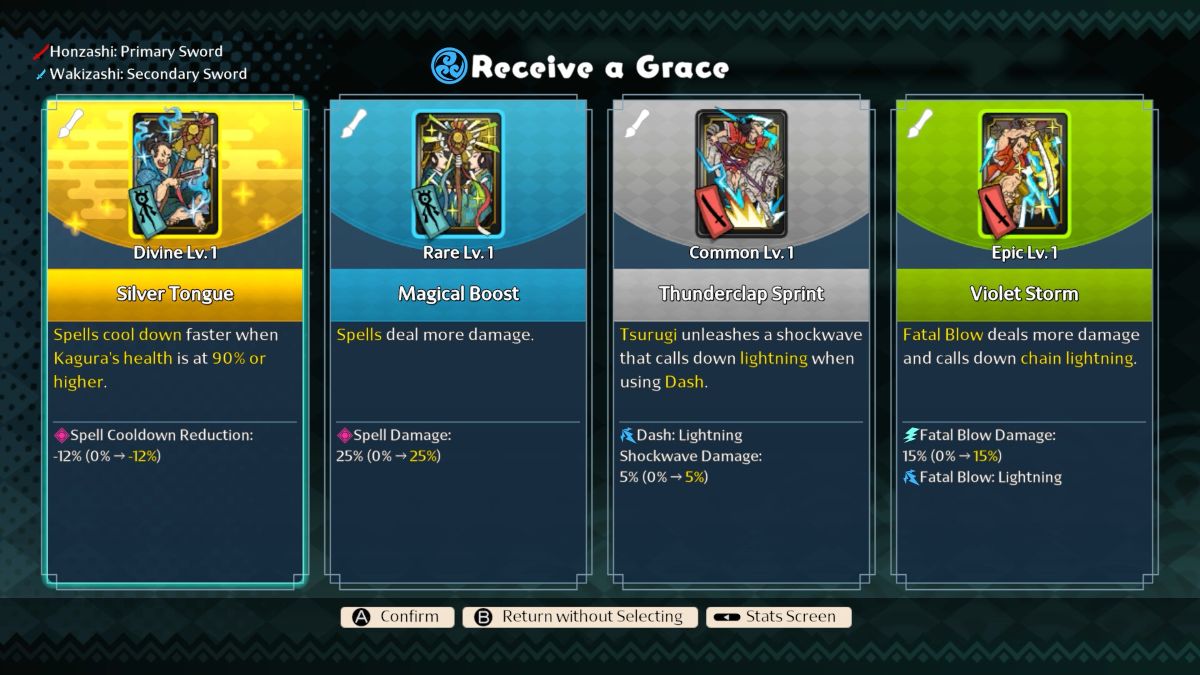
Adding to sword creation, the game also features the ability to add inscriptions, basically jewels, to swords and characters. The inscriptions can upgrade sword power, sword durability, and/or increase defense or health. The inscriptions can also add more percentages to attributes, such as speed on defense or offense. Combined, the inscriptions add more depth and strategy to characters, which changes the gameplay in a good way to make it more interesting and engaging.
Ultimately, the game does more right than wrong. Brownies put a lot of thought and organization into their offensive/defensive capabilities in Towa and the Guardians of the Sacred Tree. All of what they did works well and only stands to add to the experience. It’s quite good. There’s far more to this game than just hacking and slashing, which is what a proper roguelike action experience should bring to the table.
Overall, the gameplay brings some fantastic fun to the experience. Towa and the Guardians of the Sacred Tree is big, complex, and carries with it a deep layer of strategy that was unexpected. It isn’t perfect in some areas, but it’s excellent gameplay that shouldn’t be ignored.
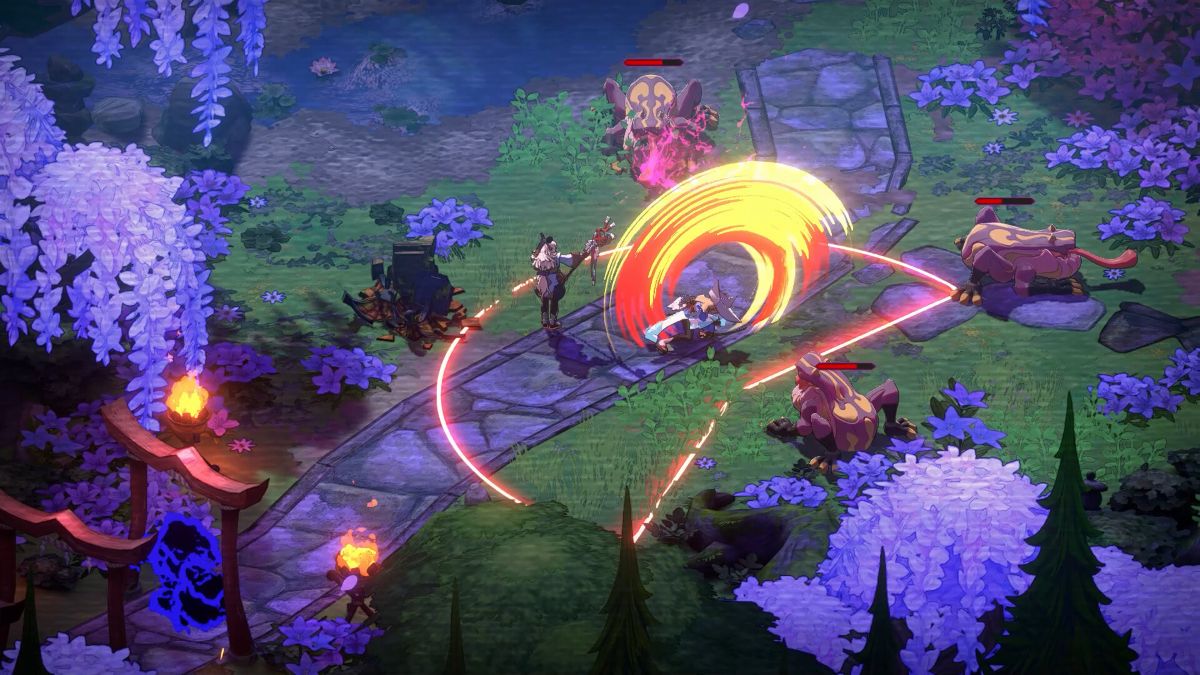
There are so many things to discuss in this area. Firstly, the game sits in an isometric view and doesn’t break from it. It’s typical of roguelike games of its type, and it doesn’t break from that previously established visual form.
While you get an isometric viewpoint, the art helps make it more than just another game. The art in Towa and the Guardians of the Sacred Tree is gorgeously detailed, creatively thought-through, and beautifully executed. It’s a pretty game, and you’ll see that from the moment you break into battle. The environments are lush with life and lovely details, which help pull the player into the world created for the game. There were many times when I just sat and enjoyed the designs of the worlds visited. The environments were superb.
If that wasn’t enough, the game also brings a fabulous set of actors who clearly bought into the script and story given to them. The actors bring personality, emotion, and fun to the game, which only stands to add to the experience. It helps the presentation value of this game considerably.
Overall, you’re going to get some great presentation in this game.
On that sweet note, let’s wrap up this review.
Conclusion
Towa and the Guardians of the Sacred Tree, from developer Brownies, is a fabulous roguelike action game that brings more to the table than not. It features solid presentation and story, a great backend system that brings a heavy amount of strategy and fun, while hiccupping only with its enemy repetition.