
I’m generally pleased with the end result of Castlevania: Curse of Belmont. It’s a metroidvania that manages to balance keeping the old-school Castlevania thematic alive and well while simultaneously refining platforming and combat mechanics that haven’t yet been possible. Knowing that Evil Empire, Motion Twin, and Konami are seeking to reimagine the now-40-year-old franchise for new players, it feels like they made a valiant effort to retain what longtime fans love most while giving new players just enough to enjoy a Castlevania title for the first time.
Over its now 40-year-history, Castlevania has stood the test of time. Even if you were to play one of its 25 mainline titles prior to today, you’d be presented with a gothic platforming experience melding horror icons together into a game that is just as much campy as it supposedly horror-inspired. The series has broken through into other games, too, such as Super Smash Bros. and most-recently Vampire Survivors. Admittedly, my own experience with the franchise has largely been shaped by the Ode to Castlevania DLC for Vampire Survivors…although I have absolutely played a handful of the earlier Castlevania titles on the SNES/SEGA Genesis.
I’ve grown to appreciate the classic platforming of Konami’s Castlevania series. Most of Castlevania’s biggest fans grew up with the series playing it on their own or (for head honcho Nathan’s case) watching an older sibling struggle to take down the immortal Dracula. After all this time, Konami has a major hurdle to overcome: They need to stay true to what makes a Castlevania game great, while also adhering to gameplay mechanics and game design expectations that today’s players assume to be evergreen. It’s a daunting task, especially because developers are still finding to strike a balance between not-too-difficult-yet-not-too-approachable. Don’t believe me? Check out the major criticisms from other outlets about Wolverine…
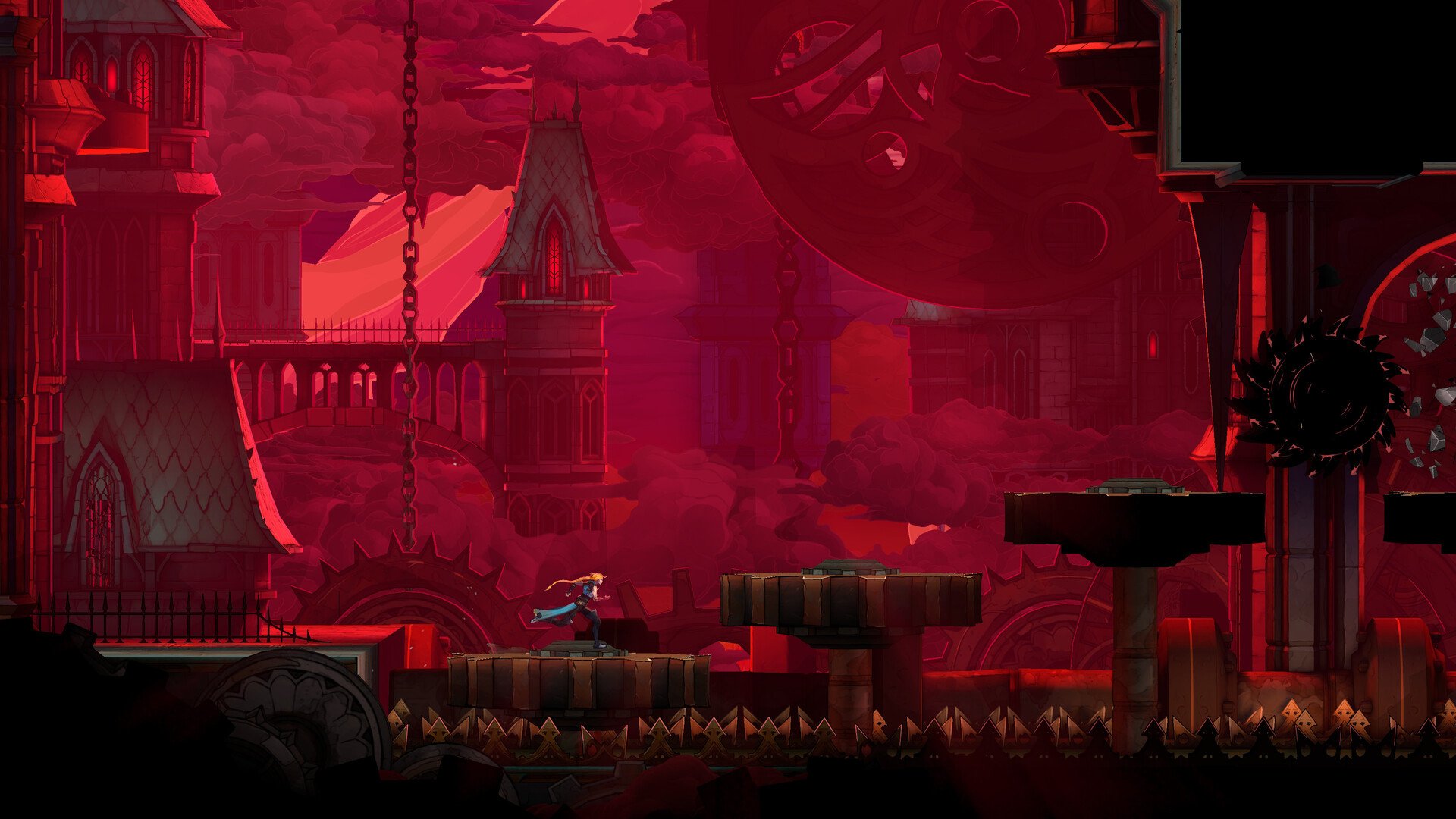 I digress. Let’s focus on Castlevania: Belmont’s Curse. As the 26th entry in the Castlevania series, it follows Rose Belmont as she makes her way through Paris and some familiar spaces that have emerged from the depths of hell to destroy humanity. You don’t have to be a Castlevania lore expert, thankfully; much of the story is new enough that anyone can follow along. That said, there will be some familiar faces in some respects, so longtime fans should be excited to see a fresh take on a Castlevania after all these years.
Much of the game’s level design and progression is dictated by a core weapon mechanic used by longtime protagonists: Rose’s Arcane Whip. Instead of a whip being the default starting weapon, one of Rose’s first obtainable upgrades is a magical yellow whip that greatly enhances her traversal capabilities. By hooking onto neon purple objects, she rappels in her chosen direction to scale larger horizontal or vertical distances. Hooking onto a neon yellow object, on the other hand, swings Rose in a circular fashion and allows for greater freedom of movement. Luckily, physics doesn’t limit that freedom of movement like prior entries that relied too heavily on real-world momentum. Belmont’s Curse assumes players’ direction, resulting in intuitive and consistent swinging. It’s clear that the developers played Insomniac’s Spider Man to get a feel of fun and accurate whip-based traversal.
The whip can also be used in combat in conjunction with whatever weapon Rose has currently equipped. By hooking onto an enemy and pulling herself towards it, she can quickly follow up with a powerful slam or slash. This enemy pulling mechanic feels somewhat unintuitive at first, but it gets overshadowed by the satisfying clash at the end of the animation. It feels fun to leap from enemy to enemy on a 2D plane, and it truly shines in biomes abundant with flying enemies. It’s not a carbon copy of Spider Man, but there’s a clear inspiration that nails the feeling of using Belmont-approved weaponry in ways that previous engines weren’t able to properly provide the player.
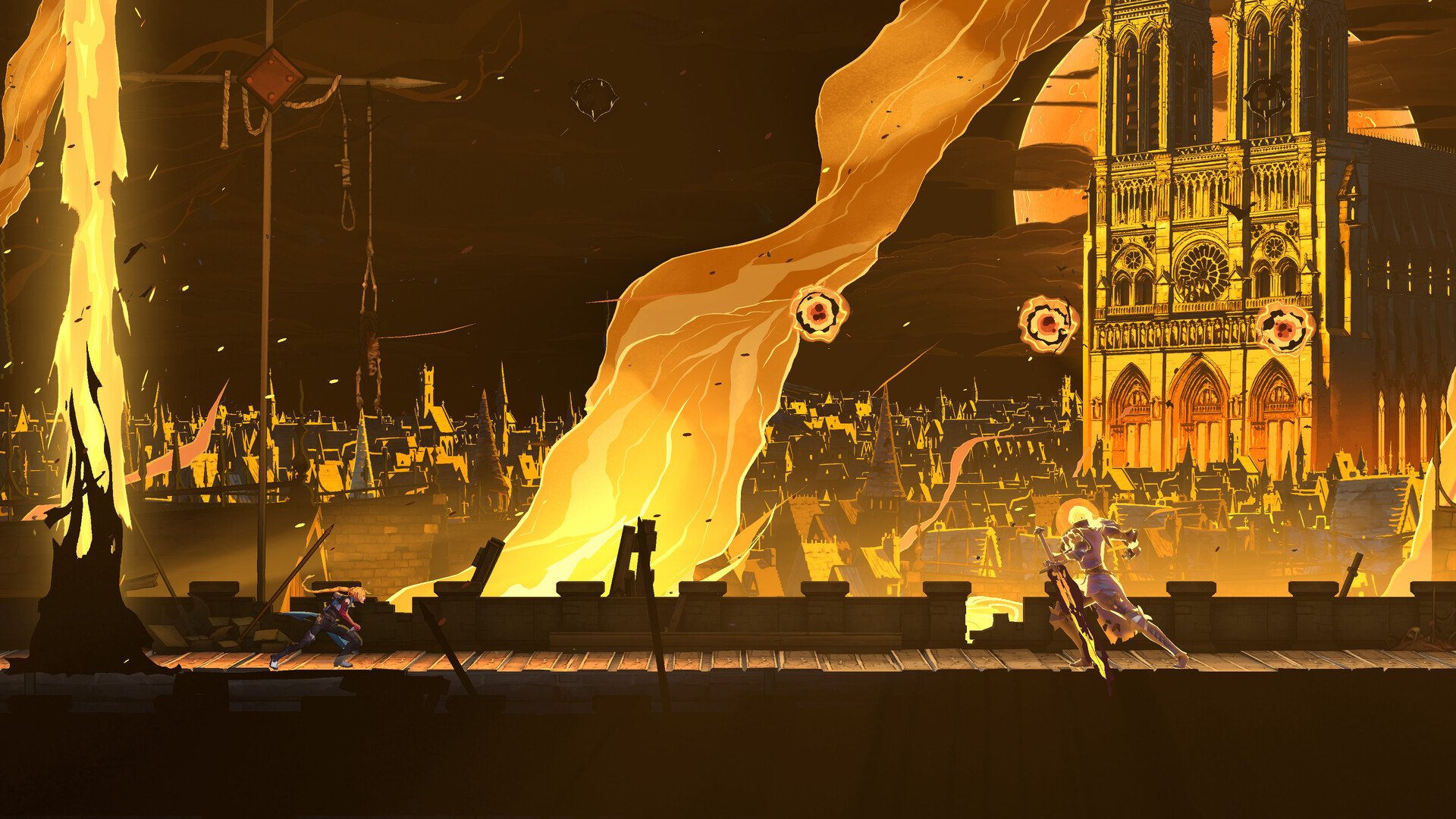
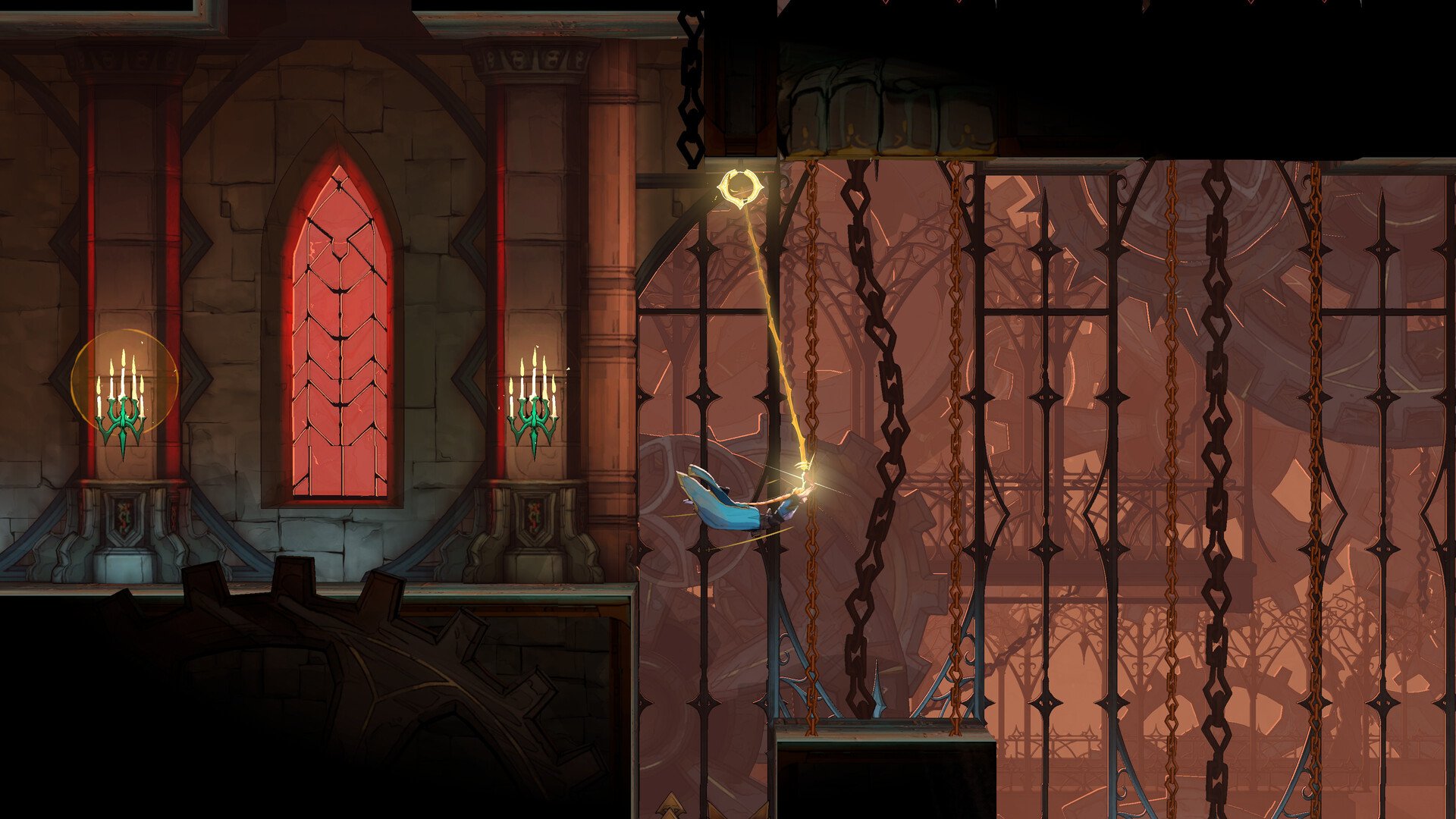 Since the whip is one of the first obtainable upgrades, this means that the levels need to be designed around enhanced traversal wherever possible. In the game’s first few minutes, Rose walks out onto a bridge while the screen zooms outward to show a panoramic view of Paris set aflame. These panoramic moments are frequent, showcasing gauntlets that utilize a healthy blend of wall jumping, whip swinging, and dashing. I was reminded of playing The Rogue Prince of Persia and its ligne claire art direction while playing Curse of Belmont, but with a greater focus on gothic horror. Having a toolbox of novel traversal works only when there’s a massive sandbox to use those tools, and thankfully Curse of Belmont offers that space for play. The first time entering a new level or biome results in a utilization of more of Rose’s toolkit that keeps things fresh…until it doesn’t.
Curse of Belmont’s massive levels fall short the moment backtracking becomes a point of requirement. This metroidvania staple can be offset by shortcuts, thoughtfully placed save points, and fast travel locations to encourage the player to seek out unexplored areas of the massive map. That said…shortcuts are few and far between, save points seem haphazardly placed except for those a few rooms away from a boss battle, and fast travel is limited to the point where it shaves a few minutes off a 10-minute backtracking sprint.
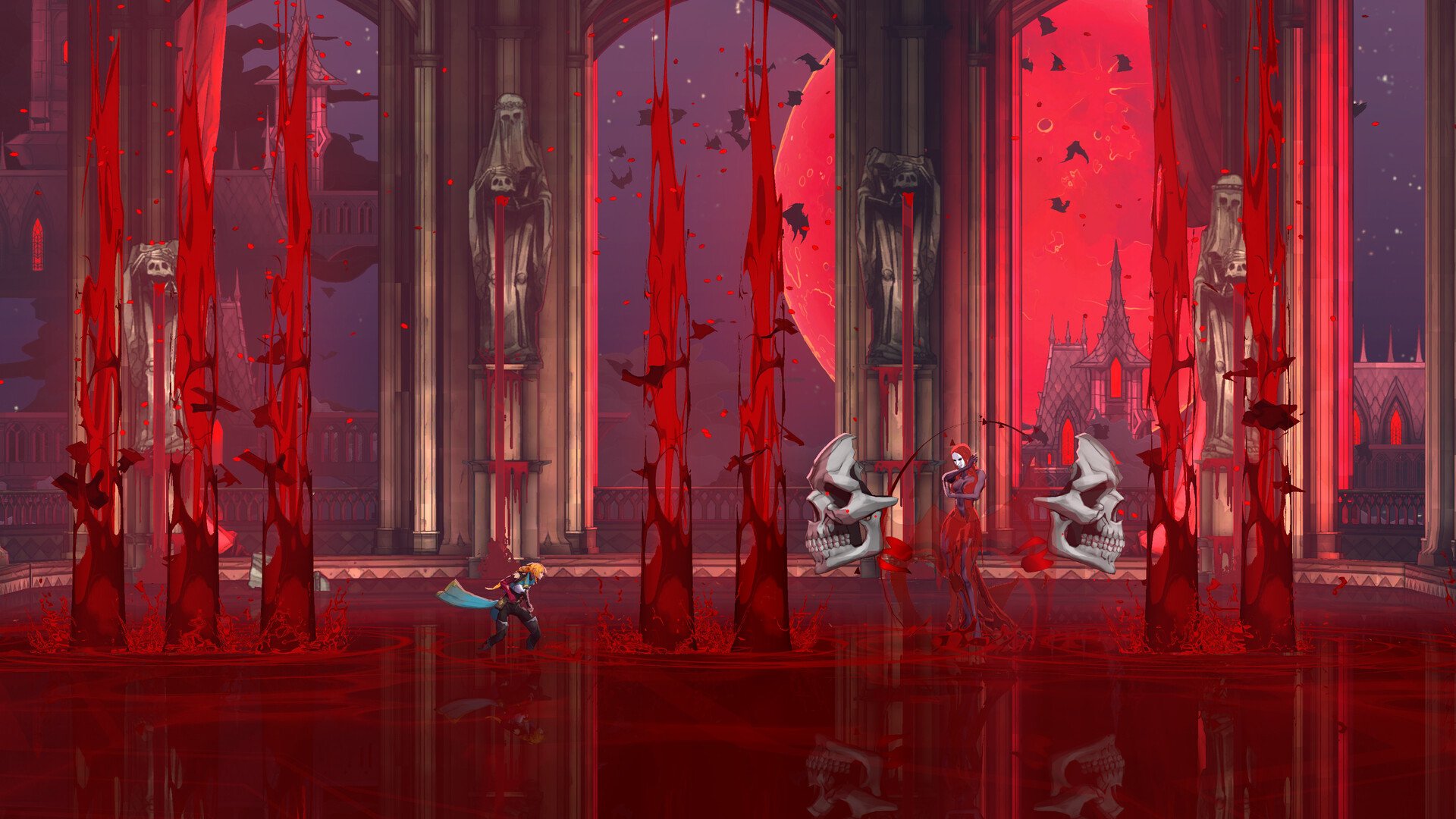 I’d be less forgiving if the levels themselves were empty and lacked variety. Unlike Possessor(s) which utilized whip-based traversal contained in massive rooms, Curse of Belmont’s biome-and-level design contained a great wealth of variety that appropriately utilizes Rose’s whip alongside the other traversal upgrades she obtains along her journey. I generally liked going through them and challenging myself, at least the first few times I had to make my way through the labyrinthine demonic streets of a ruined Paris. The map was also chock full of secrets – it’s always great to be treated with upgrades tucked away in nooks and crannies. While exploration was relatively straightforward, there were enough branching paths to appease the bravest of explorers.
This is especially true of some of the challenge rooms, which reminded me of Guacamelee!’s gauntlet challenges. Several hidden rooms in Curse of Belmont were set up to appropriately test my mastery of the most recently unlocked traversal upgrades while using some of the older upgrades. For instance, on a challenge level where I could hook into a portrait and propel myself in another direction, I also had to utilize the ability to temporarily dissolve walls with light. These challenge rooms were excellent tests of skill that made me feel like I was good at platforming. The most frustrating rooms were offset by how taking damage from traps (like spikes in a pit, buzzsaws, etc.) dealt a miniscule amount of damage overall, allowing me ample room to make mistakes without needing to backtrack.
Beyond this, much of Curse of Belmont is in line with the traditional metroidvania gameplay loop. It doesn’t attempt to innovate in heavy-handed fashions, instead opting to give players a taste of a modernized platforming experience contained within an old-school frame. The upgrade-seeking and boss-slaying segments are tucked away alongside oodles of secrets, giving players ample reason to explore and rewarding those who stick it through to the end of that expedition.
 That said…there’s one last thing that left me confused. Curse of Belmont utilizes a level up system that functions in an odd fashion. Defeating enemies and bosses grants experience. Slaying a certain undisclosed number of enemies/bosses will yield a LEVEL UP animation, but it’s not the most evident what that LEVEL UP functionality does unless you opt to check out the settings…where it tells you that higher levels gives you slightly more permanent stats. I didn’t realize that I was getting stronger via leveling up until I had returned to the starting biome, only to discover that I was able to kill enemies in a single swoop.
I’m torn here, because I understand why this system was implemented but I’m not fully convinced that I think it’s needed on the default difficulty. It makes the game easier, that’s for sure. It also makes grinding feel like something is the reward rather than nothing at all. On the other hand, the game is most difficult in its platforming segments over all else. Bosses have predictable patterns that can be learned on the first or second attempt, just like they were back when Castlevania was on older consoles. This renders the need for permanent progression via stat-acquisition to be unnecessary.
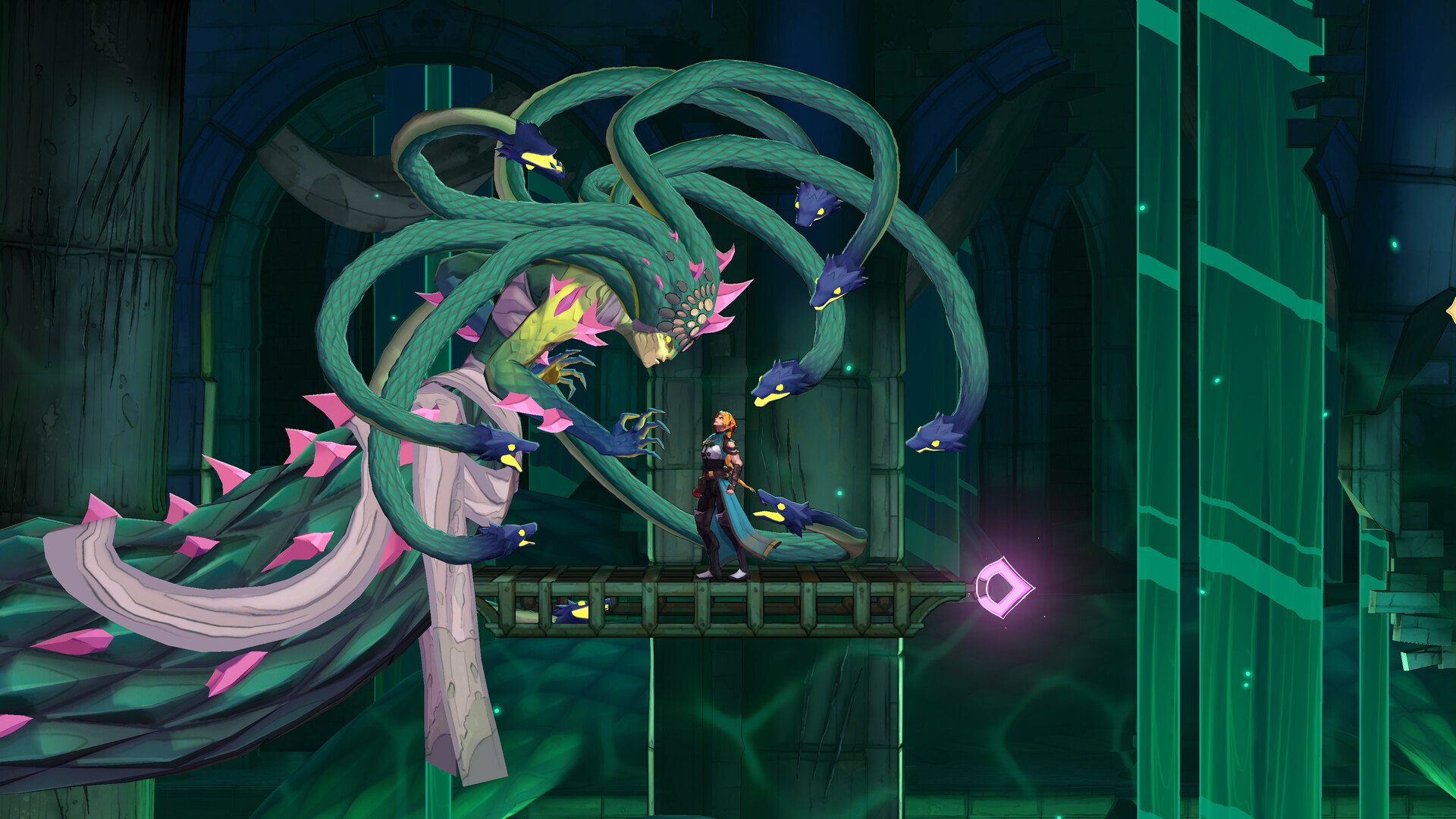
 If you’re wanting evolving abilities, though, you’ll get them by simply using the Arcana spells assigned to Rose’s tarot cards. Defeating bosses grants Rose a new tarot card with a new ability, and using that ability a certain number of times or within specific constraints level that spell up. For example, when I used Medusa’s Petrify on flying enemies 25 times, I could “purify” it and select a secondary effect that increased Petrify’s power. Leveling the tarot cards felt good, even if some of the level up requirements felt unnecessarily grindy.
I’m generally pleased with the end result of Castlevania: Curse of Belmont. It’s a metroidvania that manages to balance keeping the old-school Castlevania thematic alive and well while simultaneously refining platforming and combat mechanics that haven’t yet been possible. Knowing that Evil Empire, Motion Twin, and Konami are seeking to reimagine the now-40-year-old franchise for new players, it feels like they made a valiant effort to retain what longtime fans love most while giving new players just enough to enjoy a Castlevania title for the first time.