
I haven’t seen this much drama in a point-and-click game since The Dig.
The Drifter, from developer Powerhoof and Dave Lloyd, is a narrative-driven point-and-click experience that puts the user in the shoes of a drifter named Mick, who is trying to make it back to his family for his mother’s funeral. Along the way, he gets caught in a web of murder and mayhem and is forced into lightning-quick decisions that determine his survival. Just like Mick, this story is built for intense and suspenseful moments.
Now, having said that, and not to make it too obvious here, the narrative is the driving point of this game. Although it rides a linear line to make sure that the player gets a decisive and satisfying (if not dark) conclusion by the end, it is well-developed and perfectly cooked to a movie-esque structure that some in Hollywood could take notice of when trying to find the next great idea. The devs spent a lot of time concocting what I would consider to be one of the better point-and-click adventures that I have been on since the mid-90s. The story brings drama, meaningful moments led by complex decision-making, and is a narrative that hits hard on the heartstrings to lure and trap the player into caring what happens in Mick’s world. It has been a long time since I was hooked this hard to a point-and-click story. It doesn’t hold back with its intentions and delivers various gut punches, as well as ‘whew!’ moments properly. In other words, it’s a damn fine story.
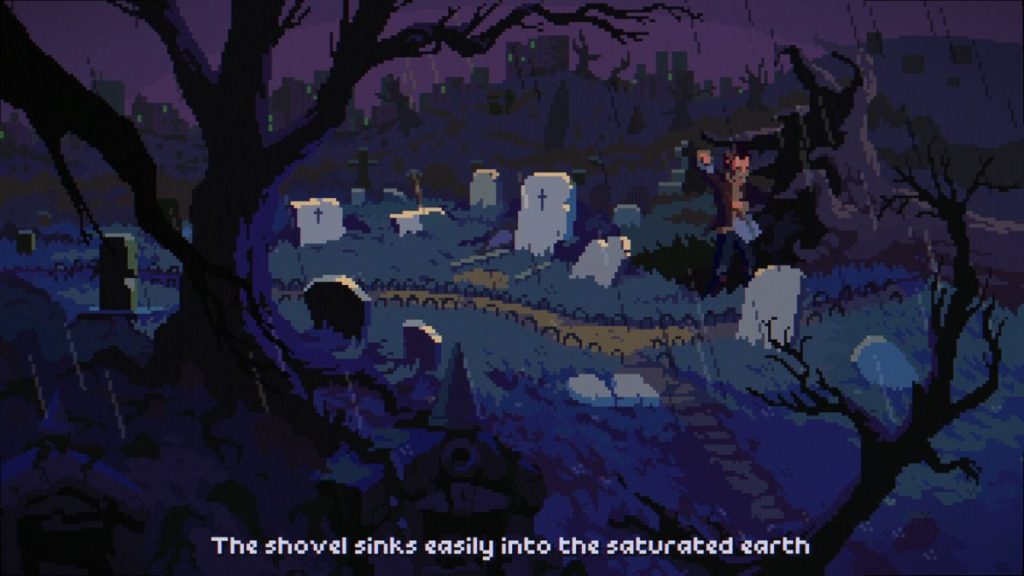
On the gameplay side of the tracks, The Drifter brings a unique point-and-click structure led by simplistic controls that offer plenty of paths for decision-making, especially during extremely tense moments in the story. Making the gameplay easy only stands to help maintain player focus on the story. Plus, it’s far more fun not to think too hard about the process of playing the game when controls get in the way.
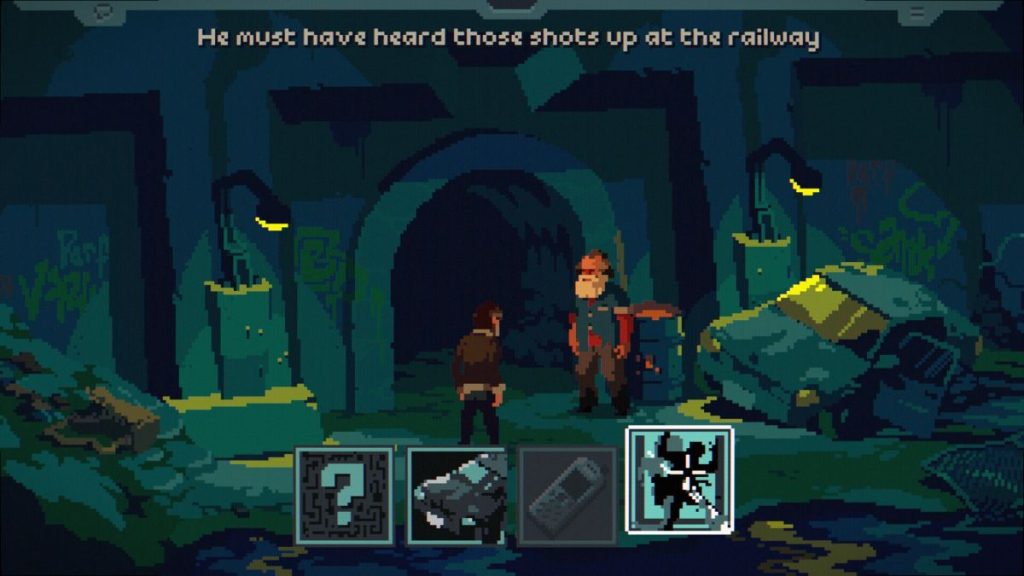
Taking the remade Secret of Monkey Island approach from the mid-2010s, The Drifter builds the control scheme into an easy-to-use design. The controls are led by the left thumbstick for moving Mick around a pixelated world, the right thumbstick for bringing up hotspots and choices in the game, and the ZR button to execute said choices. The L/R buttons are used for inventory scrolling. While that might seem complicated, it’s incredibly easy to control and select choices for Mick, which improves the point-and-click experience.
Simplified controls that are multifaceted help to keep down the traditional point-and-click method of gameplay control, which can be a complete drag and slowdown with the adventure. In short, it saves time, and it makes sense when using it quickly. For example, there is a point in the game when Mick has to light a piece of cloth, hide in the dark to avoid detection, and then escape and pull on some rotted wood to take down an enemy. The process of doing all of this starts with moving Mick into position with the left thumbstick, choosing a cloth with the L/R buttons, placing the cloth with the right thumbstick, and then choosing a lighter to get the scene going. All of these steps took around 15 seconds to execute properly, which wouldn’t be the case in a traditional point-and-click control scheme. In a traditional point-and-click game, moving the mouse to a spot, choosing an object, then choosing a command, and telling the character what to do would take time. It would definitely take the player out of the moment. The Drifter‘s control scheme simplifies the process immensely. It’s intuitive, and it feels good in its design and execution. It plays well with the story and keeps the player in the emotional moment. And even moments where the player has to stop and think benefit from the control scheme.
The puzzles that require this control scheme are not as linear as they feel. The devs make the player figure out how to get through or past a bad situation. They give hints but leave it up to the player to truly figure out the problem. For example, there is a moment in the game when Mick is trapped in a hospital, handcuffed to the bed he is lying in. At the same time, Mick is being interrogated by a police detective while also being murdered silently by a killer posing as a nurse trying to inject his IV bag with poison. The player must figure out how to avoid pissing off the police while also avoiding dying. The solution to this puzzle is not easy, nor is it obvious. Taking into account the active hotspots around Mick, while logically deducing the possible scenarios that could go down with the tools around him, is cognitively breathtaking. No doubt the game is linear, as there is only one solution, but the process of getting to that solution is clever and complex, as it is entertaining.
The Drifter also does a great job of maintaining the genre’s principles of problem-solving, but does it in such a way that the player can’t help but feel very involved in the solution. I came out of this experience feeling like I had accomplished something rather than just blindly gone through a trial-and-error type of gameplay process. There’s nothing wrong with latter, as LucasArts lived off this type of gameplay forever, but The Drifter just feels more involved and player-driven. The lack of hand-holding by the developers is impressive, as they seem to put more faith in the player’s ability to get around the presented problems than most games of this type. Trusting one’s audience is the first step in making a good game that is memorable.
Overall, the gameplay in The Drifter is thick with story, user-driven, and still maintains a linear path to keep them on track. Going into a point-and-click environment, knowing there is truly only one direction to take, usually makes the process feel mundane and exhausting for the player. With The Drifter, its story is so good, and that contains characters incredibly developed and compelling, that it’s difficult to walk into those gameplay tropes defined by this genre. I can fully understand why players have taken to this game and how fantastic, if not frightening at times, the experience can be. It’s absolutely well-done.
Before we wrap this review, let me also add that the acting, visuals, and music are superb. The acting, while a little over-dramatic at points, helps to sell the story and the suffering Mick (and his crew) go through in their situation. The heartbreak, the hurt, and the immense feeling of loss are exemplified through the actors. This is a drama that is performed beautifully.
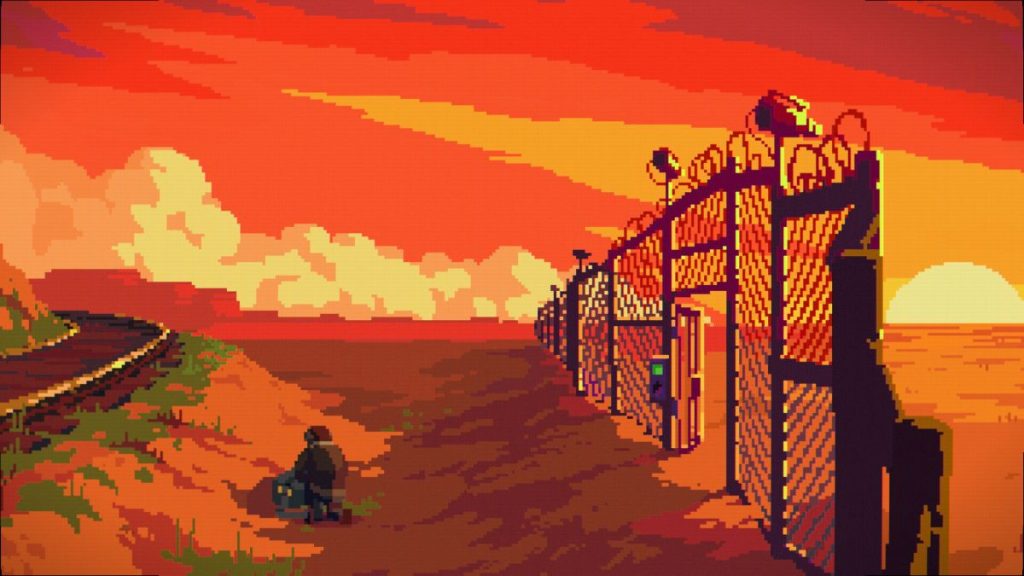
As for the visuals and music, they help to magnify the story and acting. The visuals are a tip of the hat back to a 90s point-and-click adventure. Pixelated, pre-drawn environments are helped by modern-day effects that nail the scenes. It’s a combination of both past and present, and is done well to drive home every aspect of the game. On the musical side, and I mean this with the utmost respect, it’s better than it should be for a game of this type. Orchestrated, well-composed, and only stands to help the gameplay, especially during powerful moments, the game’s music is breathtaking. It’s gorgeous to the ears and hits when the story needs it the most.
On that note, let’s wrap this review.
Conclusion
The Drifter, from developer Powerhoof and Dave Lloyd, is a point-and-click adventure that stands out from most modern games in this genre. It brings brilliant control design, a thick narrative that can be felt, and all the right gameplay elements to make the game an impactful experience.