
It has been a while since I last revisited RyseUp Studios’ game Roboquest. It has been since Thanksgiving 2023. Surprisingly, that doesn’t seem that far away, but it was! God, I miss that year’s food. It was soooooooo gooooood.
Anyway, back to Roboquest! This game came out of nowhere that year, and now it is decided to land somewhere again with the PlayStation version. The good news is that the transfer from PC to console was seamless. Unless you’re dying to go mouse/keyboard, using a controller and having it boot up quickly on the PS5 is such a nice option.
Thankfully, the run-and-gun nature of the game is still fresh with this release; it still has an easy pick-up-and-go type of gameplay, and it feels fun taking down enemies again in huge levels that only devs on Titanfall 2 could smile at and be thrilled.
So, let’s get going on this review of Roboquest on the PS5.
Story time!
The story for Roboquest is simple and easy as a Sunday morning. A young, desperate human scavenger came across a Guardian robot in the desert and decided to revive it. Once reactivated, the robot loyally stands by the scavenger’s side as it bowls through endless evil robots in hopes of helping give humanity a chance to survive.
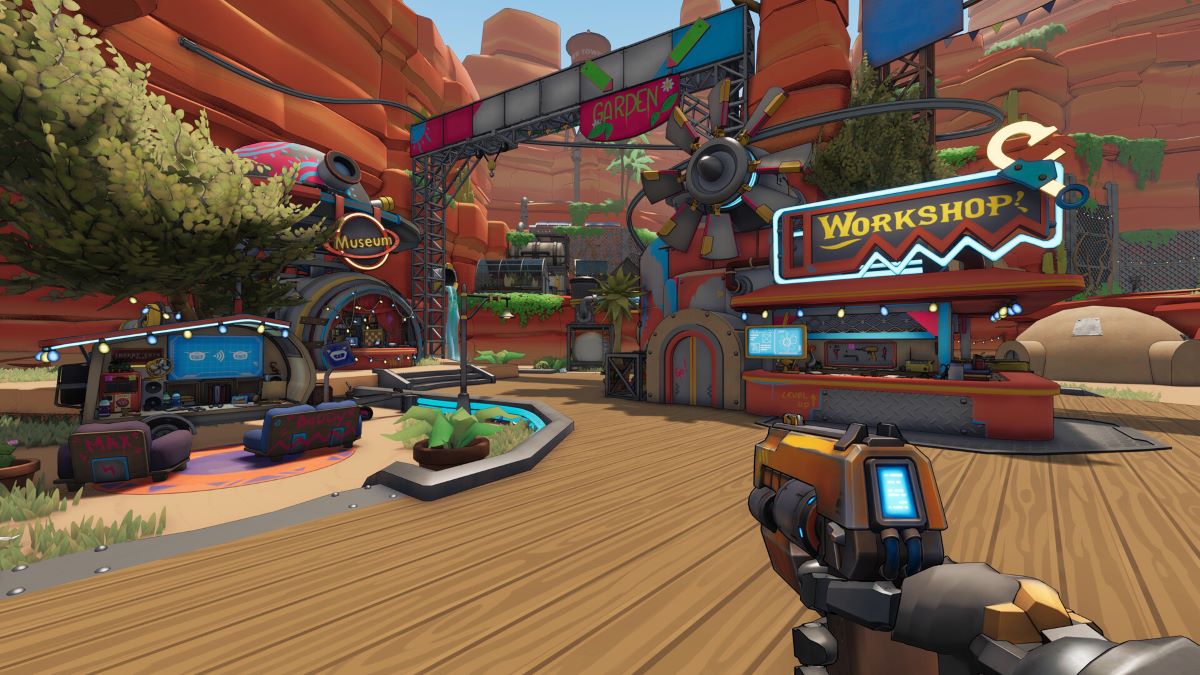
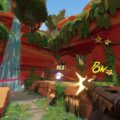
While there isn’t much of a jumping-off point with the story, it has a sort of Borderlands vibe to it in both looks and personality. You’ve got some heavy cel-shaded animations mixed with a desolate and destroyed world that wants to be free of its captors. When you get dropped into the world and its narrative, you understand the situation without being told.
The story is deep enough to give players enough motivation to explore and take on environments and robots. When you have a randomly generated action game, this is all you can hope for on the storytelling side of the tracks. But the story feeds the action well, it creates a solid sense of situation, and it works more than it doesn’t. Do I wish for a bit more details, some deeper context in the narrative, and more meaningful narrative acts? Certainly, but I’m not here to be wowed by getting hooked with the story; I’m more interested in how the game feels and works. It’s built to be fast, so it needs to concentrate on that from beginning to end.
And so, it does.
Controls done right
Part of the joy of a first-person shooter experience is how well a developer can get the controls right. The easier it is to control an FPS, the less distracting the experience is going to be. This is the case with Roboquest, where the controls are as tight as a tiger and execute as well as the Cleveland Browns defense against the Pittsburgh Steelers. Pointing and shooting are not a problem with the control scheme drawn up by the devs at RyseUp. This process feels smooth and without effort or thought, which is where you want to be when you’re trying to make a fast-paced shooter. And the controls certainly set the tone for fast-paced-ness.
Movement is quick, as is running, dodging, and firing, where they all work together well to create exciting gameplay that feels like it could go on forever. It feels good when you move the robot around. It feels like you are always in absolute control of the situation and the moment. Nothing about it feels loosey-goosey, which bodes well and complements the rest of the game. It seems like RyseUp Studios wanted its players to move quickly through the environments while shooting with confidence, and the controls meet those expectations.
This type of gun control and player movement means that you can just see/aim/shoot without any other thought getting in the way. Not a lot of devs spend time getting that right, yet Roboquest does a great job of delivering it. Of course, moving and shooting with ease needs the actual shooting hardware to be right to see the control scheme through. Let’s get right into that aspect.
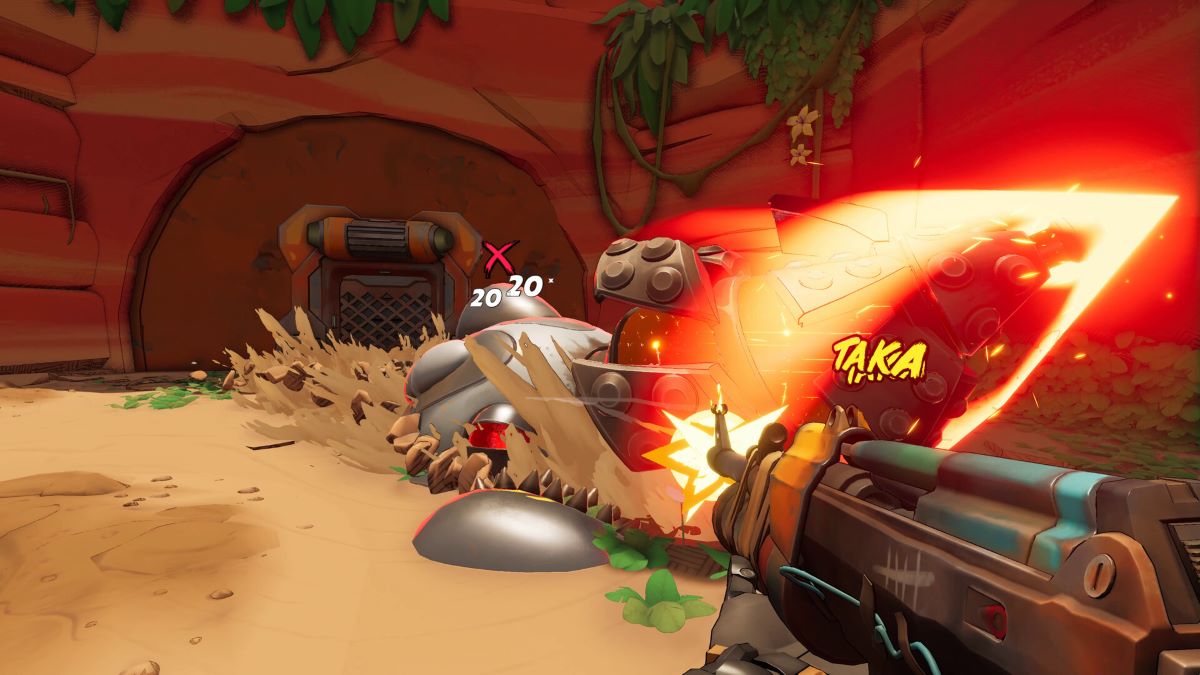
The translation from PC to console with the above expectations was 1:1. I went back and tried the game on PC before reviewing the PS5 version, and I found that there is essentially no difference, other than I feel far more comfortable and in control with my console controller. I’m more of a console gamer by heart, so that isn’t unexpected. It’s just nice that I didn’t need to learn any adjustments or new tricks when going from mouse/keyboard to controller.
Guns galore
While movement is wonderful, having a variety of weapons is also a necessity to keep this type of game interesting and addictive. This aspect of the game is what kept me the most engaged when it came to replay value. Roboquest features a good variety of weapons and a steady progression of stats for them. Both are valuable when bringing a solid shooting experience.
Starting with the arsenal, the weapons can range from bow/arrow, two-handed guns, powerful shotguns, and a variety of oddities such as a grenade launching destruction bringer that requires the right lob angle. Knives and powerful punches also come into play, and are easily accessible, though randomly distributed during gameplay. Certain points of fighting allow for new weapons, as does in-between intermissions where you randomly acquire new ways to kill other robots through a non-paying loot box. Basically, this is a checkpoint that gives you upgrades, as well as a break.
Now, as previously mentioned, the stats for weapons are steadily progressing with each drop, and the information about those stats helps to perpetuate the illusion that you’re getting new weapons as you pass each stage. It’s rewarding to know you progress in nearly every aspect of the game as you push forward, and through this stat system, the game makes it easy to feel like you’re doing a good job. Who doesn’t want encouragement? When you run into a new weapon, you get a nice little weapon stat window telling you what you are exchanging. Maybe you have a bigger, more powerful weapon with little to no range. Maybe you have a ranged weapon that lacks power. The game throws out easy stats to look at with green/red arrows supporting your quick visual scan. It’s a great complement to this style of play, and it allows you to truly translate stats on the fly.
Overall, you’ll have plenty of weapons to choose from as you progress forward through Roboquest, and you will know exactly what you’re getting along the way.
Environments that are just a tad sparse
While the guns and controls are smooth as silk, the randomly generated environments, in all their glory, are a tad bit plain. The game features multi-tiered levels that look deeper than they are during gameplay. You’ll go through ruins, canyons, cities, and a bevy of locations on your way to destroying robots and progressing ever so quickly. Not too bad when you think about it.
The plain part of this equation is what is generated along the way. When you die, you go back to the levels you pushed through, and you get a randomly generated map that is random in structure but not in visuals. The map consists of narrow spaces to contain the action, which is great for this game, but also nothing too extravagant to ‘wow’ you visually for long periods. Even when the environment gets big, such as the case with the city levels, they’re so repetitive in restrictive in visuals that you can get easily lost in them. I found myself lost on the multi-tier rooftops of buildings in the city, not being able to identify new locations without looking at the map. The map is nice, but I don’t want to stop gameplay to locate my position. Anyway, while the action certainly makes up for this lack of unique scenery and visual excitement, it is very present and prominent the longer you play Roboquest.
All this said, I understand why the environments may not be as important as they should be and understand that destruction is what you should be focused on. You came for the quick kills and interesting arsenal, not to shoot pictures like you’re playing Pokémon Snap. I mean, there isn’t anything wrong with Pokémon Snap, but that isn’t why you bought the game.
Now, having said that, getting a bit of level variety would help make the game feel like it’s huge. More details in maps, and more unique and randomly generated structures would help to separate things and make it feel like you’re getting something meaningful with levels. Again, it’s by no means a dealbreaker, especially as enemies get more and more unique through player progression, and they are the real show here, but it’s noticeable.
Just a little bit of difference from level to level would have been nice. I will give props to the number of spaces you can traverse on a single level, which helps to calm the visual dullness of seeing the same type of narrow landscape over and over. Ultimately, it’s not enough to visually entice as you play this game repeatedly. Again, not a dealbreaker, but something that could use some more polish.

Customization and polish
Now, while the environments might need a bit of variety and depth, the customization portion of the game helps to keep the experience consistently positive. There are several upgrades to the player’s basecamp portion of the game, which include additional upgrades and item availability, that help to make the gameplay far more engaging. The basecamp is a wonderful go-between for the player and an oasis of sorts for the player to improve their robot, change classes, toggle difficulty, and acquire additional upgrades for the gameplay. It’s a cool stop to have before and after you play through Roboquest, as well as a wonderful rest stop in between action points.
Anyway, as you collect objects from fallen enemies and build up a substantial number of goodies along the way, you begin to gain the ability to expand your go-between space, which helps expand the experience considerably. This could mean more places to work with or possibly better health for the robot. It has a lot of upgradeable and unlockable items to choose from, which only stand to build out the gameplay and motivate the player to keep going.
Anytime a shooter can keep you focused and motivated to return after a considerable number of deaths, then that is a good shooter to play. The customization, unlockables, and upgrades provided this type of motivation. Truly good stuff and great design.
On that note, let’s wrap up this review.
Conclusion
Roboquest from developer RyseUp Studios is just as fun on PlayStation 5 as it was on PC. It still has some of its shortcomings, but nothing that will keep you from enjoying the action, evil robots, weapons, and customization.