
I saw where this game was going, and I wasn’t disappointed by the results.
NITRO GEN OMEGA from developer DESTINYbit is a turn-based, open-world mech game that almost hits all the right notes. It features a welcoming world with plenty of tasks and side quests to complete, while beneath it all lies a sort of simulator that complicates the gameplay. The rub on this rib is that the game sometimes overcomplicates itself, which can leave a player wondering what they should be doing next. There’s a lot more to love about NITRO GEN OMEGA than there is to dislike, so let’s start with the good before we get to the bad.
The game begins with a solid premise. NITRO GEN OMEGA lies within a war-torn world of survivors who depend on mechs to make money and dominate areas. It’s like if Robotech and Battletech got together with Mad Max and had a baby (it’s complicated – go with it), and out popped a messed-up world that was violent and ever-changing. It’s a neat narrative that doesn’t take itself too seriously, as it wants you to believe that it has 50 Shades of Tank Girl driving it all. At the same time, it also has a touch of sincerity and stakes to make the journey worthwhile. If you ever needed a primer to get into the gameplay in that sort of world, then NITRO GEN OMEGA’s story is that primer.

Now, primer aside, the good gameplay parts of NITRO GEN OMEGA lie within its intentions and structure. The game was built to allow players’ choice and freedom to do what they want. It’s an open-world adventure by design, and the player will feel that as they wander a huge map filled with places to explore and typical RPG land variety. That big world is held up by player choice, as the player can pick their crew, contracts, and design their fights the way they want them to happen in NITRO GEN OMEGA’s open-world.
The game wants the player to stay long-term with it, and gives them plenty of avenues to travel as they play it. For example, picking your crew from bars and other locations means trying to find stats that can mean the most for the mech team and considering the balance of what new faces can bring to the team. Some of the hires can be folks with specific offensive, defensive, or pure support role skills. Having the right combination of fighters means the player can put together different teams for various gameplay scenarios. That is a part of NITRO GEN OMEGA that can run deep and take a lot of time to perfect, which is wonderful player agency.
On the contracts side of the open-world-ness, players can pick up contracts in various locations that feature goals they must meet to obtain a victory in battle. This portion of the game had me thinking Mechwarrior, as the contracts offered can vary in purpose, reward, and difficulty. Again, much like picking a crew, the game gives the player complete autonomy to do what they wish and go in the direction they desire with contracts. More choice, more freedom, more ways to control one’s fate when playing NITRO GEN OMEGA.
The game also throws in some simulator gameplay pieces to keep it from being pinned down to one genre. The simulator is more about finding the right pilots, pairing them up with others, and building relationships, while also having a bit of fun in the process. For example, a team that succeeds can go back to a virtual gym on their ship and do yoga together to build friendships and to get their crew closer to each other. That friendship drives the cohesiveness of the team and makes sure that everyone is happy. This part of the game is surprisingly easy, but also incredibly complicated to balance when things are going badly. Regardless of success or failure, the game throws this gameplay element into the bunch to make it different than just traveling around a large world and completing contracts. Getting people to become a team is a strong component to consider when trying to achieve success.

To make that happiness meter even more complicated, NITRO GEN OMEGA throws in a need to pay people. By getting and succeeding with contracts, crew members are paid what they request or were guaranteed when hired. An element of keeping the happiness going is keeping the money flowing. When it doesn’t flow, the crew gets antsy. For example, early in the game, I picked up my second contract, which was extracting a team from a bad situation. Traveling to the requested part of the map didn’t sit too well with my crew, who weren’t earning enough to keep their focus on the mission acquired. I was constantly pushed back to home base to acquire another contract before going too far. NITRO GEN OMEGA has some management simulation in the mix with things like this, as it was an irritating lesson on monetary balance in the midst of fighting and trying to make an honest living. And don’t get me started about ammo upkeep and having to make sure I have enough money to have enough firepower. It’s easy to forget that it’s a component in the game, but a tough lesson to learn in the midst of battle. Again, it’s a complicated piece of the gameplay that requires players to think about in order to survive and achieve success.
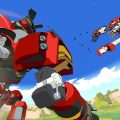
Once a crew is acquired, a contract accepted, and everyone is jolly with joy because the money is pouring in, then the action begins. Putting together a crew and going into a turn-based fight has a lot of implications for how much fun or unfun a battle can become. Before we get into the intricate details, I need to step aside and applaud the game’s battle visuals that DESTINYbit went with for NITRO GEN OMEGA. It’s straight out of an anime series, as expressive animations and over-dramatic situations are created beautifully during a fight, and with a droplet of Arcane to make it all work. The animation is good, it’s emotional, and it helps prop up the fighting considerably. It certainly builds drama to make the fight feel like it can go any direction. Anyway, gorgeous animation. Love it. It works for the mech fighting.
Now, getting back to the actual fighting portion of the game, it’s a turn-based system that runs on pilot attributes. The pilot attributes are determined by the type of hire and assignment the player gives their crew. For example, players might have a crew member who is great at launching smoke grenades to stutter enemy fire and keep the mech going. Their role might just be throwing smoke bombs and releasing some steam to keep the mech intact and functional during a fight. There also might be a crew member who has been assigned guns and missiles, which makes them the offensive solution in a fight. Playing off those attributes and designing a team that works best for specific situations and contracts helps to keep the monotony of turn-based gameplay in check.
Moving on, when a fight begins, the game does what any turn-based game would do, and that’s asking the player how they want to approach a situation through each crew member. There is a planning phase of the turn-based gameplay that ping-pongs back and forth between the player and the enemy. A player will be asked to start by selecting how they want to approach a fight, select it, and then the next step will be handed back to the enemy, who will try to counter the move. As each crew member is assigned a specific part of the fight, a small timeline is built at the bottom of the screen. That structure dictates how a player approaches a fight and what crew/choices they make each round of fighting. After all choices are made, the fights are then set in motion to see how the player did. The turn-based battle continues until the fight is won or lost. Believe me, making the wrong choices in this game can be easy, which can also create a lot more player focus on crew hires and mech adjustments. All this just stands to make the turn-based gameplay a lot more interesting and, as with the rest of the game, hands a lot more decisions back to the player. If you’re a control freak of a human being, this game was made for you.

To cap all this gameplay off and the freedom of choice in a very large open-world setting, the game also forces players to keep their mechs in tip-top shape after battles, otherwise they will risk losing a battle quickly (and crew), and to continually find ways to improve said mech through purchasing parts. The game even allows the player to change the mech’s color by parts and pieces as they see fit. There is a large amount of player agency in this gaming experience.
Pulling back a bit, there is also a downside to that player agency. Let me compare this gameplay with my own real-life scenario. I teach at the University of Maryland, and when creating a syllabus for production courses, I must be incredibly specific with what I want out of projects assigned to students. If I am too specific, then my students will feel controlled and less creative. If I am not specific enough, then the students will stop dead in their tracks to ask a ton of questions about what should be important in the project in order to succeed in the class, thus impeding progress. Somewhere in between lies a compromise that keeps both student and professor happy, but not defining that middle ground can be disastrous. I bring this up because sometimes the game leans too far in the ‘not specific enough’ side of the tracks, where it’s easy to get lost in the game and wander around using up needless time and resources in the process. There were times early on during my review period that I needed more direction out of the game. Having an open world to traverse is nice, but feeling like one is wandering around aimlessly at times can be frustrating. There were moments when I felt like a wanderer, especially at the beginning when I was just trying to grasp the gameplay structure. Not a dealbreaker by any means, but certainly a hiccup in the gameplay giddy-up. A bit more player-pointing with directions would be fantastic, especially at the get-go. Ultimately, that is a minor complaint, but it can be felt at the forefront of the experience.
Overall, I enjoyed my time with NITRO GEN OMEGA and felt like it brought a big structure with an open-world-ness to it, but still featured a familiar turn-based gameplay element. It worked more than it didn’t, and the game was fun once I got into the balancing act it required of me.

On that sweet note, let’s wrap up this review.
Conclusion
NITRO GEN OMEGA from developer DESTINYbit is a unique open-world turn-based experience that offers more than expected. It’s fast, intense, and requires the player to do one helluva fun mech juggling act.