

In only a brief slice, Ninja Gaiden: Ragebound looks to be a promising revival of the series' 2D roots, complimented by the The Game Kitchen's expertise in brutal action and flashy sprite work.
When Ninja Gaiden: Ragebound‘s protagonist Kenji is struck by an enemy, he doesn’t fly backward.
To any veteran of the Ninja Gaiden trilogy for the NES, those words are likely evocative of the cheapest deaths older consoles offered. How many times did a medusa head jettison a Belmont body into a death pit? Or a pellet from a robot make Mega Man jitter into a hole?
But with Ryu Hayabusa it stung. The guy was a ninja! He could flip around, cling to walls and scale them, shoot fire spells. Why did a light touch send him flying like everyone else?
Developed by The Game Kitchen, creators of the Blasphemous series, Ragebound is shaping up to a return to form for Ninja Gaiden‘s roots. After spending time with a demo that touches on a tutorial mission and three levels from different parts of the game, I’m confident that Ragebound has the potential to truly impress when it releases this summer.
For context, the last Ninja Gaiden game–Yaiba: Ninja Gaiden Z–was released in 2014. It’s been over a decade since the series has shown its face. And in 2025, players are receiving three games: the Ninja Gaiden 2 Black update, Ragebound, and Ninja Gaiden 4.
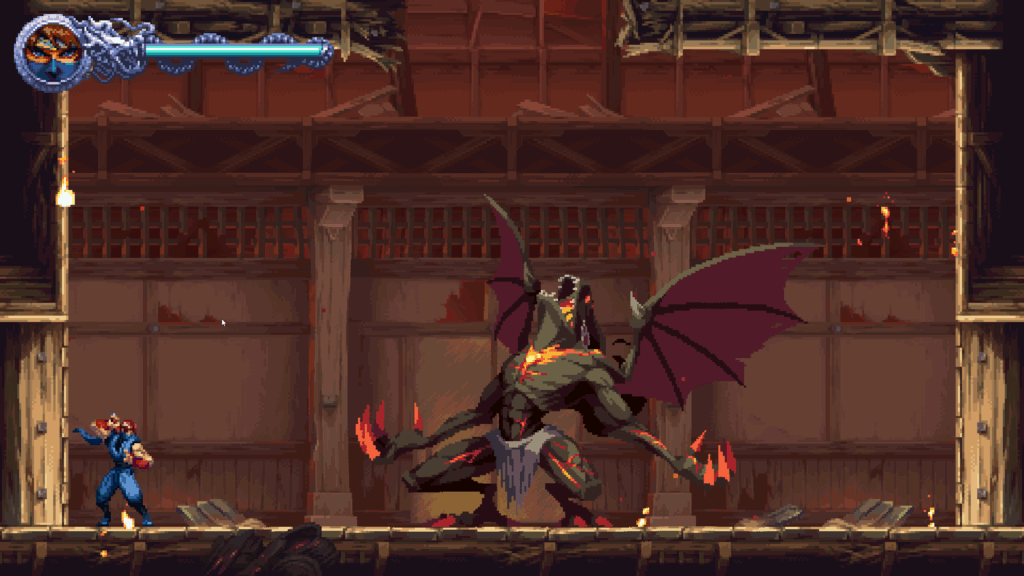
However, Ragebound is meant to evoke the original trilogy of 2D action games. And those titles have earned a noted legacy over the years for their brutal difficulty. One only has to wait for familiar themes from the Tecmo classics, ears pricking up with recognition. Or glance at a familiar enemy, translated from 8-bit pixels to high definition sprites.
The Game Kitchen is using their work from Blasphemous and translating it into a no-frills gauntlet of action. This is not a Metroidvania or a 2D Souls-like. No, this is a quarter-churning work that smartly incorporates modern-day solutions to expand on what Ninja Gaiden can be in 2025.
Firstly, the demo only has a few breadcrumbs of story in it. Ryu Hayabusa has left for America on a wink-and-a-nod mission, implying Ragebound takes place at the same time as the original trilogy. Absent are the melodramatic “cutscenes” from the NES that felt revolutionary for the time. While this may change when the full game releases and the narrative is on display, part of me wanted dialog delivered like it was 30 years ago.
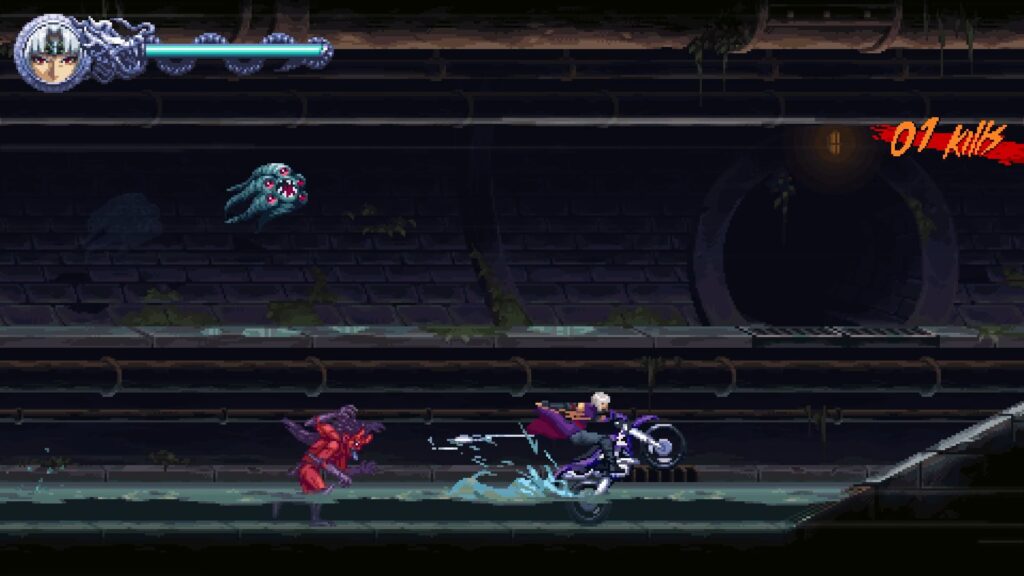
Replacing Ryu is his pupil Kenji Mozu. Kenji is defending his village from demon attacks and along the way, has his soul fused with Kumori, from the Black Spider Clan. Being a demo, its difficult to grasp what the story may be like because it moves from an attack on Kenji’s village to him suddenly talking to Kumori and their souls begrudgingly linked.
What Ragebound instantly offers is an immensely satisfying feel. Controls are incredibly tight as the player feels in complete control of Kenji’s swift strikes and lithe jumping. When I was a kid playing Ninja Gaiden, it was easy to tell that Tecmo had nailed Ryu’s platforming prowess. Jumps felt light, not sloppy. Sword slashes were instantaneous as enemies were severed from existence.
Attempting to explain how a game feels “wrong” or “off” is a challenging task, one often requiring the player to feel for themselves. Many players can adapt to crap–as the Angry Video Game Nerd has lovingly said in the past–but it shouldn’t have to be the case. Ragebound requires minimal acclimation to its general flow. Kenji feels like a ninja, not a paper bag nor a blimp.
This responsiveness is crucial because The Game Kitchen has not pulled any punches in terms of difficulty. The first level rapidly builds on the lessons learned during the tutorial, making players appreciate the incorporation of generous checkpoints, another sore spot for those who died in the final agonizing level of the original Ninja Gaiden.
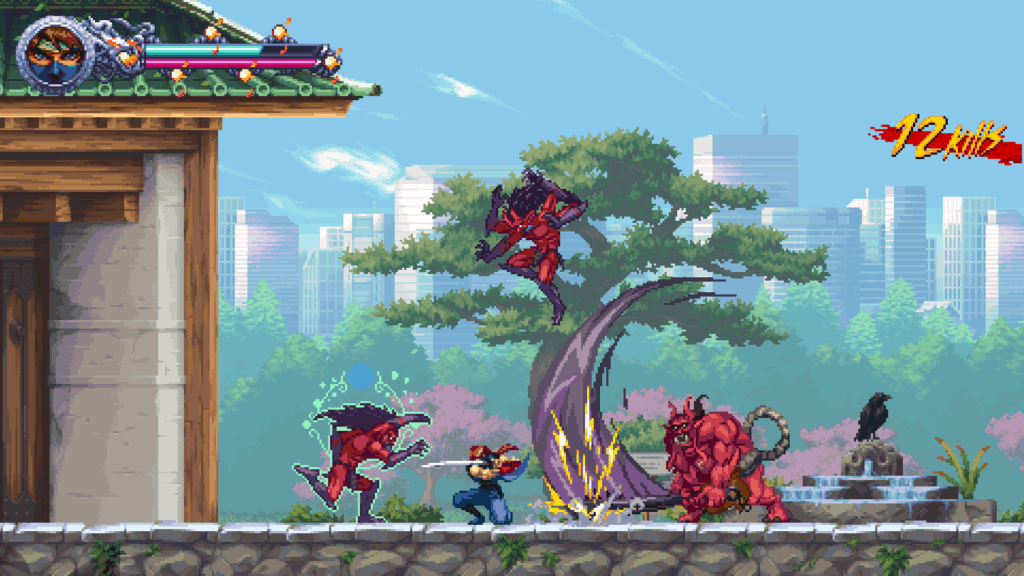
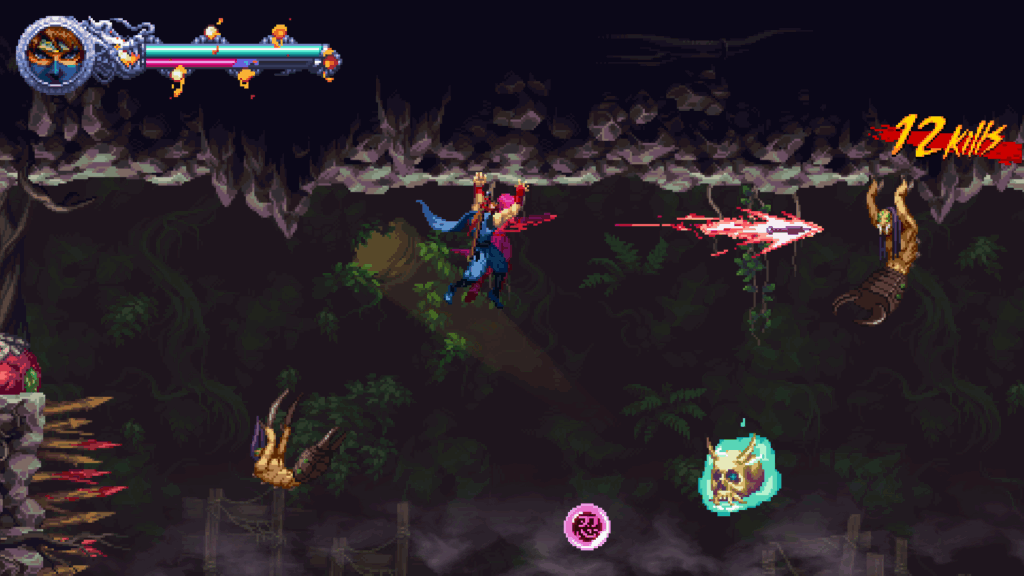
One of Ragebound‘s biggest mechanics is the Guillotine Boost, a hybrid attack and momentum aid. In mid-air, the player can press jump again to have Kenji spin. If the move strikes an enemy or a projectile, not only will the enemy take damage but Kenji will bounce off it. This allows the player to time Guillotine Boost inputs to hop past hazards, scale heights, harm enemies, and often avoid direct confrontation.
When I was young, I would have never believed that Ninja Gaiden was a game that could be triumphed without maximum skill and patience. Fast-forward to the modern day and speedrunners have absolutely robbed Ninja Gaiden of its difficulty. But in doing so, they laid bare that all-important flow state that can be achieved with enough skill. Every enemy in the game would instantly die from a single of Ryu’s slashes. Skilled players could navigate a level in Ninja Gaiden without letting go of the direction pad.
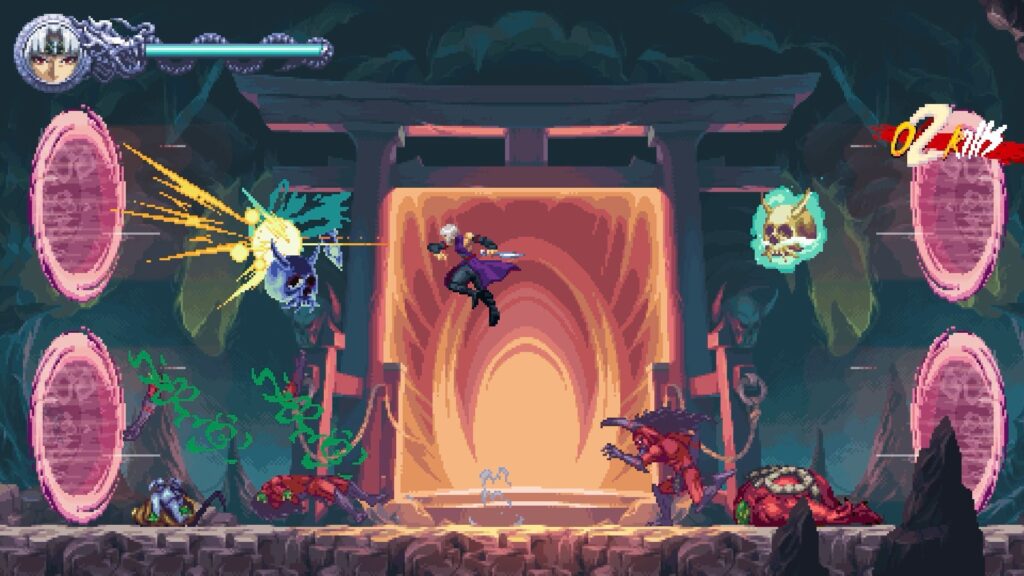
Ragebound often uses speed as a boon to its difficulty. Not every enemy needs to be killed. If the player is skilled enough, they can Guillotine Boost past groups and gracefully move to the next screen. I resorted to this method multiple times during the demo, feeling like a master ninja when I passed through unscathed.
And while a lot of enemies are instantly bisected, The Game Kitchen has spiced up combat by using tougher enemies that take multiple slashes to kill. This is where the ability to Hypercharge attacks comes in. Should an enemy have a glowing blue spark above it, killing it will infuse Kenji with power, making his next strike more powerful.
Hypercharging attacks is an interesting twist for the Ninja Gaiden loop. A handful of times, a larger enemy will be blocking the path forward, or potentially multiple enemies will close in on both sides. The player can slash multiple times to kill the enemy or keep their eyes out for a fodder enemy with a spark to enter, earning that powerful slice. As one might imagine, The Game Kitchen toys with letting players puzzle out optimal timing.
Because what makes these enemies deadly isn’t necessarily their punishing attacks but the way they occupy the playable space. Floating armored soldiers are stationary but their spear attacks have reach. While the player can Guillotine Boost off them, they can stab upward while Kenji is getting air. Hypercharged attacks aren’t a crutch but they are easy to waste. Not only do they disappear if the player doesn’t strike after a few seconds, they are depleted once the player attacks, meaning spamming the attack button could burn the charge on thin air.
Ragebound was a challenging experience in these few levels, even the tutorial had some bite. While I only died a few times, I felt as if my movement and response time was extremely sloppy. I would try and navigate mobs, only to boost into an enemy. A tight corridor would make me forget that Kenji had the ability to dodge, granting him invincibility frames for a brief moment.
My familiarity with the original Ninja Gaiden‘s combat betrayed me because I forgot many enemies don’t die instantly. And I don’t think it’s The Game Kitchen’s fault for me standing in place waiting for a sparked enemy to appear so I could get a Hypercharge. Revisiting the first level, I was able to see how enemies had been arranged to sync up with each other. Obvious set ups for attacks didn’t require patience, they required experience.
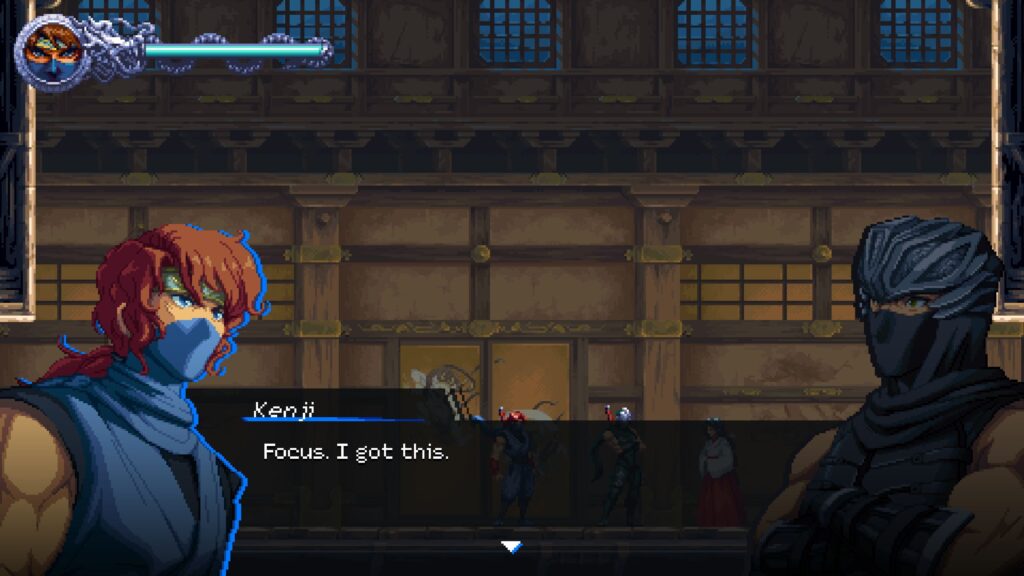
It really is possible to navigate Ragebound with a momentum that only the best platformers are capable of having. And I haven’t even mentioned Kumori’s role in the game. In the demo, she is introduced for her utility to use “Spider Weapons” that consume ki. Kenji will launch kunai in a cardinal direction or lob a slow-moving scythe in an upward curve. Additionally, striking an enemy with a Spider Weapon who has a purple spark will grant Kenji a hypercharge, making his next thrown weapon or sword slash more powerful.
It can feel a little hectic trying to keep an eye out for these sparked enemies but the player can learn, or merely implement the accessibility options that soothe the difficulty. I also found enjoyment in Kumori’s brief sections. Kumori doesn’t have a health bar and instead has a dwindling time to be in Kenji’s plane of existence. Breaking orbs will extend this time, as she races to gain a collectible or potentially unlock a gate to allow Kenji further passage.
Because the scope of the demo is merely meant to give a taste of Ragebound, I will say that I’m curious what additional challenges are in store. Even if the game was a series of levels that got progressively harder, it would find a welcome audience of ruthless players. My hope, though, is that Kumori’s challenging platforming sections evolve. There is a shop on the level map but there was no access for the demo, making me curious what these out of place skulls and gold beetles were used for.
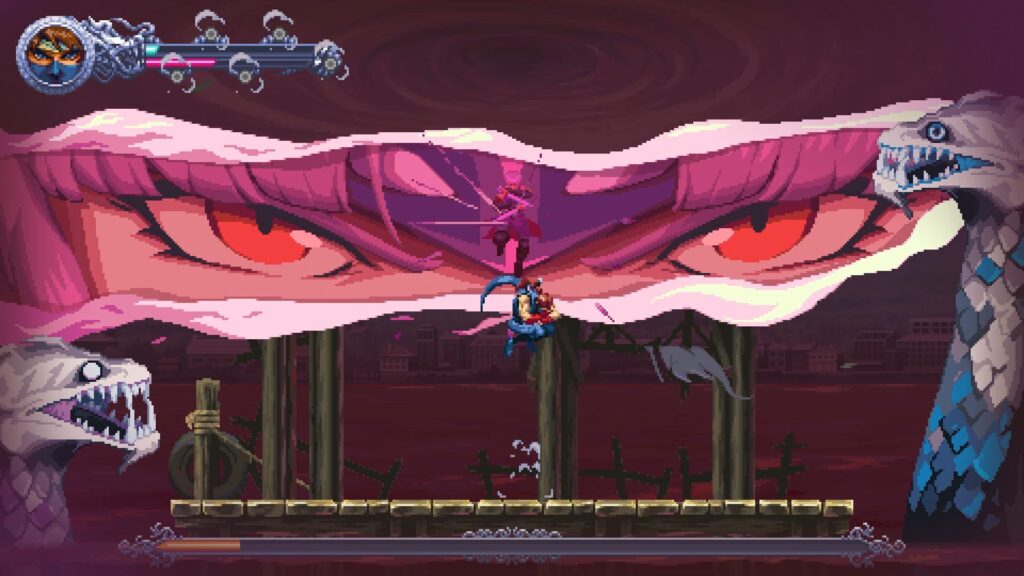
While it may be hard to completely judge Ragebound based on the four levels provided, I can’t deny that I’m excited for the full product. This feels like a taut, challenging 2D game that could surprise much like Prince of Persia and The Lost Crown did last year. And knowing the reception of both Blasphemous games, there’s little reason to believe that The Game Kitchen isn’t capable. Thankfully there’s only a few more weeks until we can make a determination.
Ninja Gaiden: Ragebound releases July 31, 2025 on PC, Nintendo Switch, PlayStation 4/5, and Xbox One/Xbox Series S/X.