
Sometimes in life, you don’t need a complicated action experience, but adding a few more gameplay elements to keep it engaging and interesting doesn’t hurt. Some gameplay elements could be building, crafting, gathering, and completing small missions. Combined, that’s enough to create a tasty game that you can play in short stints, but always brings a good feeling of fun positivity. That is where we are with my most recent review experience with an ARPG called Lynked: Banner of the Spark.
Lynked: Banner of the Spark from developer FuzzyBot brings to life a fun, energetic world that doesn’t require too much effort to get into and seems to deliver the bare basics when it comes to understanding what it’s trying to do and how it executes. Lynked: Banner of the Spark brings just enough RPG to qualify it as such, while mainly focusing on clever action controls and a hefty amount of crafting/building to lead the way. FuzzyBot seemed to find the right balance with the latter, so much that it excuses the former.
So, sit back, strap a robot to your arm, and let’s get swinging on this review.
Hooked
The gameplay in Lynked: Banner of the Spark is driven by a simple story. You play as a human trying to help liberate a group called the Unibots from evil and corrupt military bots that have trapped and enslaved them. A worthy narrative for an adventure, and maybe an ’80s action flick.
Anyway, the actual gameplay of Lynked: Banner of the Spark is divided into three main elements — action, crafting/building, and all of it attached to a role-playing game backbone. Much like in that sentence, action leads the way with gameplay structure and importance.
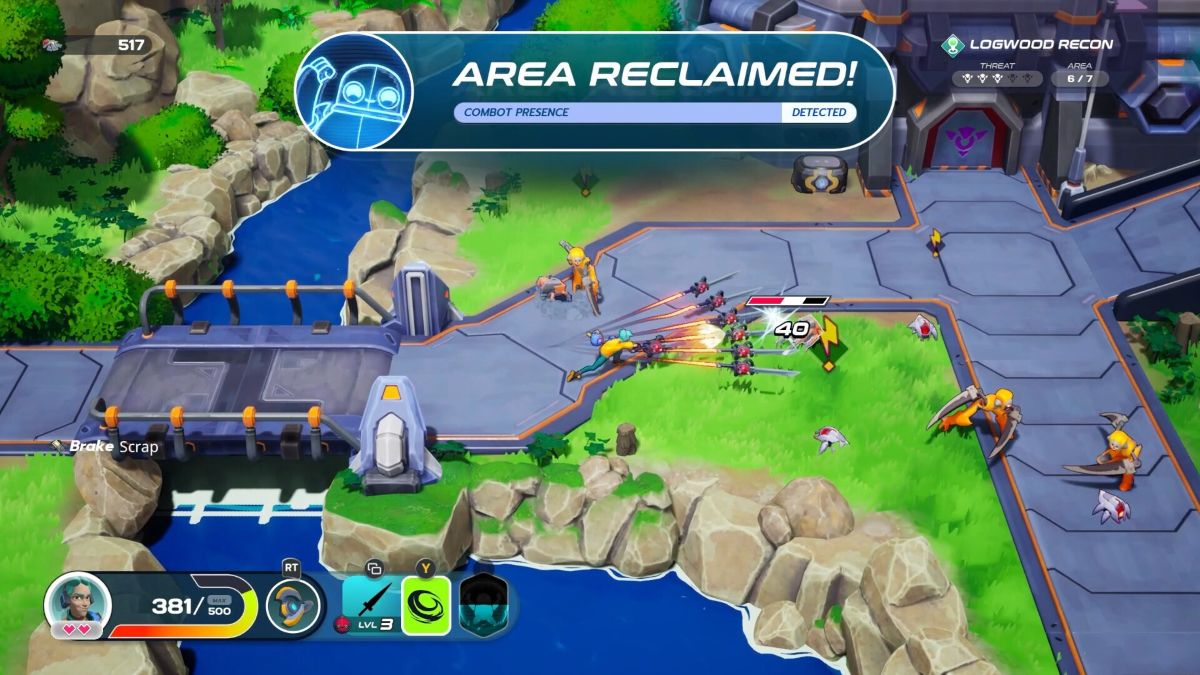
The main character has an arm owned and operated by one of the main Unibots in the game. The arm can hook rogue robots, throw boxes/objects, and act as a haven for rogue Unibots that need a home. The arm is a key mechanic in the action element of the game, as it can severely disrupt enemies during fights and works as a creative secondary weapon to your main weapon, which could be a sword/claw/hammer.
Structurally, the mechanics of this game work seamlessly together, as using the Unibot arm to accompany the main weapon is a no-brainer and can be executed very smoothly. It creates a wonderfully addictive and thoughtlessly usable pair of action weapons that won’t get in the way of players developing strategy and executing it. One of the great mistakes of action games is that devs can create cool and creative ways for their characters to fight, only to have the controls and mechanics get in the way of enjoyment, as players might have to obsess over the best use of said mechanics. This is not the case with Lynked: Banner of the Spark. At worst, the game allows you to strictly focus on how you’re going to approach a fight with the robot arm, and you must determine what weapon is best used in tandem to circumvent enemies. That’s as complicated as the process gets, which is wonderful because it allows the player to focus on so many other elements of the game. Getting a main weapon going with the robot arm makes for a fun time during gameplay. There is nothing like grabbing a box, throwing at an enemy and hitting them, knocking them on their butts, and then driving into the action with a swinging sword.
To make this even more fun, the mechanics feature special moves that you can perform to add another layer to the game’s strategy. This could be hitting the square button on the controller to perform a charging stab, or maybe even hitting the triangle button to perform a ground pound that disrupts the enemies who are in proximity to your character. These special moves are easy to pull off and even more entertaining to watch in motion. Ultimately, they add another layer of offense and provide a mechanical strategy for how your character approaches a fight. It’s seamless, and I loved the simple design and execution of it.
Now, with all this praise said about the mechanics, there is one that is missing – defense. While sword swinging and grappling are nice, the only defense that the human character has is rolling out of the way of enemies. Unless I missed something in the initial tutorial, the game doesn’t go beyond that and tries to support it by allowing the main character to acquire defense-boosting items that are just numerical (DEFENSE +2) rather than controllable.
For me, that’s a mistake in the game because I wanted to be able to block enemies, maybe even parry, and get out of dangerous situations quickly, but the game just allowed me to roll out of situations, which wasn’t a great defense ultimately. While I admit that the game did this to possibly keep mechanics simple, it would have been nice to have some sort of deflection option when enemy sequences get overwhelming. There are times when you’re surrounded by enemies and looking for a quick defense to at least start the process of choosing who you’re going to take down first. Having a more girthy defense option, much like what you have with the offense, would have gone a long way.
Enemies everywhere
Staying with enemies, one of the cleverer parts of the game is navigating the many enemies during action sequences. The good devs at FuzzyBot nailed enemy variety and gradual difficulty. Both gameplay elements work together, as bowling through bunches of enemies gets more difficult as the player progresses through missions. The enemies are based on whatever the narrative mission is thrown at the player for the main quest, while also broken into mini-stages of enemy groups that create one whole mission. Imagine a mission that has smaller, multiple acts to it, and you get the picture.
The game does a great job of throwing gradually building groups of enemies as you play missions. For example, early in the game, you will have missions that feature a ninja-like robot with two swords, with mini-dog robots fighting alongside them. At times, a variety of enemies will collapse toward you, with maybe 5-7 enemies leading the way. When you complete this mini-act, you go to the next mini-act of the mission, and the game throws in more enemies with a better variety of attacks on top of what you’ve already encountered. For example, you might get the mini-dogs, the ninjas, and then a couple of round-shaped robots that roll at you with a spinning blade on them, and who require you to wait until they get dizzy to attack them. Lynked: Banner of the Spark excels with enemy variety, which keeps the gameplay interesting and the action exciting. By the end of the mission, you might have an entire group of enemies that feature 5-7 different robot types, and then have a giant boss to take down at the same time. The action is quite good in Lynked: Banner of the Spark, and it never gets boring, which is a huge plus.
Related, as new enemies are introduced and the fights get bigger and more complicated with strategic requirements for success, the game becomes gradually more difficult. The difficulty arc that was created for this game was vital to its action success. It’s an appropriate arc that doesn’t ask too much of you too quickly, and that works well within the gameplay boundaries that it establishes. Much like the mechanics, the game doesn’t seem interested in overwhelming you, and wants you to focus on the action, but at the same time experience a challenge. I played this game for hours and didn’t have an issue, as enemies grew with my character, which meant I was never too far off from victory, but at the same time, constantly pushed to get better and think quicker depending on enemy variety and strength. It was well-planned and executed with gradual difficulty. It helped keep the entire experience fresh throughout.
Weaponizing
While the action is solid and the mechanics are simple, the one downer of the action is probably the gradual progression of the character’s weapons. The initial jumping off point for weapon variety with Lynked: Banner of the Spark is broken down into swords, claws, and large hammers. The game does allow you to upgrade these weapons and mod them, but doesn’t give any sort of breadcrumbs on how to properly get the most out of your weapons.
The beginning of my adventure with Lynked: Banner of the Spark made me happy that I could try out these, as well as new weapons, and slightly upgrade them through leveling and mods. That was clear and understandable, but the progression to getting the weapons upgraded was a slow process, which meant I was mainly stuck with underpowered weapons that were mainly relying on temporary mods to feel upgraded.
The mods are only offered during missions. They are offered by a Unibot blacksmith named Smithy as you travel through the in-between mission acts. The mods you get from Smithy are random and directly affected by what you have purchased/unlocked. This works with the crafting/building system in the game, which allows you to purchase/unlock said mods. We’ll get into that in a second, but for now, the mods can gradually and significantly play a vital role in mission success. For example, you might run into the smith, and they might offer you a mod called Healthy Cashflow, which gives you a “3% chance to gain +5 health on collected scrap (from fallen robots)”. You can increase those odds with mod upgrades during additional smith visits, and you can build your weapons into formidable and brutal solutions to easily dispose of enemies. The only caveat is that those mods go away once you lose or succeed with said mission. I don’t mind the temporary feeling of these mods, but having a definitive and more transparent upgrade system that doesn’t depend on mods to make the weapons exciting would be preferable.
Now, the saving grace of the weapons in the game is that there are a lot of mods to choose from, and those mods can be used for unique strategies depending on what you’re going up against in a mission. The bigger variety of mods, the more mods I can use at once (each weapon has multiple mod slots), means that I’m getting a hefty amount of ‘try this and see what happens’ type of strategy in the action. I dig that, as various combinations of these mods can be complete gamechangers when you’re stuck in a sticky situation.
The other saving grace of the weapons is the variety of weapons offered. You’re going to see some off-the-wall weaponry make an appearance in the game. For example, there is a sword called the Shark Saber, which isn’t necessarily the most powerful weapon in the game, but it is unique and requires specific material to create a unique sword. What specific material? How about catching a random robot shark? That always helps with creating a shark saber. While fishing in the game, I just happened upon that weapon, and it intrigued me to the point where I didn’t mind its offensive numeric awfulness, as it just seemed like a cool sword. C’mon. I mean, shark saber! Absolutely a badass weapon. Anyway, you will find a lot of weapons with different capabilities to choose from in the game as you push through all gameplay elements. The weapons can have different levels to them, but that isn’t too obvious in the first three hours of play.
In addition to the claw and actual weapons, one of the neater aspects of the offense is your sidekick buddy robot that can go with you. In the first hour or so of the game, I didn’t fall in love with the offense of this game, as it seemed basic and just sword-swinging madness. In the later levels, once you rescue more robots, you have the opportunity to take on a sidekick that is more than just enemy weapon fodder. The sidekick carries upgradable attributes that are meaningful offensive options, while also becoming a medic when your player is defeated. They offer an entirely new style of gameplay to the weapons process that makes up for any shortcomings of individual weapons. When they made it to my gameplay, it completely changed my strategy when approaching enemies and allowed me to relax a bit when taking chances. It changed how the game worked, and it did it for the better. The sidekicks were such good additions.
In short, I enjoyed the mods, liked the weapon variety, loved the sidekicks, but was disappointed with the leveling of the weapons in the game. I felt like progression should have been more prominent, faster, as well as more obvious with each weapon.
Crafting and Building
As you begin Lynked: Banner of the Spark, you’ll notice a few things. The biggest thing is that you’re plopped onto a huge land of emptiness that doesn’t make much sense. You will also notice that farmable materials are lying everywhere. This could be junk lying on the ground, trees that can have wood acquired from them, mounds of crystals and gold (and other elements), and the occasional rogue robot that you can capture with your claw.
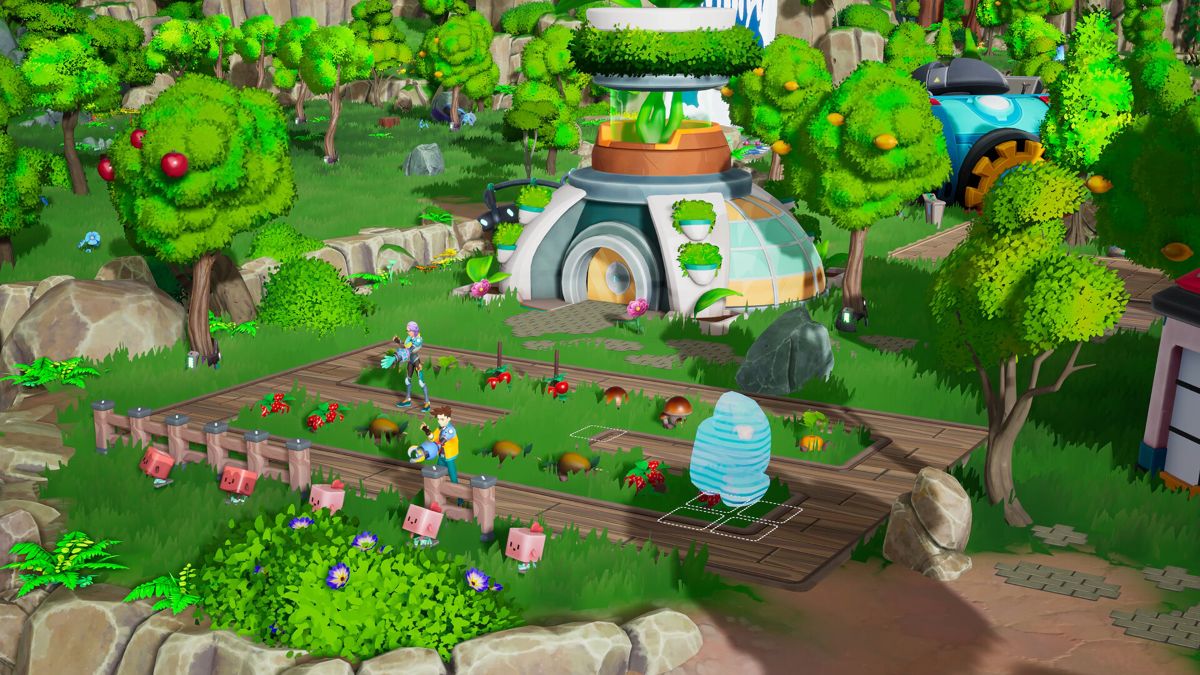
As you start missions, you’ll begin to realize that for every Unibot that you rescue in a mission, they generally offer a particular attribute that can gradually grow your character, as well as your town. For example, one of the first missions of the game is rescuing Smithy the blacksmith. Once you complete this rescue, Smithy offers a forge as a thank-you gift. Your character can build that forge, meaning another building appears, place that forge wherever you would like (depending on space), and begin to create a town. It also helps that new craftable options are available because of that building, and thanks to the rescued robot.
Now, as you complete missions, you get more Unibots, which means the town and its usefulness become greater. That helps to create a healthy amount of motivation to complete more missions, while at the same time opening the world of crafting and adding that to your gameplay experience. The latter of the bunch will push you toward mining minerals, chopping trees, and fishing. This expands the game and creates an avenue of entertainment where crafting plays a heavy role in the process. And it can’t be overstated that collecting and crafting are driving points when you’re trying to figure out what makes this game fun and interesting.
The FuzzyBot devs did a great job of balancing out action, collection, and crafting/building to create a circular, motivating experience to constantly keep returning to Lynked: Banner of the Spark. As I have stated in previous reviews, I don’t hang my gameplay fun hat on a crafting/building coat rack, but games like Lynked: Banner of the Spark prove that it’s fun to collect and see what you can discover to expand gameplay elements and to create motivation to keep playing. Building out a town with your design doesn’t hurt either.
Quests and Side Quests
Truthfully, I didn’t get hooked on the game’s narrative as much as I did the gameplay elements. Somedays it’s like that, good folks. Sometimes, the driving point of the game can be how it is played, rather than what story it is trying to tell. Granted, the narrative is worthy of your attention, as you want to free and work with Unibots to overcome the evil military bots and make the good robots’ lives better. That’s worthy on its own. Peace is better than not having it, and liberating robots from their captors is always a morale-boosting feeling when playing a game.
I mention this because the game is divided into main quests directly related to the story, which help to build out your town and arsenal, while featuring side quests that are smaller missions requested by the robots you rescue. While not on the Skyrim level of number of side quests, the game does a great job of creating smaller missions that directly affect all aspects of gameplay. It keeps the whole fresh without getting caught and cornered in action alone. In short, it creates a good variety and reminders of what this game is made of while playing. For example, the side quests could be as simple as buying sunflower seeds. It could also be as complicated as finding new fish while fishing. These are mini-missions that don’t mean much in the main story, but they do help keep the overall gameplay fresh and more balanced.
The main quests are what you would expect. They are linear with the narrative and offer major jumps in crafting/building, while also making good leaps with introducing new weapons and enemies. They are the main veins of the game, and drive it, but the side quests expand that gameplay, pushing it in gradual, good ways and directions.
Overall, the main and side quests are meaningful, fun, and they only stand to expand the game and make it much larger than it seems.
Overall gameplay thoughts
Lynked: Banner of the Spark contains a variety of different gameplay elements and does a solid job of balancing them together. This is a game that I could play in short stints, but come back too often, I prefer that type of game anyway. I enjoy small sips of progression and a variety of gameplay elements to experience, while not having to fully commit to big gulps of gameplay. Having crafting/building mixed with solid action, and a fun progression system, means that there are plenty of experiences and goals to accomplish. That will certainly keep this game interesting and fun.
On that note, let’s wrap up this review.
Conclusion
Lynked: Banner of the Spark from developer FuzzyBot is a cornucopia of different types of gameplay experiences rolled into one title and balanced in ways that work well together. The story is good, the action is easy and fun, and the crafting/building helps to bring a juxtaposition to the game’s action component. While not all of it works, the game still brings what it needs to create a big, unique, and entertaining experience.