

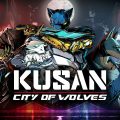
Kusan: City of Wolves doesn't mask where it has taken inspiration from. But the exploration of top-down action finds an incredible home here with addicting, acidic combat that strives for enough diversity and complexity to fuel numerous high score attempts.
Yeah, Kusan: City of Wolves isn’t making much of an attempt to hide its influence.
But let’s be honest, Hotline Miami was not the first video game to make exceptional, near-perfect top-down action. Decades of arcade cabinets and home consoles have provided players with countless worthy titles featuring score attacks, relentless enemies, and a reliance on a quick trigger finger. Yet it’s impossible to deny that common thread.
Kusan: City of Wolves is etched with the same brutality. The ferocity of its enemies requiring expert timing to survive. The need to kinetically sweep through glitzy levels of pixels and stain them red in hopes of maintaining a constant combo. An eclectic soundtrack fueling the proceedings.
Hotline Miami 2 is one of my favorite games–which I don’t think is too hot of a take, even though the first might be more universally beloved–and few games I’ve played in the last decade match the high Dennaton provided me. But, as they say, game recognize game and developer CIRCLEfromDOT has made a convincing case for Kusan: City of Wolves standing among the modern greats of the genre.

Honestly, I don’t want this review to be me holding a mirror between two games, it’s simply a boring proposition. Do you adore or even enjoy Hotline Miami? Go play Kusan: City of Wolves, you’re going to be pleased on a fundamental level. Funnily enough, I was going to make some argument about animal masks but Kusan: City of Wolves is a game literally featuring anthropomorphic animals. Actually, if you don’t want to witness the violent murder of numerous animals (even if they are trying to kill you), then maybe this is a hard sell…
CIRCLEfromDOT has made a thematically confident action game presented with pulpy comic pages and stylish dialog. It tells the story of Jin, a soldier that becomes embroiled in a plot between the government, rival gangs, and his own mysterious past. There’s dabbling of PTSD, police brutality, corrupt systems, bodies being ground down by the war machine, and a smattering of science fiction. It’s nothing grand or entirely unique but I found myself connecting to the drama, especially the way it was presented through the imagery and text presented between scenes.
Kusan is a fascinating city that is meant to invoke the neon-soaked metropolises of the future. It’s a setting where technology is advanced enough to be science fiction but grounded enough to be practical. Level design communicates disparate levels of wealth and status. Dens of drug activity and sex trafficking aren’t relegated to the corners of the screen. The player will often guide Jin through brothels where female-appearing characters lay sprawled out in bed or weep in the corners. Bodies slumped over on couches and poker tables indicate a culture of desperate excess. But there are clubs thrumming with music and shady laboratories that conduct experiments on those with psionic abilities.
Looking across the 54 stages of Kusan: City of Wolves, it’s easy to picture that totality of its visual palette. These are rooms most often housing things for Jin to kill. Furniture and objects and debris will be shattered and splintered and soaked with blood. They feel brimming with activity until they become crimson coffins and the score screen pops up breaking down how well the player did, nudging them where to go next.

Legibility is often a problem with this genre, especially when the developer attempts to make a game that isn’t solely devoted to mechanics and action. Numerous times in Kusan: City of Wolves I found myself trying to negotiate the flow of Jin’s movement. Where are enemies likely to be? Where is the most optimal door or path I should navigate?
While I’m not sure CIRCLEfromDOT entirely mastered this issue, it was never something I couldn’t manage. Often enough a small arrow will appear trying to show the player where the nearest enemy is. And most rooms aren’t so big that they can’t be managed. I remember one of the biggest complaints about Hotline Miami 2 was the size of its stages being larger in the sequel and it was harder to guess where an attack would come from–not a critique I shared, by the way.
Players will find that Kusan: City of Wolves features vapid real estate where geometry or pixels exist merely to act as set dressing or make the player urgently push into the space. However, there are also breakable walls that act as shortcuts and some clever pathing here and there.

Ultimately, though, this is all meant to add challenge for the player. You see, on a casual playthrough of Kusan: City of Wolves, dying probably isn’t too frequent if one is playing it safe. Enemies will rush towards sound or if they make line of sight with Jin. But the player can abuse doorways to their heart’s content. That’s not how I play these games and instead I was constantly dying, constantly rushing because I wanted to maximize my score.
As the game progresses, it becomes increasingly more difficult to maintain a constant combo throughout the levels. In the desperate quest for an “SS” ranking–one I only achieved a couple times on my initial run–players need to be flashy and fast. A number of stages are sprawling or require the player to push Jin through multiple kill floors/rooms. This amounts to a stressful amount of dead air where the player is desperately hoping for an enemy to appear so they can give them a love tap and keep the combo going.
It’s manipulative, it’s cruel, it’s addicting. That’s the formula.
Games like this need to crack the player open through a crucible of frustration and instant, out-of-nowhere deaths. You push yourself because goddamnit the game isn’t going to get the better of you. Kills are met with a chuckle in as equal parts as a swear because it’s all training for the eventual moment where you will prevail with a better score than before.

Kusan: City of Wolves is designed in a way where its mechanics lead towards complexity rather than simplicity. Jin and nearly everything else dies in a singular hit. His primary vehicle for death is the War Hand, a robotic arm that replaces the one he lost in combat. It’s capable of stopping vehicles or careening objects into the soft tissue of an enemy.
The War Hand is an interesting tool not because it only presents close-range as an option but because of how versatile it is. Players will be able to parry bullets, rockets, a boss’ entire body. They will be able to charge the War Fist up and have it punch through a wall and kill an enemy on the other side

Jin also has use of four guns that have different firing patterns and utility. Then there’s the Quantum Knife which can target the closest enemy and kill them with a single throw.
None of these tools are used statically, though. Fans of Resident Evil 4 inventory management and Tetris rejoice! Over the course of Kusan: City of Wolves, players will earn currency to unlock upgrades. These upgrades are granted in the form of chips that often look like tetromino blocks that must be placed on the Techtrix to be used by Jin. Players start with a limited amount of space in the Techtrix but can then unlock more room by invested upgrade materials into it.

There is no godlike ability to apply every upgrade and ability at once. Players much search for what they enjoy the most or target towards specific builds. While no intense personalization exists in Kusan: City of Wolves, there are abilities that lean towards the War Hand, Quantum Knife, and guns. Players can punch the Quantum Knife in mid-air or press a button to recall it with the right timing. Abilities exist that instantly charge the War Hand or make it stronger. Jin can move faster by changing up his attacks and weapons can get more ammo. Most of these abilities can be “enhanced” to take up less room in the Techtrix, enabling a few granular adjustments with clever placement.
These ability to customize Jin and your own playstyle give necessary depth to Kusan: City of Wolves. I’ll be honest, the game gets pretty stingy with high scores. There were several stages I flawlessly executed a floor, never lost my combo, and was pretty ballsy in how I rushed into danger. Still got an “S” and when a scene was done was potentially several thousands of points away from maximum rewards. CIRCLEfromDOT really wants players to juggle the varying abilities here to maximize both score and cool factor.

To do that takes a significant amount of practice and memorization. Because this game becomes absolutely brutal about halfway through. I’m not entirely complaining because my reflexes are pretty decent and I can handle the kind of quick recovery death these games focus on. That being said, those longer and bigger stages can absolutely take daunting amounts of practice and likely coming in with a loadout built entirely around beating them as skillfully as possible.
Additionally, enemies are ruthlessly placed not only far apart but condensed in rooms where you can burst through a door and be hit from all angles. Players will go to pop a melee enemy in the jaw only to be gunned down from a distance right before a laser turret blasted them in the face. I died countless times watching another source of death be milliseconds away.
Enjoyment here isn’t measured by any definitive metric. A combination of quantity, quality, and density is meant to have these relatively bite-sized stages that can be beaten in a matter of a couple minutes be digestible enough for a player to be fine with repeating them ad nauseam in hopes of getting better.

This is not to say Kusan: City of Wolves nails everything. I think there is a degree of mastery required here. The War Hand isn’t infallible because it can’t be spammed. A number of times I would feel like I connected when I didn’t or simply couldn’t understand when I could parry gunfire to have it deflected back to the source. There’s also a tendency for enemies to be able to shoot through what feels like viable cover. Whether it be a vehicle or trash in the middle of the room, I often found myself dead by an enemy that could tell what was cover when I couldn’t. After multiple deaths, I began to recognize what would or wouldn’t keep me safe that wasn’t a wall.
That feels a bit limiting in terms of mapping out how one can tackle stages but I suppose it is all part of the arithmetic of getting better. Still, I think it would be better if this set dressing was either removed entirely or was given more visual clues to indicate that yup, bullets are going through it. Because again, this is a top-down shooter and not a three-dimensional space.

While I can’t say that it is a flaw on the part of Kusan: City of Wolves and more of a personal qualm, I have to admit to not being floored by the music. Look, the Hotline Miami games have some of the best soundtracks in any game ever. The synthwave music evokes an era and a mood Dennaton was going for and they were able to pick some absolute bangers from music that already existed before.
Here, CIRCLEfromDOT employed the talents of hip-hop artist Loptimist who I’ve never heard of but did come to appreciate. Loptimist weaved lo-fi beats, Asian themes, and some generally powerful rhythms into these tracks. A number of them I absolutely grooved to over the course of the game. But I remember thinking there were moments the music felt slightly more subdued considering the speed I was trying to move through stages with and the amount of gore I was spilling. Really, it’s not a flaw on the part of the game and I think the soundtrack fits the world, it’s just my preference.
When it’s all said and done, Kusan: City of Wolves almost mastered the assignment. I really did not expect to be intrigued by its world from a narrative standpoint but along with the visuals, really felt cohesive. For those who have a library stacked with games like this the notion of it being “derivative” certainly could bubble to the surface. But this is an entry into the genre that plays with mechanics to be complex rather than just another game where you mass slaughter hundreds of bodies.
Kusan: City of Wolves doesn’t mask where it has taken inspiration from. But the exploration of top-down action finds an incredible home here with addicting, acidic combat that strives for enough diversity and complexity to fuel numerous high score attempts.