

Cthulhu: The Cosmic Abyss revels in the player working to unravel the unfathomable in Lovecraft's influential universes. This is a game about eerie atmosphere and piecing together mysteries, taking players on a claustrophobic journey through infinite horrors.
The well-tread depths of H.P. Lovecraft’s vast oeuvre have been iterated upon and translated into countless forms of media. And at the center of it all often looms the monolithic, tentacled god Cthulhu.
The Great Old One. A cosmic horror. It is an indecipherable terror that infects the mind and draws lesser men into incomprehensible worlds for whatever sinister purpose. Cthulhu is so prominent and intrinsic to the genre that in DOOM: The Dark Ages, it was on equal footing with the forces of Hell.
While Cthulhu has gained a kind of “standard” look over the last century, the god’s appeal is rooted in the unknown. It represents the infinite ocean of knowledge that exists outside the bounds of our understanding. The more we work to comprehend, to quench our thirst for knowledge, the more insane we become. Irrational truths warp our ability to understand the cosmos that Cthulhu and his ilk have domain over. But maybe… just maybe…
How does one incorporate Cthulhu and Lovecraft’s work into a piece of entertainment? Reveal the monsters too early and you rip away the mystery and the tension. Dwell too much of the ratcheting insanity and the perpetual unease and your plot may become a distorted mess. But more importantly, how do you not tread familiar ground?
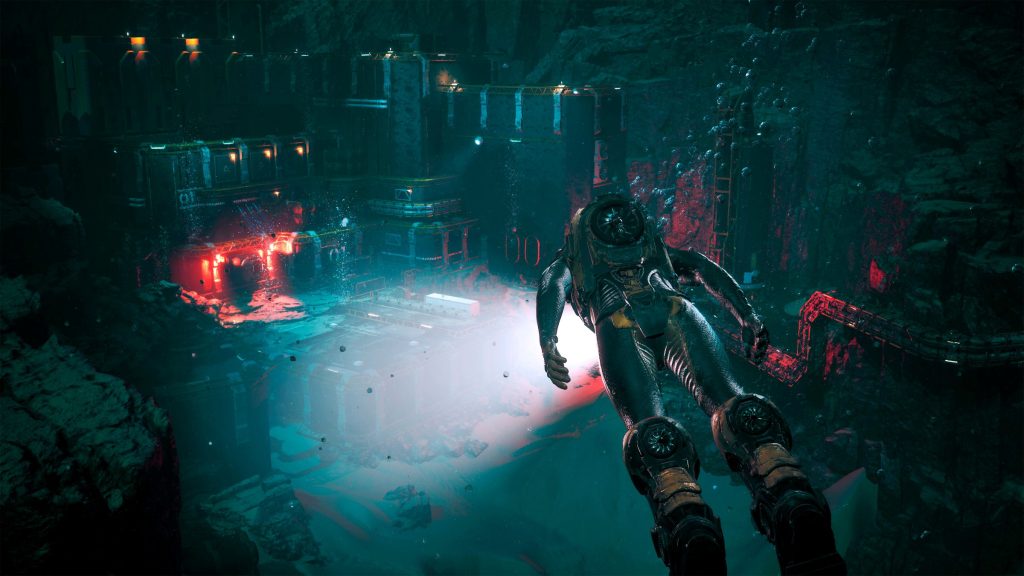
Cthulhu: The Cosmic Abyss is rife with the kind of claustrophobic horror I would expect from a game inspired by Lovecraft’s work. Best yet, it doesn’t take place in a mildewed village where people on the verge of turning into fish peep their glowing eyes out of cracks in the doors before slamming them shut. Many of the games I’ve played involving the clash of the Old Gods’ and our universe use a place like Innsmouth to craft three-fourths of the structure around, poking pin holes that ooze dread. And then the final act rips the fabric of reality apart.
Developer Big Bad Wolf uses Earth’s only unknown universe as the thesis behind its cosmic terror. There is so little we know about the darkest depths of the ocean. So much of the surface of our planet is covered with water. And miles below that water is what exactly? We’ve identified deep sea life and most of it is the closest we’ve gotten to something appearing as alien life. It’s certainly plausible that a portal to Cthulhu’s dimension could be unearthed miles down below.
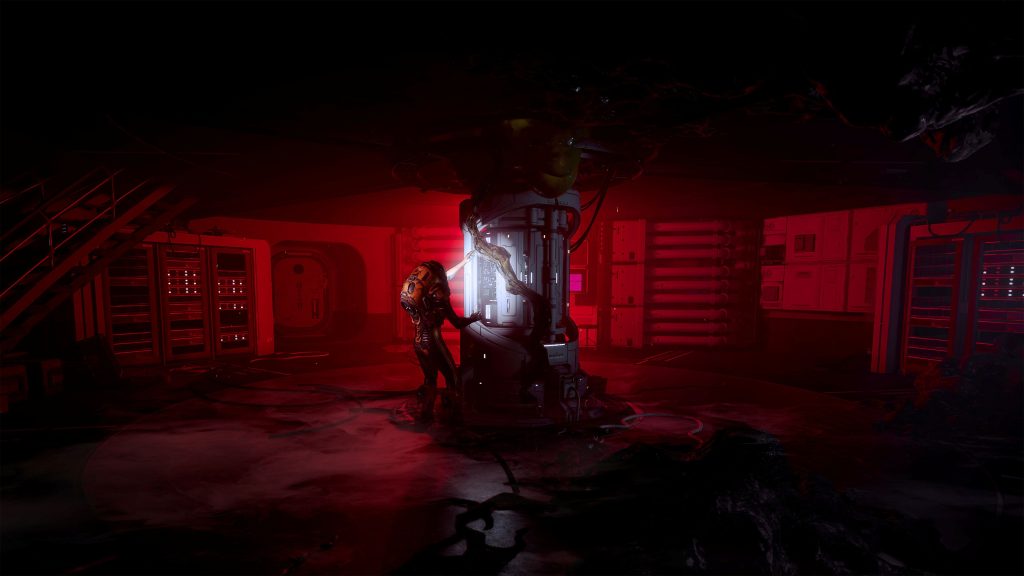
Set in the year 2053, Cthulhu: The Cosmic Abyss frames the norms of society teetering on the edge as occult activity is more prominent and natural disasters are spreading. Players control Noah Williams, a man who works for Ancile, a shadowy organization that investigates occult activity across the world and has seemingly boundless resources. As a child, Noah’s parents were sacrificed by a cult before he was rescued by Elsa, an agent of Ancile.
The game begins with Noah and Elsa investigating an Ancile agent who has gone dark, traveling to her home that has almost been swallowed up by a flood. Acting as an introduction but also homage to the saturated roots of Lovecraft’s haunted townships, the player attempts to piece together answers, only to be teleported to Cthulhu’s realm. He escapes but Elsa is left behind.
Following the natural progression of leads, Noah is led to Ocean-I, a deep sea mining facility at the bottom of the ocean. Its population has seemingly disappeared and before contact was lost, the man in charge of the operation began acting erratic. What could possibly be wrong? As Noah works towards a solution, he is accompanied by KEY, an artificial intelligence interface implanted in his head. KEY is more than just a talking companion, it acts as support for Noah and the player.
At its heart, Cthulhu: The Cosmic Abyss is a game about investigation and uncovering the mysteries packed inside. Stripped of combat, the player’s main goal is to collect information across the game’s chapters to reach a solution.
In essence, Cthulhu: The Cosmic Abyss is one giant puzzle that the player has to piece together. Using observation, attention to detail, and the ability to connect varying threads together, the player will help Noah understand what exactly is going on. Initially, the question posited is merely what happened to the Ocean-I facility and how does it connect to finding Elsa and potentially learning more about this other dimension. As the game evolves, the answers grow more convoluted, bizarre, and deadly.
Depending on the player’s comfort level, Big Bad Wolf provides two main difficulty options and one custom one. In “Investigation” mode, little help is offered on how to solve puzzles. In “Exploration” mode, KEY can be asked to provide three additional hints, including explaining what the exact solution is to the current puzzle. A custom difficulty also allows for adjustment with various gameplay aspects.
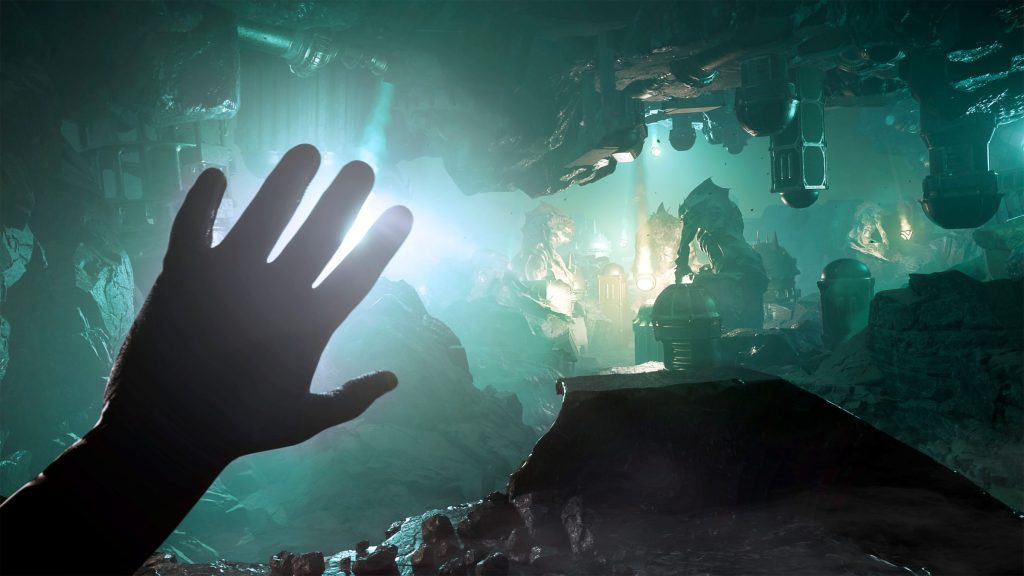
Cthulhu: The Cosmic Abyss does not mechanically evolve a great deal outside of the investigation aspect but I didn’t mind. The absolute dearth of content the player can investigate is not meant to provide easy answers to such a complex question. And eventually, the player does go into the Sunken City of R’lyeh which is astounding in how alien and contorted it feels. Attempting to find solid footing and explore grows into a challenge the deeper Noah goes.
Using KEY, the player can tag certain frequencies that send out sonar pings labeling that specific frequency. Scan mysterious claw marks in the walls of rocks, tag that frequency in the sonar, and follow the trail. Looking for rocks? Attune to the mineral frequency and every result will ping around.
As players grow their database of clues and discoveries a virtual “vault” can be accessed that acts as a digital evidence board. Elements can be moved around, virtual string can link clues together, and eventually, a solution will need to be solved by dragging the appropriate clue to it. While not entirely intuitive at all times, there is a real sense of the player being the one responsible for making sense of it all.
Like many puzzles games, there will be times the solution seems obvious but the player either isn’t doing the exact thing the game demands of them, or they are missing a random arbitrary step. But I found Cthulhu: The Cosmic Abyss to be extremely respectful not only of my intelligence but my time. The game made me feel relatively smart because I am naturally the kind of player who attempts to find and read everything I can. Curious minds will be able to piece together hints of where a clue is nudging the player or what might be soon expected of them.
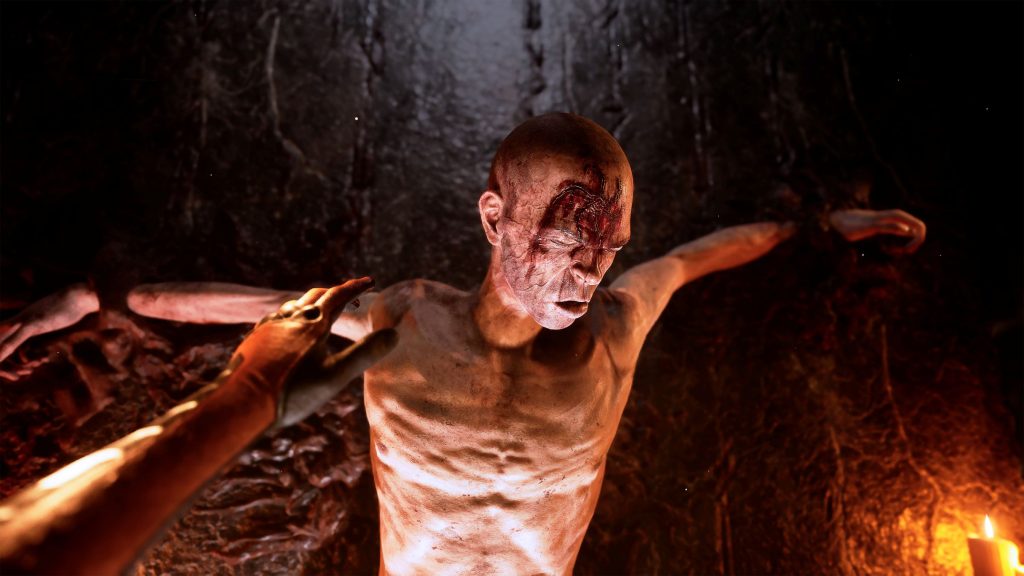
Over the course of the story and its investigations, there will be two primary “solutions” the player can lead Noah towards. The one that is usually simpler is tied towards corrupting the player’s mind more, leading them towards the influence of Cthulhu. The other solution is meant to keep Noah more sane and tied to reality. And based on the choices made across the game, the ending will of course be affected. Additionally, the player can acquire evolutions that act as gameplay aids–usually improving sonar or helping with energy recovery–but these are lost as corruption grows.
The lack of true mechanics may likely turn away players who wish for a game with more to do or a pace that isn’t so reliant on the act of exploration. Cthulhu: The Cosmic Abyss proudly strives to be a game focused on unraveling a mystery meant to test the bounds of sanity. And for that, I appreciate it deeply.
This is a narrative puzzle game through and through. It has notes of a walking simulator but the player’s input is so vital to not only progression but to understanding the narrative better. I don’t need combat in a game like this because honestly, it’s usually subpar and focused mostly on hiding and sneaking around, and I hate that.
Cthulhu: The Cosmic Abyss is meant to imbue the player with a feeling of dread. The Old God is something that we are not meant to understand. And as the attachment to realities begins to fray, the game responds in kind. The Ocean-I facility gives this science fiction element linked to a high-tech future. But then the game turns into more cosmic horror, relying on the Lovecraft mythos. And it’s rare that we see the intersection of technology with a being like Cthulhu. I especially appreciated watching how Noah and KEY approached their specific goals and how their characters changed as more about the world was revealed.
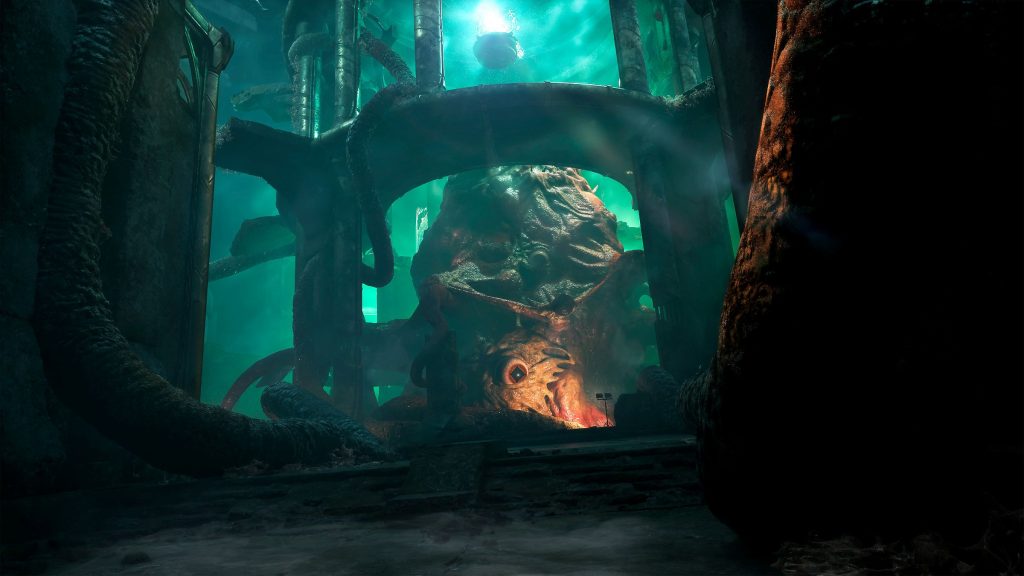
While Cthulhu: The Cosmic Abyss is very much a tone piece that relies on the player accepting its pace, I still think it is a bit rough around the edges. A distinct lack of manual saves obviously exists so the player can’t save scum their way through the game. But it also does provide for some frustrating auto-save moments when more progress is lost than expected. The game’s visuals and sound design are appropriate bleak and haunting but visual and mechanical bugs do exist. Clipping and framerate drops aren’t persistent but can be prominent in busier scenes or even allow the player to access items through solid objects.
Cthulhu: The Cosmic Abyss feels like a breath of fresh air to Lovecraft’s body of work. It revels in forcing the player to parse through the madness, unraveling the unfathomable questions of places and being we are not meant to understand. Wrapped in cosmic horror like an offering to the Old Gods, this is a claustrophobic journey that respects the player’s intelligence in putting the pieces together to solve eerie mysteries and hopefully not succumbing to the influence of insanity.