


Heading Out is a wholly unique game that defies expectations. More narrative-driven adventure than vehicle-driven roguelike, expect a fascinating black-and-white style and progressive story beats but little else in the way of meaningful longevity.
Heading Out is, perhaps, a game that seeks to defy both expectation and definition.
A cursory glance would make the game appear to be an overtly stylish driving game. Not a racer. Not a simulation. Some random “roguelike” elements are seemingly peppered in. Is it a road trip game? A thriller? A high-octane piece of action?
Like some art house flick, Heading Out unabashedly does not force itself inside of any box. It is very much an atypical video game that takes a risk simply by being different from nearly any peer. And that’s likely one of the reasons I found it to be such a fascinating, engaging play. Not everything about it works, especially in the context of being a game, yet it still has appeal. Heading Out stands in its own arena and because of that, it’s worthy of your attention.
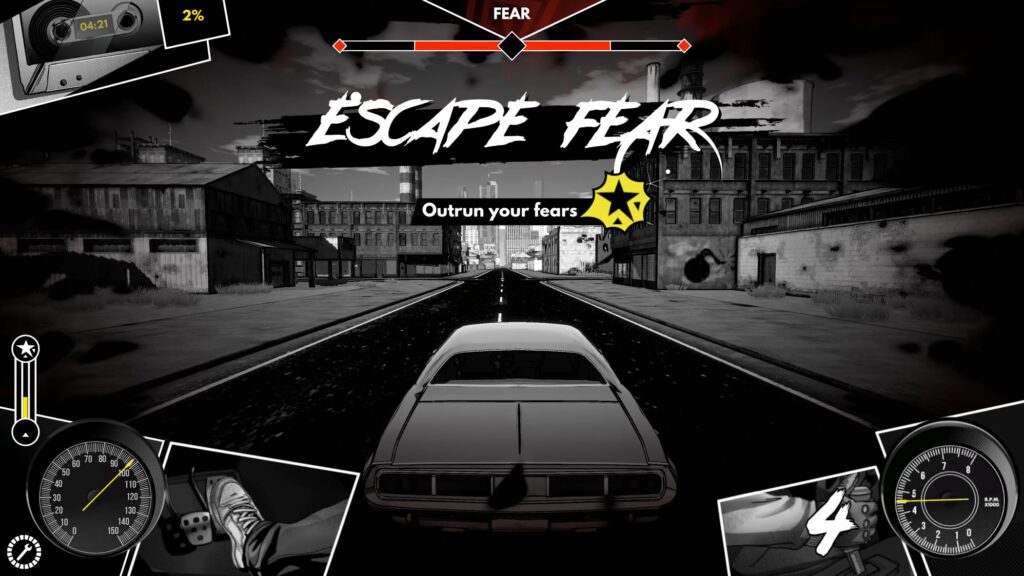
The Interstate Jackalope–or Jackie, for short–is the enigmatic figure shepherding the action of Heading Out. Each new act and each new “run” begins with a gravel-voiced narrator explaining Jackie’s demise: speed, a blinding glare, a car crash, and death. A cycle that seemingly repeats itself.
And every time, it starts with Jackie attempting to escape their encroaching Fear on four wheels, out of a bustling city.
Not a moment passes where Heading Out lacks flair and style. Jackie’s flashback of their final moments burst into frame like a comic book, moving squares and stylish text like a reader’s eyes capturing the mood and impact of the static image. Tone is set immediately and never lets up.
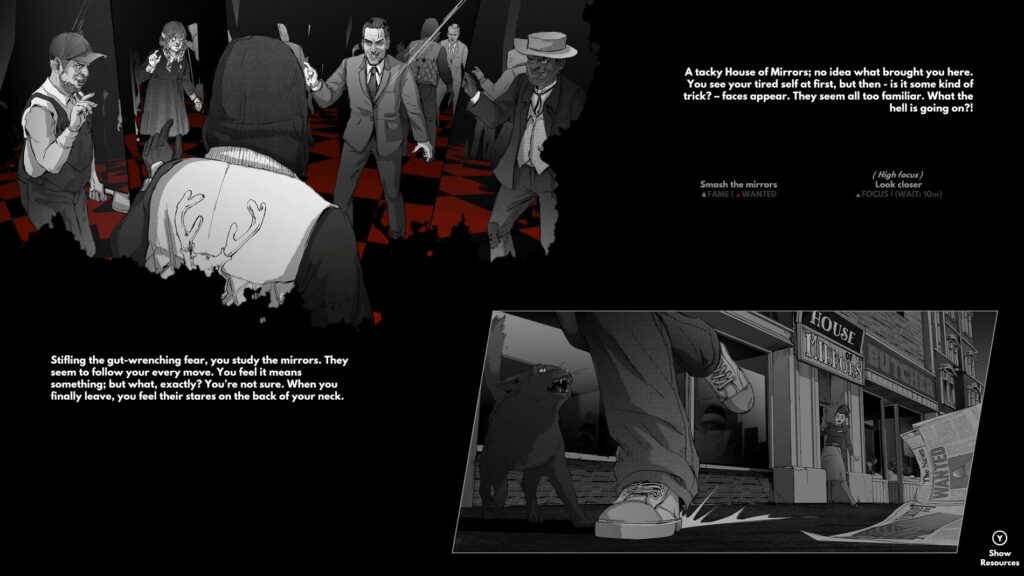
Color–or lack thereof–is one of Heading Out‘s most prominent features. A game undeniably inspired by graphic novels, or at least the film version of Sin City. 90 percent of the game’s palette is black-and-white, while splashes of color permeate the action, starkly contrasting specific elements with the world and central focus of Jackie’s car and the road ahead.
While Heading Out is not the first nor the last game to employ blacks and whites and greys as its dominant color scheme, it feels so uncharacteristic for a title seemingly centered around a vehicle. But again, Heading Out works to defy expectations.
My biggest complaint with Heading Out lies in the notion to box it into any kind of genre. Developer Serious Sim (with console porting done by Crunching Koalas) uses random “runs” and elements to propel the narrative and the action. But attempting to allocate “roguelike” elements to this game simply fall flat.
Structurally, Heading Out is a game about Jackie putting as many miles between themselves and their “Fear” as possible. Once players escape the city, they are placed on a map of the United States, seemingly Missouri each time. Jackie’s destination? A race with the greatest driver to have ever lived. That driver is indicated by a blue mark on the map and after each act, that blue mark moves further and further away from the starting location.
“Americana” is the theme of Heading Out and that slowly becomes apparent as the gameplay act of driving frequently takes a backseat when player choice and action become involved. To progress along the map, players choose a road they wish to go down. The highlighted path will indicate events that the player can expect to encounter as Jackie drives along. Maybe it will be a random narrative beat. Maybe it’s a chance encounter with another racer. When arriving at the destination city, the choice is given to move on or explore. By “exploring” the player will usually trigger another narrative moment then, if available, be allowed the choice to repair Jackie’s car, shop for items, or rest.

The difficulty and pace of Heading Out is dictated not only by the random nature of potential risks and rewards but by the player’s understanding of how to best plan out an efficient route to the ultimate destination. Most of the decision-making process occurs on the map of the United States. Players need to be concerned with money, Jackie’s focus, the police wanted level, the condition of the car, time, and the constant momentum of Fear.
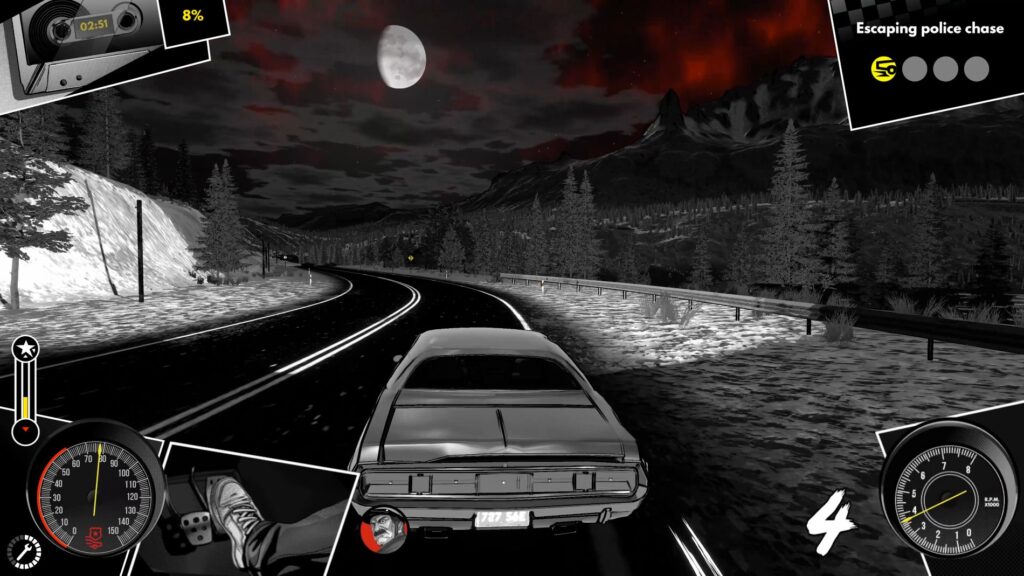
Driving from one stop to the next takes a certain amount of money to pay for gas. If the player chooses to do so, they can “drive” faster along the route–literally just holding down the trigger button to accelerate–but at the risk of churning through more money. Go over the speed limit and watch the wanted level rise for the cops, meaning they might pull Jackie over more frequently or chase them down. Jackie’s focus also dwindles over the long drive. A diminished focus means that the screen may continuously fade to black during a race, simulating drooping eyelids. And if players are traveling between locations and Jackie runs out of focus, they fall asleep at the wheel and lose time, allowing the Fear to catch up.
This ominous, red Fear acts as a bright red aura, slowly moving along with Jackie, threatening to overtake them. It doesn’t take much exposition to recognize what the Fear is and what it represents. But it is constantly biting at the heels of the player and Heading Out does a good job to make it an appropriate looming threat. Only a handful of times did the Fear manage to catch up to me, providing me one last chance to outrace it before consuming me. And one time, a poorly planned route meant that I was not able to reach my destination as the Fear enshrouded all available paths.
As a kind gesture on the middle difficulty, Heading Out doesn’t really seek for the player’s failure. “Resource” management is tight enough to add tension but not enough to be overwhelming. Into the third act after my first failure, I understood the importance of actually participating in races that would award cash. But my focus would also take a hit and I constantly would fall asleep at the wheel. But with enough funds, I could afford items between destinations when I didn’t have the time or the opportunity to actually take a rest.
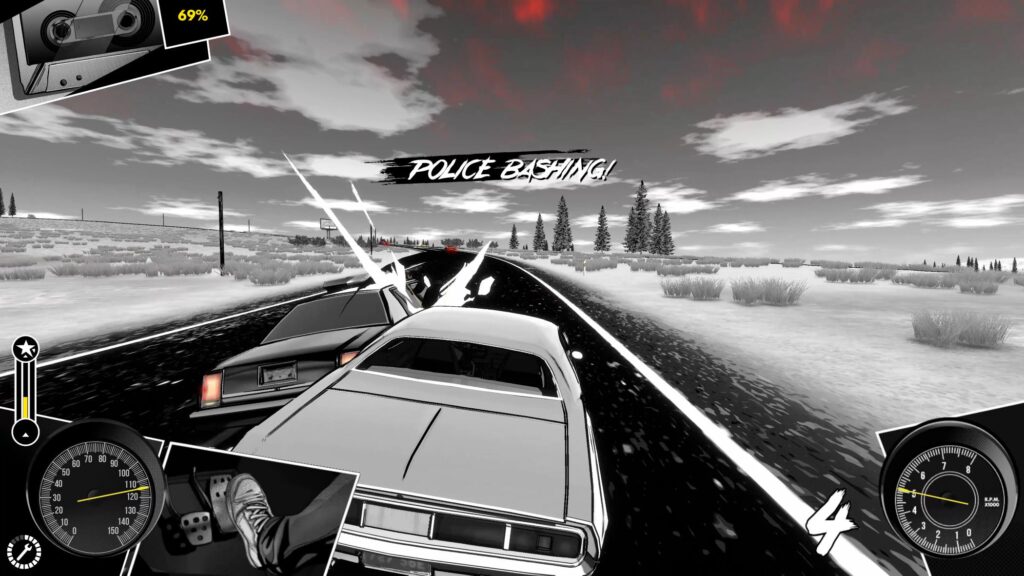
The opportunities that exist to “choose your own adventure” do exist for the player mechanically but very few added twists arise. As the acts progress, police more aggressively patrol the roads and delays are more inevitable that require the player to burn time or start a race. But running out of cash usually means the player may get a police chase for not paying for gas.
Strangely, the act of driving in Heading Out sometimes feels like more of a punishment than a desired outcome. I appreciated the handling of the four unlockable vehicles in the game. There is a feeling of mastery when it comes to using the handbrake to drift, knowing when to slam the gas or lean into slowing down.

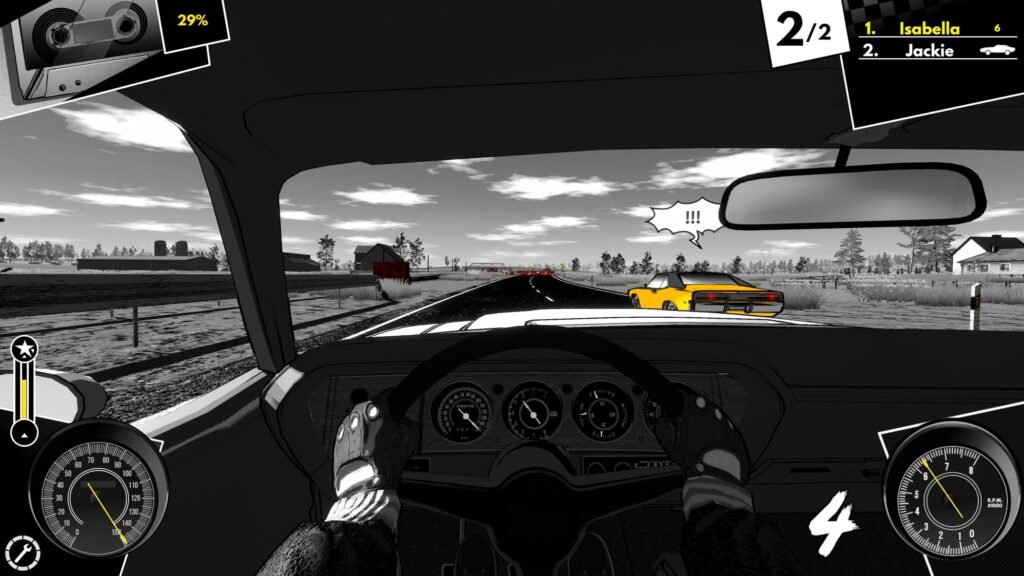
Heading Out‘s visuals capture speed and velocity, marking navigable roads in darker tones and highlighting traffic with white lights for headlights or subtle reds for brake lights. Because Jackie is usually going speeds of 100 mph, crashes are “fatal” and the player will chip away at their car’s health and lose a “retry” for that specific race. Racing against multiple drivers is thrilling and the same applies for police chases as well. Interestingly, the player merely needs to come in first place or prevent capture for the length of a song on the radio, usually around 3 minutes on average.
But I did reach a point where I actively wanted to avoid more than a handful or races or chases, especially during the fourth act. Here, multi-car races and angrier cops thrive. And traffic is more frequent, requiring the player to weave in and out of slow-moving harm.
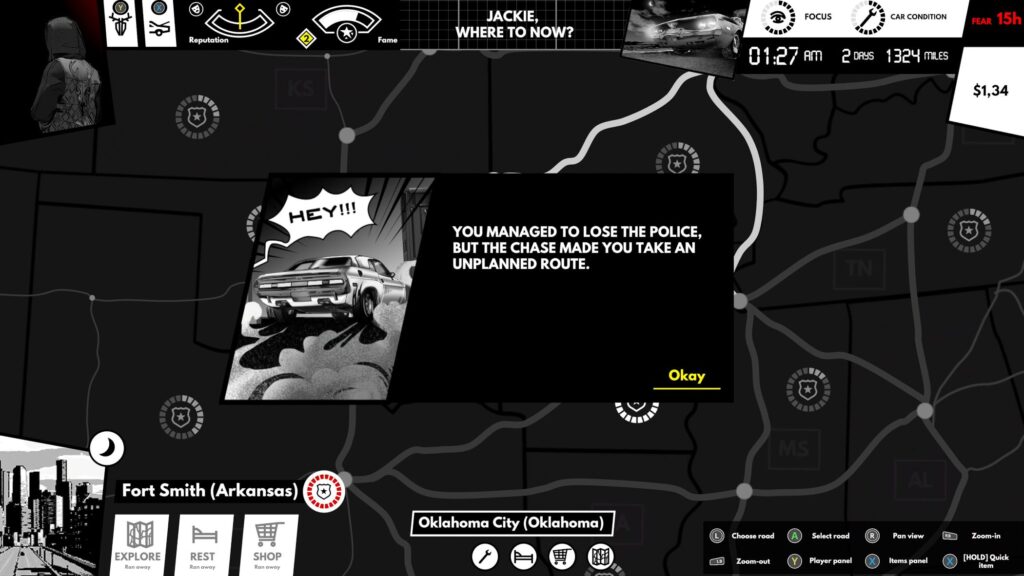
It may feel at odds with a game about driving that the driving was only mildly eventful. And honestly, much of the gameplay of Heading Out was simple and repetitive after a point. Yet it was never bloated or overly difficult, preventing the player from getting to the actual meat of the experience.
Ultimately, it was Heading Out‘s narrative that sold me on its indelible vision. When I say the theme of the game is “Americana” I mean that as a resonant portrait of the ailments and hope of a country constantly in a turmoil of the soul.
Though portrayed in this pulpy, comic style, Heading Out often feels stark in its portrayal of life in this country. While the game doesn’t take place in any specific time period, 1960s and 1970s themes seep through its surface.
Players will frequently encounter segments called “A Glimpse From the Road” which act as bite-sized narrative moments. Effectively narrated by the game’s constant omniscient presence and extremely well-written and engaging, these story moments are randomly scattered among the numerous playthroughs Serious Sim hopes you will engage with.
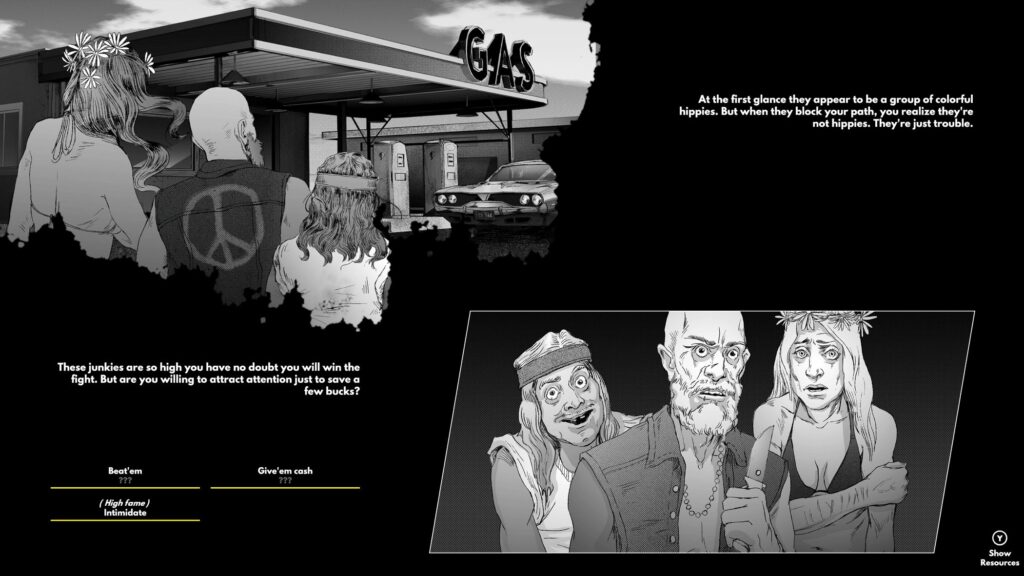
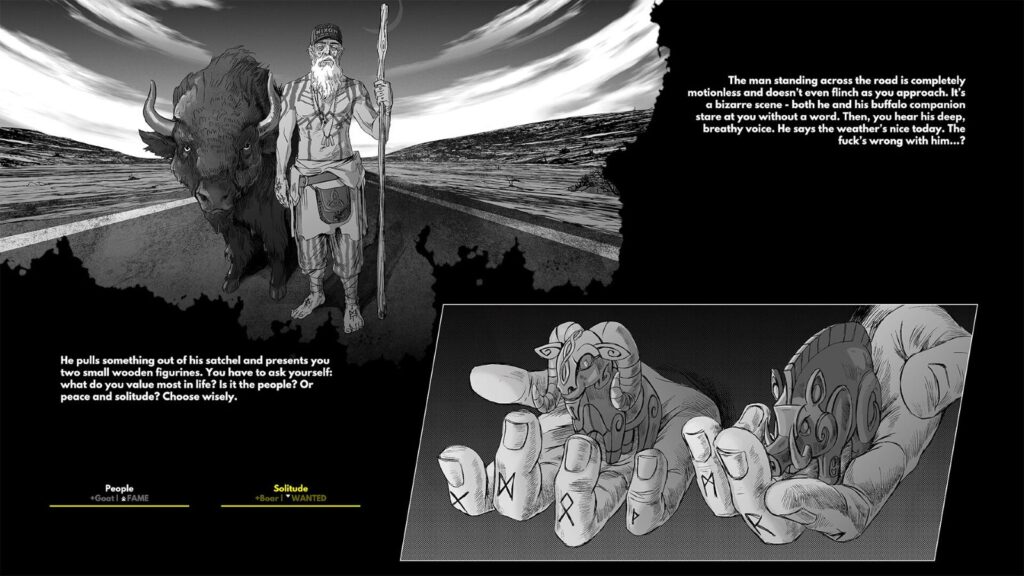
Along the journey through the United States, Jackie will encounter racial injustice, police brutality, kind vagrants, drag queens, stranded drivers, potential one-night stands, and numerous other events. Told with text and the same comic style, players usually have at least two choices to make based on what they have encountered. At times, having the right amount of focus, cash, reputation, or fame allows other choices to be me as well.
Some choices will display the potential outcome of making them. Should Jackie drive away from the cops racially profiling minority children, they will avoid a chase but lose reputation and fame. Jackie may stumble upon the decaying corpses of a family in a home, offering to call the cops, leave altogether, or stick around while the cops show up, all providing a different kind of rewarding.
Dozens of these moments exist across the span of Heading Out. Many are useful in picking up extra money or focus, potentially providing a lifeline should players choose their preferred outcome. The more involved stories that occur over multiple parts are usually based on choices the player makes, whether it be selling out a wayward kid to a cult or assisting a thief who previously stole from you.
Many of the one-off beats don’t actually pay off. They simply happen and wrap up in that moment. But there is a sense of attempting to roleplay as a specific kind of Interstate Jackalope. Will you be a hero for justice? Assist in the fight against fascism? Just look out for yourself? Heading Out is a surprisingly progressive game, one that contains a lot of political commentary in rapid fire, not trying to break down or build up an argument, mostly put it on the table as food for thought.
During drives and on the map, multiple radio channels buzz in with chatter. Often they will respond to events that Jackie participates in. A right-wing host peddles in conspiracy theories much like the vile trash that exists today. Another is simply just news from the road, while another host has a romantic and personal fascination with Jackie. Coupled with the incredible soundtrack that seemingly fits any chase or scenario, Heading Out finds ways to keep itself interesting and fun.
It may sound as if Heading Out is a kind of one-trick pony but that couldn’t be further from the truth. Honestly, when framed as a mostly narrative adventure hearkening back to the point-and-click days, the game makes the most sense. The management aspect of driving across the United States has its moments but often it results in the same outcome.
Heading Out is a wholly unique game that defies expectations. More narrative-driven adventure than vehicle-driven roguelike, expect a fascinating black-and-white style and progressive story beats but little else in the way of meaningful longevity.