

Directive 8020 is very much a Dark Pictures Anthology game through and through. This sci-fi entry isn't vastly different enough to alter Supermassive Games' formula but steps in the right direction still make it an entertaining horror to play with company.
“You should totally save scum,” my friend whispered as they watched me enter a potentially harrowing scene in Directive 8020. I felt the same way.
Wake-up procedures hadn’t gone as planned for the first wave of the Cassiopeia’s crew. Two Sleep Technicians were supposed to wake them up as they closed in on the planet of Tau Ceti f’s orbit. This handful of scientists, pilots, and technicians were supposed to determine if the planet could be suitable for human colonization. In six months, the Andromeda would arrive in hopes to settle on mankind’s newest hope.
And after a four-year journey, everything was going fine. Until, as expected, it all fell apart.
Of course, I knew that something had gone horribly wrong. In the opening moments of Directive 8020 I was put in control of those two Sleep Technicians mulling about their day, prepping to wake up the rest of the Cassiopeia. But a foreign object decided to collide with the ship, disrupting systems across the board. Hours away from a smooth start leads to a deadly fate I knew was coming for at least one of the characters I was controlling. He had a wife and daughter waiting for him back at home. I watched a video message they had sent as he worked to fixed an antenna in the cold depth of space.
Directive 8020 is the newest entry in Supermassive Games’ long-running efforts to instill tension and fear into players. For the past decade, the studio has been chasing the dragon that was Until Dawn, providing a slew of titles in the horror genre where the fates of characters are decided by the choices players make.
Until Dawn‘s ability to weave campy vibes with legitimate scares buffered by professional actors and incredible facial capture was unparalleled. To this day, it’s one of the best horror games I’ve played because it captures the essence of so many pieces of media through reverence and replication. In 2022, lightning seemingly struck twice with The Quarry, another lengthy excursion into genre horror. However, Supermassive’s Dark Picture Anthology has been a bit more of a rollercoaster.
Each entry in the Anthology has followed the developer’s formula to varying degrees of success. Gameplay is mostly delegated to QTEs, there’s a sprinkling of celebrity, and some legitimate scares can be had. But whether it be the inconsistent writing, scattered pacing, mediocre voice acting, or limited interactability, none of the entries have had the staying power of Supermassive’s biggest games.
While Directive 8020 does possess elements of the Anthology‘s weaker aspects, the first entry in four years acting as the debut of a “Season Two” is a step in a hopeful direction.

There I was controlling Laura Eisele, the Senior Mission Officer and Cassiopeia’s architect. She was trailing after Simms, the remaining Sleep Technician who was doing a poor job of avoiding suspicion. In my gut I knew something was about to go wrong and almost in unison me and my friend felt that save-scumming was the best way to ensure Eisele could potentially live if I pressed the wrong button or made the incorrect choice.
In fact, I had been in this same situation before across numerous Supermassive titles. Death had frequently arrived from a choice I thought was the right one or I didn’t hit the square button at the right time. I feared for Eisele’s life like all those other poor souls that would be saved by a checkpoint reset rather than a chapter restart.
Yet Directive 8020 grants players a safety net. Should players wish, they can opt for the “Survivor” mode, which cements every decision made as the final one, no going back. But picking “Explorer” mode opens up the “Turning Point” feature. Here, players are given the ability to change their mind and reverse course on a decision should they not accept the results of a choice.
Further convenience is offered in the form of a timeline for each of the game’s eight chapters. Players are able to see all key events that can be made in the game and how those choices and actions splinter off into unknown possibilities. With this one mechanic, Supermassive addresses one of my biggest complaints with the entire genre of Choose Your Own Adventure games.
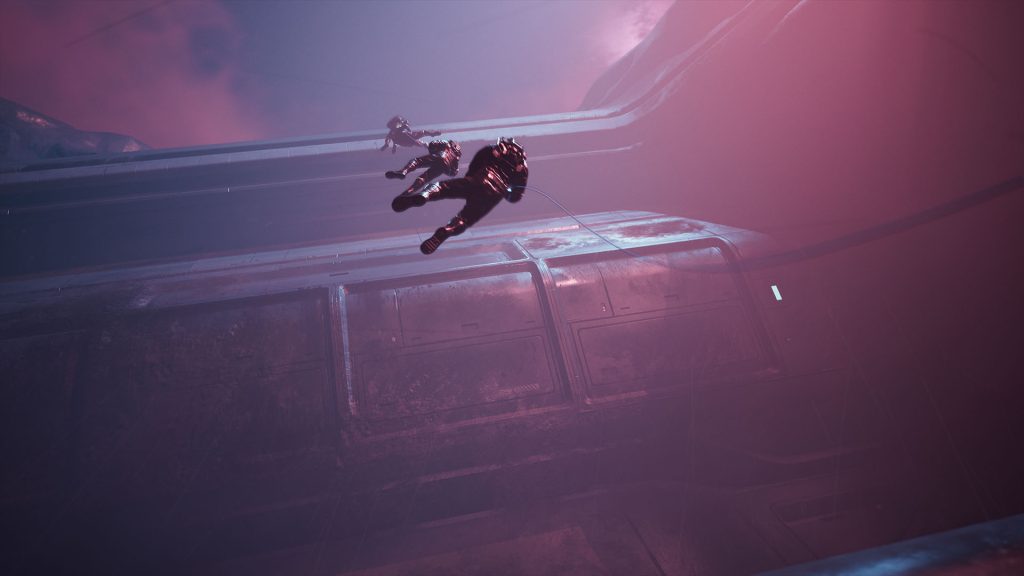
Despite the fact that I primarily play through these narrative-driven games once because I consider that playthrough “mine”, a large part of me wants to explore the what ifs. Maybe I want to see all 44 gruesome or unceremonious deaths in Directive 8020. Maybe I want to see if that choice I thought was innocuous actually is. And by providing players with the ability to pause the game, see their place in the narrative, and act accordingly, Supermassive has increased the viability of continued replays.
They system is not perfect but it is one of the best additions to the Dark Pictures Anthology I could imagine. In Directive 8020, players will notified when one of these “Turning Points” is happening. To ease decision making further, the game will pause to allow players the time to chew over which option they would like. Though some binary or quick choices are shown on the timeline, not every moment of the game will be dictated by the press of a button in that instant.
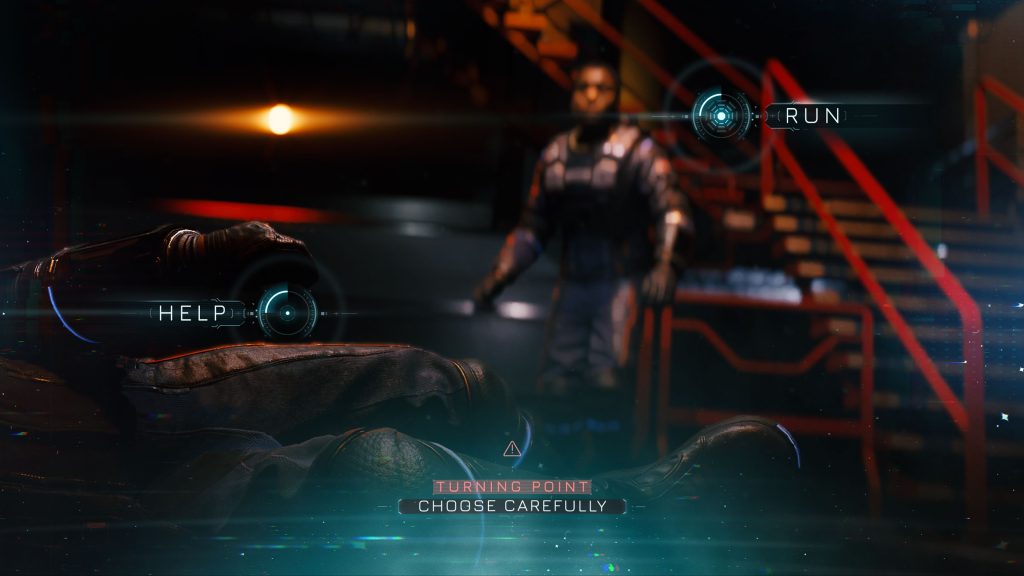
Supermassive loves its characters, especially when it comes to putting them through hell. But every one of their games strives to allow the player to help shape the personalities of the cast. There are countless moments where the player is given dialog options to respond to. Over the course of the game, that malleable personality will payoff by potentially having the character act in a way that could save them or send them to an early grave. Because these character traits are molded over time, players may have to go further back to an early chapter to see the desired payoff.
Given the wealth of options and choices on hand, it would be hard for any writing team to construct a taut piece of horror. Yet I think Directive 8020 does a lot of great character work with a minimal amount of script work that is outright mediocre rather than campy or a bit tongue-in-cheek.

And it’s important for these characters and the scenarios they are placed in to be done right considering the nature of the game’s overall narrative. Without revealing too much, the crew of the Cassiopeia has fallen victim to some kind of alien presence that is capable of mimicking the humans on board. In the first few chapters, Directive 8020 establishes a sole threat that spends most of the time hovering around the edges of the ship and the story. As the mystery begins to deepen, the threat expands in fascinating ways that I truly didn’t expect.
Though I knew the general premise of the alien threat, Supermassive goes to good lengths to layer on the intrigue. Directive 8020 is obviously inspired by films like Alien and especially The Thing (two of my all-time favorites). Early on I could see seeds being planted by the writing team that were actually quite clever and rewarding for people like me who skulk around the playable space for collectibles. Players can expect to find the typical menagerie of video messages, audio logs, news reports, and tablets to expound upon the established universe. But even here, some details have a hidden significance.
A few tricks are employed to keep players on their toes. Simple tricks of the eye instill doubt in what is real or not. Jumps in time feel like they could reveal too much. Because there are so many moving pieces–especially in the form of characters who can die at numerous junctures–the game and writing doesn’t always respond appropriately. If everyone is alive, some scenes might feel too large or like enough dialog wasn’t written. And because the story has to continue, players simply might miss out on crucial information–thus emphasizing the usefulness of Turning Points. But because a core aspect of the game centers around identifying the true threat, there are several instances in which players may inadvertently be making decisions for a character that may not truly be that person. This twisting of the knife can result in some eerie and surprising moments.

Directive 8020, the Dark Pictures Anthology, and Supermassive’s other games have always rewarded a bit of media literacy. Players well-versed in genre tropes might feel like they have a leg up not only on narrative direction but overall tone and when to expect scares to happen. Directive 8020 has some great jump scares. A number of them are expertly subtle from a semi-loud noise of a screen turning on as a character walks past or slight movement almost out of frame. And many of them are violent and in-your-face. And honestly, I’m glad Supermassive made the move into space. Their prior games often leaned into folklore like ghosts and witches, the supernatural. Creating a science fiction game pushes the developer into new territory and gives them a separate section of inspiration to cull from.
Another big change for Directive 8020 is abandoning fixed camera angles. Now the game acts more like a third-person action title where players can swing the camera around to get a feel for the playable space. I’m of two minds about this. In prior games, having a semi-fixed camera angle would allow Supermassive to have more control over the direction of a scene. This way, scares can be a bit more dynamic as the player walks into a certain part of the frame. But many of the Cassiopeia’s interiors are relatively small and confined and framing these scenes might not translate well.

Part of the reason why this switch exists is because Directive 8020 is packed to the brim with stealth sections where the player is meant to sneak around to avoid being seen by one threat or another. Previous games centered all the non-exploration gameplay around QTEs, making for a more directed experience. While some of these stealth sections are great at building tension–especially for any anxious people watching you play–they are extremely rote. Threats can be a little dumb and have tunnel vision and they have simple, specific paths they follow. And sometimes they just kill the pacing, especially when it feels like most characters get at least one or two stealth sections.
Though being caught can often mean death, players have an electric baton that can be used in some instances as a safety net that is on cooldown after use. And in one instance, me getting caught at the beginning of one of these sections and escaping actually caused a sequence break where the next step in me sneaking around wasn’t properly triggering, forcing a reload. In future Dark Pictures Anthology entries, I hope that Supermassive works to expand on their gameplay and camera work, not double-down on stealth.

As important as the characters are in Directive 8020, there are times where they are failed by technical shortcomings and the delivery of their lines. Not every actor fires on all cylinders 100% of the time and I legitimately feel there were moments where a few more takes would have ironed things out. Sometimes the accents of a few characters also felt inconsistent, taking me out of the performance. Additionally, the motion capture and lip syncing can be off-putting at times. Supermassive has always done some impressive work capturing an actor’s likeness and putting them into the game. But simply put, numerous times I felt like certain characters just didn’t get the same attention when having the character model’s mouth match the words being spoken. Further taking me out of it were strange head movements and other quirks that made these characters feel more like code in a game and less like people I was meant to embody and care about.
This has always been a bit of an issue with not only Supermassive but other developers across the genre. There’s a thin line where performances can move in and out of the uncanny valley. Since Directive 8020 is going for realism, the moment characters don’t look, sound, and act realistic, it harms the performance.

Yet it’s hard to deny how visually cohesive this world is. There’s some genuinely disgusting and creepy body horror at work here that only a few games have managed to match. Creatures and corpses are contorted in gruesome ways. The ship has a strong identity with nothing feeling too futuristic or visually out of place. And outside of a few audio levels being too quiet or loud (and some licensed music that didn’t impress me too much), I love the eerie sounds that would often emanate from the quiet corners of the Cassiopeia.
Of course, much of Directive 8020‘s enjoyment may simply rest on how open the player is to this kind of game. I have always found it best to enjoy these titles with at least one other person who can help make decisions or at least react to the scares and action on screen. Supermassive has included couch and online co-op where players can assign specific crew members to each other or take turns making decisions. Even so, this is a narrative-driven horror game where decisions and quick button presses dictate the pace, not gunfights and combat. And thankfully, Directive 8020 seems to be setting a new bar for Supermassive in the future.
Directive 8020 is not without a handful of recognizable flaws and quirks that have been present in Supermassive Games’ horror titles for a decade. But the shift into science fiction is one of the many necessary changes to the formula. By toying with player expectations, this involved, character-driven horror fest emerges as one of the strongest entries in the Dark Pictures Anthology, laying the ground for a potentially enthralling Season Two.