
Way back in 2022, Will Silberman wrote a wonderful review for Triangle Strategy. It hit all the major points in Will fashion and did a great job of breaking down the ins and outs of the gameplay. In short, Will loved the game and was one of the first to identify how complex and wonderful the design of it was.
Now, it’s 2025, and developer Artdink’s game has been released on the PlayStation 5, and you get my perspective on how it did. Much like what Will thought, Triangle Strategy is an intricate and complex tactical RPG that may have focused more on story than action. The former deserves praise for its construction and how it plays out. The former might be far and few between during the game, but when you get going on the tactical side, it shines with its longevity and strategy. It’s been a long while since I’ve played tactical RPG gameplay that lasted at least half an hour.
So, let’s get this review of Triangle Strategy going.
Story
This emitted a lot of Phantasy Star III vibes for me, as the game’s narrative runs on player choice. Let me just say that PSIII laid the groundwork for RPGs like Triangle Strategy when it comes to story and choices, which is why it was the first game I thought of when I got going with this one. Anyway, the story of Triangle Strategy!
You play as a budding prince named Serenoa, who is destined to be the heir of House Wolffort, as his father is ailing and his fate will be set. As a soon-to-be ruler, Serenoa must travel the world, help bring three kingdoms together that are natural born enemies, and save his continent of Norzelia before it’s undone.
As stated above, this game thrives on narrative. The kingdoms and their leaders are defined through well-written dialogue and passionate, yet potent storylines. To make the moments more complex, the game features a heavy amount of branching narrative, which helps shape Serenoa’s adventure, as his view of the world bends to the player’s decision. And it truly makes a difference.

When you are talking with people in a village or when Serenoa is alone with friends, the game will give you choices of dialogue to pick as responses to conversations. How Serenoa responds shapes how the game goes. For example, if you’re discussing with a group of underserved citizens of a village of refugees, the first conversation you have is about what you want for the group in the future when you’re a ruler. Choices that lean toward being under Wolffort rule or hoping the group goes off to make their own path come up. Whichever choice you choose dictates how that group feels toward you, as well as shapes the viewpoint that Serenoa carries with him.
Now, this doesn’t mean that you’re going to get an overly complex Knights of the Old Republic from this type of branching dialogue, but it does sway heavily with how things play out. Again, it’s complex and not at all meaningless. Sometimes branching narratives like this throw choices out to the player with only one right path, but Triangle Strategy doesn’t do this. It allows you to shape Serenoa’s future and persona, which is impressive and well thought through.
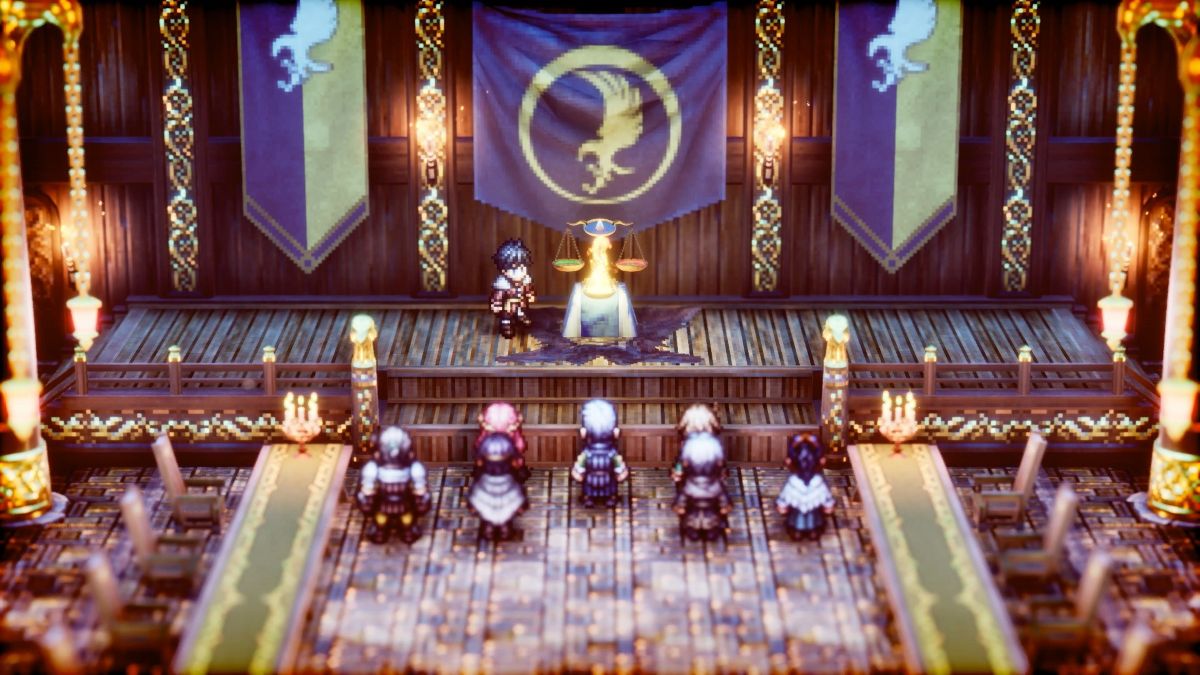
Of course, this branching portion of the narrative doesn’t simply exist within player-choice dialogue. The game also features moments called ‘Scales of Conviction’, where branching choices influence difficult decisions the group must make. Serenoa’s task during these moments is to sway his group members one way or another, and that all depends on what the player decides to say on whatever subject matter is being decided upon. For example, at the beginning of the game, you’ll have Serenoa honored as future ruler, married off to someone from a different nation, and this ends with his decision to visit other nations to get to know a future unified Norzelia. He must ask his group which nation he should visit first, and each person has their own opinion. The player literally must speak to everyone and try to sway them in the direction they’re trying to choose. At the end of the day, if the player does a good enough job swaying, then they get what they want when the group votes. If the player isn’t convincing with their conversation, then the tides can be turned and swayed in a different direction.
Again, you’re going to spend a large amount of time with narrative and conversation in comparison to action. And while this might not seem like the best idea to some people, I can only assure you that this game is worth the price of admission when it comes to story and characters. It’s a well-written piece that you should pay close attention to from beginning to end.
Now, if that doesn’t convince you that the story is first when it comes to this game, then let me throw this at you — you can tell it’s going to be a story-heavy game that is good when you hear the actors take up their parts for the first time and show off their passion through their acting skills. They play their characters well, and they sell the moments unbelievably well. This helps with a narrative-heavy game.
Overall, Triangle Strategy is a story-first game and rightfully so. It tells a well-written tale, throws the player into the mix through meaningful choices as it goes along, and brings in the right actors to bring the characters to life. It’s one helluva story experience.
Technically Tactical
In between all the stories, acting, and narrative choices, the game does feature some good tactical gameplay. In this arena, Triangle Strategy does a great job of bringing the player a large amount of tactical RPG-ing. I’m talking about the game throwing 30-45 minute battles that you won’t feel a second of because of how engrossed you’re going to be with the experience.
How it works – you’re thrown into a battle mode at some point in the storyline. With this battle mode, you get to place your troops where you believe they should go before the battle begins, and you can also adjust the characters beforehand. Once the battle begins, you’re in the scrum and you won’t be coming out of it unless you win or lose.
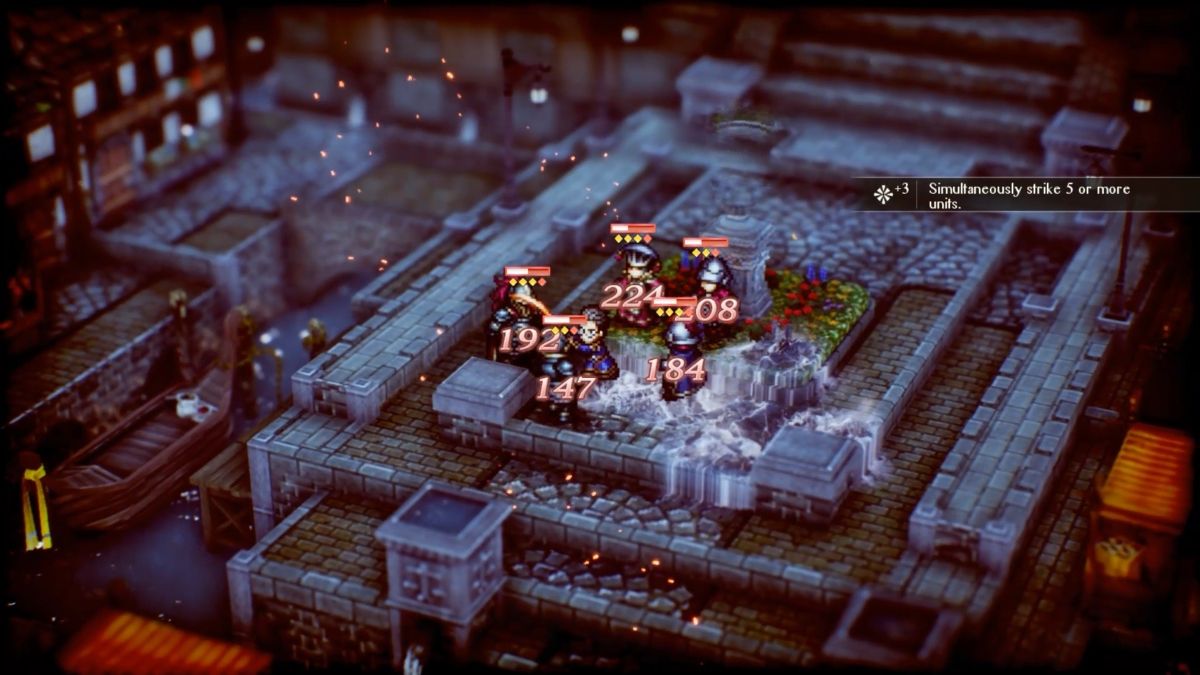
The game’s battles work in a tactical, new-turn-based way, where characters are chosen from an ever-moving timeline at the bottom of the screen. When a player’s turn is made, they can choose to move across the board, cast spells, heal others/themselves, or fight. Once a player moves, and depending on the character and what their specialty is, they can begin to take out enemies. Once enemies begin to drop off, the timeline of characters at the bottom starts to become very one-sided, which means far more turns for your characters.
Now, the actions range from spells, arrows, daggers, swords, canes, and shield busters. Each one works with a specific range for the character, and each one can be upgraded and improved to work better. That comes with leveling, which is remarkably uneventful and easy during battles. Through the battles in the game, I found my characters leveling up without paying attention to the process. It’s so secondary. But that secondary gameplay element brings new ways to attack, heal, or cast spells. That makes it useful, even though you won’t be counting on it during scrums.
As standard as the above sounds for a tactical RPG experience, the game becomes more. As you strategize your way through battles, you can trap enemies and treat them like ping-pong balls, bouncing attacks back and forth on enemies. For example, if Serenoa stands adjacent to an enemy and another character armed with daggers stands opposite, if Serenoa attacks the enemy, the enemy will bounce toward the dagger-character, who will also be able to strike them. It’s a neat and simple bit of strategy during fighting that plays a heavy role when trying to plan approaches and attacks.
Of course, while this is an advantage for the player, it’s also their disadvantage. Enemies are ruthless in this game. They will find ways to trap characters and dispose of them, which makes battles incredibly difficult and complex. Having to keep an eye on enemies while adjusting your own moves to their movement is strategically engaging. It’s a great gameplay.
In addition to all of this, the backend of the game is impressive. Ranking players, growing weapon upgrades, and gradually making a character powerful ends up being a motivational treat in the game. The game has some real depth on the backend that lends well to the front.
Overall, the tactical gameplay is great, as is the leveling and character progression, but there just isn’t enough of it because of the story’s size and importance. But when you do get to play the tactical side, this portion of the game excels in what it’s trying to do. It’s more than a standard tactical turn-based RPG experience. It brings so many good strategic elements to the table that you can’t help but fall in love with its gameplay design.
In short, it’s damn fun.
On that note, let’s wrap up this review.
Conclusion
Triangle Strategy from developer Artdink is a marvel of a tactical RPG experience. While it is heavy on story that is driven by complex and solid branching choices that affect outcomes, and fantastic acting, it still brings some amazing tactical gameplay with new twists and turns.