

There’s little doubt that Octopath Traveler 0 is one of the best JRPGs of the year, if not the best entry in the series. Its novel additions alongside the series’ staples elevate it to new heights. Despite having enough content for a hundred or so hours, it respects players’ time more than any other JRPG I have played.
Standing before me is a psychopath playwright and his significant other who just so happens to be his leading actress in his plays. He triumphantly turns to me (the player) and announces that both he and a child have taken a poisonous elixir and the actress (the mother of the child) has only one drop of antidote. She must now choose to save the marvelous playwright or…her currently unconscious son.
This cutscene results in the actress entering a state of frenzy. It’s now up to me and my seven other traveling companions to take her down.
Octopath Traveler 0 contains several shocking moments like these. Like its predecessors, it brings together a large cast of characters of multiple shapes and sizes and sets them off on a journey to take down sources of evil that threaten the region of Orsterra. Unlike its predecessors, however, Octopath Traveler 0 incorporates a customizable protagonist, a townbuilding minigame, and a gigantic cast of characters. It’s like Octopath Traveler meets Final Fantasy VI meets…Cult of the Lamb. What an absolutely wild mashup of games, right?
Square Enix’s Octopath Traveler 2 has cemented itself as one of my favorite JRPGs, up there with Final Fantasy VI, Persona 3, and Undertale. It contains the perfect blend of turn-based battles, beautifully designed environments, stellar music, and captivating storytelling. When I saw the Octopath Traveler 0 announcement, I had some concerns that it would lean too heavily into its gacha mobile game roots and be a console port of Octopath Traveler: Champions of the Continent. Thankfully, it has shed most of its mobile gameplay loop and is properly presented to console owners as a JRPG that is not just worth playing, but necessary to play.
Octopath Traveler 0 is that good.
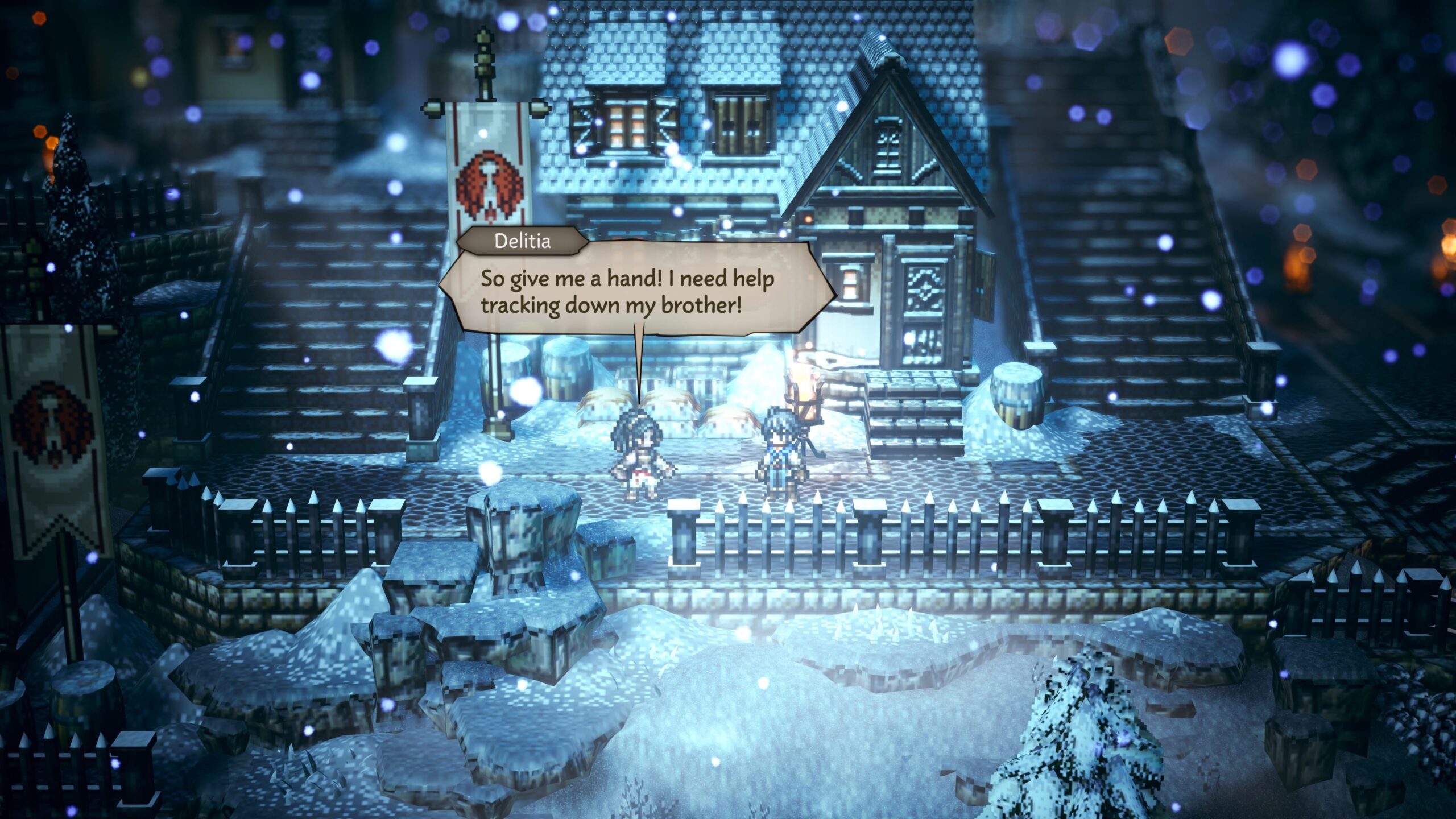 If you’ve played prior Octopath Traveler games on console, then Octopath Traveler 0 will feel innately familiar. The tried-and-true Break/Boost battle system returns along with Path Actions, except now the customizable protagonist can do all of the things with seven other party members in-battle.
Within its traditional turn-based battles, Octopath Traveler 0 tasked me with identifying and exploiting enemies’ weaknesses. After correctly identifying weaknesses and BREAKing down enemies’ shields, I had several turns where I could freely attack before the enemy came down from its stunned state and began attacking me as usual. The BOOST system functions similar to Bravely Default, where I could wager points I have accumulated during the battle to enact supercharged versions of attacks. Boss battles become spaces for the player to strategize: Should I use all of my boost points now to reduce the enemy’s shield and stun them, or should I wait until the enemy’s shield has hit zero in a few turns and go all-out with powerful and satisfying attacks?
New to Octopath Traveler 0 is its “swap” mechanic in-battle. At any given time, I could have eight travelers in my party (out of far greater than eight, mind you!), but only four of them could be used in-battle. The “swap” mechanic let me switch the character in front with the character in back. When swapping, the characters would be safe from attacks while gaining boost points that could be used in future turns. Additional depth emerged in the form of abilities that were powerful if the caster was swapped in that turn, encouraging me to experiment with how to best utilize my entire party rather than those just in front.
In practice, swapping feels very fluid and a natural extension of Octopath Traveler’s shield-exploitation system. If a character in front lacked the weapon or spell to exploit a weakness, a character in the back almost always did have what I needed for that previous BREAK to flash up on my screen. The constant swapping of characters made boss battles feel more active than ever before, despite being turn-based.
Once I had a larger party (more than eight), I had the freedom to swap characters at will to make the perfect party. I experienced the same degree of flexibility as I did with Final Fantasy VI, even though I also experienced a smidge of choice overload when attempting to figure out who to put in and who to swap out of my party. Unlike having eight travelers to choose from in older Octopath games, Octopath Traveler 0 has nearly 30 playable characters.
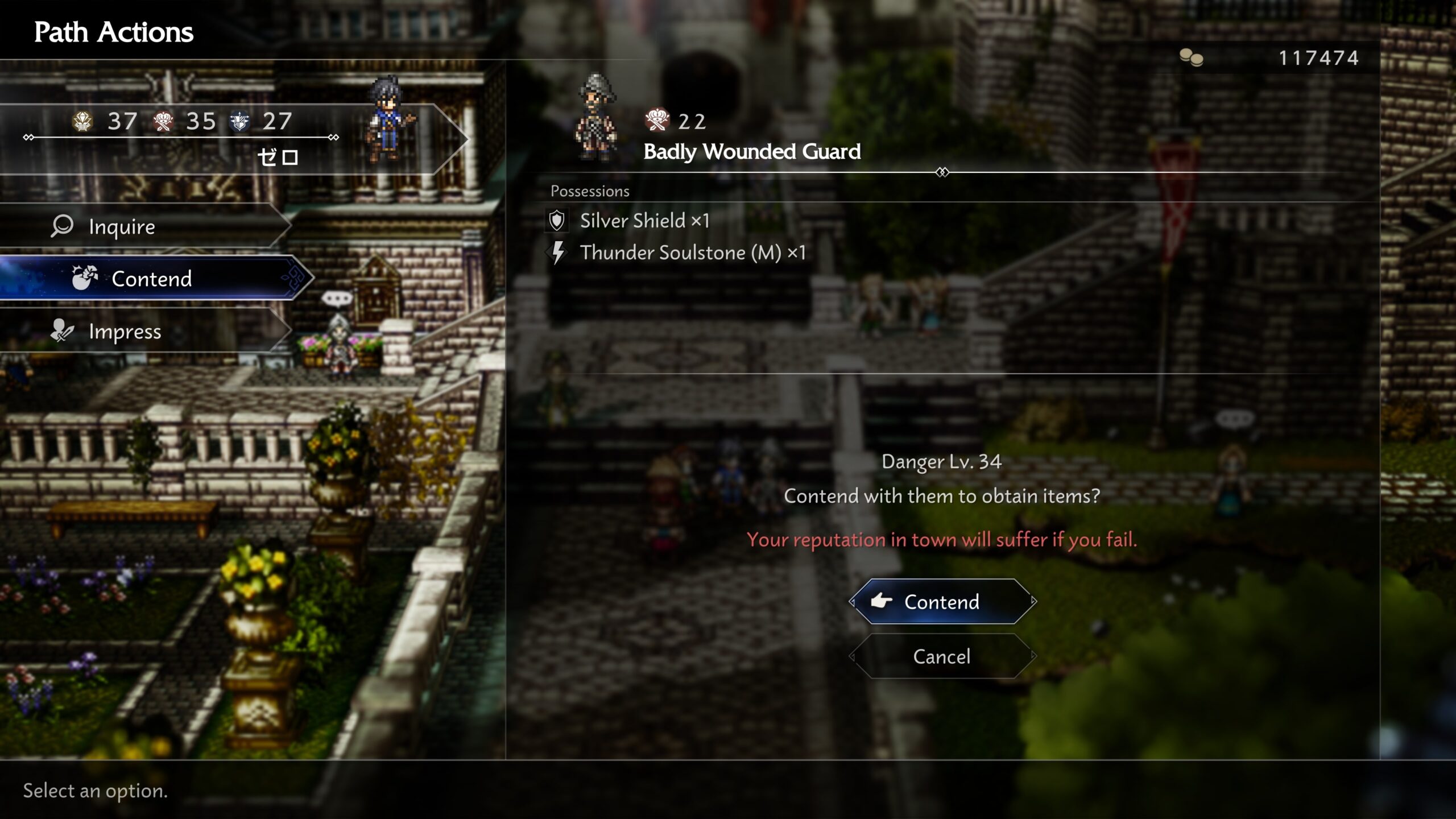
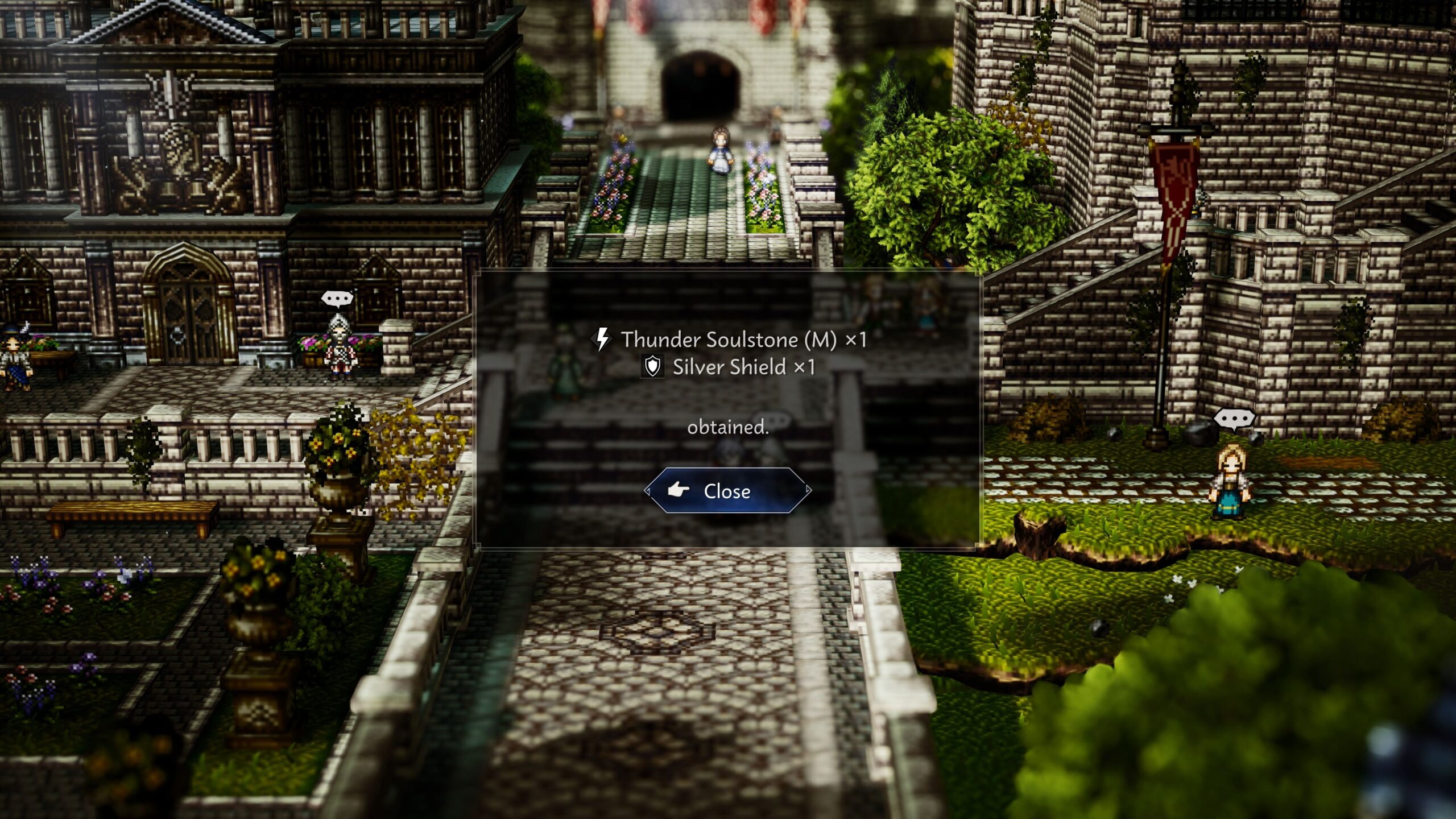 Path Actions return, too, functioning slightly differently than prior games. The customizable protagonist, the Ringbearer, can walk up to just about every NPC and learn more about them via Inquire, fight them for items via Contend, Haggle for cheaper items, discovering hidden items placed in towns/caves, or even inviting them to the Ringbearer’s hometown of Wishvale. Path Actions have varying degrees of success rates, meaning that failing them too often results in negative reputation that can only be improved by spending money. I couldn’t fight NPCs willy-nilly!
The one space where Octopath Traveler 0 leans into its mobile game roots is within the town management. In between quests (or sometimes in the middle), I would see a little notification on the world map that would tell me that my Wishvale Residents had gathered supplies for me. Upon returning to Wishvale, the residents I had placed in homes would give me anything from building supplies, actual items, to leaves (money) that I could use to purchase weapons, armor, and accessories. I was unable to determine how much in-game time needed to pass for my little citizens to grant me goodies, but it generally took around the time it took for me to complete a single chapter.
I appreciate that the time requirement was hidden, as it let me focus on completing quests instead of idling around in Wishvale and waiting for them to give me supplies. I didn’t have to sit around and wait for things to be built by button mashing, either. Some of my biggest frustrations with similar town management minigames (like Cult of the Lamb) were how the town management acted as a time sink rather than a space for me to gain power, improve my characters, or express my creativity. The only things gating me from building up my town were resources (be it money or otherwise) or my current position in the story.
I never thought that I would appreciate a JRPG with elements stemming from Stardew Valley and Cult of the Lamb, but here I am. Wishvale respects my time and gives me an income stream that I otherwise would have solely gotten from grinding random encounters. Oh, and I get a free place to stay instead of paying to spend the night at any of the towns’ inns.
 The biggest change to Octopath Traveler 0’s storytelling is the inclusion of its silent protagonist, the Ringbearer, which is also its biggest shortcoming. Right from the start, I was told that my life was my own and free to choose my destiny. You know, the common choose-your-own-adventure trope present in most Western-influenced RPGs. My character interacted with all of the NPCs and could even participate in party chats, but it still felt like I was a silent observer rather than a character with an emotional purpose. Sure, the Ringbearer would be asked questions and a “. . .” dialogue box would appear above his head to emulate discussion within cutscenes, but it felt like the Ringbearer’s story of revenge felt less fleshed out than his companions or even the forces that destroyed his home town.
Yes, there are a ton of travelers to recruit – nearly 30. I came across them one-by-one as I completed the main quests and by simply exploring towns. The natural progression of discovering a new traveler and having them join the group feels great. But storytelling wise? It becomes burdensome to attempt to keep up the multitude of stories and become emotionally attached to the travelers’ character arcs. I’d rather have a smaller cast with fuller backstories, even at the cost of having less team flexibility or protagonist individuality.
The contents of Octopath Traveler 0’s story, however, are excellent and tug on the heartstrings. Each of the villains take further steps into wickedness with each passing chapter, giving me more reason to take them down and attempt to undo the pain wrought upon Orsterra. With each passing chapter, I become just as engrossed in defeating them as I become stunned with their acts of depravity.
Looking beyond the storytelling and larger-than-expected cast, Octopath Traveler 0 remains ever so engaging as a JRPG. The fact that any player can jump in and become engrossed with the in-game universe without needing to brush up on previous games’ lore should be praised. The previous two entries require hundreds of hours, so it would be foolish to expect that a new player would just understand what’s canon and what’s not. Here, longtime fans get treated to small Easter Eggs here and there while new players get to enjoy some of the best elements of the Octopath series.
It bears repeating – the gorgeous pixel art and atmospheric soundtrack make it worth it alone. Everything else is icing on the cake. Square Enix has truly perfected the HD-2D art style over the years with the likes of TRIANGLE STRATEGY, Live a Live, and even Dragon Quest 3’s remake. Octopath Traveler 0 retains the glorious HD-2D designs with environments that look like physical dioramas that blend 2D sprites with 3D effects. Dungeons contain shimmery and flowing water, mountains contain little snowflakes, and mansions contain a smidge of flickering fire amidst pixelated books and crudely designed bloodstains.
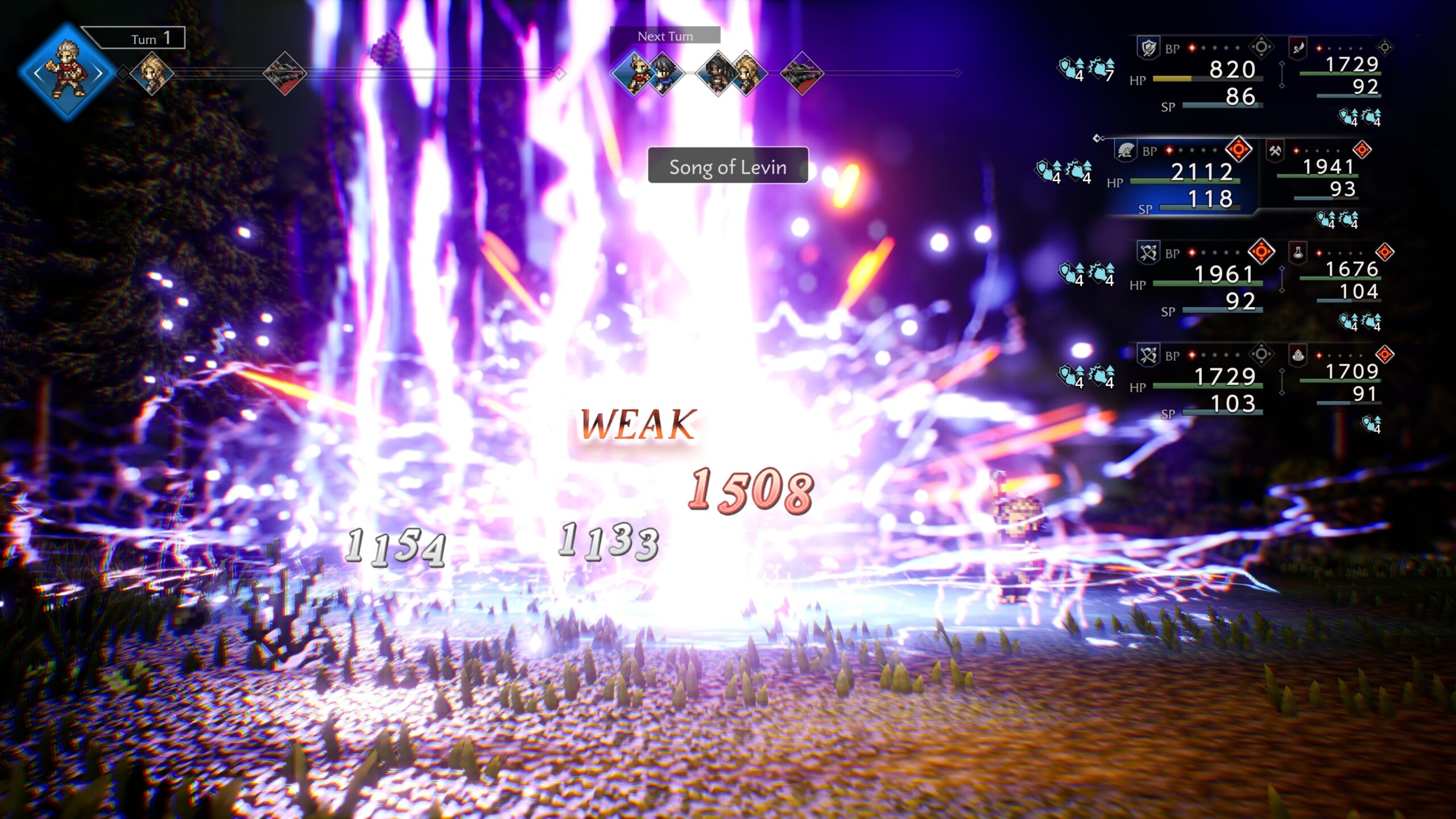 Characters stand out with this art style. In a game literally overflowing with charming protagonists and truly harrowing antagonists, HD-2D gives characters the space they need to be front the center all the while the world feels slightly alive. Well, it feels far more alive than a traditional pixelated 2D JRPG.
If you’re concerned about the traditional JRPG grind, don’t be…at least until well into the endgame where you’ll feel compelled to grind for the sake of experimentation. Octopath Traveler 0 prevented me from getting too far into any specific story path thanks to level-minimum mini-chapters. If anything, the early- and mid-game resulted in me feeling overpowered and capable of taking down the gorgeously designed and massive bosses that awaited me at the end of each mini-chapter. Random encounters felt quick and painless once I found enemies’ weaknesses.
I wish that there was a way to disable random encounters, but I’d rather feel overpowered and prepared for the next chapter instead of feeling compelled to walk in circles and defeat the same enemies over and over. Octopath Traveler 0 is wonderfully respectful of my time despite its supposed 100+ hour playtime. If I was able to get through the first 10 hours (or so) by defeating random non-boss enemies in one or two turns, you should, too.
You’re probably curious as to why I’ve avoided discussing too much about the Ringbearer’s origins, the supporting cast of characters, or even the names of the villains. Octopath Traveler 0 is best experienced blind, despite the fact that its story is very similar to Champions of the Continent. A quick Google search or peruse through the Octopath wiki could tell you all you need to know about the story, but you shouldn’t. If you’re on the fence about the game, you definitely should try the free demo to get a taste of what’s in store.
There’s little doubt that Octopath Traveler 0 is one of the best JRPGs of the year, if not the best entry in the series. Its novel additions alongside the series’ staples elevate it to new heights. Despite having enough content for a hundred or so hours, it respects players’ time more than any other JRPG I have played.