


Swapmeat won me over on its chaos, silliness, and replayability. Its grotesque meat swapping mechanics kept me on my toes in building wild looking yet wildly powerful meaty monsters.
We live in a time where so much creativity and cognitive processing is offloaded onto generative AI. Players have been quick to point out off-putting imagery from game trailers and static advertisements, and rightfully so: AI is threatening creativity to the point where gaming art are skewing generic. It’s so rare for games to catch one’s attention in a good way. Seattle-based studio, One More Game, has caught my attention: They’ve designed a roguelike shooter so grotesque and wacky that I am unsettled in all the right ways. It’s called Swapmeat, and it’s broken free of its Early Access status.
On paper, Swapmeat is a daunting idea. I’ve described it to my colleagues as Risk of Rain 2’s third-person shooter roguelike meets Deep Rock Galactic’s gigantic maps with a sprinkle of classic Borderlands’ tongue-in-cheek humor wrapped up into one game. It’s built upon the simple roguelike premise where you get as far as you can during a single run by swapping body parts of slain enemies to create a custom character – it’s in the name, folks. You swap…meat. All of the meat! In my first few playthroughs, my character went from an amorphous ball of meat (Squishy!) to a half-skeleton-half-robot hybrid with a turret for a torso to a ninja with a fly for a head. The roguelike fantasy of no two runs being the same was elevated by the idea that my character’s own construction varied wildly (and grotesquely) each time I set off.
Swapping meat served an important function – my abilities (head, torso, and legs) changed based on whatever body parts I chose to equip. Ninja legs made me a massive boost of speed. What looked like a clown car let me drive around for a few seconds with reckless abandon. The turret torso gave me a few seconds of unlimited ammunition before going on cooldown. That turret torso also dramatically increased my character’s model which was ever-so-funny so see wobble around the map. The designs and potential combinations made it so that my companions and I looked silly and creative without feeling bored.
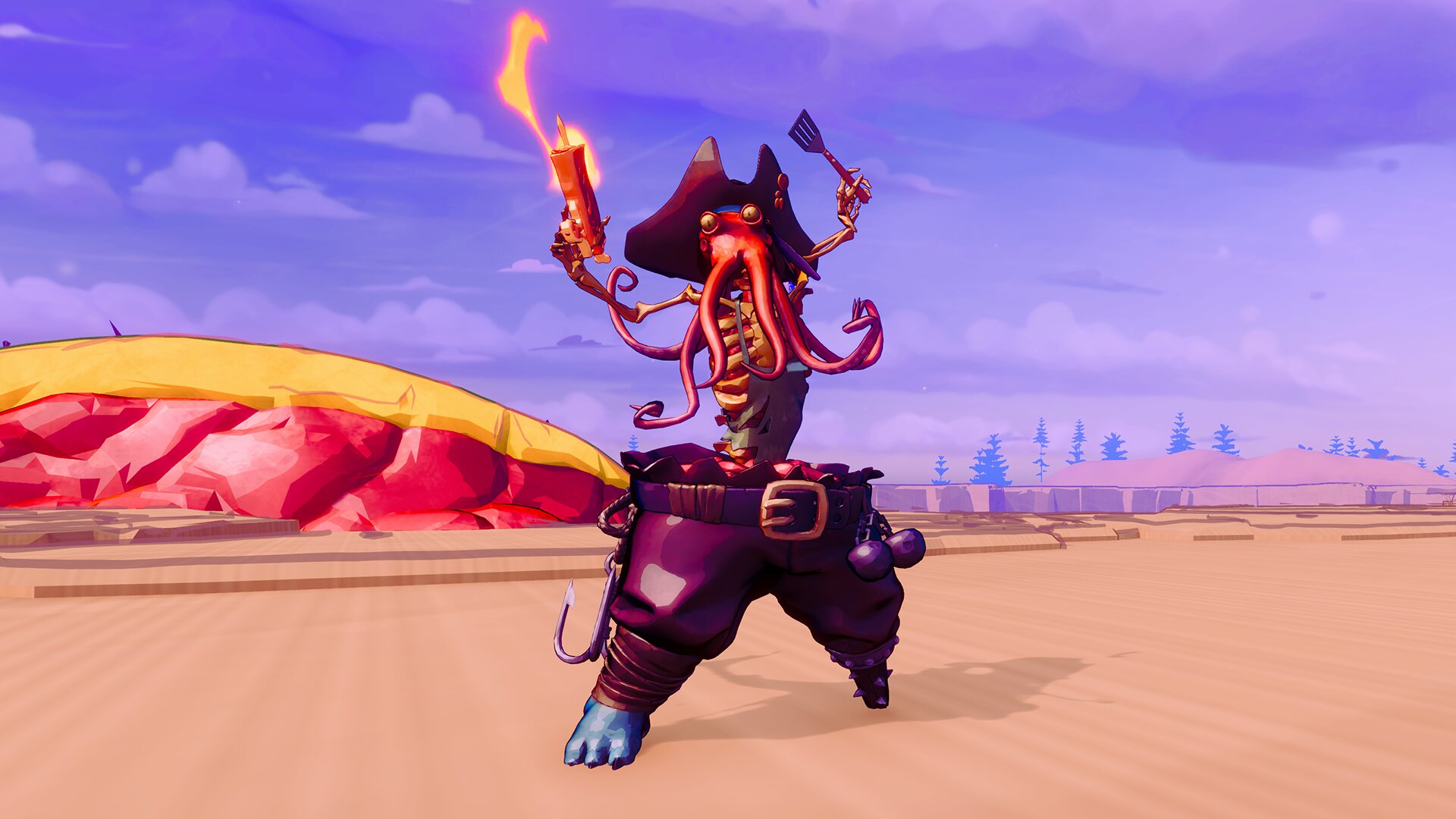 The body parts aren’t permanent, though. They had their own health bar and would break when I sustained enough damage. They would also unequip at the end of each level, meaning that I had to hunt for new body parts to swap before I could continue onwards. I didn’t like that feeling of losing my abilities, at least at first, but doing so pushed me into trying new things and pushing the game to its limits.
Swapmeat’s roguelike gameplay manifested in the form of planetary runs: After choosing my two weapons in my spaceship hub, I was sent to a galaxy to secure meat. Each run involved exploring two planets before facing a boss battle. Upon landing on a planet, I was given free reign to run amok in massive maps comprised of three main objectives, multiple optional secondary objectives, and randomly placed resources to mine and fish. The expansiveness of the levels had some small secrets peppered throughout, but nothing that truly encouraged exploring these alien worlds. If anything, I was actively discouraged from too much exploring because of the persistent countdown at the top of my screen that alerted me of an imminent alien invasion that could very well blow me to meaty smithereens.
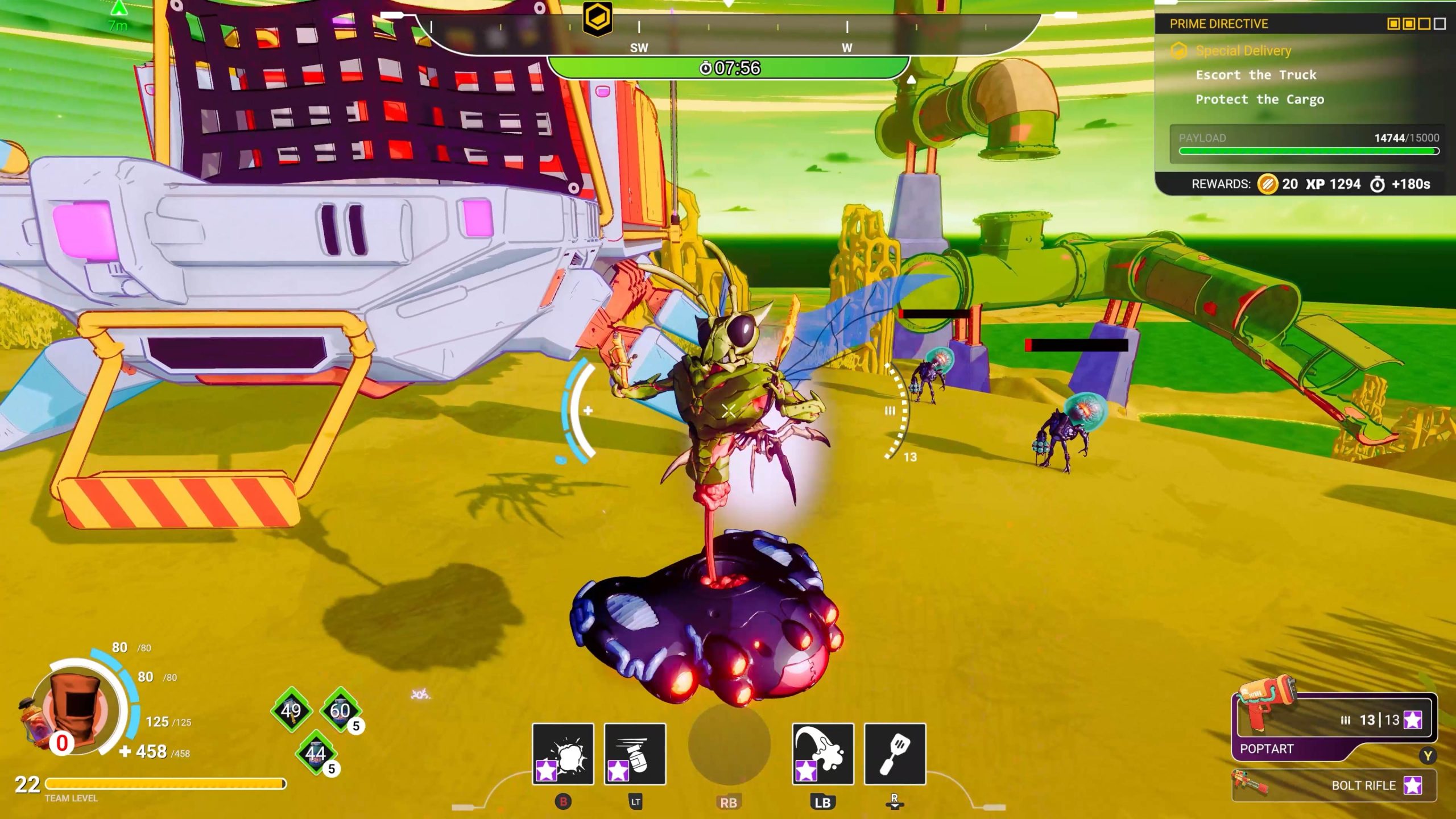 During my runs, completing the main and secondary objectives granted me a little more time to spend on the current planet alongside experience points that granted me temporary stat boosts like bonus damage, bonus health, and other elemental perks that aligned with the elements of my currently equipped guns. The lack of a reroll button (for cycling subpar rewards or gun) felt a bit too restrictive for my liking, but it did encourage me to try out new weapon elements and new perks.
Swapmeat doesn’t rely on overpowered perk/weapon combinations that break the game, which is a massive plus. While the 30 perks I equipped put a hard stop on limiting my character’s power level, I felt like I could choose whatever perks I wanted without feeling like I chose the “wrong” perk that would otherwise end my run. I had originally assumed that having the slime element attached to my gun made it weaker, but it didn’t: It shifted the power away from DPS and into a minionmancer playstyle that spawned wasps that would attack enemies. Having that freedom to build a character how I want was refreshing.
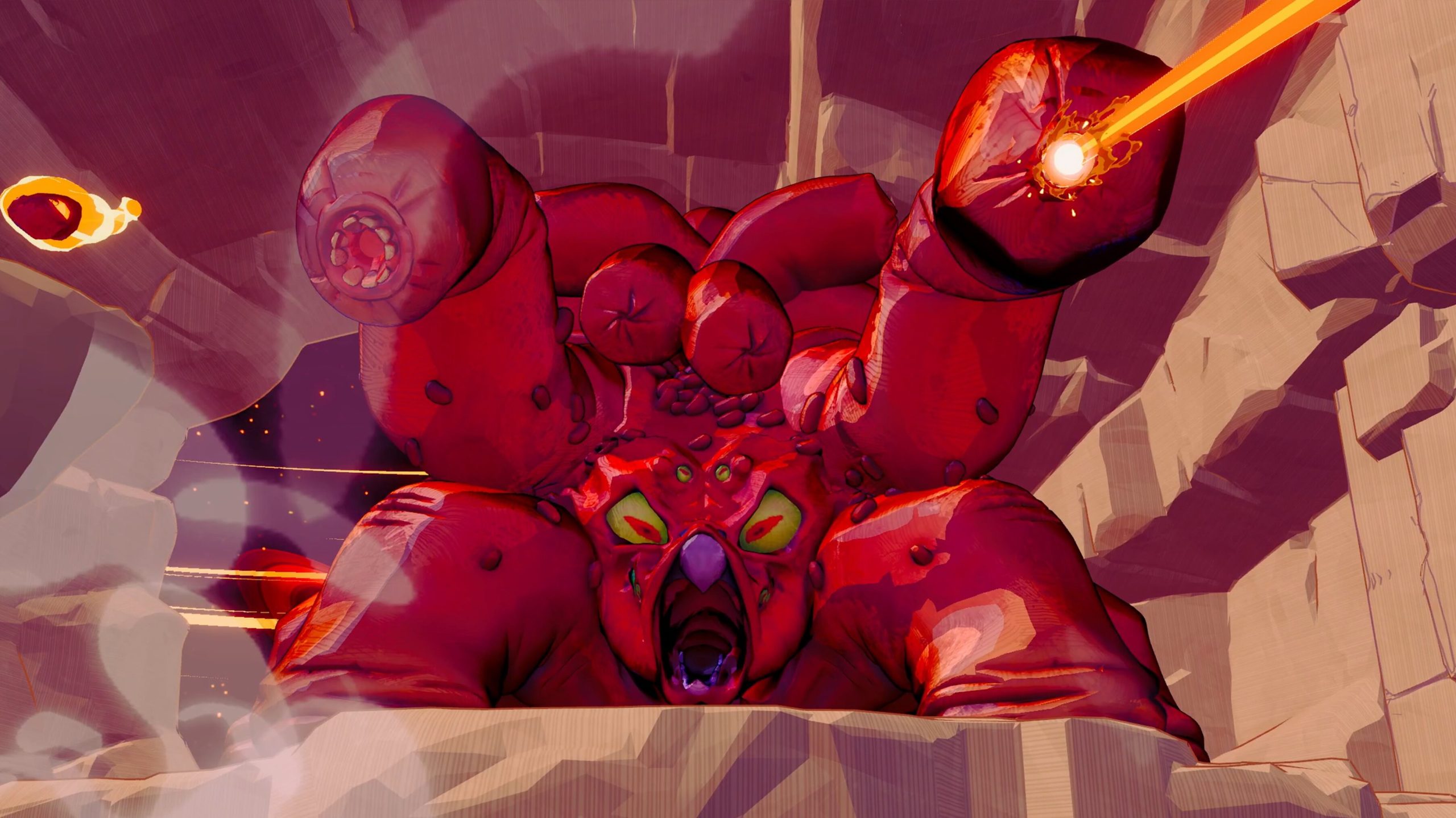
Remember how I said that there are boss fights? They’re creative as hell. At first glance they looked like bullet sponges (a contrast to the otherwise explosively fast-paced combat), but they all featured novel interactivity that broke the game’s logic. When I was fighting Franken Beans (a massive spider that looked like it was made of miniature hot dogs and beans), I had a moment I could equip a boss-specific body part to throw a rock and clog one of its orifices. I cringed writing that sentence, but it was satisfying to see the giant monster topple over so I could get some shots in before the attack patterns resumed.
 In terms of progression, it’s safe to say that one can complete the main story missions and rank up the corporate ladder in maybe ten hours. You could go as low as eight, if you’re lucky enough to spawn the required in-run main objectives that act as prerequisites for the late-game’s missions. Either way, it’s not the most satisfying in practice. Some missions felt arbitrarily difficult because I had no way of knowing when or how to complete them, and even when I did, it didn’t feel the most satisfying. Nearly all the challenges (side missions) granted currency, making it so that there wasn’t much worthwhile to chase. Completing these challenges didn’t require me to go out of my way, though – I was naturally completing them as I was playing with friends.
Upgrading weapons and permanent perks was the extent of the grindiness, but I’m willing to give that a pass. Each weapon’s perk tree had to be unlocked by completing main objectives in-run with that specific weapon equipped, and then increasing the weapon’s level to assign points to the perk required currency (of which there are 18 types of currency – yeesh).
I could hardly discern any sense of story when playing Swapmeat. I would usually have a problem with this, but I play a bit of Deep Rock Galactic, and I don’t recall it having meaningful worldbuilding involving its silly dwarves and endless mining. It wouldn’t hurt for Swapmeat to lean further into its universe just a smidge, though, as the floating cowboy CEO-in-a-capsule that is Carl Rangus and the megacorporation that is Rangus Meats seem like they have some chaotic nefariousness worth exploring. Maybe there’ll be some post-launch content to explore the universe or add more NPC characters to the already silly world that One More Game has created.
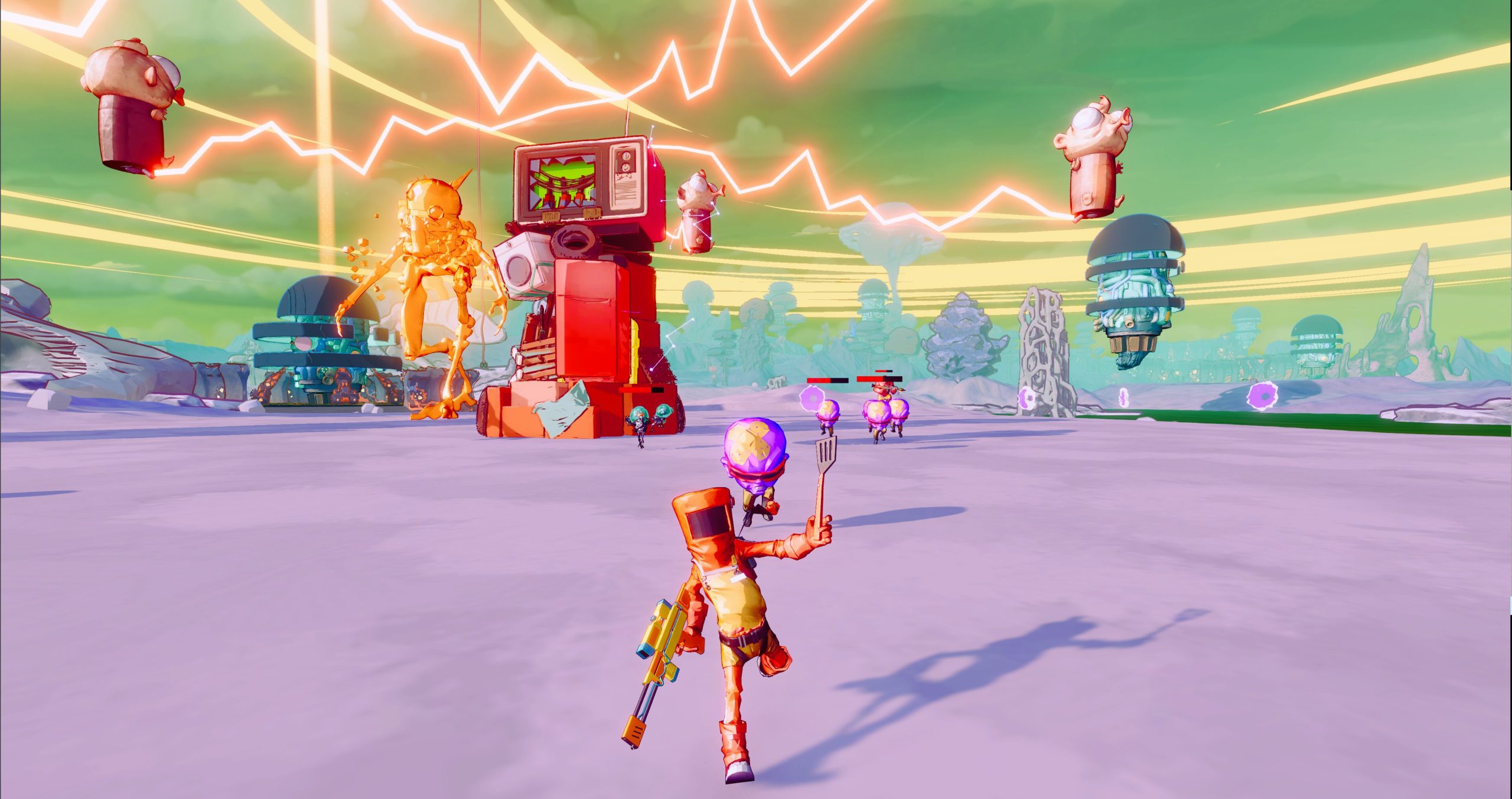 Like Risk of Rain 2 and Deep Rock Galactic, there’s the option of playing solo or playing with up to three friends. I played with two colleagues during my review period. Co-op proved to be far more satisfying and silly given how we could divide and conquer the entire map and level up efficiently. At higher difficulties, playing solo lacked satisfaction and required me to focus on using my two most-powerful weapons rather than experimenting with my underleveled weapons. Part of this could be solved by adjusting the weapon leveling process at higher difficulties (for the purposes of catching up) or possibly adjusting the weapon leveling system to require less currency. Things get tough at higher difficulties, folks – the devs weren’t lying when they said that there’s some meaningful challenges for those wanting that challenge.
An argument can be made that Swapmeat feels unfinished, albeit at the content breadth level. There are only six planets, a small number of (admittedly creative) bosses, not the most satisfying progression, and a missed opportunity in exploring the in-game universe. But, it’s worth noting that One More Game absolutely nailed the core gameplay loop with sniper’s precision: They’ve implemented just enough content that bears replaying (with friends!) without forcing the player out of their comfort zone to complete arbitrarily grindy challenges. Even after reaching the highest management rank (completing all the main objectives) at the tenth hour of playing, I still wanted to play more and stay up later into the night for the sole purpose of seeing what would happen.
Coming out of playing Swapmeat, I’m excited to see where things go in the future. I would love to see One More Game make some more content for it in the form of new levels/modes/bosses, more cosmetics, and more fantastic music (the base soundtrack by the dev team and score by Austin Wintory are so catchy and lighthearted!).
Swapmeat won me over on its chaos, silliness, and replayability. Its grotesque meat swapping mechanics kept me on my toes in building wild looking yet wildly powerful meaty monsters.
