

Sometimes it’s fun to dive head-first into a new title that you haven’t actively been following. Sometimes that brings about some good surprises, and sometimes it’s nice to have not wasted time following said title. Thankfully, this review is about a game that I’m quite sure falls under the former.
Steel Seed from developer Storm in a Teacup is an interesting game built on a stealth-action construct within a futuristic dystopia where killer robots are trying to impede your progress within massive environments. The game features plenty of puzzles, strategic decision-making, and quite a bit of stealth and action to satisfy even the biggest Metal Gear Solid fan. Its biggest drawbacks are difficulty and organization, with the former being the most disagreeable of the two.
So, sharpen that sword, make sure your robot buddy has plenty of battery power, and let’s stealthily look at the ins and outs of Steel Seed.
Humanity is sorta extinct again.
Okay, well, maybe. Anyway, the story of Steel Seed follows a protagonist named Zoe, who is woken up to uncover what exactly led to humans becoming nearly extinct and how they can hope to survive on an uninhabitable Earth. The only things standing in Zoe’s way are huge environments she must find a way to navigate through, and soldier robots that are trying to actively prevent her progression.
I love stories like this that throw in some details at the beginning and then simply ask you to uncover the rest as you go from place to place. As you work forward, the story uncovers backward, and the breadcrumbs picked up put together a solid narrative. The story and world of Steel Seed fascinated and motivated me to push forward with this stealth-action game. The desire to know more about the world and how it became the way it ultimately ended up is enough push to make the story engaging. It led the pack when it came to separating itself from a majority of stealth-action titles built like it.
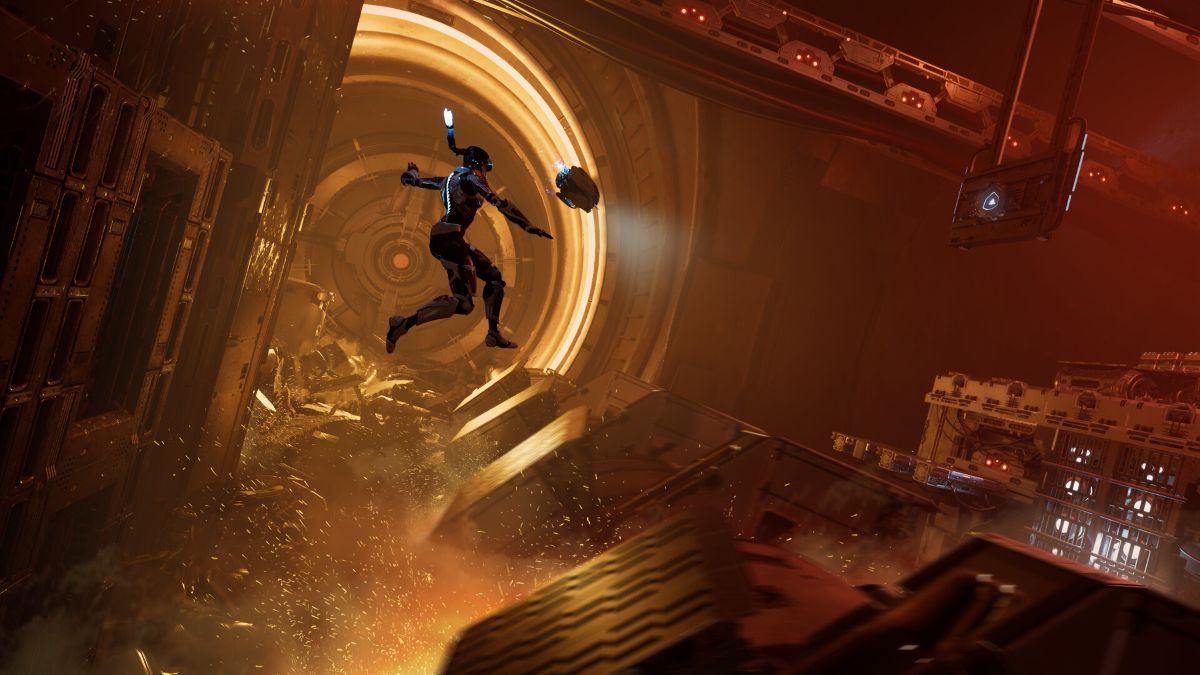
I have no qualms about the story. It’s interesting, especially the two-lead protagonist, Zoe, and her robot drone buddy KOBY. They were well-written and built a good enough relationship during the adventure to truly get a solid connection going. Overall, the story of Steel Seed is solid. It works well with the visual world built for the game, and is magnified by the girth of that world, and it will give you a strong narrative build to work with as you see Zoe through her robotic confines.
Slashing, stealth, and puzzle-solving
This game reminded me a lot of the cauldrons in Horizon Zero Dawn. There are a lot of places to jump around, good puzzles to solve, and plenty of action to be had when the time comes for it. The former of the two is the lead piece of the gameplay. Let’s start there.
Jump around! Jump around!
The action you get in this game is secondary to the puzzle-solving and navigation of obstacles. You will find yourself trying to navigate from place to place more often than performing sword-swinging destruction. In a way, and related to the narrative of the game, this order of operation makes sense.
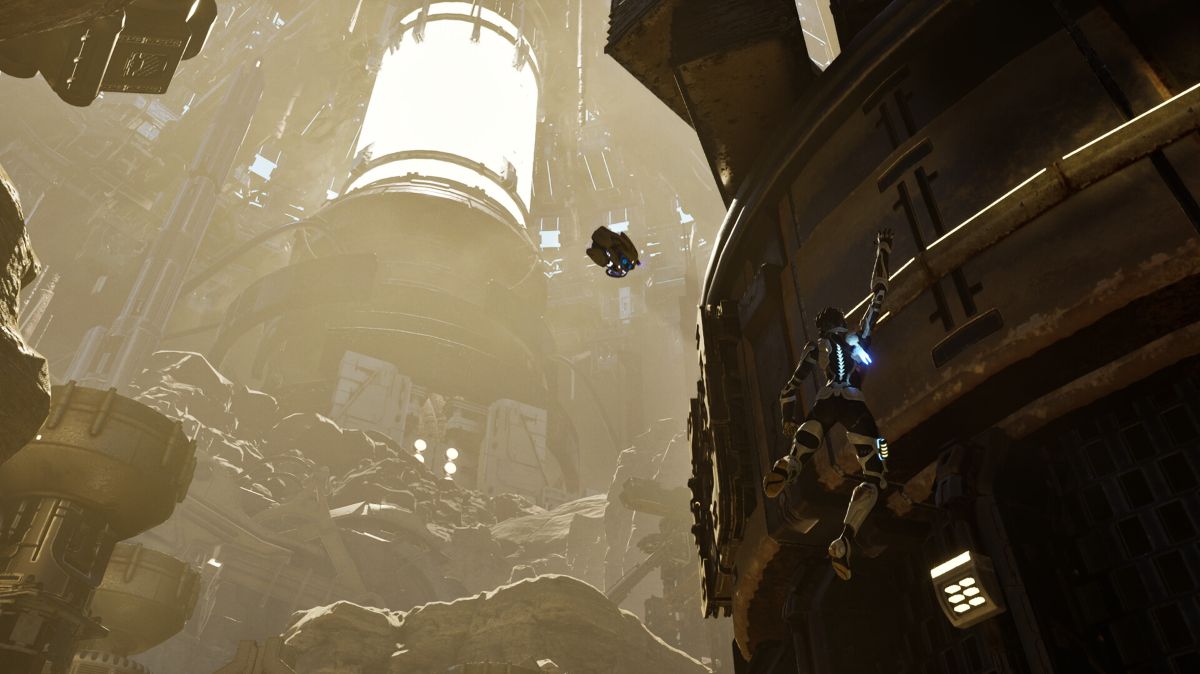
Your first charge with Steel Seed is finding your way around and through its mechanical areas. It plays heavy into the stealth aspect of the game, as you’re actively trying to avoid killer robots when you can, while figuring out the best direction to go. The game does a good job of tipping you off to the right direction, pointing the way at times, but for the most part, you’re seriously just trying to navigate upward to the next level. And that comes with a varying degree of difficulty.
Sometimes during the navigation portion of this game, you’ll find an easy, smooth route to take Zoe. You’ll see this at the beginning, when you’re jumping off large areas, sliding down oil-slicked throughways, and running on walls to quickly jump to a platform. All of it is planned out nicely, and it works when the game design is hitting on all cylinders. At the very least, the pace of the game will excite you, as you make decisions quickly. Very high-sensation value stuff.
Occasionally, the game’s path will be less obvious, and the world shifts from stealthily navigating through places and things, and becomes more puzzle-solving, which can be incredibly confusing/difficult. For example, early in the game, right about the time I popped into a place called the Assembly Node, the game started becoming slower and less forgiving with my obstacle navigation. I found myself jumping around, hanging on to ledges, waiting for solutions to appear, only to find that there was no way I could go, which impeded my progress. The solution was around this area, and probably hiding in plain sight, but it was frustrating trying to solve exactly where Zoe needed to go to progress the game. I must have died about 10-15 times trying out a perceived path, only to find death waiting for me in a nasty fall. Even with Zoe’s handy robot drone, KOBY, who Zoe can take over and navigate via first-person (and scanning), I was unable to find the next step quickly.
I don’t mind jumping puzzles or trying to find the right path to navigate to the next step, but any single obstacle that takes more than 20 minutes to solve is just frustrating. I get that solving where Zoe needs to go is one of the gameplay components, but it shouldn’t be such a rest stop for the gameplay. Anytime you can’t see or detect a path and it prevents you from moving forward in the game, well, that is a bad time. Challenge your players, sure, but don’t stump them to the point of frustration.
Now, having said that, I do appreciate the thought that went into this. I appreciate the fact that the world is not completely linear and that there are potential bad paths for Zoe to go down. I like it because if you’re going to build your world out in your story, then you make it massive and uncertain to travel through. It creates a huge sense of scope that not only gives you a challenge, but it also gives you a clear picture of Zoe’s world.
In a way, it’s good. In a way, it’s not so great. Ultimately, it’s appropriate.
Stealth, Slash, and Skills
When you’re not climbing up massive columns, running over walls, or trying to find a way through to progress to the next level, there are enemies to take out.
The other part of Steel Seed is how you can strategize and execute a balance of stealth and action with robots. I think that Storm in a Teacup did one heckuva job with mechanics and how they felt during gameplay. Sneaking and sword-swinging is a good time when you’re not being overrun by robots. The game prefers that you sneak up on robots, take them out, collect their innards, and then move on to the next one, but the action mechanics are a hoot and a holler. Now, having said that, stealth keeps things quiet and more challenging.
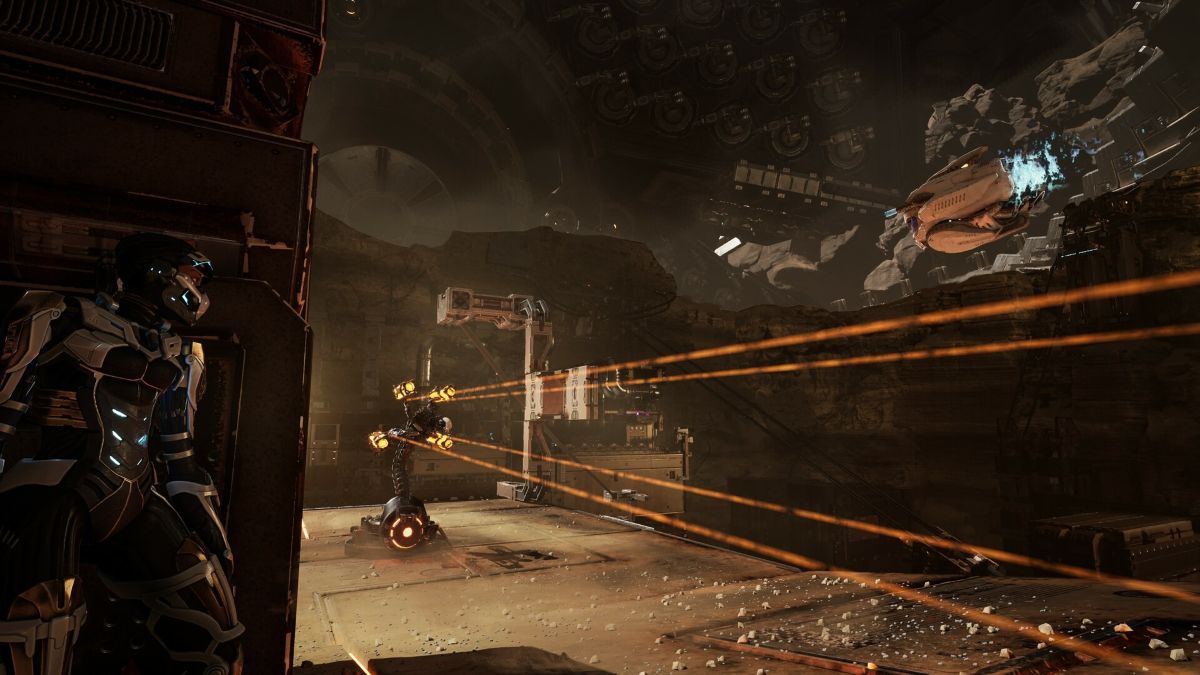
If stealth isn’t your game, then what you will more than likely do is take out a robot, tip-off another, and then find yourself amid a large firefight with ballsy robots that will run at you at any given time. Going stealth is the best way to get through this game, although it does provide a hefty challenge, as well as require good planning. For example, there was a level where I had to hide behind a barrier, take out one robot, then progress to a corner, take out another, and then alert the remaining robots on different platforms so that they can come get me, only to have them explode because KOBY sets off some explosive drums nearby. The action works in that respect, as does some thick strategy.
Now, continuing with KOBY, Zoe’s robot buddy has some offensive uses, as well as puzzle uses. The former is nice because KOBY can offer itself as a good distraction to the killer robots. You can request KOBY to stir up some trouble, as Zoe tries to stealthily navigate to a better position. KOBY can get taken out, or at least temporarily taken offline, so you must be careful with how he is used, or you may find yourself in a firefight alone. Regardless, KOBY’s usage is genius, as it can fight and do damage to actual robots, act as target practice, and also help hit switches to progress Zoe further in a hot zone using its laser. KOBY has a few different types of attacks, but mainly, you’ll just use them for minor moments.
Anyway, KOBY is a perfect complement to Zoe’s needs and mechanics. The devs made a great choice, including the robot drone as an offensive and puzzle-solving tool.
It’s the love inside.
Getting back to an earlier comment, as Zoe takes out robots through stealth and slashing, she will pick up the innards from the leftover bodies. The material picked up helps Zoe perform upgrades within skills trees. Now, this part of the game wasn’t intuitive or initially clear. The skills that she can upgrade include stealth, utility, and combat.
Stealth skills allow for upgrades to how Zoe would approach a fight. It offers explosives, like KOBY, launching a projectile that catches a robot’s attention and makes it explode when in proximity of the projectile. Stealth can also mean creating a glitch field to hide within so robots can’t see you. The upgrades aren’t at all bad in this category, as they offer a bit more strategy with how Zoe can approach a fight.
On the utility side of the tracks, you can upgrade skills such as increasing energy regeneration when Zoe ingests an energy bar, recovering a small amount of health with looting, and/or launching a projectile that generates noise. This category is purely to improve the small ins and outs of Zoe’s adventure.
The final skill is combat, which is what you think it would be. This might be Zoe being able to sprint and perform a heavy attack, or something as simple as obtaining a special attack. Regardless, Zoe’s combat skills are improved, which can make battles interesting.
The overall concept of the skills tree is solid, but my main problem with it is how it’s presented. There is no clear direction on what you should choose in each category, no flowchart or pointer. It feels slapped on, which might mean picking the wrong upgrade to go with early in the game could make your life more difficult. I just wish it were a bit more organized and methodical, with some indication of the best route for the player to go. I know that sounds silly, but having a flowchart that splits into multiple paths is easier to follow than just squares. It might be petty to bring this up, but my expectations have been set because of other skills trees before this game. There is some consistency and clarity with those.
Overall, the gameplay is quite clean and clear for Steel Seed. It’s a stealth game that requires you to navigate obstacle puzzles, but also has a cool fighting component embedded within it. Sometimes the jumping around can get you cognitively stuck when trying to progress through the massive environments, which can be incredibly frustrating at times, but the gameplay works more than it doesn’t.
My GOD, the visuals
Steel Seed is a gorgeous game, from environments to character models. The environments are massive, complex, and help to sell the world that the story is trying to convey. The characters look cool, work smoothly, and are modeled and textured in a good sci-fi way. In addition, the ray tracing and extra visual bits are gorgeous. They help to portray that cold and mechanical feel, and you can tell there was a lot of love put into making everything look good.
At the end of the day, Steel Seed is a graphically stunning game.
On that sweet note, let’s wrap up this review.
Conclusion
Steel Seed from developer Storm in a Teacup is a gorgeous and stunning stealth-action game that does a lot of things right, but also stumbles at times with difficulty.