

SLEEP AWAKE's psychedelic horror takes players on a delirious journey where the very world shifts and deceives. Mediocre stealth inflicts minimal damage on this mind-bending narrative that exists to confound with its captivating premise.
How often do you embrace the irresistible lull of slumber?
How frequently do you wish, bleary-eyed, that you could stay awake?
Exhaustion. Tiredness. Sleep eventually comes for us all. But what if falling asleep meant you were suddenly blotted out of existence?
SLEEP AWAKE posits a cataclysmic phenomenon where humans are able to sleep but if they do, a worse fate than merely not waking up befalls us.
Often I lament having to sleep. Imagine the things I could get done if I simply could keep my eyes open at all hours of the day and not feel delirious. What if I could close my eyes for an hour and rest, knowing that my body and its cells would do their thing and allow me to not nod off at the end of a work day. But that fantasy is for a creature with a different genetic makeup, not a man in his late thirties.
Instead, like everyone else, I’m shackled to the constant pull of sleep. The allure of closing my eyes for… just… one… moment… And trying to reassure myself that of course I’ll wake up and feel rested. Of course that five minute power nap will render me fully-charged for hours to come. While the quest for a full eight hours seems like a fool’s errand, I typically get around five or six hours of sleep. Enough to spend the day passing as a conscious being capable of decision making.
And despite enjoying the occasional all-nighter, finally clamping my eyelids down and feeling my soul drift off feels incredible. Would that ability to fall asleep whenever I wanted to be stripped away, I would certainly go mad.
In SLEEP AWAKE the world has gone mad.
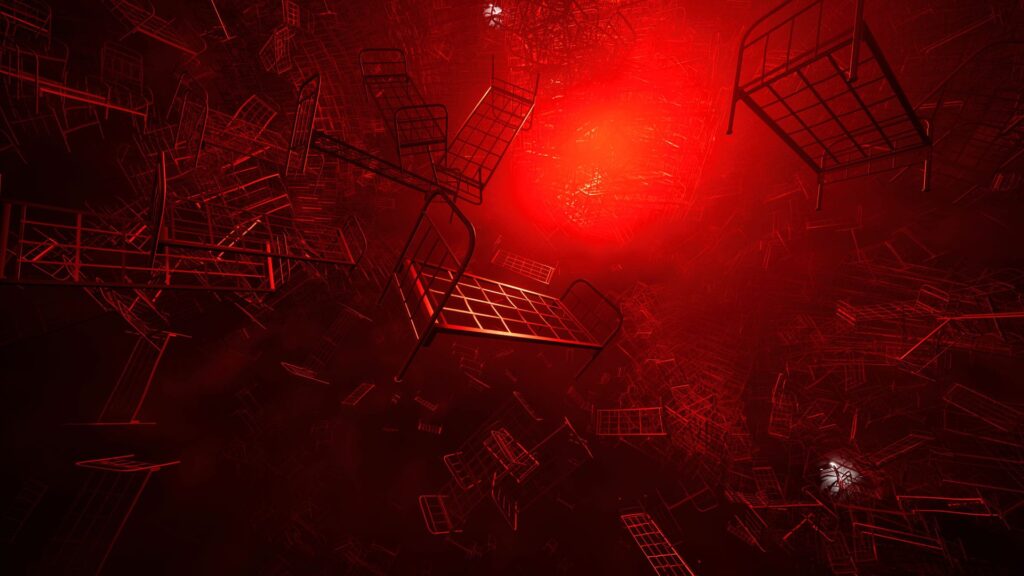
Stripping humanity of the security blanket of sleep has inflicted permanent psychological damage on the species. Society has crumbled. Numerous cults have propped their ideology up as the only solace for this plague. And no matter what god one prays to, no matter what extremes are concocted, sleep comes for them all.
But developer EYES OUT was not content in making a world merely circling the red-eyed drain.
For the denizens trapped inside the reality of SLEEP AWAKE, sleep is still possible. That essential act is right within their grasp. But go ahead, close your eyes. And when those delta waves take over there’s a good chance The Hush will come and whisk you away. Your body will turn into a Void Shadow, a glowing charred stain left right in the spot you fell asleep.
You aren’t murdered in your sleep. You aren’t prone to a mysterious infection that leaves you convulsing in pain. No. You’re simply just… gone.
SLEEP AWAKE dabbles in the brand of cosmic horror by introducing the unknown of The Hush. The collective knowledge about this sleeping phenomenon is a patchwork study of the brightest minds long gone. This unknown entity could be divine in nature, they could be an otherworldly force, or it could simply just be that the world has lost its grip on reality.
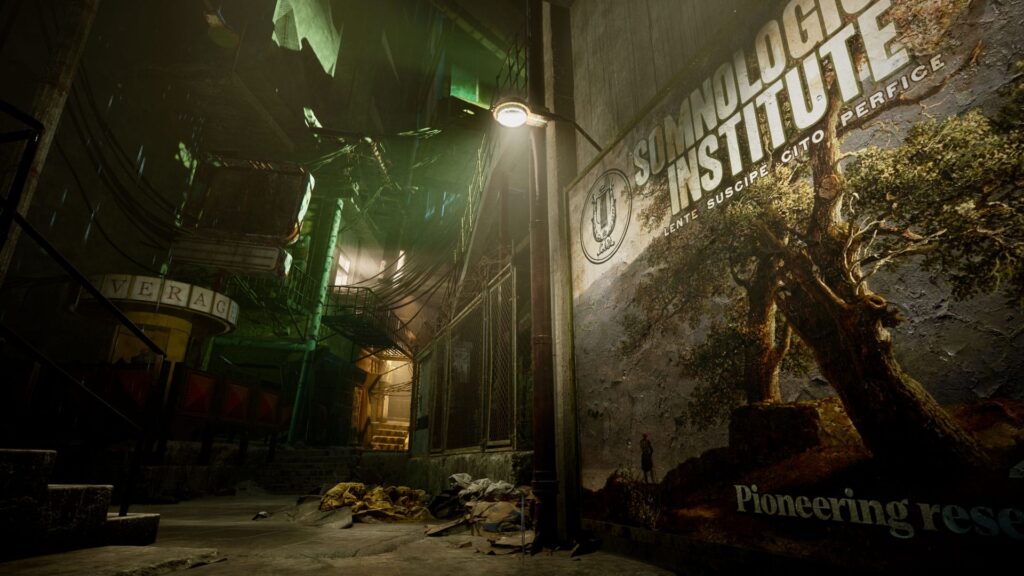
As the young woman Katja, players are well attuned to the stakes of The Hush. Katja’s mother is long-gone, potentially a victim like the rest. Her brother Bo was taken in his sleep as a boy. Her father was a scientist at the Somnological Institute, a group working on studying The Hush and how to prevent this new illness of needing sleep.
Katja lives alone in The Crush, a dilapidated metropolis and one of the last bastions of humanity’s existence. Her hovel sits atop one of the numerous skyscrapers along a vast city that is crumbling from constant earthquakes. Because the The Hush wasn’t enough, the world was struck with geological disasters, leaving glowing blue scars on the surface. The game establishes that the world is tenuously staring at the edge, the void of nothingness in full view.
Players can look out the window of Katja’s home and feel how desperate and scrappy it is. Signs of her father’s research are scattered everywhere along with strange relics of the world. Concrete and steel buildings are angled and twisted with makeshift shacks stapled to their sides. A concrete jungle indeed.
The Hush is a fascinating premise to base any kind of psychological horror on. Because Katja’s father was involved in research on the phenomenon, she acts as a grounding rod for players. We are thrust into this world confused and curious. But Katja has just enough knowledge so as not to make her guidance completely blind. And EYES OUT establishes the world it has created with confidence, likely knowing all the answers but doling out morsels of information piecemeal–a carrot on the stick that makes players ravenous to unspool the secrets of this sleeping horror.
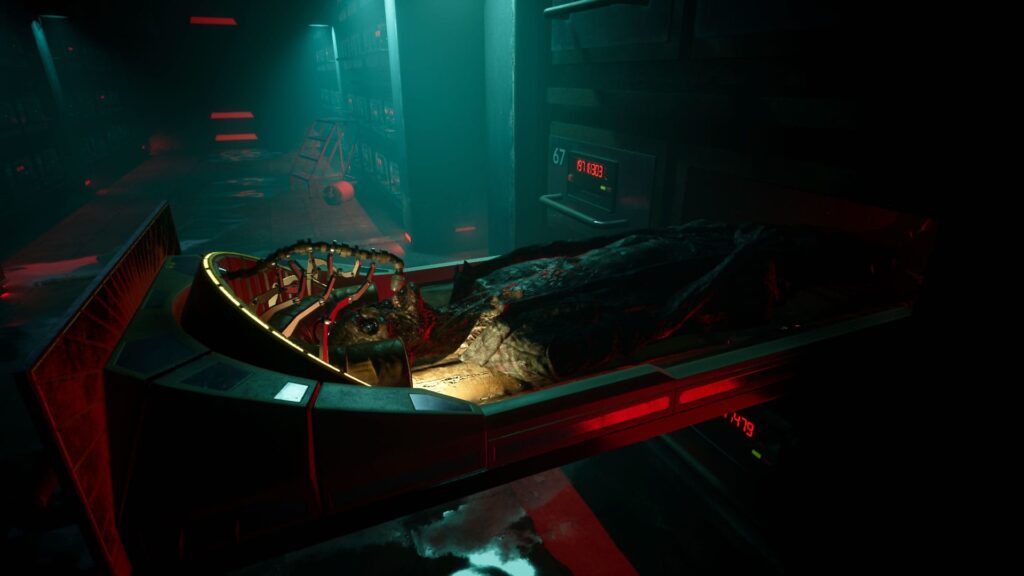
The primary function of SLEEP AWAKE‘s narrative is to follow Katja as she desperately tries to stay awake. But that mere task crumbles before her as domino after domino of opposition keeps toppling her efforts.
If I were to sum up SLEEP AWAKE, I would flippantly describe it as a game where the protagonist tries to stay awake, moving from one location to the next in an attempt to accomplish this goal. It’s established that Katja knows Amma, a woman and dear friend of her family who lives in a distant neighborhood. One “task” or “mission” is to deliver a serum to Amma that will help her stay awake. And it’s through this “quest” that SLEEP AWAKE unfurls its stark world before us. The trigger event for the player and Katja to ultimately reach some kind of revelation.
Yet SLEEP AWAKE is less interested in the details, relishing in the deeper subtext that one may infer while playing.
Throughout Katja’s struggle to stay awake I wondered to myself, “What’s the point?” No, not in the playing the game but for her as a character wanting to exist in this facsimile of a world, of a life. I’ve thought the same in media featuring particularly dire and violent post-tragedy events. At what point does the will to live merely flicker out of your soul and you cease to want to carry on?
Looking at the devastation around Katja, SLEEP AWAKE is less strict horror and barely even psychological horror. This is a game of existential dread and the futility of combating against forces against our very understanding.
And it felt cozy, warm.
Developer EYES OUT is primarily helmed by Cory Davis and Robin Finck. Players may recognize Davis’ name from Spec Ops: The Line, a game featuring its own brand of internal demons and narrative defiance. Finck, on the other hand, might be more recognizable for his relation to Nine Inch Nails, the experimental industrial rock band that has proven itself a force for decades.
Do you perhaps feel that recognition? I did as well.
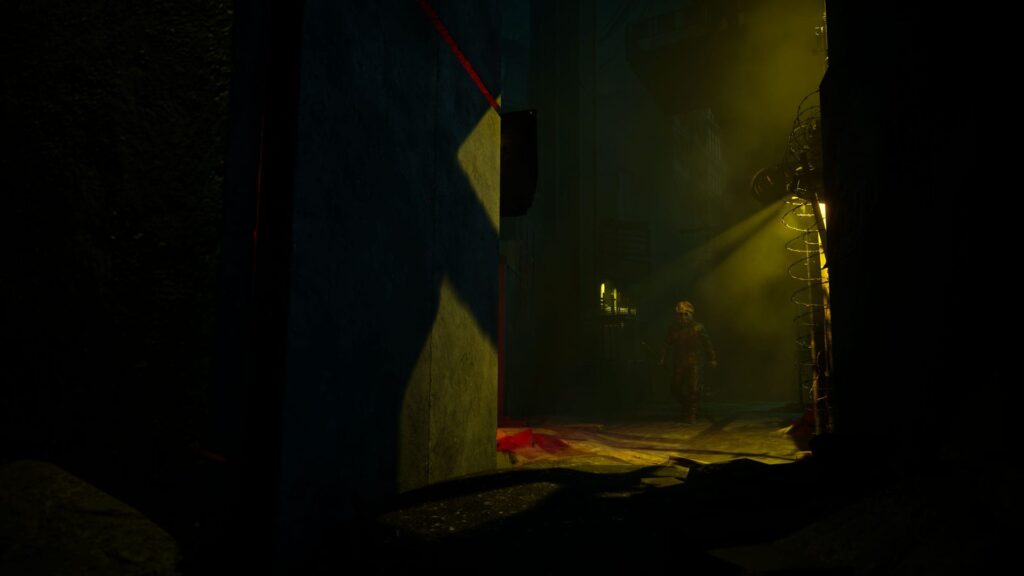
As a game where players engage in puzzles and stealth and other mechanics, SLEEP AWAKE falls short. And it’s often a symptom of these narrative-rich games where players are prone to do a lot of walking with minimal other elements keeping them from one story beat to the next.
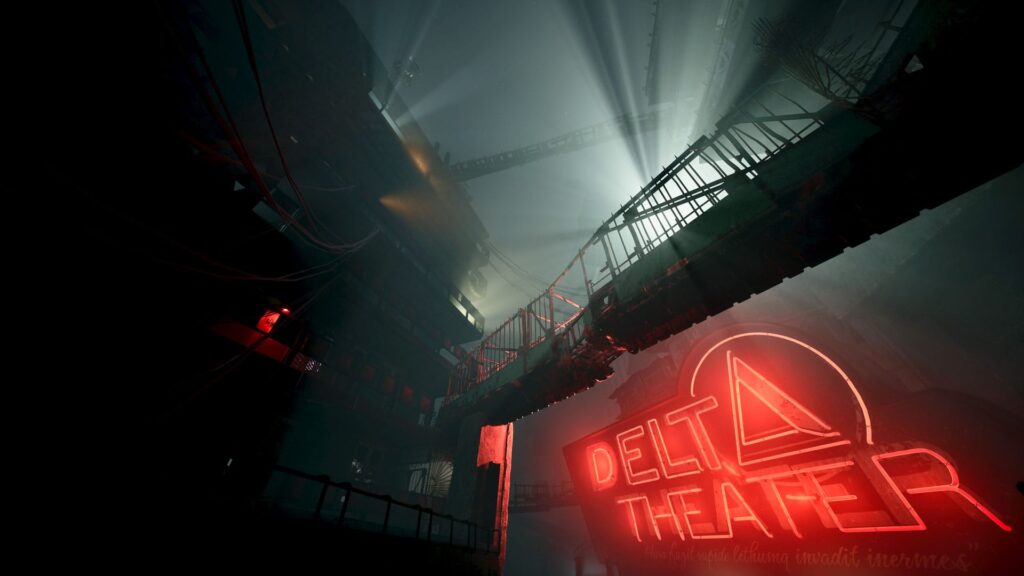
Here, Katja and the player are responsible for solving a few puzzles impeding progress. Finding the correct rune in order to turn a radio dial to the correct frequency. Plucking herbs and mixing them in order to make a potion to stave off sleep. It’s all relatively standard and shouldn’t flummox anyone. Stealth, on the other hand, is a bit of a joke. There are a handful of “chase” sequences that ask the player to merely run forward and they have a moment of thrill to them–better yet, Katja has a great run speed that players can enable by holding down a trigger. But in a handful of moments, players must sneak past groups of the Delta Transport Ministry, a militaristic-like cult spawned from the Somnologial Institute’s shattered remnants. Katja merely has to crouch and shuffle past these goons without meeting their sight-lines. However, being caught isn’t the end of the world if players can merely crouch under a table or desk. There’s no bad guys peeking under, they merely stop giving chance even when their prey disappears in front of them.
While SLEEP AWAKE offers a couple methods of stealth scenarios that break up staying out of sight, they are fundamentally simple and create a basic level of tension for the few minutes they exist. Hiding from the Delta Transport Ministry is SLEEP AWAKE at its most basic and silly. Later in the game, the stakes change and feel more horrific. Thankfully EYES OUT packed only a handful of these moments in the game, ensuring players remain hard-focused on exploration and keeping aware of the delightfully erratic narrative.
As Katja exposes players to this world and its pain, the hidden and unspoken lore of SLEEP AWAKE itch at the subconscious. How fascinating and woefully accurate that humanity was once united in its effort to solve the problem of keeping themselves awake. Posters and propaganda cover The Crush of medicines and methods that were once employed to keep people awake but make them feel rested. Cures became more extreme until nothing worked. SLEEP AWAKE‘s world feels somewhat dead because it mostly is. The players is rummaging through the husk to come to some kind of understanding.
I was fascinated by the individual groups that worked to solve the sleepless cure in new ways. Men grafted runes to their skin and bones in hopes of divinely channeling electricity through their bodies at just the right voltage to not fry them completely. Others use pain, caging their bodies in spikes and scars to be closer to pain and a heightened awareness. The bleak desperation is felt through every corner of SLEEP AWAKE.
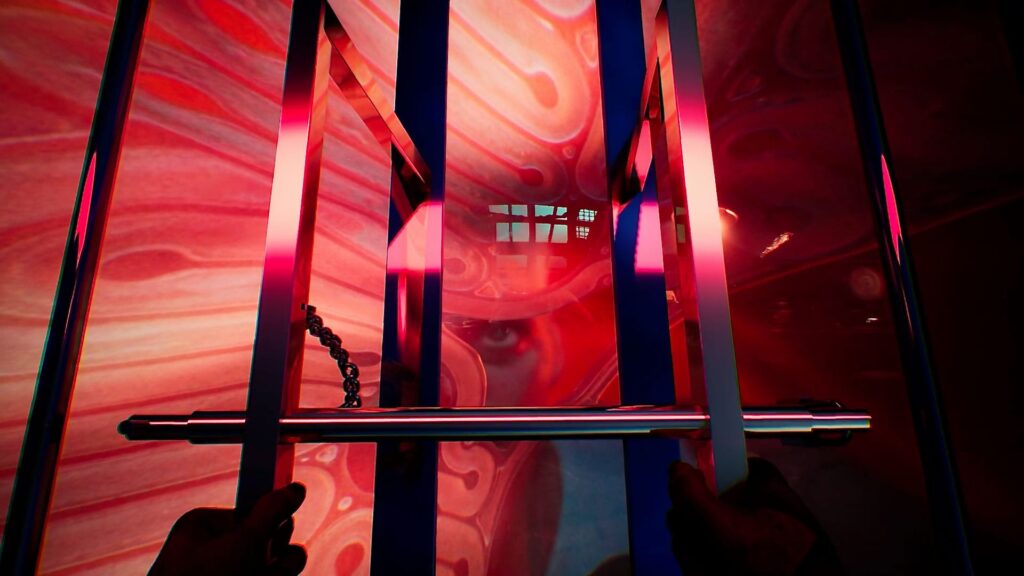
But it’s as the game progresses that the veil begins to lift. What, in fact, is real? EYES OUT explores SLEEP AWAKE as a kind of transcendental mixed media experiment. Once Katja blots her vision with this homemade awake remedy so she doesn’t succumb to The Hush, the screen distorts and fractured FMV segments play. Narration, music, sound, images, videos… it all bathes over the player in a delirious cacophony. And Katja usually opens her eyes with no knowledge of how she got there.
Tricks are played on the player akin to something like Eternal Darkness on the GameCube. The screen will mirror itself, or fold into fourths. The walls will phase away as an FMV plays, mimicking Katja seeing things. The sky will pool with feverish red and pink hues. While SLEEP AWAKE isn’t fundamentally a technical marvel, it’s these fanciful visual experiments that further absorbed me into the game. Meant to mimic hallucinations, initially I wondered if the game was merely bugging out on me only to realize that a kind of psychedelic horror was being inflicted upon me.
To amplify the disorientation, Finck’s influences begins to flood in as darkened synths pound on the player like some kind of eldritch orchestra. Musical cues sprout from the vast emptiness of the world and linger with no calculable beat. Even the calm moments of Katja trying to navigate her home feel unsteady as soft instrumentation works to defy harmony and order.
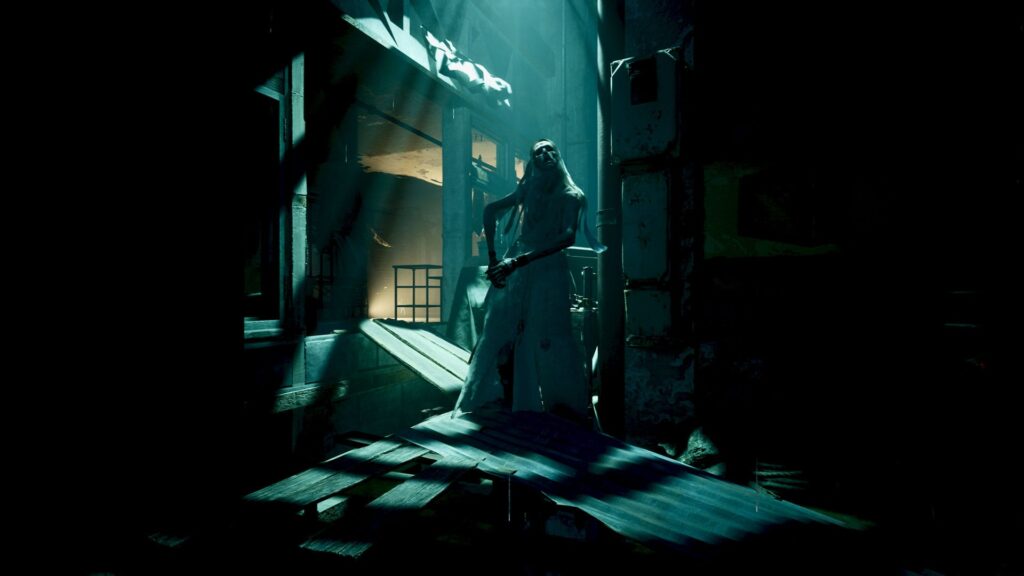
The torrential swirl of auditory and visual noise is meant to be the true horror of SLEEP AWAKE. Were you or I to exist for days, weeks, months without sleep, how would it affect us? Though SLEEP AWAKE isn’t a constant battering ram of dystopian sludge, even its bright, colorful, serene moments hide an uncertain poison that puts the player in a state of mistrust. There’s something sinister here. Maybe it’s the antagonistic woman that haunts Katja’s sleepy mind and her dream-like visions. Maybe The Hush are beings that arrived here and are somehow controlling us. EYES OUT is satisfied with not providing all the answers, merely a semblance of catharsis to tantalize the player for what lies beyond for Katja and the helpless human race.
SLEEP AWAKE‘s psychedelic horror takes players on a delirious journey where the very world shifts and deceives. Its strength lies not in its ability to scare but its ability to make the player question their own eyes. At what point would exhaustion take hold and we refuse to carry on? Mediocre stealth and remedial puzzles inflict minimal damage on this mind-bending narrative, proving that not all fear must jump out at you. Sometimes the worst horrors are the fictions we create in our head.