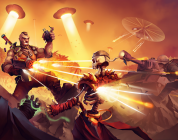


Boasting an unparalleled art style, Shinobi: Art of Vengeance is steeped in its classic roots but offers incredibly engaging modern touches. Peak combat and level design should keep players hooked the entire journey.
While the DNA of more recent titles can be seen in Shinobi: Art of Vengeance, it is unequivocally rooted in the framework of classic action games.
Perhaps this shouldn’t come as a surprise from Lizardcube, the team that worked on Streets of Rage 4, the first entry in that classic beat ’em up series in 25 years. Why wouldn’t Sega ask the team behind that well-received revitalization to resurrect another of its dormant series?
Shinobi is a name I well recognize but not one I have any depth of experience with. Despite owning a Sega Genesis, most of my time was spent on the Super Nintendo. In total, I probably played about twenty games on my Genesis. It had my preferred version of The Jungle Book and Earthworm Jim and Boogerman. It had Vectorman. It had one of my all-time favorites with Dynamite Headdy. And while Shinobi may have released on the Master System in 1987 and was extensively ported, it was simply one of those “classics” I never touched, the same goes with its numerous sequels and spin-offs.
Shinobi: Art of Vengeance is the first Shinobi game released in over a decade. But one doesn’t need any prior knowledge of the series to appreciate the masterful work Lizardcube and Sega have done. While references to the old games exist, Art of Vengeance exists as an effort to preserve but also redefine what a Shinobi game can be in this era of modern classics.
To put it bluntly, Art of Vengeance is an absolute masterclass in 2D action-platforming. It does this partially through an engrossing art style that is populated by some of the best visuals in recent memory. But, more importantly, Lizardcube’s focus on intricate level design, tight platforming, and blistering combat help the game ascend to the heights of a modern classic.

There is no simple way to avoid addressing Art of Vengeance‘s hand-drawn visuals first. A few seconds of footage allows Lizardcube’s work to speak for itself. But when fully exploring the breadth of the game’s 14 playable levels, bisecting its numerous enemies, and activating countless flashy attacks, every animated, moving element breathes with a special kind of vigor.
My eyes sopped up the colorful, detailed worlds that run the gamut of traditional video game levels. And it’s that connective tissue that begins to expose Art of Vengeance for what it is: a tried-and-true video game. Anyone who has rummaged through the most obscure and most popular games of the 1980s and 1990s will have encountered the kind of stalwart, trope-like locales and tricks that Art of Vengeance savors.
Backgrounds in this game are brimming with detail and life. Take the Fish Market level that acts as a shipping dock but multiple times splits into a once-bustling market full of moving food displays that act as platforms. Or the level taking place at a Lantern Festival where fireworks spark and explode on the tops of roofs. A desert breaks way into ancient ruins. An otherworldly plane swirls with chaos. The insides of a colossal beast churn with spikes and viscous goop.
These are all levels I’ve played in a game before, these are worlds that have been populated by all manner of mascot and protagonist. And many games have done them exceptionally well in their own unique style. But Art of Vengeance is not only easily identifiable, it is unarguably stunning. It would be one thing if the art style was merely pretty. But Lizardcube adds layers of depth to the foreground and background of every level.

Though a traditional 2D action game, Art of Vengeance has shifting angles where the action zooms in or out when most appropriate. Often, reveals are done at the speed of the player’s momentum. At one point, Joe Musashi races towards a fortress, its imposing size blatantly obvious. But as the player moves progressively to the right, the background begins to shift, revealing the true scope of the destination. Murals in the background of an underground city provide context clues towards Shinobi’s overall lore. A neon city has tributes to Sega at large. Architecture is elaborate and detail with towering statues or beautiful art adorning lines of sight. And at one point, players will race atop a massive wolf in a sprawling field, camera mimicking a 3D effect as the world curves rather than stays flat.
Lizardcube is a phenomenal communicator and translator. And I would argue that Art of Vengeance‘s second crowning achievement is its level design, housed in maximizing real estate and enjoyment.
The game dances on a sword’s edge of being a Metroidvania. During the first level, players will encounter a handful of impassable obstacles. A wall with strange markings on it or a glowing spot on the floor–indications that an undiscovered power will grant passage. A useful maps highlights these spots in a hazy purple, indicating potential secrets and unexplored gifts.

While Art of Vengeance does feature a number of newly acquired movement techniques spread across its levels, players are never required to backtrack unless they want to. Progression is not locked behind any particular skill or move. Only in the final few stages of the story does Lizardcube present players with obstacles requiring Joe Musashi’s full suite of skills to successfully navigate.
Outside the sheer surprising scope of its 10 major levels, several flourishes and tricks are stuffed into many of them. It’s here that Lizardcube shows its mastery at understanding classic video game feel and approach. Shortly into the game, players will find themselves falling down a bottomless pit, battling enemies and trying to wall jump up platforms to not plummet. Bonus levels that are on-rails escapades of silly spectacle have Joe Musashi surfing and air dashing to avoid mines and rockets. A burning building requires agile movement upwards to not get burned. A jet will give chase, blasting platforms away and requiring constant movement forward.
Art of Vengeance feels like a game on the Super Nintendo or Sega Genesis that was allowed to nestle itself in a cocoon and transform into this modern day butterfly. Effort is made to build a game that isn’t wholly focused on combat or platforming, not placing overly difficult brick walls in front of the player.

Should players want a traditionally “classic” Shinobi game, they can blitz through the campaign and ignore most of the side content. Back in the day, you played a game for a few hours and you were done. I collected every optional piece of content in the game and clocked in around 18 hours.
With every new level and every new challenge I kept being astounded by the rollout of not only the impressive visual buffet but the creative challenges placed before me. Art of Vengeance awards player curiosity and exploration with a combination of platforming and combat challenges. Levels will have three instances of harder, wave-based enemy assaults that when completed award a passive or permanent boost. Orboro Relics might be slightly out of reach but open up new items for purchase at the shop. Finally, dimensional portals can be found that take the player to unique, expressly difficult challenges that can stand tall against recent juggernaut Prince of Persia: The Lost Crown.
I would argue that the hardest challenge Lizardcube throws at players are Art of Vengeance‘s numerous platforming gauntlets. The game lacks any kind of traditional puzzle elements. Better yet, I never found myself absolutely directionless and in need of guidance. But when players specifically stray off a few beaten paths or access a few portals, there are some dense challenges that, while fair, can truly put the player’s sense of timing and skill to the test.

For the most part, Art of Vengeance‘s movement is fluid and empowering. A handful of quirks add flair to Joe Musashi’s jumping, making him feel like a powerful, agile warrior. A double jump and an air dash exist from the start… thank god. Holding the jump button when landing against a wall causes Joe to run up that wall a few extra steps to extend height. Over the course of the game, a kind of grapple helps players latch on to points. A set of claws allow Joe to stick to walls and scale them up and down freely, while also resetting the ability to double jump and air dash. A few challenges in the game requiring deep understanding of movement reset mechanics are truly the peak difficulty spikes but also expose a couple issues. As generally accurate as Art of Vengeance feels, a few times Joe can be overzealous when grabbing an edge and scaling it or there are simply collision issues that feel slightly cheap. But it’s nothing to frown at because Lizardcube never traps players in one moment for too long, knowing when to place checkpoints or safe spaces for the player to breathe.
Equally as fluid but somewhat more complex is Art of Vengeance‘s hack-and-slash combat. While enemies are peppered around levels waiting to snipe Joe with a gun or toss an axe in a curve to knock him over mid-jump, the hardest doses of enemies are the ones that spawn in and block progress until defeated.
Lizardcube shockingly doesn’t turn its fights into tedium, despite them fundamentally remaining about the same over the course of the game. Units that shoot projectiles are meant to put on the pressure while players try and tackle melee enemies. Air units can annoy from above and swoop in unpredictably. There’s also interesting and smart combinations that continue to add enough spice to encounters so as not to let the player steamroll too much when they’ve acquired enough skill or upgrades.

The best feature of Art of Vengeance‘s combat is the Execution Gauge almost every enemy has. If enough Execution damage is done to an enemy, a symbol will glow above their head, meaning they can be instantly killed by pressing both shoulder buttons. Joe Musashi will instantly zip to the enemy and they will die, spilling out coins, health orbs, kunai, and charges to an ultimate ability. But if multiple enemies are executed at once, more resources will be gained.
Players have access to light and heavy attacks from the onset of the game. Heavy attacks build up the Execution gauge more but also do increased damage to enemy armor, which must be depleted to build up their Execution gauge. To assist in battle, players can build up Ninpo charges, which act as special moves that cause different types of damage. A blast of fire, a mid-air bomb, a lightning shock, or a spectral serpent that bites enemies can focus on overall damage, armor damage, or Execution-type damage. Additionally a passive amulet that often empowers Ninpo and a amulet that activates based on the player’s combo meter allow for a mild kind of combat build. Finally, Ninjutsu moves are built up slowly over time but can change the tide of battle by doing things like causing massive damage or healing Joe. Unlike other games of its type, Art of Vengeance freely allows players to not only fast travel at any time, but to change equipment at any time, ensuring players can make changes if they don’t feel their playstyle is working.

Despite this wealth of possibilities in combat, I always found myself enjoying the moveset that could be expanded by purchasing new attacks at the shop. If players wish, they can purchase a number of useful moves that also do specific damage types. I began to rely on an ability that would let Joe Musashi do a dive kick from air, then by pressing the heavy attack would cause him to whirl in a circle doing constant damage before slamming down with another hit. Players can have the ability to throw kunai after a basic attack to do significant Execution damage. Follow-up attacks are purchased that truly allow for interesting, fluid combat.
Will ever player use every ability granted to them? No. I often forgot about my Ninpo abilities and would spam them upon remembering. Near the end of the game I relied heavily on the serpent spirit Ninpo because if it could be timed right, would munch a boss in a few hits. But that shouldn’t be an indictment of the game, instead another feather in its cap for providing players with so many great options.
Though I haven’t touched on Art of Vengeance‘s story, its existence doesn’t drastically alter my opinion of what’s at stake. Joe Musashi–the original protagonist from the first Shinobi game–is on a quest to avenge the Oboro Clan’s massacre by the evil Lord Ruse. Things get weird with the introduction of weird mutants and the Grim Reaper. All the parts are acted well and Joe literally grunts his way through the entirety of the game. But even with a simple story, Art of Vengeance still makes an impact, especially a handful of extremely cool story beats that lead to awesome setpieces.

This is a cool ass game dripping with style, that’s really what it boils down to. Lizardcube understood the assignment and went out to make a piece of interactive entertainment that held true to standards set almost 40 years ago. The music is modern but often echoes that crunchy electronic style so often assigned to the Sega Genesis, while still maintaining an Asian flair. It might have been nice to have difficulty options or more complex enemy configurations that needed specific attacks to be felled. But doing so would have made the game less pure. Players truly seeking a challenge can tackle the Boss Rush or Arcade Mode that unlocks at the end. Arcade Mode lets players take on the game’s levels but gives them a ranking at the end, offering a satisfying leaderboard climb.
Shinobi: Art of Vengeance‘s unparalleled art style is an intoxicating gateway into this incredibly engaging action game steeped in classic roots but offering undeniably modern touches. Lizardcube’s peak combat and level design are equally at the forefront, providing a masterfully crafted interpretation of a classic that will now be a triumph in its own right.