
Shadow Labyrinth is an earnest attempt at transmogrifying Pac-Man into something more than he is. While a futuristic Metroidvania makes as much sense as anything else, the game fails in many key ways that keep the genre engaging and not an absolute slog.
Shadow Labyrinth was a satisfying imitation of a classic Metroidvania in its first hour or two.
At that point, platforming felt confident. “Swordsman 8” was nimble but not floaty, jumps were relatively precise. Combat had a punch to it where a sword swing registered enough against alien foes to feel satisfying. It felt good to play and become acclimated to its rhythm.
But somewhere around the fourth or fifth hour, Shadow Labyrinth began initiating a kind of campaign of exhaustion against my patience. This grating, nagging feeling of bad design kept tugging at me across numerous hours-long play sessions. At what point will meaningful movement tech be a reward? Will these bosses ever be challenging? Why am I not getting stronger? Where the hell am I supposed to go?
I don’t want to be clandestine with my criticism for Shadow Labyrinth. It is not a bad game. But it so frequently scratches at the boundaries of mediocrity that it makes me wonder how it came to exist in the first place.
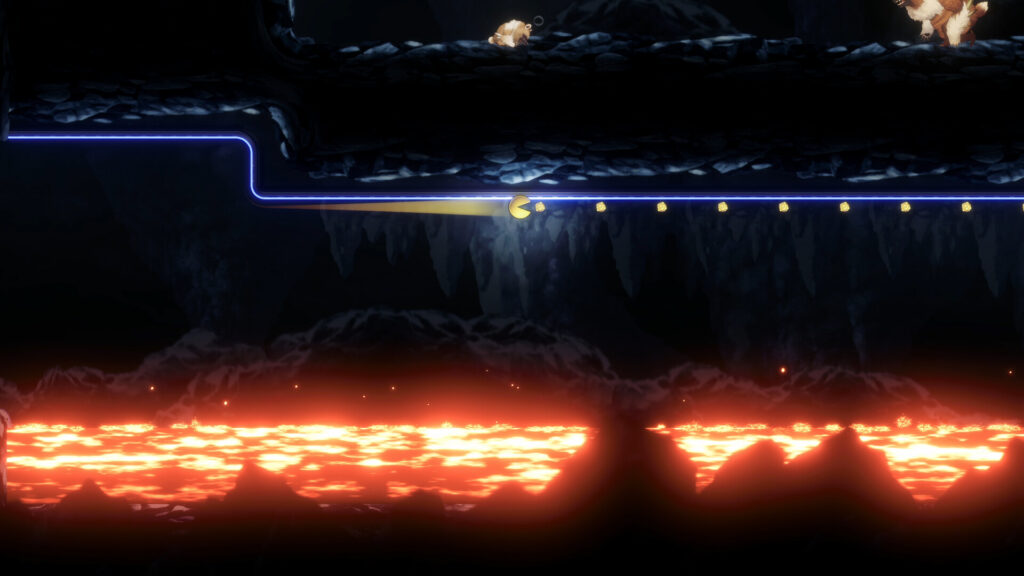
Shadow Labyrinth does have the makings of a fascinating project. For decades, the medium has viewed Pac-Man the character primarily through the lens of his original arcade cabinet. A ravenous yellow circle that gobbles up dots in a twisty screen, avoiding ghosts until he eats a power pellet granting him the ability to consume his oppressors. Over the years, Pac-Man has dabbled into platformers, adventures, puzzles, and even been a Smash Bros. character. He’s simple, flexible–a Renaissance man, if you will.
When the gaming anthology series Secret Level released, the episode titled “Circle” rose in popularity because of its outlandish, gritty interpretation of Pac-Man. Unsurprisingly, “Circle” serves as a precursor to Shadow Labyrinth, continuing the story of Puck in his goal to escape from the “maze” he is seemingly imprisoned in.
The premise of “Circle” and Shadow Labyrinth is an interesting one, yet it is also a concept rooted in Bandai Namco’s United Galaxy Space Force (UGSF) timeline. For the life of me, I had not heard of the UGSF narrative until playing Shadow Labyrinth but it is a novel approach. Somehow, the publisher created an overarching universe where several of its games and properties exist simultaneously in this futuristic science fiction backdrop.
Despite “getting” the premise of Shadow Labyrinth and the sweeping nods–mazes/labyrinths, G-Hosts, a mysterious sister–it never captivated me. This is a world where Pac-Man is named Puck, a callback to his originally intended name. Puck seems to be a robot or an entity hellbent on completing his mission after being marooned on a planet after an introductory section paints him as a Gundam-like mech. The rubble of a hundred years or more has caused Puck to summon a humanoid from an unknown dimension to act as his sword-wielding bodyguard, the eighth entity to do so, hence Swordsman 8.
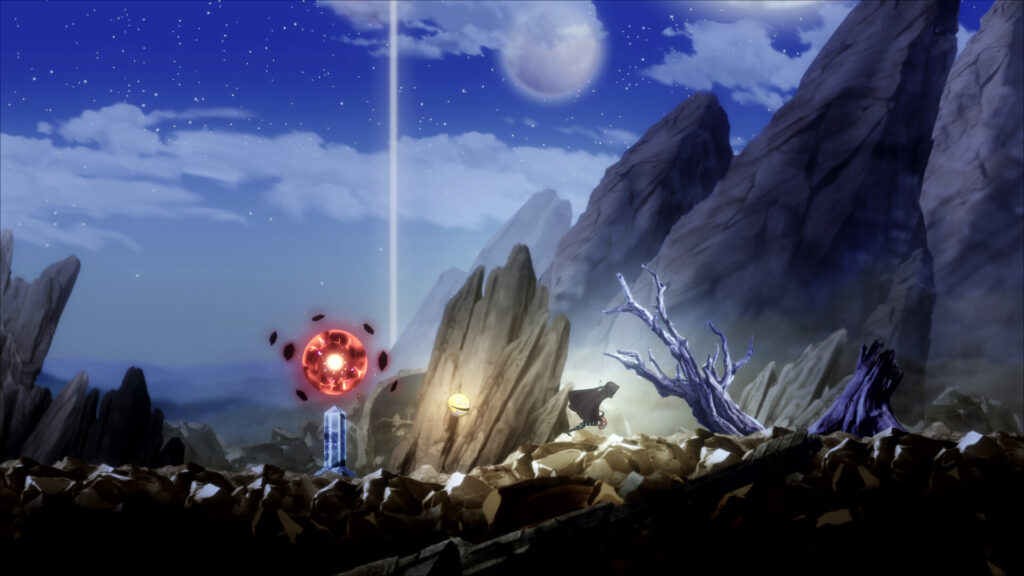
What follows is a relatively slow boil plot that is beleaguered by not only by Shadow Labyrinth‘s pacing but a world constructed of numerous other ideas and races and characters that try to vie for the player’s attention. So much of the narrative relies on exposition text boxes after Puck and Swordsman 8 arrive to a location or fell a boss. Lore is delivered by finding optional logs that work to hint deeply at a backstory. And while I tried to stay cognizant of what was going on, the story ultimately took a backseat even when I started blistering through the golden path.
Personally I feel that Shadow Labyrinth‘s biggest mistake was the kind of game it aspired to be. And when the foundation is flawed, anything it tries to support is likely going to crumble as well.
Let us, of course, look to the two North Stars: (Super) Metroid and Castlevania: Symphony of the Night. We all know the names that gave birth to the concept of a Metroidvania. The two biggest foundational examples where the player gained new items and powers over the course of the game to feel stronger, more agile, and tackle previously inaccessible parts of the world.
Metroidvanias revel in a player’s sense of progression and discovery. When Samus earns Super Missiles will players forego the intended path and return to the beginning of Zebes to unlock a door that might lead to a new Energy Tank? When Alucard was able to morph into a bat didn’t we all start flying upwards and clinging to ceilings in hopes of untold secret paths?
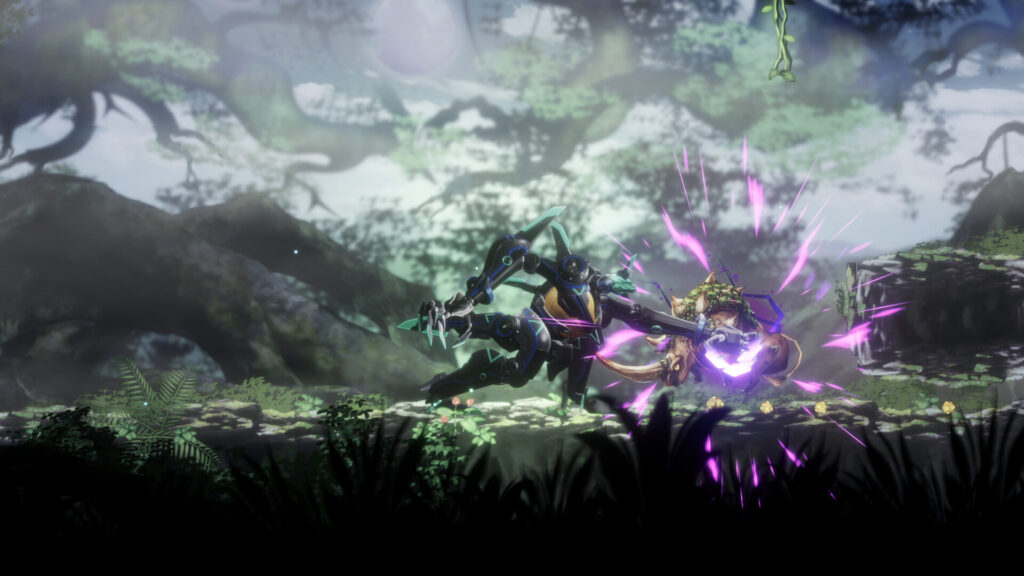
Shadow Labyrinth seems to forget the genre it’s aiming for during the first almost ten hours of the game. Right at the beginning of the game, players are intended to progress by moving right. Like a few dozen other games I’ve played like this, a door lies in wait to the immediate left of the starting location. Of course it can’t be opened. Likely not for several hours.
But what any good Metroidvania does is sprinkle out legitimate anticipation for new paths and valuable rewards for pure skill. Shadow Labyrinth is practically linear for its first two areas. A handful of times players can view an out-of-reach item or an obvious “you don’t have the appropriate power to get here” platform or environmental cue.
Normally that would be okay. The player can press on knowing that eventually they will come back and scoop up more health and items to boost power. But Shadow Labyrinth keeps pressing the player forward. And forward. And forward.
True frustration began to set in for me when Puck and his charge arrived to a treetop biome where tribal humanoids would attack. The vertically tall areas hinted at potential value when a double jump was earned. Yet I moved to a cave system where random doorways and elevators led to paths that seemingly were dead ends. I spent a few hours in this area fumbling around for progress. At one point after constantly checking the map in confusion, I reached the border and had no option but to fall. But rather than plummet to the floor below, I moved #8 to a platform near a tree that I could go into. Upon reaching the bottom I noticed I had to take a door on my right to leave and that an inaccessible item was to my left. I would have got the item had I just fallen all the way down. But if I wanted to claim it I would need to retrace minutes-worth of steps, likely for just a piece of lore.
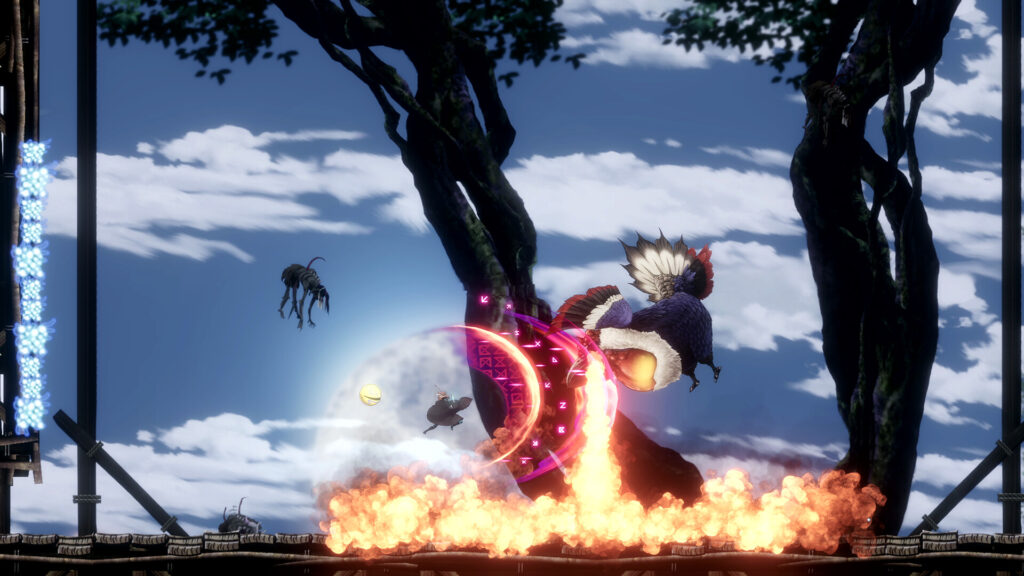
Shadow Labyrinth has poor map design, especially in the first part of the game where the player should feel a sense of excitement to return to. As I opened up a new area in the game, I dreaded that I would eventually have to come back to it. The game’s moniker certainly lives up to the labyrinthine structure of its map creation.
These zones are far too open-ended and the game provides meager guidance on the proper path forward. Shortcuts offer little in the way of satisfaction or respite, usually being placed in a way that still requires a massive amount of backtracking to reach previously inaccessible routes or items.
Worse yet, the map is rife with pointless distraction. Rooms have far too many unnecessary chambers or footholds. Players may bounce and hop along a difficult path up only to be greeted by a small open square with one enemy or nothing else inside it. Shadow Labyrinth‘s world is in desperate need of an editor because so much of its real estate feels extraneous, meant to pad the runtime for no good reason.
But even all this excess fat would be less a hindrance if the player was given meaningful rewards over a good amount of time. Movement tech in a Metroidvania shouldn’t be given away like candy at Halloween, nor should it be drip-fed to a desperate player. My first seven hours in Shadow Labyrinth, I earned the ability to dash in the air. It took about four hours to get to that point. My second “reward” was a grapple hook that couldn’t have come any sooner, especially after the gauntlet of challenges and bosses that had come before.
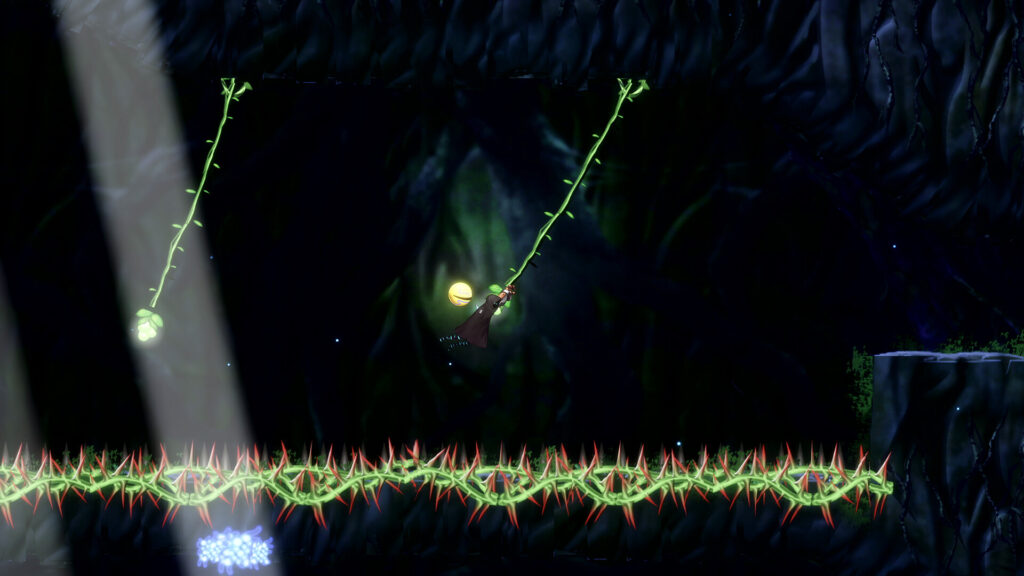
Incentives should not come to players in this form. With sprawling rooms and screens of just enemies, Shadow Labyrinth‘s pace turns into a game of running past potential obstacles. Why wouldn’t the player just want to rush along the Golden Path until they get to the good stuff?
As I’ve said, the pacing in Shadow Labyrinth leans far too heavily towards the second half of the game and by that point, its runtime feels quite egregious, making the player realize the dearth of content they have trudged through.
It doesn’t help that combat does not evolve in any meaningful way beyond the first few hours. Swordsman 8 has a basic 3-hit combo and can graciously attack with a combo upward and in the air and slash down. A stamina/ESP gauge dictates the use of several abilities, including a dodge, the air dash, special ESP attacks and skills, parries, and more. Running out of ESP is a deadly gambit because players will only be able to attack until the full gauge recovers, which can be painful in a boss fight.
A few hours into the game, players unlock the ability to transform Puck into a GAIA mech that looks like something out of Evangelion. This “rage mode” acts as a free pass to soak up damage and have stronger attacks. But it also unlocks the ability for Puck to eat downed or stunned enemies as a nod to his origins. Eating enemies sounds like a cool feature because it rewards players with materials that can be used to purchase items in shops. But the shops primarily deal in perks that amplify abilities but are limited in slots, meaning players have to progress further before they can really use many perks.
Shadow Labyrinth‘s combat is rarely challenging. More so, there’s an artificial quality to its difficulty. Players take damage just by touching an enemy, which feels frustrating when health is limited and only replenished by a handful of potions that can be carried at one time. A massive number of bosses have patterns that can be easily read and manipulated using dodge generously with the right timing.
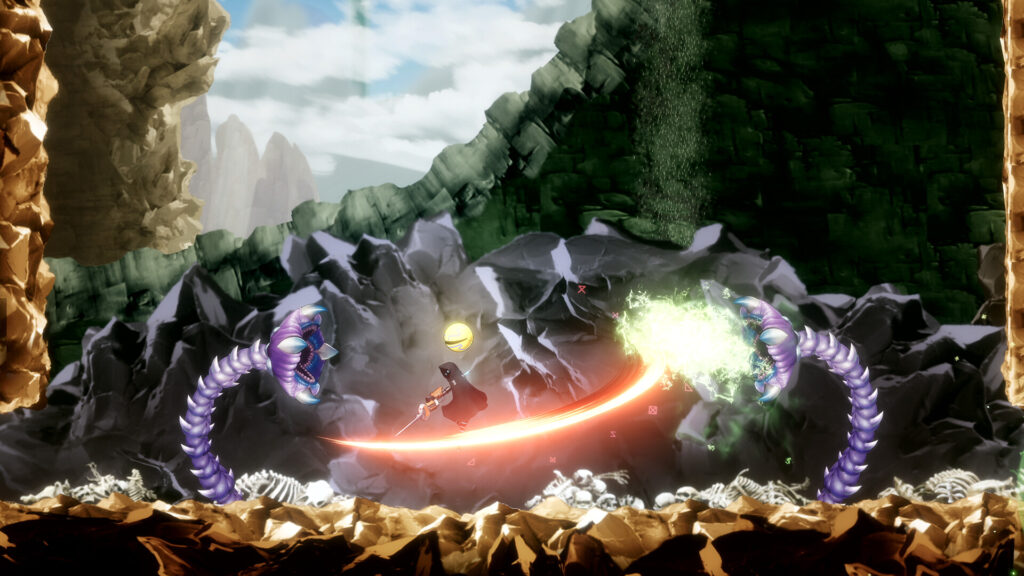
And again, the small annoyances with Shadow Labyrinth build towards a greater frustration as a whole. The mere mention of combat makes me consider the game’s upgrade path, which presents a few points of contention. When enemies die, they drop these globules meant to imitate the dots eaten by Pac-Man. Yet these items will fall down pits, jettison down cliffs, and otherwise be inaccessible. Worse yet, upgrading Swordsman 8’s damage is almost negligible. Enemies will still take the same number of hits to kill even after upgrading damage output four or five times. Instead, it feels like a way to ensure the boss takes a few less hits to kill.
However, another thing amplifies pacing and combat issues is Shadow Labyrinth‘s exhausting use of checkpoints acting as a constant thorn in my side. The game features two kinds of checkpoints. The normal blue crystals scattered around the world act as a revive point for players upon death. Running up and activating one of these checkpoints also restores lost health but not healing potions–an absurd choice. But at these crystals, players can also teleport to Miku Sols, “primary” checkpoints that allow players to change equipment, level up, fully heal, and teleport to other Miku Sols around the game.
While this checkpointing system would be convoluted in almost any game, in Shadow Labyrinth it can feel like an unforced error or a slap in the face. The game’s poor map design also bleeds into how friendly it is to players. Miku Sols are rarely found before or after large boss fights, meaning that players won’t have an opportunity to top up health before a big fight or after one. Death is a worst case scenario because it means having to trudge a well-worn path, bypassing enemies in hope of not losing any health for fight. It may sound like the game is just difficult but that simply isn’t the case. After defeating a main boss, there should be some kind of safety net for the player, not another series of convoluted screens making the player overly cautious, negating any satisfaction of killing a boss.
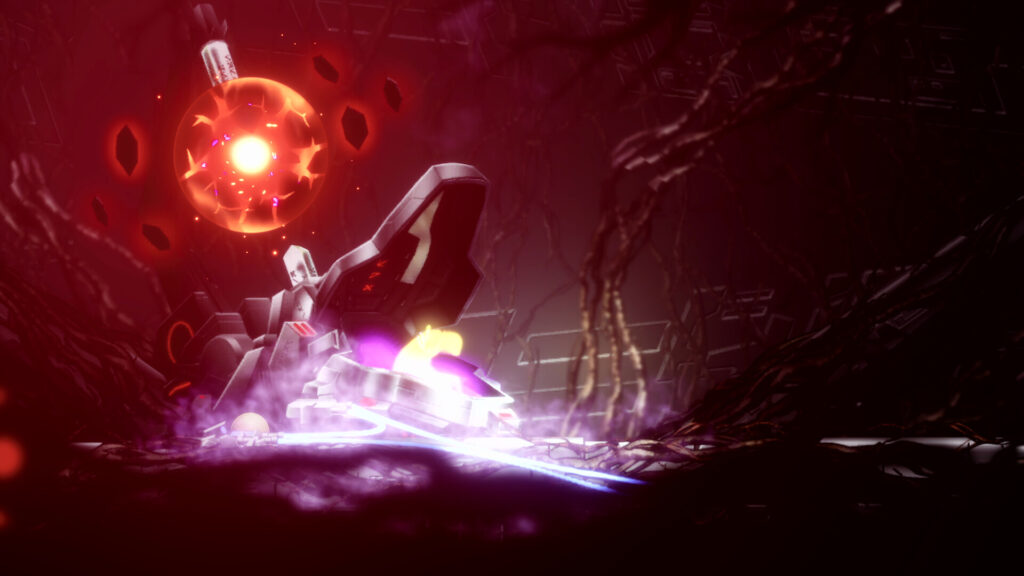
The fact that such a crucial element of respecting the player is so mishandled is indicative of Shadow Labyrinth‘s constant fumbling. I think of games like Hollow Knight or Prince of Persia: The Lost Crown, modern day examples of how to do the formula right. Shadow Labyrinth appeared to be content with painting by numbers but ended up forgetting that all its disparate parts never congeal into an enjoyable whole.
So much could be forgiven if the game was able to justify its massive size. But it shouldn’t take players hours before they get fun upgrades that make them excited to explore. Enemies shouldn’t turn into annoying beasts that the player would rather avoid.
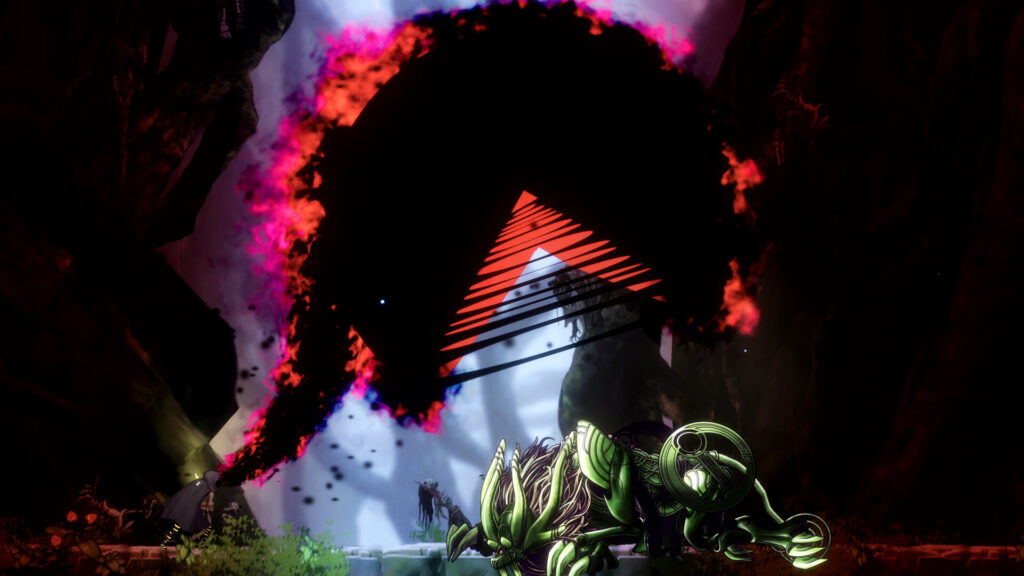
Looking at Shadow Labyrinth from a distance, I truly wonder if anyone had played a Metroidvania before deciding to make this the genre a weird Pac-Man tale would take place in. And even those attempts to inject the game with a classic Pac-Man vibe are somewhat half-hearted. At times, players can hop on rails and turn into the classic Pac-Man, munching on dots. A handful of times these parts of the game are novel but once numerous enemies and timed jumps come into play, tedium rears its ugly head. Jumping from rail to rail is somewhat clumsy and inaccurate and enemies can only be attacked in a straight line. However, a handful of times players can enter a semi-traditional Pac-Man challenge with neon lights and ghosts to defeat. Here players will attempt to gobble up dots and eat ghosts but also engage in light puzzling where they may slam against walls to crush ghosts to the flash of lights and celebration. Yet another fun element that should have been accessible hours prior.
Shadow Labyrinth should have been so much more. I wanted my first impression of the game to linger. But the longer I engaged, the more my mind wandered to better Metroidvanias. Ones that either delivered pitch-perfect combat and exploration, or ones that tried something new. Shadow Labyrinth attempts to make a weird, novel Pac-Man experience but squanders the opportunity on sluggish pacing, exhausting checkpointing, and a map that severely needed a few bites taken out of it. Maybe Puck should just stick to ghost hunting.