

Ruffy and the Riverside is a joyful and quirky collectathon that attempts to bridge past and present sensibilities. Bursting with personality and a novel gameplay mechanic, should enjoy a sense of discovery and a helping of clever puzzles.
When Yooka-Laylee released a lifetime ago back in 2017, I couldn’t help but be charmed at its blatantly obvious bid for nostalgia. Comprised of former Rare developers, Playtonic Games wasn’t trying to hide that Yooka-Laylee was a callback to the wave of collectathons from the Nintendo 64 era.
While a number of critics admired Playtonic’s ability to capture the look and feel of what was basically a lost Banjo-Kazooie game, many lamented Yooka-Laylee‘s lack of innovation, seemingly stuck in the past. Perhaps when I played Yooka-Laylee I didn’t want anything new, I just wanted to feel like 10-year-old again.
Summoning the specter of The Legend of Zelda: Breath of the Wild when reflecting on Ruffy and the Riverside feels overtly dramatic, yet here we are. Nintendo’s reformatting of the traditional Zelda experience of dungeon-hopping has rippled across numerous games since it released in 2017, the same year Yooka-Laylee dropped. The sense of adventure and discovery that Breath of the Wild offered felt unmatched but also reminiscent of Link’s original adventure on the NES.
There is a world where innovation and nostalgia can be equally gripping. The comfort of familiarity can captivate just as much as a new challenge. Ruffy and the Riverside succeeds in part because it is a visually stimulating game, a hodgepodge of styles and eras. But what’s most worthy of accolades is its ability to blend the joy of discovery housed in a 90s-era mascot platformer.
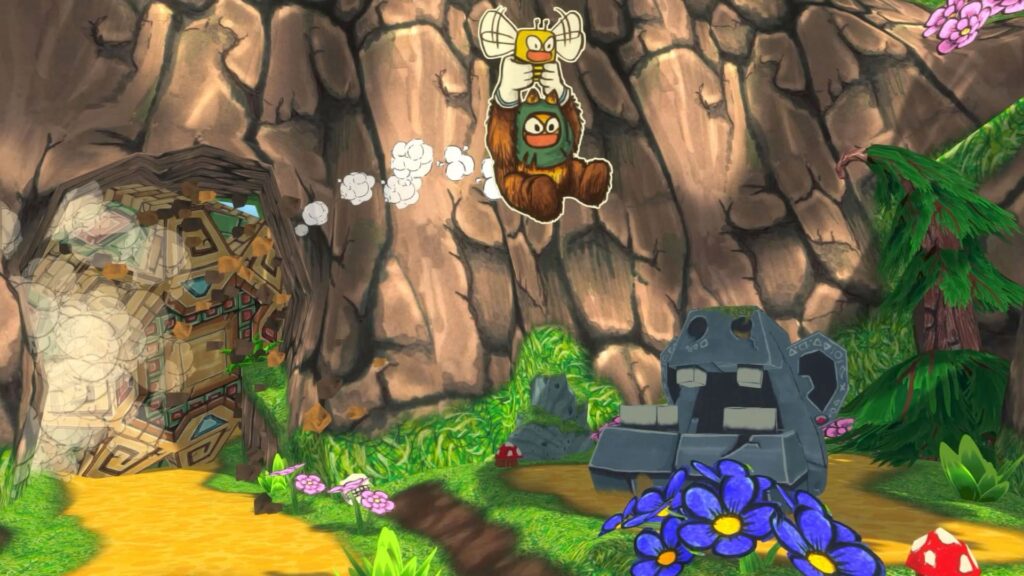
Ruffy and the Riverside jovially follows the kind of traditional hero’s journey many of us have played across a wide variety of games but relishes in being wholly unserious. Developer Zockrates Laboratories rarely strips the goofy joy from a plot that is beyond self-aware. Within minutes of the game’s start, the lovable bear Ruffy is whisked away from his normal life of swapping out paintings. He’s been summoned by the mole Sir Eddler because of his mysterious powers using the SWAP, an ability that literally allows him to swamp the details and materials of one object for another.
The plot moves rambunctiously as Sir Eddler and Ruffy accidentally awake an evil being named Groll who, for whatever reason, is a malicious kind of Rubik’s Cube that starts wreaking havoc on the world the moment he’s loose. What follows is a number of interconnected quests all meant for Ruffy and his bee companion Pip to recover the actual letters of the Hollywood-esque “RIVERSIDE” sign that adorns the land. Because, of course, the sign is actually linked to the World Core, which holds the fabric of the planet together, apparently.
Yes, this is all absolute nonsense. But it’s written and delivered with a chaotic vigor where the task at hand is both deadly serious and relatively casual. Ruffy and the Riverside features no actual spoken dialog. The game is quite dense with conversations between characters that can last upwards of 30 seconds or more based on how fast the player reads. While there’s certainly an audience who will skip past all text boxes with glee, I surprisingly found the writing here to be silly in a way that embraced the absurd.
Characters vacillate between recognizing the world is in danger but also taking a hands-off approach in fixing things. Sir Eddler is capable of digging his way to almost anywhere but conveniently can’t or won’t bring Ruffy and Pip along, nor will he go grab an important item. Late in the game, Ruffy and Pip literally fight Groll and defeat him, only to help the bad guy recover his power… just because they were being nice and Groll said sorry?
Plot points are brushed aside or given boundless meaning and it was this kind of narrative whiplash that gave Ruffy and the Riverside a great energy, kid-like in its eagerness for exposition and velocity. And because the game sometimes is intentionally ham-fisted, it’s incredibly difficult not to laugh along with its characters. Headier critiques like tropes and emphasis on exposition don’t really have the same effect when lobbed at Ruffy and the Riverside. Zockrates embraces their colorful world of talking animals who live life to its most casual.
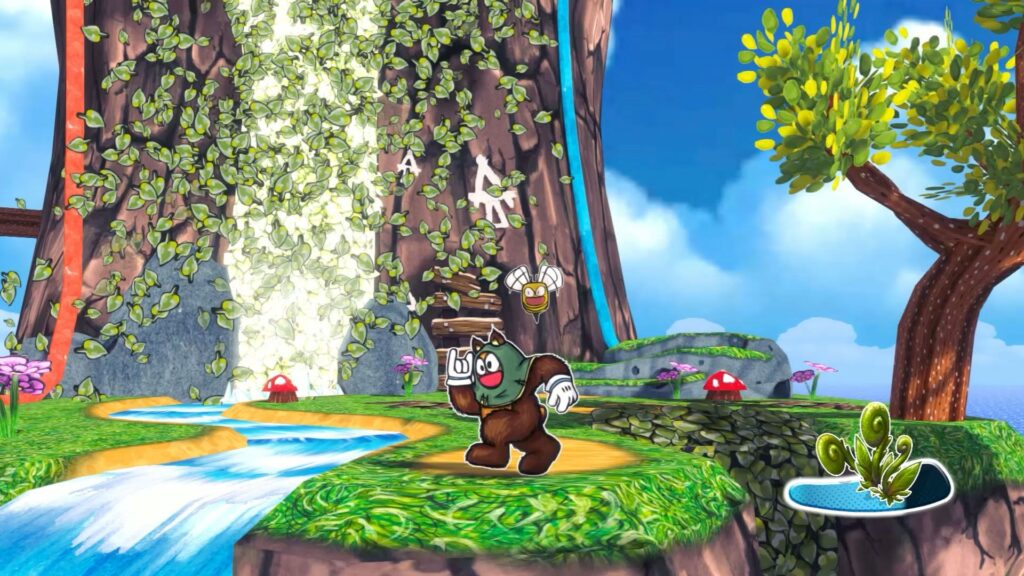
But what helps even more is the profoundly impactful visual language that is threaded across every fiber of the game. Being a collectathon, Ruffy and the Riverside proudly replicates the chunky polygonal nature of the earliest 3D worlds and games. Mushrooms have sharp-angled tops you could easily poke yourself on. Branches and leaves on trees are those flat, two-dimensional shapes. Enemies are bug-eyed and lacking in finer detail.
And it’s fantastic. Truly. Growing up gaming in the late 80s, it’s impossible for me not to appreciate when today’s developers swing for the fences and try to either outright replicate or emulate older generations of games. Last year’s Crow Country was emblematic of a stylistic approach to the PlayStation 1-era but split the difference between Resident Evil survival horror and Final Fantasy 7-coded visuals.
Ruffy and the Riverside obviously has the semblance of a budget but that works in its favor. The blocky world of Riverside channels what many of us remember about older games’ distinct landmarks and points of interest. However, that is coupled with not only a smooth framerate and high-definition fidelity but hand-drawn characters jumping and bouncing around like they were in Paper Mario.
The contrast of this vibrant, colorful, and semi-lo-fi world and its detailed characters living in harmony was what ensnared my attention for Ruffy and the Riverside months ago. This is one of those games that could be churned out with .gifs and people would want to get a taste for themselves. On PlayStation 5, it runs smoothly and I never noticed any speed bumps where the framerate would get choppy or any significant issues. My only real technical quirks with Ruffy and the Riverside stemmed from an occasionally wonky camera that would clip through environments or zoom in too close.
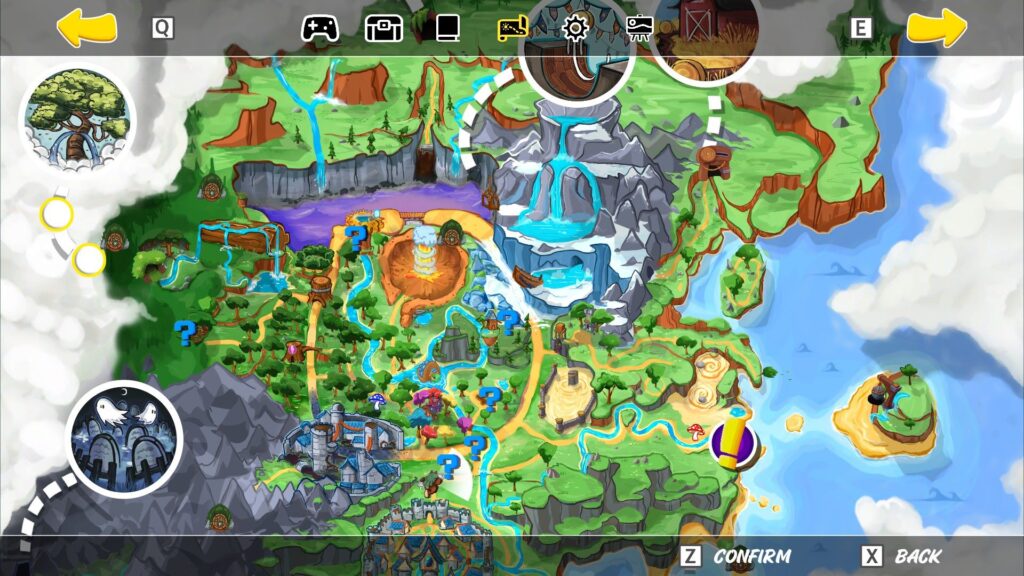
With a loose enough story that primarily acts as a vehicle for funny dialog and to send players across all corners of the map; it’s a godsend that Ruffy and the Riverside has minimal frustration and hedges its bets on players’ yearning for discovery and genuine curiosity. When looking back on the game, I can’t help but think of its feature-packed overworld that is peppered with puzzles and collectibles.
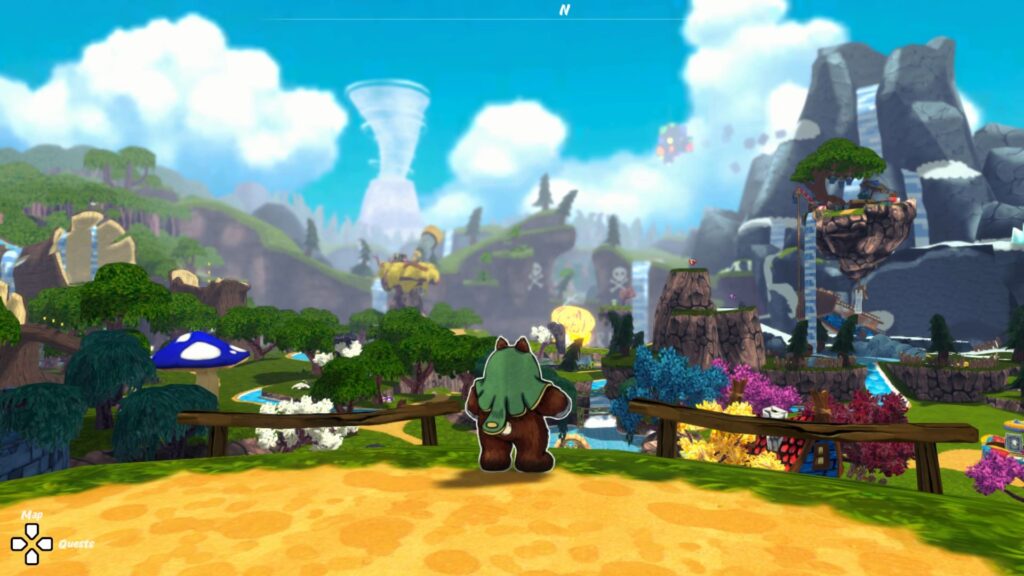
In a sense, Riverside is very much an Ocarina of Time-esque Hyrule Field. Players start in the main village which is caked in NPCs to talk to and things to do. The narrative directs Ruffy and Pip into the game’s primary open zone. The sightlines are easy to acquire and it’s plain to see where Zockrates Laboratories is directing the eye. But on the borders of this manageable but large area are access points to one-off areas and smaller open territory. Navigation is seamless and features minimal loading.
The story will dictate that Ruffy needs to head to the spooky ghost zone, or the toxic gas area, or the icy section. But what’s more fascinating is that Ruffy and the Riverside features these hallmark visuals but doesn’t get lost in trying to do “The Water Level”, “The Snowy Field”, “The Industrial Zone”, and other madness seen elsewhere.
The charm of the game is in its constant ability to punch above its weight. To complete the game players need to accomplish the main objective of collecting an “R”, an “I”, a “V”, an “E”, an “S”, and a “D” to complete the “RIVERSIDE” sign and progress the key parts of the story. But these letters aren’t rewarded by climbing a volcano and killing a boss.
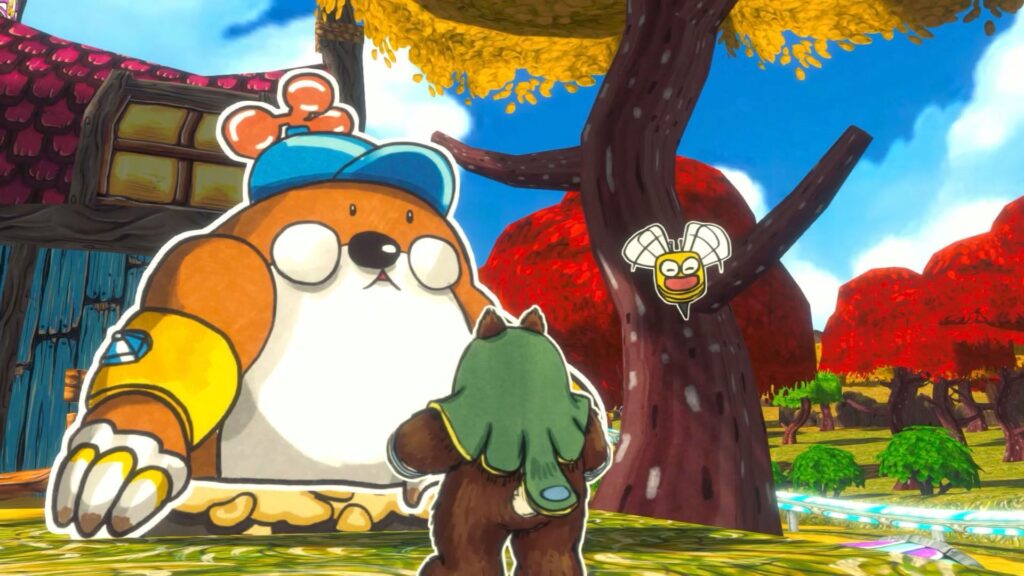
No, one letter is rewarded by navigating a series of Lost Woods-like paths where players need to sniff out clues of which playing card suit door is the correct one to walk through. In another, a ghost needs to win a competition for most appealing grave. In another, Ruffy has to beat impossible odds in a race. Never grandiose but never overly simply, Zockrates Laboratories invented some clever platforming sections to truly spice up what could have been a rote journey through varying biomes.
This is not to say that Ruffy and the Riverside doesn’t have a limited palette of level design. A lot of its themes cull from the general category of “nature” in that forests and jungles and foliage are some of its most prominent elements. Oh, and water, too. It’s called Riverside for a reason, even though it exists on an island…
And while the player is guided towards these narrative milestones and sectioned-off areas, they are free to return and collect anything they missed. Because one of the biggest time sinks of Ruffy and the Riverside is the number of things players can collect. Over 30 butterflies, a bunch of fuzzy creatures, a dozen line puzzles, and magical crystals are the bulk of extraneous items players can collect and solve. Completion of the game does not entirely hinge on finding everything. It’s more an incentive to keep playing and testing your brain.
One thing I could levy against Ruffy and the Riverside is that it is almost too loaded with stuff. Combat can feel like an afterthought as there are only a handful of enemies to punch and only a few boss fights. Ruffy has a butt stomp that I barely remember using for anything outside of one or two puzzles. Players can purchase different colored hoods for Ruffy and then use coins to spin a roulette wheel to upgrade the stamina and health recovery of each one several times over. New heart tanks can be bought. It’s… a lot, especially for a game that took me about 15 hours to beat and acquiring a large portion of the collectibles.
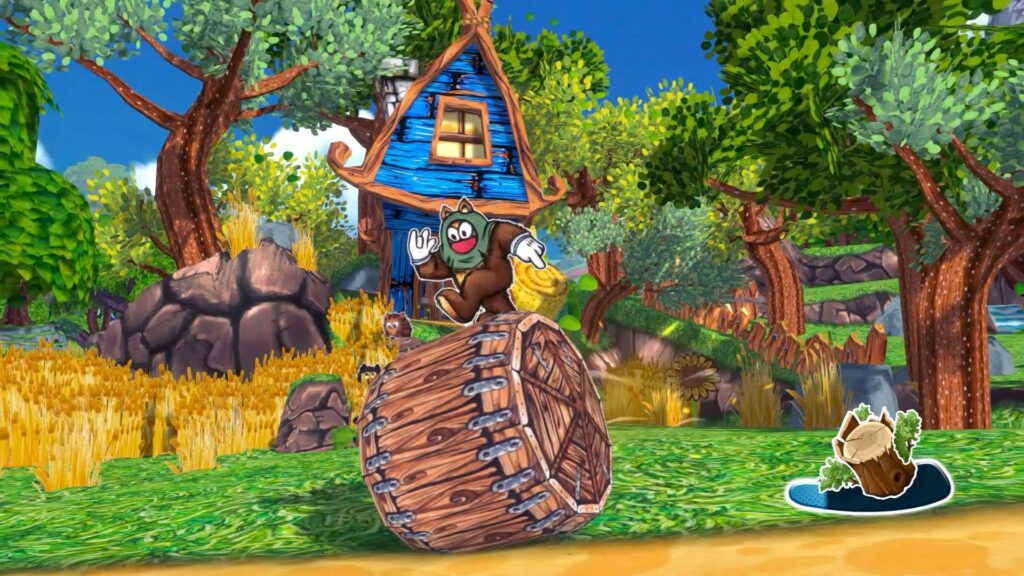
But the fun isn’t entirely in forcing the player to find these things, it’s in allowing them to discover the methods themselves. Maybe an NPC will drop a hint about how all the nearby mushrooms used to look like the “Mother Mushroom” and the player can infer from there. Maybe they need to find graffiti scrawled on walls that apply to a nearby line puzzle. Or maybe a boulder doesn’t sit right and the player later discovers they can pilot that boulder to a distant place for a reward.
Numerous times when playing Ruffy and the Riverside I thought about how Breath of the Wild didn’t force the player’s hand too many times. Zockrates Laboratories seems to be attempting the same here. In fact, some puzzles seem to be direct nods to Link’s vast journey. The main open area contains a few dozen points of interest where the player is likely able to find and discover an opportunity to collect something. Sometimes it’s obvious, other times it’s a little tricky.
To aid players in combing the depths of Ruffy and the Riverside, Ruffy employs the game’s most unique mechanic: the SWAP. Ruffy is capable of taking the texture or property of one thing and applying it to another. A waterfall can be swapped with vines to allow for a direct climb. A pond can be turned to fire to burn wood platforms. A bale of hay can be swapped with a stone to make it heavier.
The process is relatively simple. Players press a shoulder button to have Ruffy primed to swap a surface. If the material or object can be “collected” it will light up and releasing the button takes that property and temporarily banks it. A separate button is then used to apply the banked material to a different object or surface.
It sounds confusing but it’s really not. However, things can be mildly problematic when players attempt to discern what exactly they are supposed to do. Knowing that players are in the right area is one thing but executing the right Swap is another. Zockrates Laboratories was smart to indicate what could and couldn’t be swapped by having that surface flash.
Many of the puzzles in Ruffy and the Riverside want the player to run to one area, Swap a specific property, and then run back with just enough time to execute. But I would often wonder if I was just missing something? Why can’t I grab the fire from a candle and not the color? Other times a specific Swap needs to take place and players are just going to wonder what they are doing wrong. And some objects in the environment can be swapped but there’s no reason to do so.
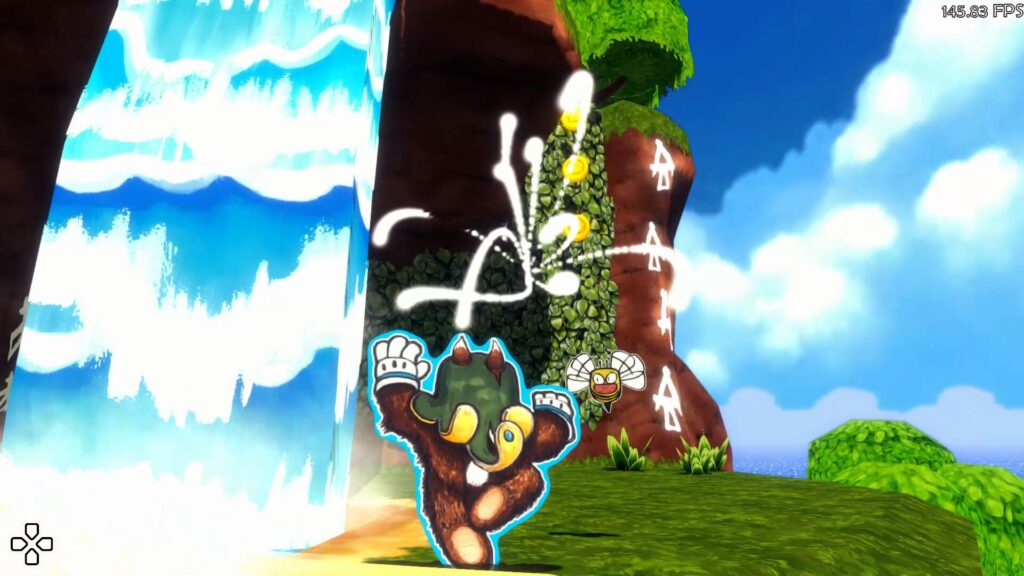
Part of me was frustrated merely because I saw the potential of the Swap gameplay and didn’t feel like it was taken far enough. A few brilliant moments shine through. One of my favorite implementations of the SWAP was using it to cheat a competition where Ruffy needed the highest score in a hay bale trick competition. Yes, you read that right. Players can participate in a mini-game where they time out tricks and perfect landing to get a high score. But, should you perform poorly, Ruffy can swap out the numbers on the scoreboard in the first round to give himself a massive advantage and give the competitors no points. It was a hilarious moment that truly made me laugh out loud.
The Swap is responsible for some interesting, quick puzzles. Numbers, images, and other elements can be incorporated in the process and by the game’s end I had found a good rhythm. But again, it would have been nice to see really obscure and convoluted uses for the Swap as kind of pinnacle content.
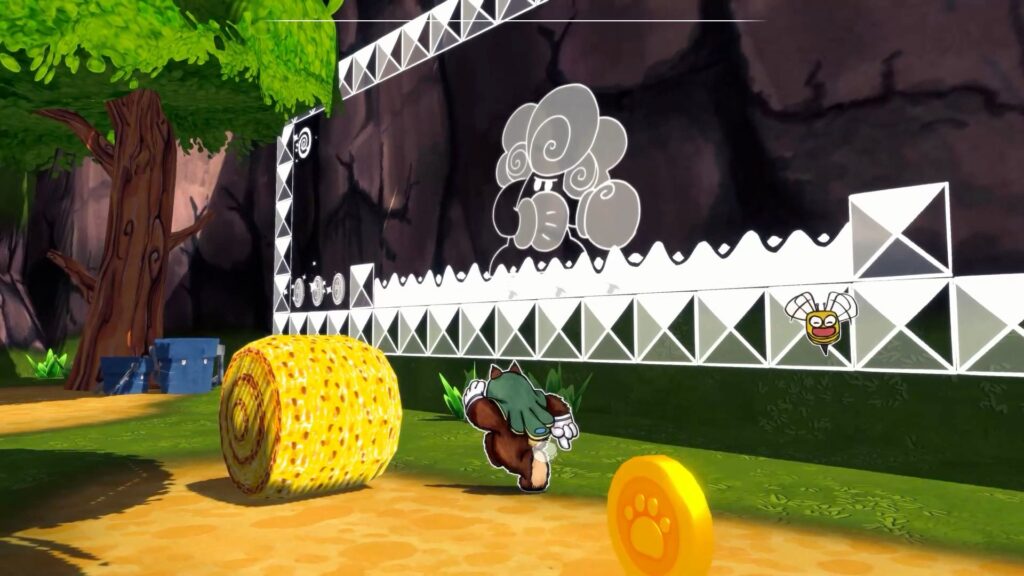
While it may be problematic for the core mechanic to feel lacking, Ruffy and the Riverside so frequently shifts the momentum around that players are never really stuck for too long doing one thing. Often I was annoyed by how often the game made me backtrack and run from one place to the other merely because I wanted to get back into the action.
There are so many weird and fun ideas that are given time and humor to breathe. Some may be annoyed at Ruffy’s constant noises when he jumps and punches but it always made me laugh. I loved how loose the platforming felt and how I could use Pip to float to distant places. The music and sound were bouncy and chill, making me feel like I was playing on a sunny, cool beach. A weird cutscene about the literal edge of the world had me deep in thought and a brisk ride through a deadly water current injected variety into the game’s pace.
A limited scope is one thing but Ruffy and the Riverside really does shoot for the moon numerous times. It has a lot of polish and is packed with good ideas that are primed for evolution in the teased sequel bait. If we never see Ruffy again, I’m glad that this debut was strong enough to have earned him a special place among the platforming mascots.
Ruffy and the Riverside finds quirky and joyful ways to meld past and present gaming ideologies. This is a mascot platformer collectathon at heart, feeling like a Nintendo 64 game but not being too bogged down by nostalgia and reverence. While its best ideas may sometimes feel underutilized, Ruffy and the Riverside is inventive enough to constantly push the player towards one new thrill after the next.