


TAMASHIKA is undoubtedly a surreal, bizarre game that uses psychedelic visuals and whiplash action to funnel players into a flow state. Yet it is a game that also feels intimately familiar and natural to the roots of the FPS genre.
TAMASHIKA is very much a game you have played before.
TAMASHIKA is very much a game you have not played before.
TAMASHIKA presents a kind of quandary to a person wishing to encapsulate its whole in a kind of coherent manner, one that is digestible to the discerning eye who merely asks: “Should I play this or nah?”
TAMASHIKA‘s developer, quicktequila, seems vaguely indifferent about a value proposition. A structureless game that possesses structure. A rudderless direction that is piloted by a confident captain.
TAMASHIKA will strike many of you as pretentious, too artsy for its own good, weird for the sake of being weird. Deeper analysis will work to circle that square by identifying publisher EDGLRD as a studio founded by Harmony Korine, known for films like Kids, Gummo, and Spring Breakers. And yes, the game blitzes the player with fathomable weirdness in an attempt to corkscrew them through corridors, shooting weird frog-like critters down cramped, psychedelic Thunderdomes.
TAMASHIKA appeals to players like me who embrace different and new. I’ve played hundreds of games in my several years of existence and often find a kernel of appreciation with most everything. Value and entertainment propositions don’t always work out. Narratives collapse. Mechanics buckle and break. Yet for a few minutes, most games possess enough of a spark to entice the eyes and hands and mind to keep going out in a potential ocean of content.
TAMASHIKA is likely going to make me sound pretentious and it won’t be the first game to do so. Or maybe even a shill. I’ve grappled with contrarianism numerous times for games that many people would deem not worth dying on any hill for. Admittedly, it’s rare I would want to play a game that, in my eyes, looks like shit. When you’ve played so much, it’s easy to parse what’s going to be worth your time and what is either run-of-the-mill entertainment or hollow drivel. And, likely, several years renting games in the 8- and 16-bit eras helped hone that recognition. You do in fact get burned after wasting your weekend rental on a broken game likely developed in a matter of weeks or months. Thank god my mom bought me Battletoads, so I could suffer on demand rather than on a Friday night and Saturday morning.
TAMASHIKA doesn’t really explain itself. And while there isn’t a lot to actually explain. I can’t help but be fixated on the words provided by Vidhvat Madan of quicktequila conveying a semblance of meanin: “As your species accelerates deeper into its eternal tango with technology and machine, it’s an occasion worth celebrating with a medium that sits at the very heart of human-machine interaction. Videogames share a uniquely intimate relationship with humans and technology–and I come as a celebration of that symbiosis. I am machinic desire, made manifest. Pay attention! Attention is all you need.”
TAMASHIKA speaks these words, both as the game and the simulation “she” represents. But these words aren’t in the game. The flashy and frequent katakana and kanji that bursts into the player’s view says words I do not understand, nor am I probably meant to. Is the game’s title a reference to the player character or the simulation that is scarcely reference in-game? To really peruse those questions is to get left behind because quicktequila splatters the player with imagery rather than exposition because here, gameplay matters most–despite a heavy-handed artistic slant.
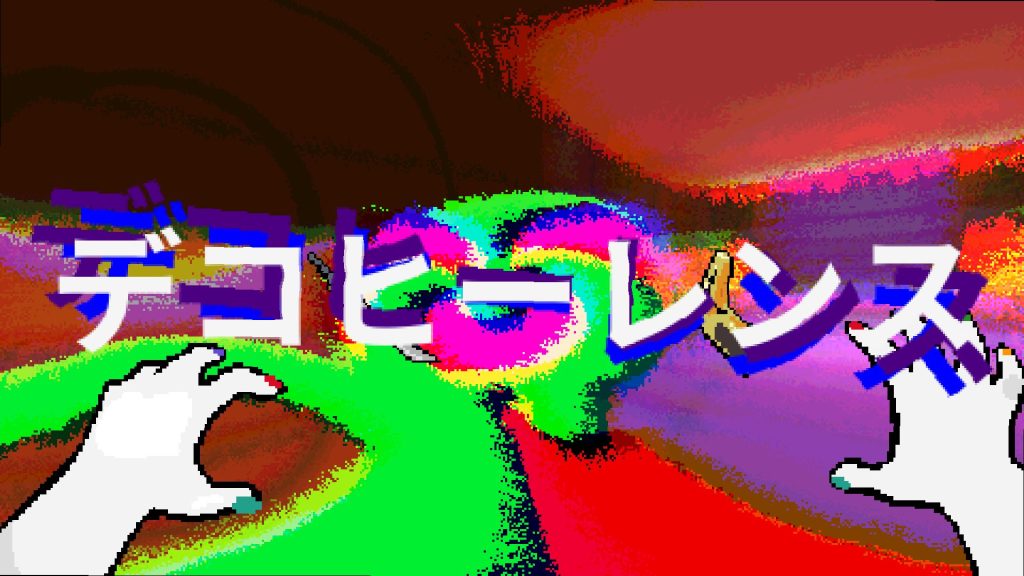
TAMASHIKA is a first-person shooter that leans into the earliest roots of the genre. The DOOMs and the Wolfensteins. It also calls out to 90s progenitors that many developers have used to express their love for the games of their youth, the “boomer shooters” if you will. And with razor-thin plot, the game is a distillation of a feeling just as much as it is a translation of nostalgia. There are no scores of enemy types meant to rely on varying approaches. There are no towering arenas that house layers of puzzles and switches. There are no weapon wheels to think about. There’s barely a HUD. Just some hearts and numbers I barely understood the purpose for.
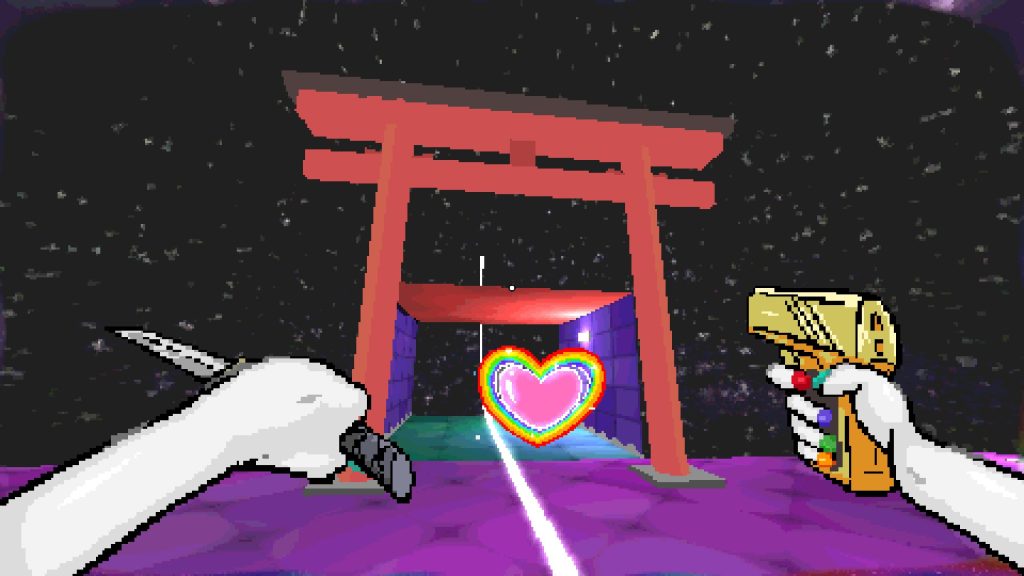
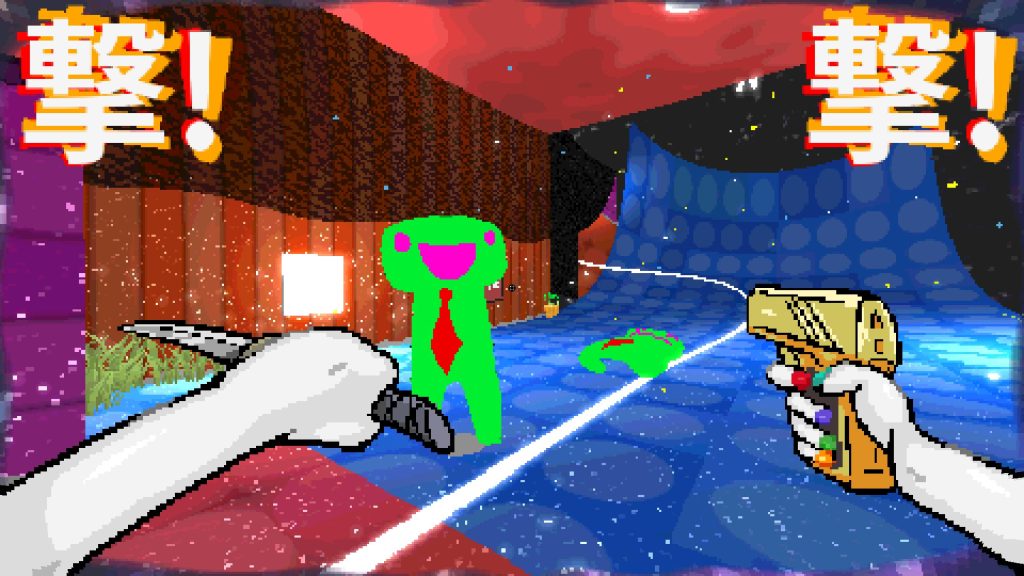
TAMASHIKA makes sense because there are no frills. The limits of one’s attention span serves as one of the few distractions. The game hands players a gun and a blade and asks them to plunge forward, a white line acting as the golden path forward if direction is needed; a carrot on a stick if purpose is desired; or a breadcrumb if the player ever gets lost. A pistol shoots to kill, sometimes those green critters, sometimes balloons. A blade is used to slice but it is also used to deflect bullets. Within a minute, players will have most of the knowledge they need.
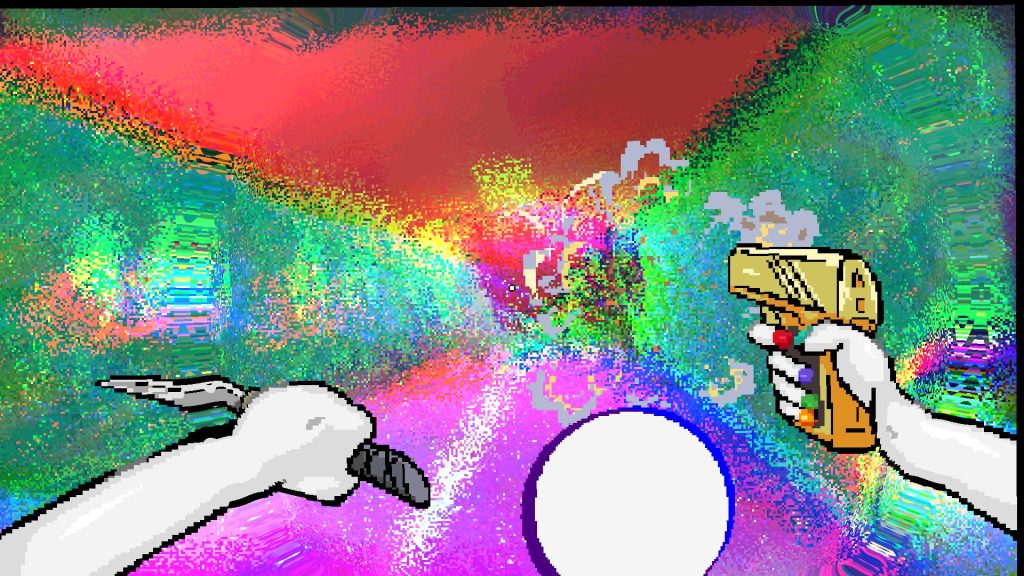
TAMASHIKA, in its own words, continues with the following: “She isn’t vying for your time or rewarding you for grinding long hours–she’s not clingy like that. Treat her like a meditation. Your daily dance with the machine… You meet her in a more primal feeling-space, one that exists prior to language and symbol. It’s about how it feels to be with her–the lights, the sounds, the sensation. She just wants a little bit of your attention, to arrive together in Flow. If you get attached, you’re doing it wrong. Pay attention, and you’ll find she’s not addictive–she’s hypnotic.”
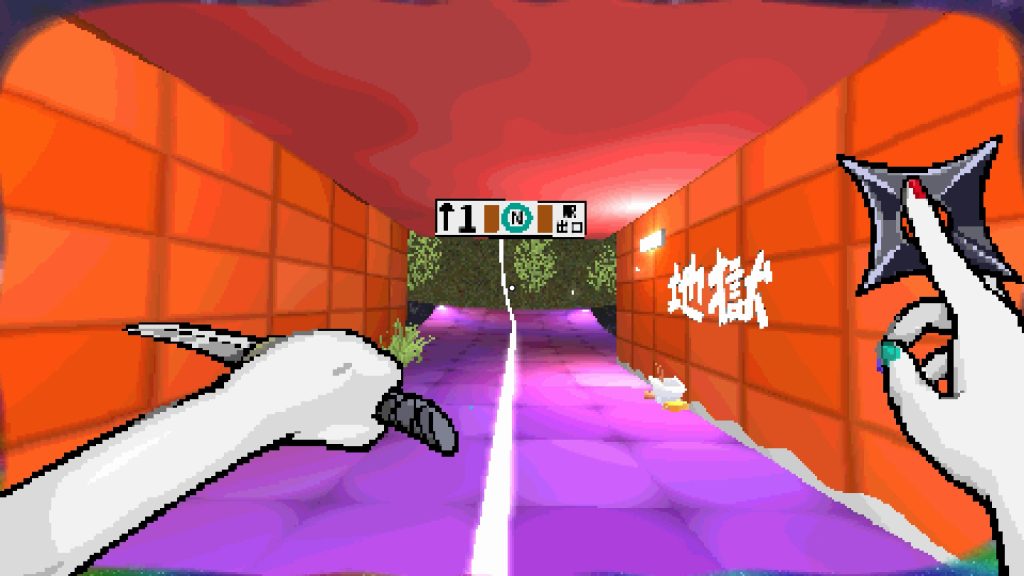
TAMASHIKA relies on that feeling of being wrapped up in the Flow State many of my favorite games have achieved, ones that are often searing in their difficulty. To me, it reminds me most of Hotline Miami, one of my favorite games. Through the cacophony of music and rhythm and difficulty, there’s a direct line to victory, the player just has to file themselves and the game down enough to reach that endpoint. And here, a number of clever tricks are employed that work to hone the player’s patience and skill. Shooting wildly will “damage” the simulation and lead to a fail state. Bullets are only meant to hit the opposition. Health is represented by distortion on the walls, trickling down and tearing at the edges of virtual reality until nothing is left. Bullets can be deflected with a slash of the knife but the player can also be hit by a deflection. Words streak across the screen, one must pause, then slash. Failure to do so careens you back to the beginning of a vague checkpoint.
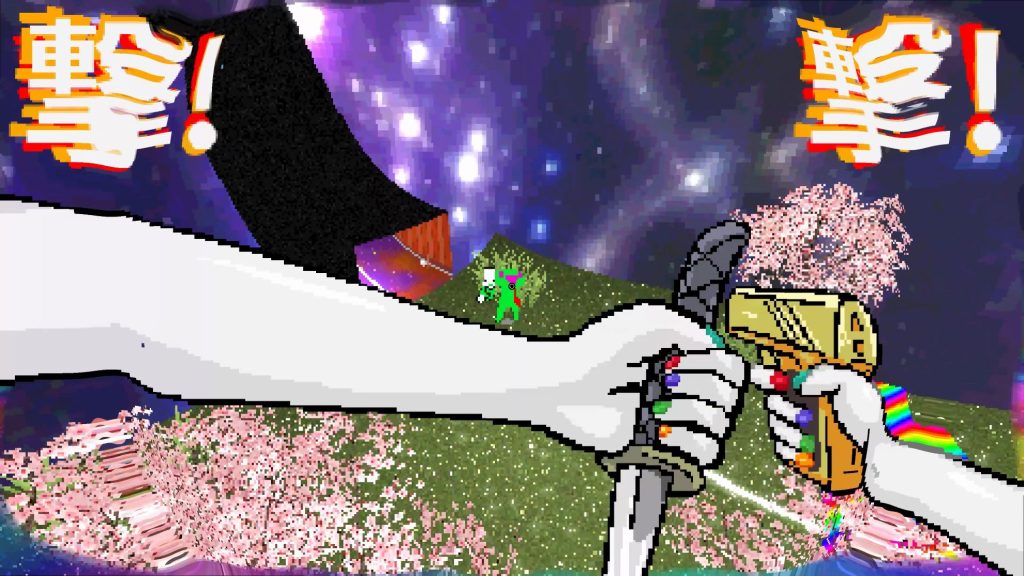
TAMASHIKA is a game about repetition and reflex. No, it does not yearn or beg for your time as stated. But in the ever-rotating daily level, repetition is how victory is earned. By barely tutorializing the player, understanding can take some time and frustration. I died numerous times in the minutes-long corridors where I was supposed to master the art of parrying. I instinctually and reflexively timed my parrying slash too early, despite being told to wait for the telltale sound to hit my ear and the Japanese text to flash onto the screen. 20 minutes later, the rhythm had set in and I was no longer blindly stumbling through the motions. My senses were aflame.
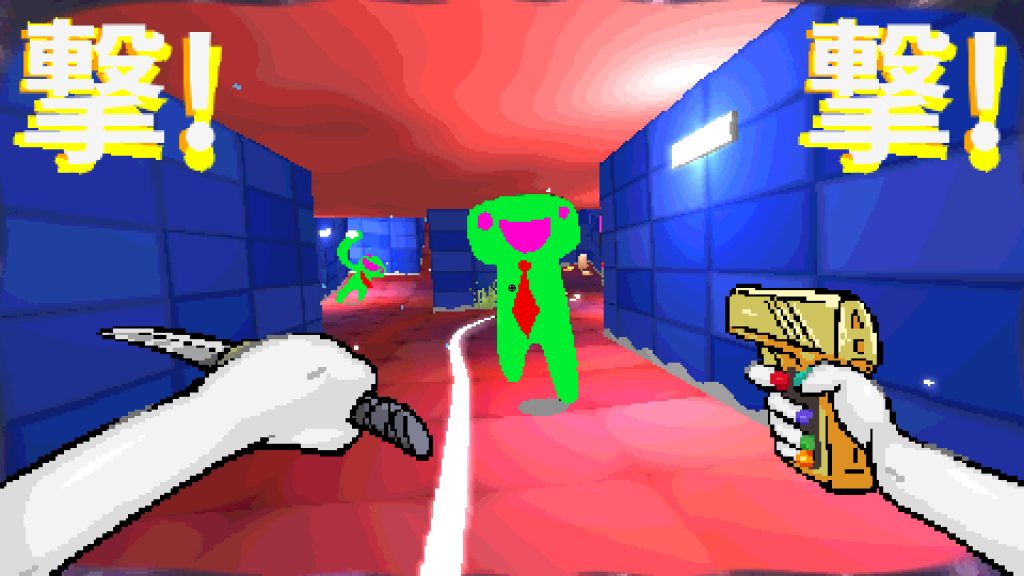
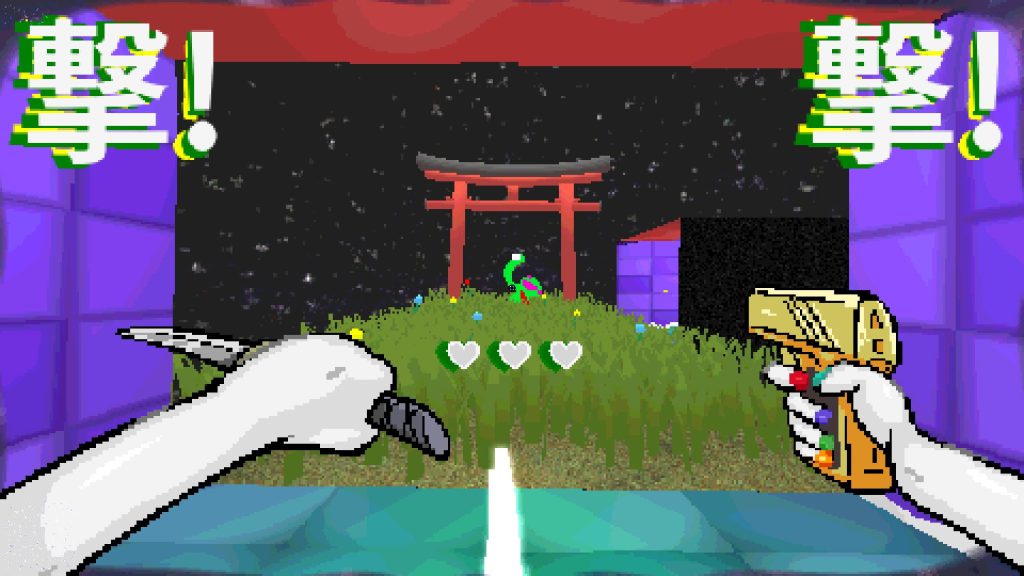
TAMASHIKA implements this appealing and dangerous notion of a single level that shuffles and randomizes itself every day. There is the potential for random new weapons to appear–a shuriken or an SMG or whatever–or for enemies to die and leave behind damaging pools of rainbow goop or whatever. No “path” is predetermined. What is available that day can be surmounted but it may take numerous tries before the player masters each new trick that comes before them. Failure meant an initial maddening frustration to be booted back to a checkpoint or, when losing three “lives”, all the way back to the beginning of the level. But in the frantic shuffle, my timing became more precise. I had been here before and done this. So I was prepared. Bam! Bam! Bam! Bam! In what felt like a split-second I had shot the frog floating in space on the left, on the right, the one on the ground, the one standing on a torii gate. I pressed on and I turned and BAM! BAM! I shot the one in front of me and sharply turned to kill the one hiding behind a corner who had already assaulted me before, catching me by surprise and sending me back.
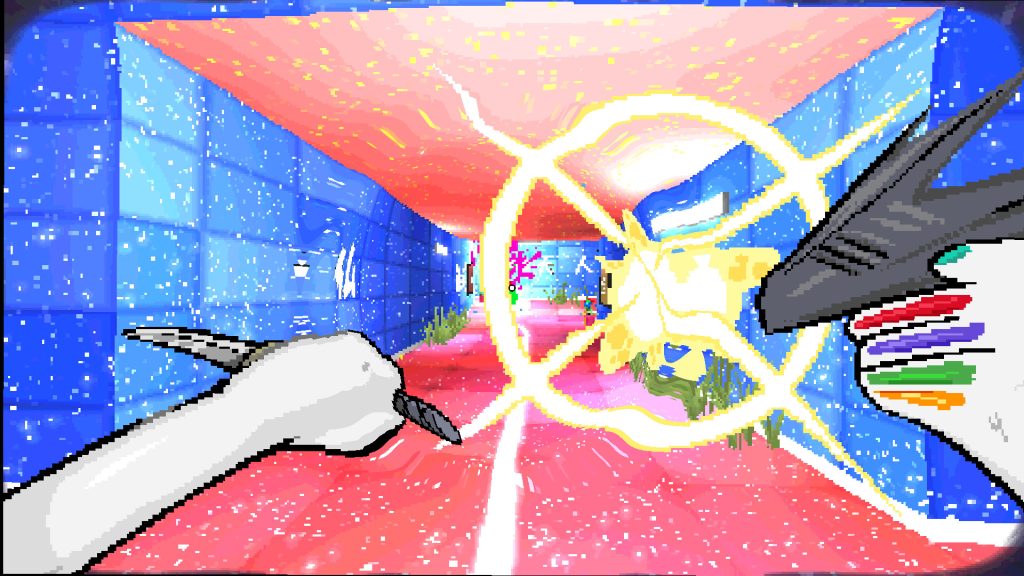
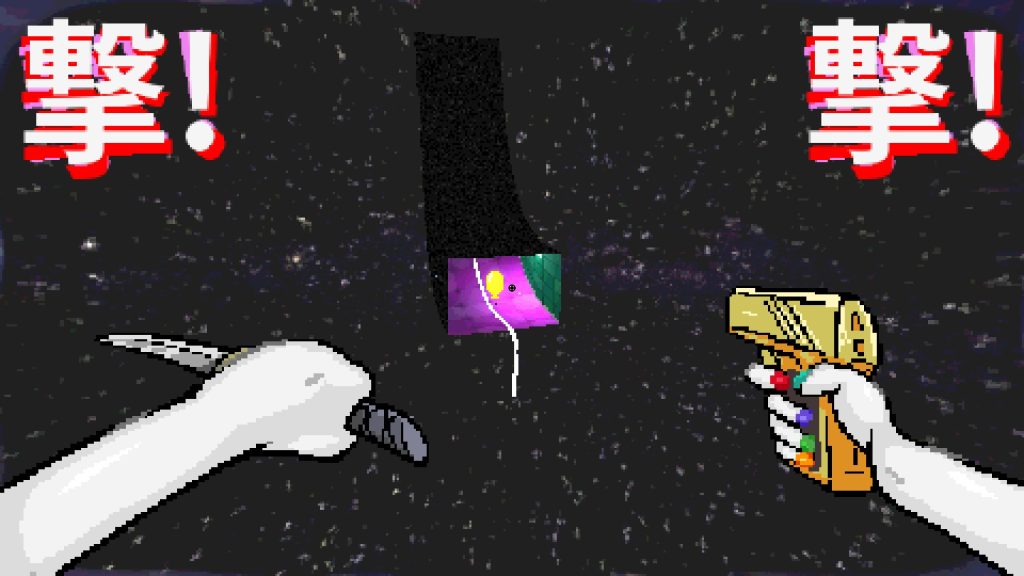
TAMASHIKA presents itself as a bath of noise. Through its psychedelia and chaos, there is a sense of order, it just needs to be parsed through. As players, we aren’t necessarily meant to question why shooting green balloons maintains a connection to this hypothetical virtual reality we know nothing about. In tandem, we don’t really question why a yellow balloon warps us ahead, across chasms or saving us from a perilous fall. In the immortal words of Todd Howard, “It just works.” Because the locomotion present here is not meant to be broken. Certainly players can take their time, ease into the action. Imagine Thumper as a kind of distant cousin where the player character moves upwards in tunnel vision as music pounds the ears. Bright colors and thudding beats are a nightclub of gameplay and the player is asked to navigate the clutch of sweaty bodies to take center stage.
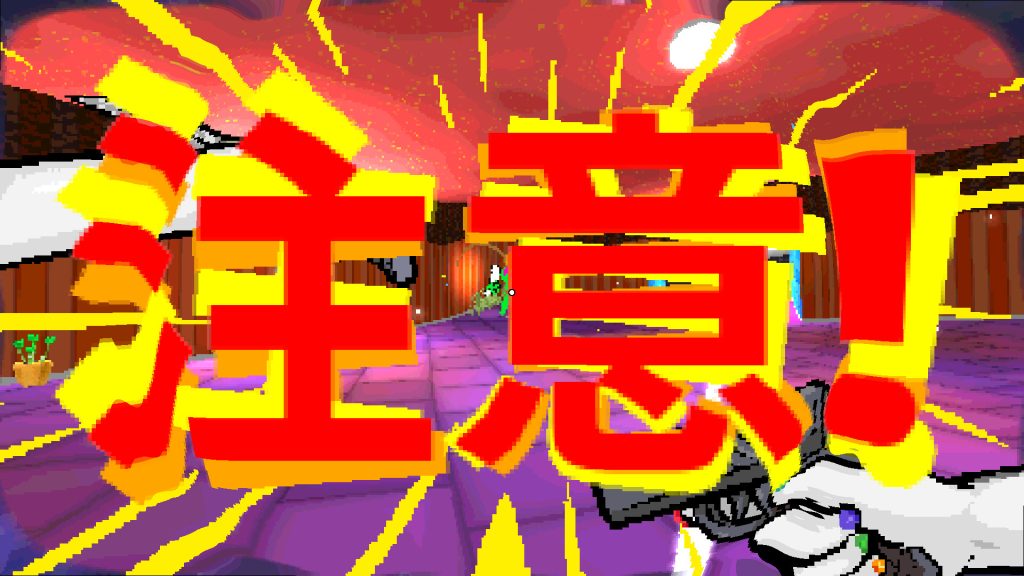
TAMASHIKA is creative and bizarre and those pillars hold up the structure quite well. A game being weird for the sake of being weird can create a great deal of runway for itself and I think quicktequila works in the confines of the somewhat intangible game it has created. As I was swooping through these levels and manic tutorials I felt as if I had no sense of place. Not only did the lack of direction befuddle me, it made me question what the point really was. Okay, sure, it’s an artsy shooter that tests players’ reaction times and squeezes out every last drop of skill they may have. And while frustration set in a few times because I continuously got booted back to the jump, I began to transmogrify into some agile gaming god. The rooms and paths and directions I needed to shoot and when I needed to deflect became burned into my brain’s memory.
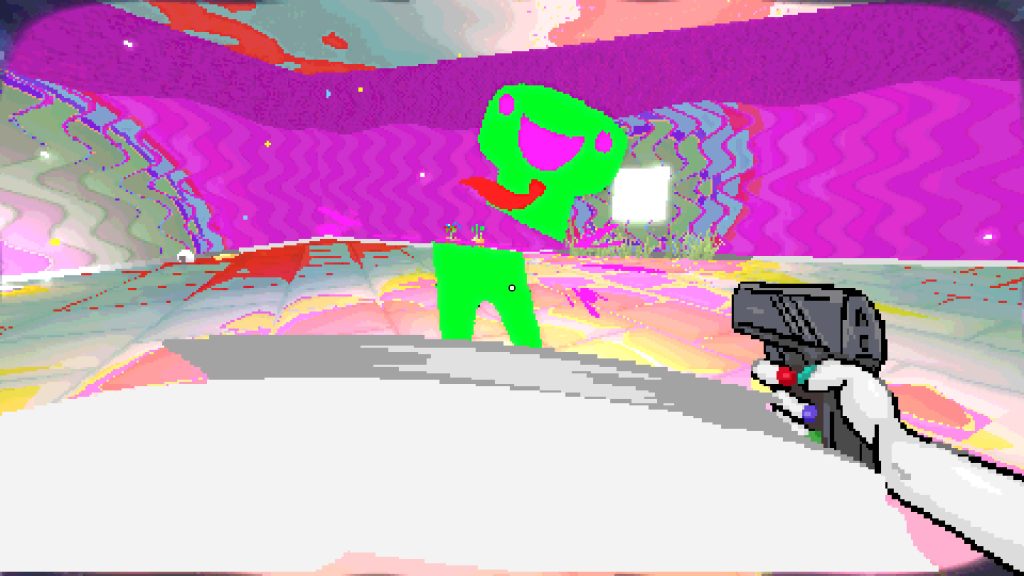
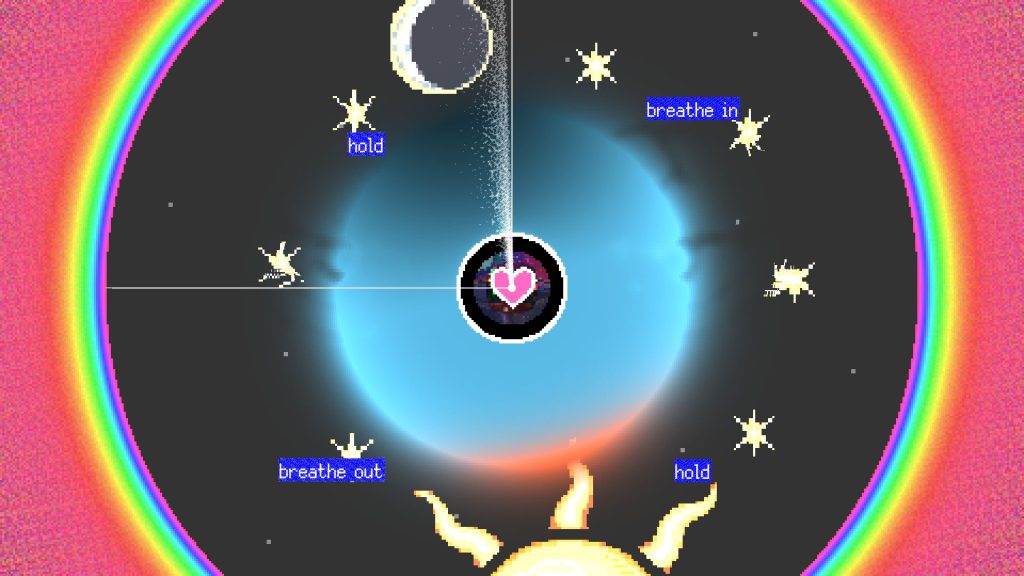
TAMASHIKA became the grey matter inside the soup of my head. SHING! BAM! POP! were the sounds I kept hearing as I worked to unfold the ones and zeroes that were attempting to barricade me from progression. My first session with the game was a couple hours doing the same few things over and over again. The next day, a little less time but the same scattered attention to detail. I remembered to shoot the green balloon, turn, shoot the yellow balloon, blink, hear the gunshot, see the text, wait a beat, deflect, shoot the frog, instantly shoot the yellow balloon, teleport to safety out of a free-fall. These clever tricks tucked into bite-sized rooms and hallways. The screen will flash or rip the player’s vision into a different direction, meant as a distraction. But don’t get distracted because distraction means death. Instead try to stay calm, despite the thudding in your heart. Listen to the title screen and breath in and breathe out. Hopefully it will all make sense.

TAMASHIKA appears at the end. She/it smiles and winks at the player. Good job. You beat it.
TAMASHIKA moves on. Asks the player to wait, come back.
TAMASHIKA will have a new challenge the next day for you. That constant, kinetic forward momentum you experienced doesn’t have to be dialed back. You can climb a leaderboard if you wish.
TAMASHIKA, however, doesn’t care. These 10-minute levels will come and go and the player will remain. When the game is opened back up, things will be different but the structure will, mostly, remain the same. New tricks and traps may be thrown in but the player still presses on through opposition to reach a goal that serves no real purpose outside of eliciting a feeling of finality. But what more does one really need in the end?
TAMASHIKA is borderline experimental. Therefore, it won’t be for everyone. A pure first-person shooter that holds no ambitions of plot or extended play. Developer quicktequila asks little of the player outside of growth. Whether that growth comes from patience or hardened reaction forge from repetition, the result is the same. Its kaleidoscope of feedback, colors, sounds, and stuff smother the player, gnaw at them. Like a chant, it summons you. Stay a bit, leave, come back. Things will be different but the thrill will be the same.