


With Spiritforged’s release, Riot is building out on their existing frameworks and elevating champions’ power fantasies in new ways that feel great. Card availability and learning quibbles aside, it contains great potential in shaking up the Riftbound competitive meta and gives collectors more gorgeous cards to collect.
“Teemo, I’ve got a feeling we’re not playing Legends of Runeterra anymore.”
I received my Spiritforged review pack a few weeks ago. Within seconds of opening my first booster, it occurred to me that the cards in my hand were novel in their designs. No longer were they utilizing the Legends of Runeterra art; they were novel to Riot’s card art catalogue and stood apart on their own. Legends of Runeterra is an excellent digital card game with some beautiful designs, yes…but Spiritforged looks and feels like steps in uncharted TCG territory within Riot’s universe.
It’s refreshing and slightly relieving.
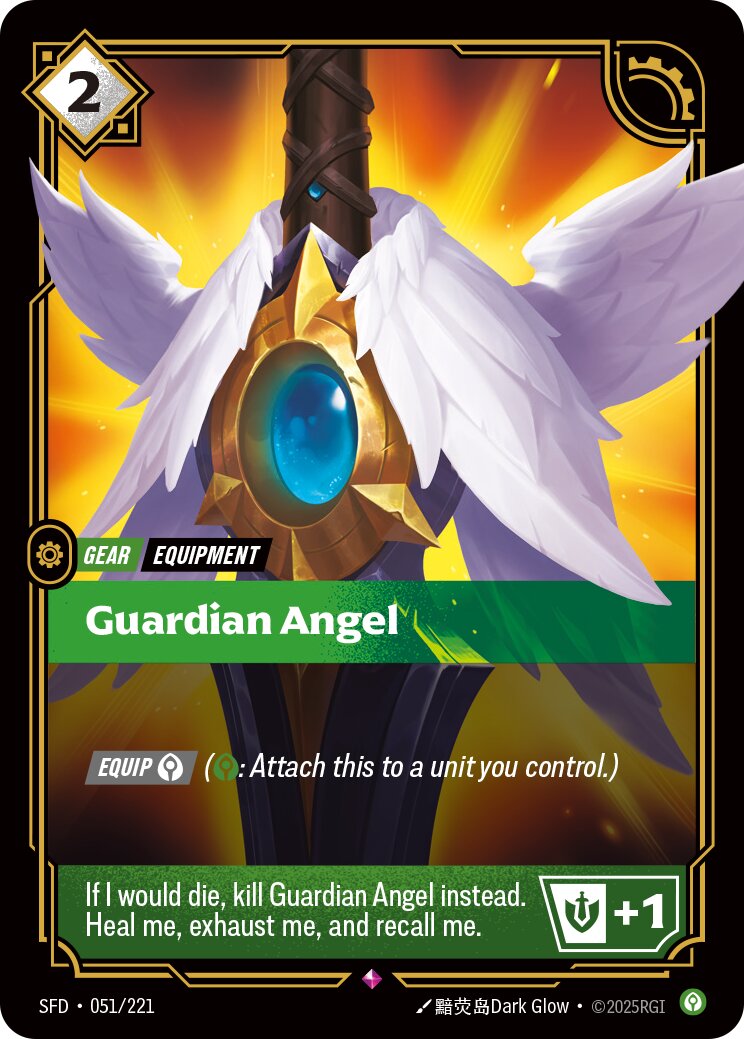
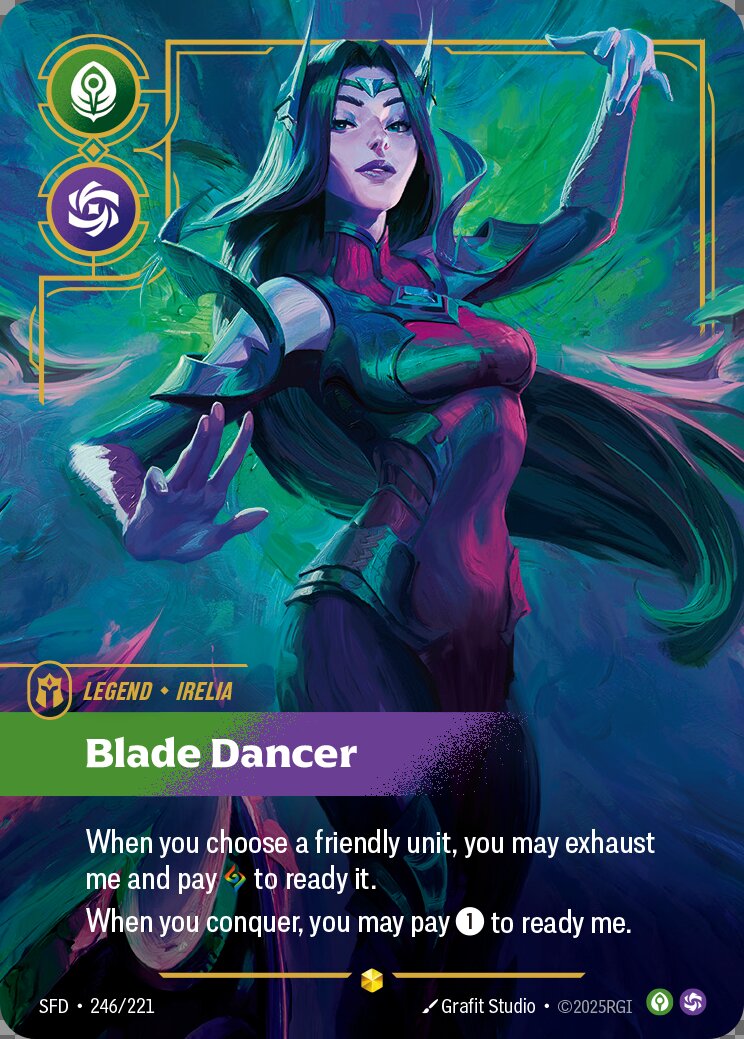
Where Origins provided the rudimentary framework of Riftbound’s gameplay loop, Spiritforged is all about giving champion legends and other units tools that can emphasize their unique strengths. I initially thought that Spiritforged was going to be Riftbound’s “Spirit Blossom” set based on its cherry blossom petal motifs and inclusion of Irelia (the Ionian blade dancer) on the promotional materials. I was wrong. Spiritforged leans into the “forged” by celebrating the items and artifacts that League players have grown to love over League’s 17-year-history, but in card form. League of Legends fans: If you’ve ever wondered how Guardian Angel would function in a TCG, Spiritforged is the set for you.
 Coming out of Riftbound’s release set, Origins, I was thrilled with most of the game’s accessibility. Sure, acquiring the cards at launch was near-impossible. The cards were sold out from just about every major retailer near me and I was lending my friends decks to play when they came over to my house. On the gameplay side of things, Kai’Sa and Annie decks were supposedly S-tier despite my insistence that Master Yi and Yasuo’s ganking effects were overpowered in day-to-day casual play.
Spiritforged is a natural extension of Origins. It retains the core rules, keywords, and loop of Riftbound’s first set without compromise. It adds meat to the combat phase, it aligns closely with League of Legends figureheads’ power fantasies, and clarifies the fuzziness of Origins’ training wheels all in one fell swoop. Best yet, it retains the gorgeous art that I just loved from Riftbound’s first set. Let’s dive into this new set of Riftbound:
First, Spiritforged introduces Equipment, an elevated version of gear from Origins that can be attached to units and champions. For you Magic fans already familiar with Artifact Equipment, Spiritforged’s equipment function similarly albeit tied to one color. You pay the summoning cost to play Equipment from your hand, and then you play another cost to equip it from the field to a unit of your chose (in most cases). The equipment cards in Spiritforged feel innately familiar as a League of Legends player, functioning similarly as items from League such as Guardian Angel (one of League’s first legendary items), Cull, Sterak’s Gage, B.F. Sword, and Trinity Force.
One of the new champions introduced in Spiritforged, Jax, takes advantage of Equipment exceptionally well. It shouldn’t be surprising, as Jax (in League) is known to use anything as a weapon. The Weaponmaster effect on Jax – Unrelenting makes Equipment cost less while Jax – Unmatched accelerates equipping Equipment from anywhere onto any friendly unit an instant affair because of the Quickdraw effect. With the introduction of so many new Equipment cards in this set, Jax decks feel the most flexible to build and containing great variance. I don’t see Jax decks being solved anytime soon, either.
Azir, League of Legends’s Shuriman bird emperor, is another new champion introduced in Spiritforged. He functions similarly to Origins’ Viktor in the unit generation department while incorporating Weaponmaster in his Legend card. When playing Azir – Soveriegn on battlefields, moving the physical Sand Soldier tokens feels like an inversed Shurima Shuffle in League (as League has Azir dash to his solders, while Spiritforged has solders follow Azir). Either way, Spiritforged is a space where League champions can reach their power fantasies in new ways, cementing their novel identities while giving them new sources of power.
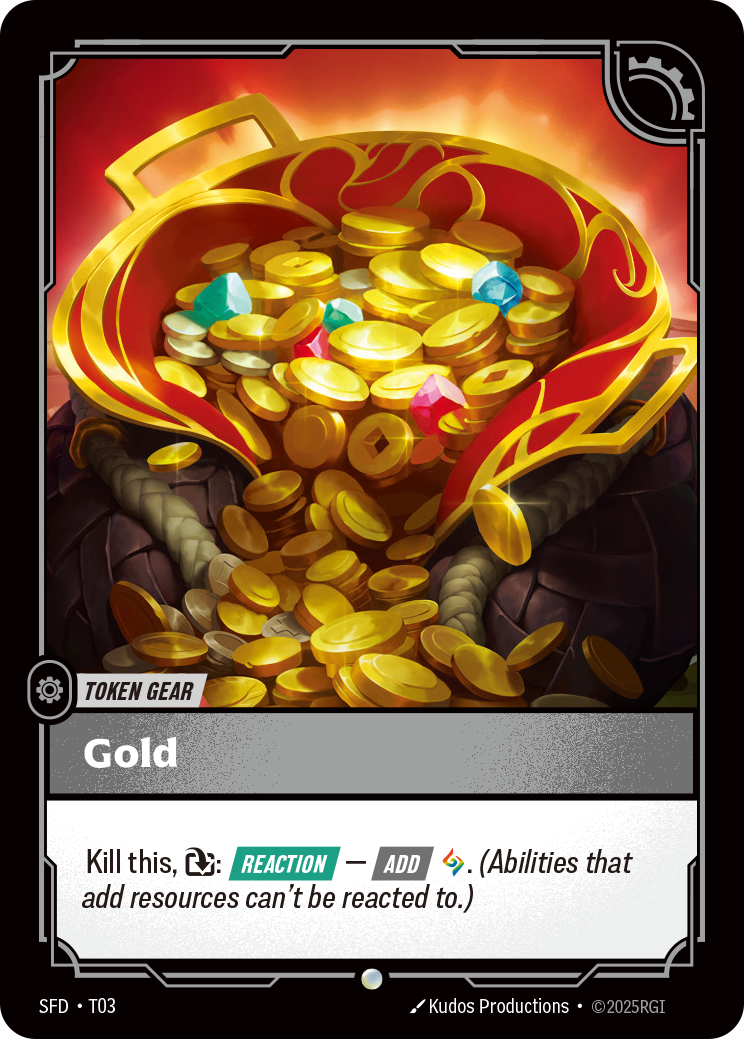 Gold gear is a new resource introduced in Spiritforged. It functions as a one-time use rune card, often coming into play after being generated from an existing equipment or champion effect. Unlike expensive Seal cards that price out casual players, Gold is generated from multiple sources. This mechanic improves existing Origins decks by giving players access to the higher-cost cards earlier in a match all the while improving deck diversity. If I wanted to play something like Volibear – Imposing (a card that costs 12 energy) or Needlessly Large Yordle (which costs 10), Gold alleviates some of that cost and helping me ramp up faster.
In theory, Gold helps players make bigger plays earlier, but it doesn’t cut down on a match’s playtime. I prefer games to have a bit of meat to them so that they’re not decided by turn 5, but I can understand that longer playtimes do not translate well to competitive events with strict time limits. My few recent matches ended up hitting the 30-minute mark or so, but some of that can be attributed to learning the few new mechanics introduced in Spiritforged.
Riftbound still needs to iron out some of the deckbuilding pain points that originated in Origins and return in Spiritforged. The biggest offender here is the Gold Gear token mechanic. A significant portion of Spiritforged’s new cards operate in the realm of generating Gold Gears…yet the Gold Gear cards themselves are almost as rare as Legend cards. When I opened six booster packs my first night, I got one Gold Gear card. One.
Building an Azir deck has a similar issue, but I’m willing to give this case a pass knowing that Origins had Viktor decks that relied on similar token generation. Azir’s sand solders are only needed for Azir decks. Gold gears are needed for, well, most of Spiritforged’s cards.
 I wouldn’t have a problem with the existence of Gold gears if they were as simple as some of the dummy simple tokens like those in Magic: The Gathering. Cards that generate tokens/dummy units in MtG say what the token does, like “Create a 1/1 goblin token with haste when I die.” That’s easy to learn and simple to understand. Spiritforged’s Card Sharp card has the description: “When you play me, you and each opponent may play a Gold gear token exhausted. For each opponent who did, you play a Gold gear token exhausted.” Cull, a purple equipment, has the text: “When I conquer, play a Gold gear token exhausted.” Draven generates exhausted Gold gear tokens when he wins combats. See where I’m going with this?
For new players, what exactly is a Gold gear token? Is it a resource, is it a unit, or is it something else altogether? Gold gear generating cards do not say. Spiritforged is adding unnecessary complexity that pushes away newer players.
In my original review of Riftbound Origins, I critiqued it for having an unnecessarily difficult champion acquisition loop. In Spiritforged, this pain point is exacerbated by the notable rarity of Gold gear cards (a core novelty of this set, mind you) whose description is only available on those rare cards themselves.
I’ll put it plainly: Spiritforged boosters should have come with a rune or a Gold gear token.
It’s slightly easier to obtain Riftbound cards this time around. At the Spiritbound pre-Rift preview event and release events, the vibe felt far less frenzied than several months back. Players of multiple backgrounds came together to test out the new mechanics and try to pull the alternate art and overnumbered (ON) cards that are somehow even more gorgeous than before. I was lucky enough to pull an ON Ezreal – Prodigal Explorer in my second pack and was pleased by its purple and blue hues. Riot has yet to disappoint in the card art department, that’s for sure.
My one lingering concern as of mid-February 2026 is on the Riftbound cards’ availability. To date, it is still moderately difficult to come by Origins boosters. Spiritforged is not meant to replace Origins, mind you. It’s meant to supplement the existing first set and open up the meta in ways that were previously unavailable. With Origins being harder to obtain than Spiritforged, the local circuits may feel locked into a meta that’s skewed towards newer cards (like the Red Draven meta that dominated the most recent local event near me). Some folks on Reddit claim that Viktor and Lucian decks may be successful, but other folks’ first-hand experience claim that Ezreal, Yi, Fiora, Yasuo, and Ornn are successful, as well.
I’m no high-level player, but all of this tells me that the current Riftbound meta is far from solved. As players continue to test what works (and what doesn’t) with the new Spiritforged and existing (yet hard-to-find-for-now) Origins cards, I’m sure that the competitive meta will evolve and keep us on our toes until the third Riftbound set releases later this year.
 Looking forward, there’s room for Riot to iron out acquiring the “must-have” cards that are tied to deckbuilding along with clarifying some of the effect nuances. The most recent Errata article (posted a few weeks prior to Spiritforged’s global release) is an excellent preemptive attempt at ensuring players’ understanding of the newest cards.
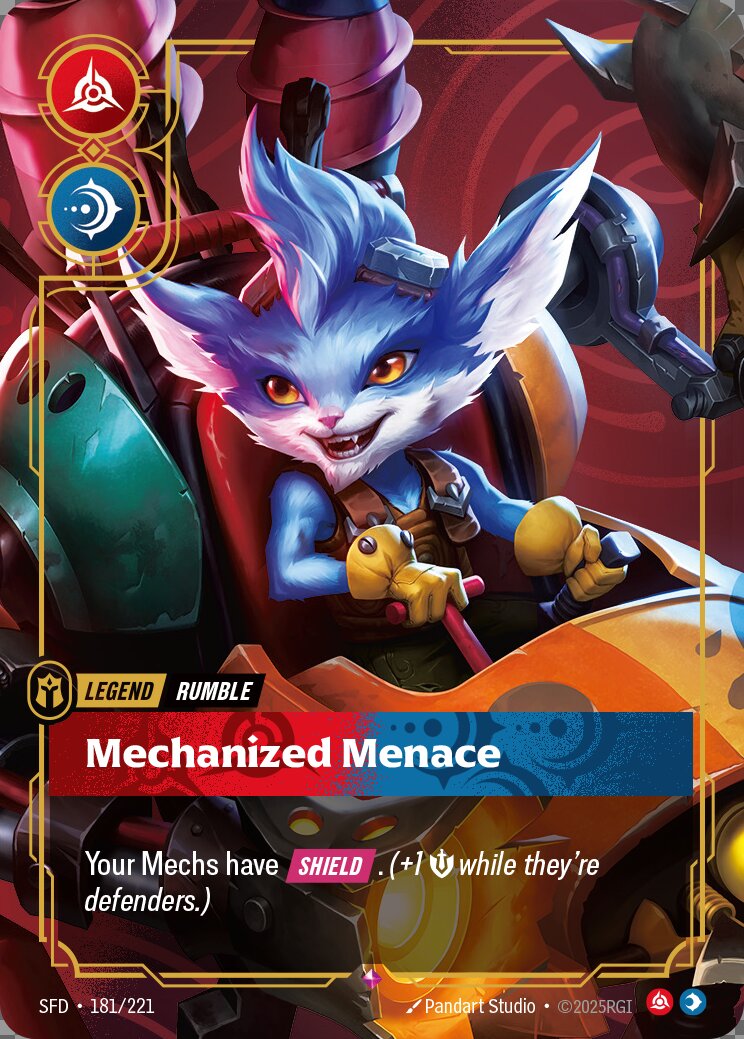
Before concluding this review, I wanted to touch on two of the precon decks that are unique to Spiritforge’s release: Rumble and Fiora. Riot included these two decks along with the rest of the cards I reviewed in this release. Riot has been crystal clear in positioning these decks as appealing for most players. Additionally, these decks are to be used as viable jumping off points in a player’s deckbuilding journey. As such, it’s expected that these decks will contain a good amount of power alongside opportunities for players to slot in cards of their choosing.
Starting with the Rumble deck, I’m generally pleased with its reliance on mostly common and uncommon mech cards. Rumble – Hotheaded boosts all mechs and lets me play mechs from my trash. Rumble – Scrapper is an excellent addition that summons 3-might Mech tokens when he conquers. This easily pushes the fantasy of summoning a robotic army (like Viktor’s precon), but with greater flexibility in summoning from multiple spaces. The issue I found is that it feels slower to play with Gold token generation cards than cards that can grant Accelerate. By that, I mean Kai’sa – Survivor or Thousand-Tailed Watcher. I know that Wages of Pain and Plundering Poro (both included in the precon) offset summoning higher cost cards via Gold tokens, but there are only two cards in this precon (Breakneck Mech [8] and Ferrous Forerunner [6]) with a largeish summoning cost. Frankly, the deck feels less weak with the inclusion of units with Accelerate. I’m not saying that the Rumble precon requires another champion (like Kai’sa or Riot’s recommendation of Renata Glasc – Mastermind) to feel complete; I’m saying that some of the existing cards hinder its fantasy of ramping up power.
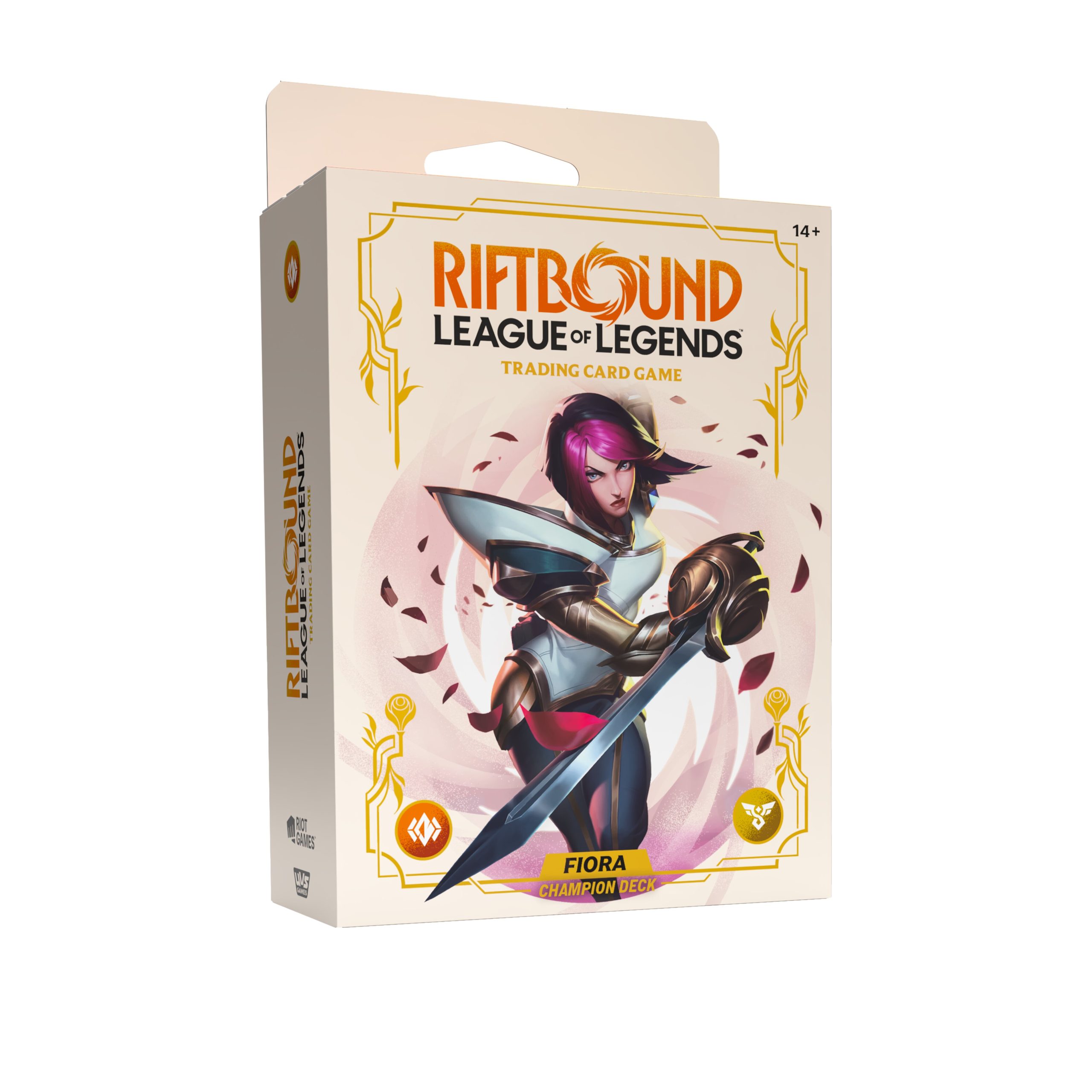 Fiora, on the other hand, feels more complete. The existing cards of the deck lean on making Fiora and other units Mighty as well as poking enemies down with Yone. Interestingly, it includes 5 Sand Soldier tokens despite lacking cards (meaning Azir) that generate Sand Soldiers. (Yes, I know that Sand Soldiers are on the back side of a generic “Buff” card, but bear with me here.) Azir can’t really be added to this deck because of it being a green yellow (while Fiora is orange yellow), so it feels like the additional draw of this deck is to kickstart a secondary Azir deck if you lack Sand Soldier tokens. In terms of additions, there’s quite a bit of potential in incorporating Sett – Brawler (who can take advantage of the Fiora Legend when he’s summoned) and potentially Akshan – Mischievous to take control of some Equipment for bonus perks. Honestly, Fiora feels like a ready-to-go deck that can function on its own with some minor tweaks.
If I was deciding between the two, I’d err on selecting the Fiora deck for its existing strength and source of Sand Soldiers (if I was a lucky duck who pulled an Azir from a Booster). It doesn’t need too much adjustment to get it ready for casual play and is relatively flexible.
Oh, on the topic of Sett – Brawler…I wouldn’t mind if it was included on the next Errata update, as I was personally confused by the “Spend” aspect.
Let’s wrap this up.
With Spiritforged’s release, Riot is building out on their existing frameworks and elevating champions’ power fantasies in new ways that feel great. Card availability and learning quibbles aside, it contains great potential in shaking up the Riftbound competitive meta and gives collectors more gorgeous cards to collect.