
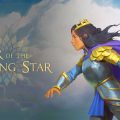
Order of the Sinking Star is a daunting, all-encompassing puzzle game--one naturally expected from Jonathan Blow. With it comes sparks of brilliance, frustration, and inspiration often in equal measure, constantly testing the brain's ability to overcome.
Order of the Sinking Star is likely a game I will never finish.
Ten years ago I wouldn’t have said the same thing about The Witness. Ten years ago, however, I was somewhat of a different person. Muted ambitions, a person working to be content at best. The solace of a game as all-encompassing and brilliant as The Witness felt grounding.
It has often been easy enough to grow lost in the worlds and moods and feelings a game provides. One lucky enough can shelve the outside world long enough to retreat to these digital spaces full of success and failure. You can exist here and accomplish something, regardless of how temporary it may actually be.
For most players, it shouldn’t take long to recognize The Witness‘ potential as a masterpiece. Whether it be the gaudy, colorful art blanketed with intention; the interconnected world where secrets are etched into its blueprint; or the deluge of puzzles that batter the player’s brain into a machine of introspection. Back then I was taken aback at how transcendent many of those early moments and mid-game reveals felt. The moment I realized I could situate myself at a specific perspective and trace a line from one carefully crafted vista to another.
The ambition to see it all was real.
Eventually, though, cognitive fatigue set in. Solutions felt more obtuse and scattershot. The answer was right there yet my neurons couldn’t find the right path. Roadblocks became prominent as time, life, and the desire to experience new worlds set in. But I’d finish it, one day.
And one day I came back. The game likely still existing on my PlayStation 4’s hard drive. A few inches of progress, not much. Colored stars making new rules in the treetops becoming the bane of my existence. I couldn’t do this right now. But I’d finish it, one day.
And one day I came back. It had probably been a few years. I wanted to expose The Witness‘ beauty to another, a fresh set of eyes. In turn, I started a new save, enamored with old knowledge being dusted off. So I went back to those old roadblocks. They felt as rigid as ever, more so because so much time had passed and this return journey was more a brief stop than anything with permanence.
The Witness is likely a game I will never finish.
Ten years later, that statement feels more comforting than it would have before.
In contrast, I know that I will boot up Horizon: Forbidden West and wrap up its story before the eventual third game–it’s simply a matter of intention and time management. Still, I lament the many games I don’t play, finish, and do everything in, almost as if I’m committing some sort of betrayal that I haven’t extracted every last ounce of value and appreciation for the work countless others put into delivering it to me.
Never could I force myself to look up a solution to a puzzle in The Witness. Doing so would be a betrayal of the game’s foundational goals. Without words the player collects knowledge, infers solutions based on past experience. Complexity is built upon as lessons from other puzzles coalesce, challenging the player to incorporate everything they’ve learned thus far. Were I to look up one solution, what would keep me from doing it again? Breaking that dam would inherently cause The Witness to lose its magic and value to me.
Could I return to it as a wiser person and make further progress? Absolutely. The only thing stopping me is me and the unyielding passage of time. But will I? Likely not. And that is still more ideal than spoiling what I have managed to preserve all these years.
Order of the Sinking Star applies everything I’ve said about The Witness, every lesson learned, every soft victory, every bitter acknowledgement that I’m (not good enough, not smart enough, not patient enough, not good enough, not smart enough) not going to get it (yet? maybe? I don’t know).
But then amplifies it, exponentially so.
How does one concisely, accurately explain a sensation to another person who has never experienced it? Describe the color of the sky to a person without sight. What do you say? Blue has no meaning but you may express that on a particularly clear day, the sky is blue in a way that water feels cool–likely because you associate a blue sky with the crystal-clear waters of a blue ocean. The task may be easier if you’re describing smell or taste to a person who lacks the other, merely because they share a connection. But I’ll always stand by things tasting slightly different if you can’t smell them.
How does one explain and describe a puzzle without also describing the solution? I dwelt on the notion for a few moments. I thought of the simple math problem: 1 + 1 = 2. Okay, so what is the number 1 to a person who simply doesn’t understand it, has no knowledge of it? And why do two ones make two? To describe that without using the term “two ones” I would have to further extrapolate, twist myself into a knot. Why does a singular, contained instance of “one” repeating itself result in two? The one doubles itself. What is “double”? What is “singular”?
What is acceptance?
At some point in the straight line of time–closer to the end point we currently sit at than the beginning–someone and then, to a vastly exponential degree, many ones accepted that 1 + 1 = 2 and sought not to inquire any further. Because what would be the point? What would really be gained from waxing philosophical and mathematical on that absurdly, stupidly simple fact?
Order of the Sinking Star, like any puzzle game, teaches you that 1 + 1 = 2 within seconds. Except the equation is in a different language, translated by a mechanic.
With controller in hand the player doesn’t question how the electricity in their bodies and brain are sending signals to their fingers to push buttons and sticks that are fueled by electronics and gadgets and circuitry that move data to a bunch of places that send that data to another place to make the thing on the screen move.
We just push the button. We just move the stick.
And in those initial moments of Order of the Sinking Star the player–though they won’t know it yet–is made aware that this is a puzzle game ultimately about pushing things around.
Players do not create portals. Players do not draw lines inside of boxes. Players do not flip gravity to get from one spot to another. Players don’t put together disparate clues to solve a case.
And in some tangential way, they kind of do in this game.
That’s because Order of the Sinking Star contains multitudes. Those multitudes can be expressed flatly by saying the game contains more than a thousand puzzles inside of its sprawling, baffling architecture. And that at the earliest inception of its opening screens, the player is going to control a character that pushing a thing around in order to get somewhere. Soon enough, the atom is split and the variations begin to confound and dazzle.
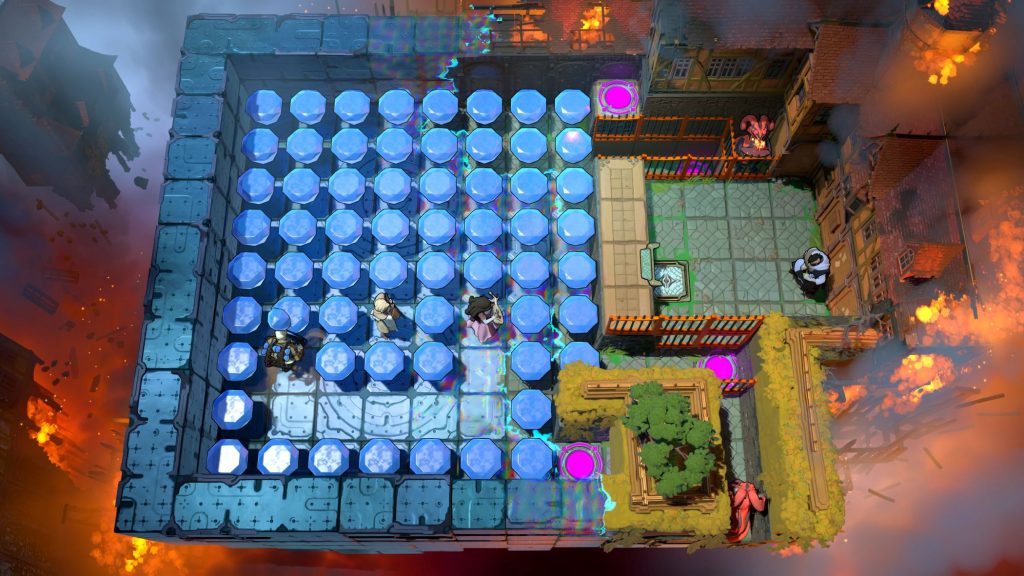
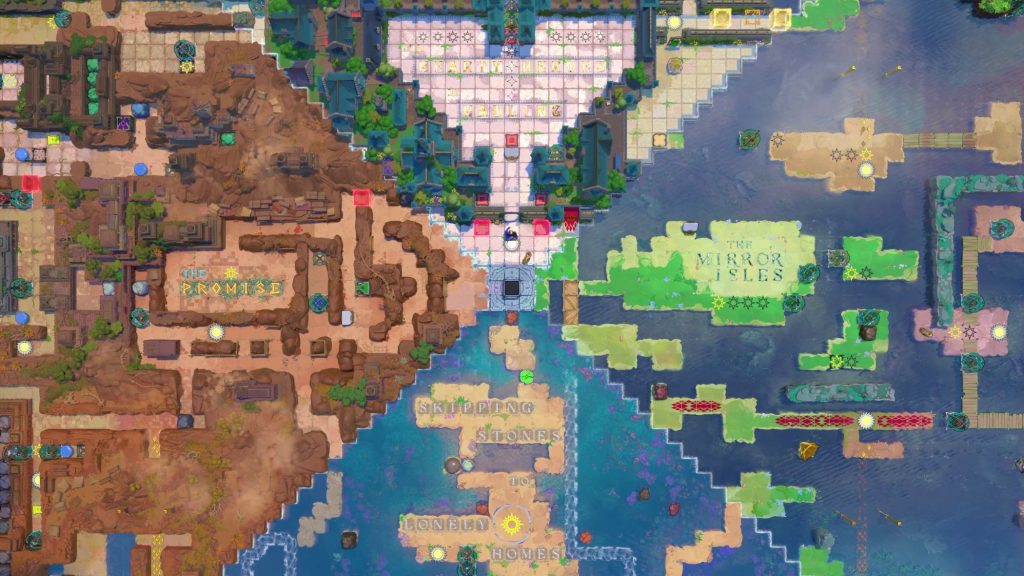
Order of the Sinking Star houses four main “concepts” that begin to branch off in exciting and challenging ways. There is a sprawling hub world that branches out in the four cardinal directions. Even contained within this hub world are puzzles, ways to navigate danger, and secrets to solve. Do we expect anything else?
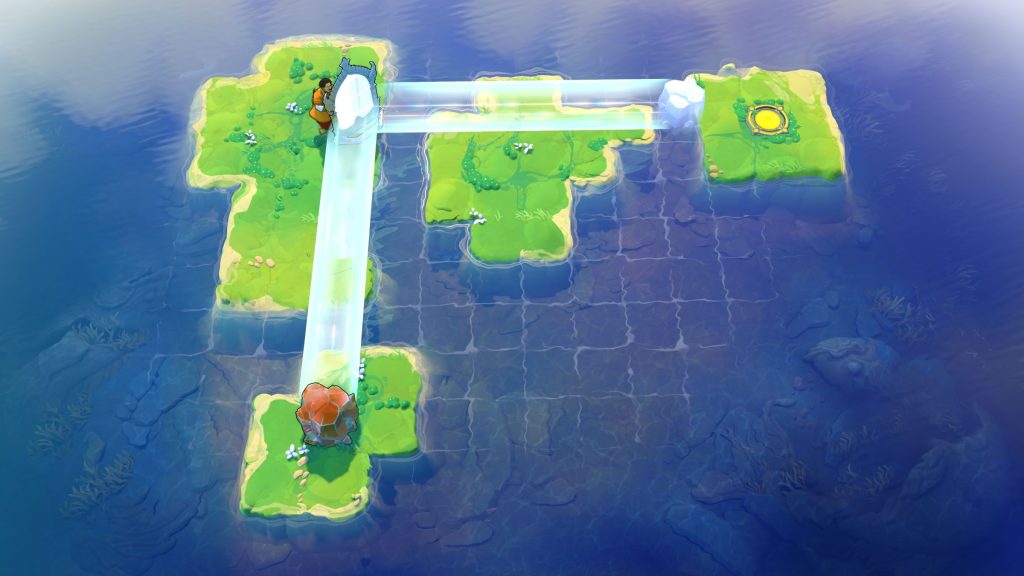
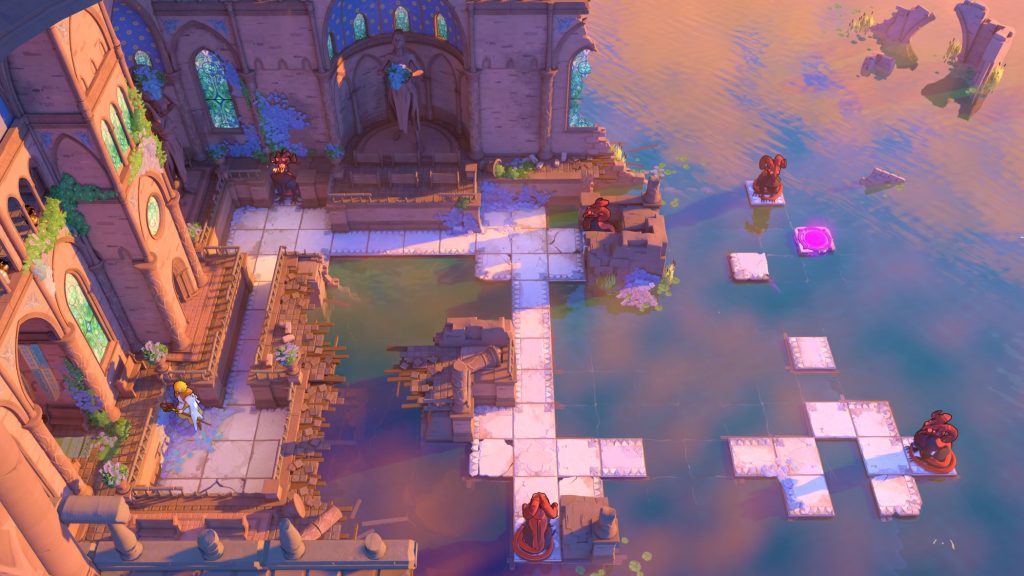
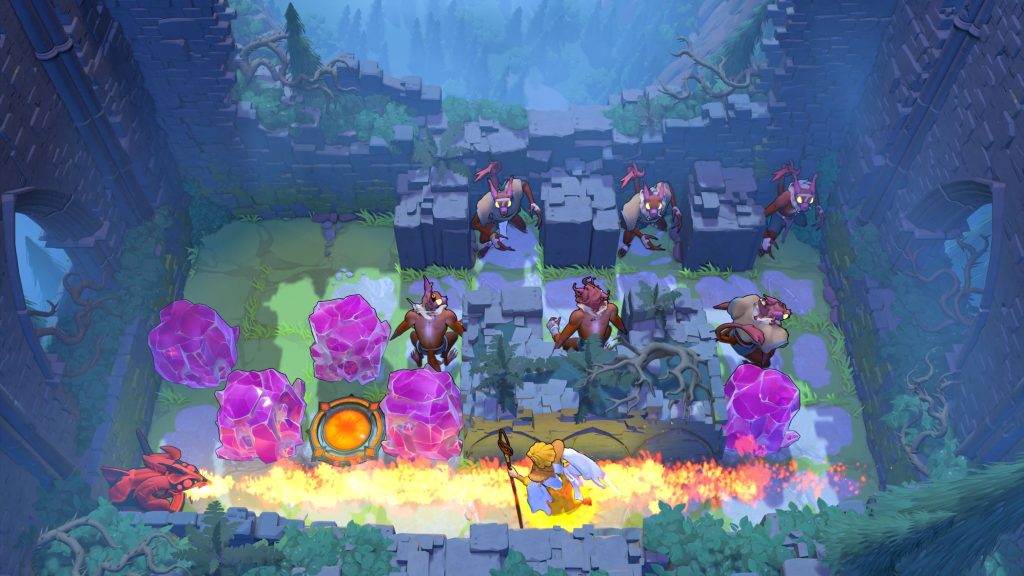
North is “Hearty Heroes of Hauling” where the player eventually has access and control of six characters each capable of one distinct ability. The warrior can push stones; the thief can’t push anything but can drag objects and characters; the wizard swaps locations with anything he makes contact with in a straight line; the bard enchants things to follow her around; the druid can turn things to stone; the cleric can’t be killed by monsters. Wait… monsters? Yes, the monsters are just a variation of stones. But they can kill the characters or each other. But they are just a part of the bigger puzzles.
To the East is “The Mirror Isles”. Here magical mirrors allow the player to swap physical form with the mirror’s reflection. That reflection could also be reflected to create a clone that can die, step on pressure plates.
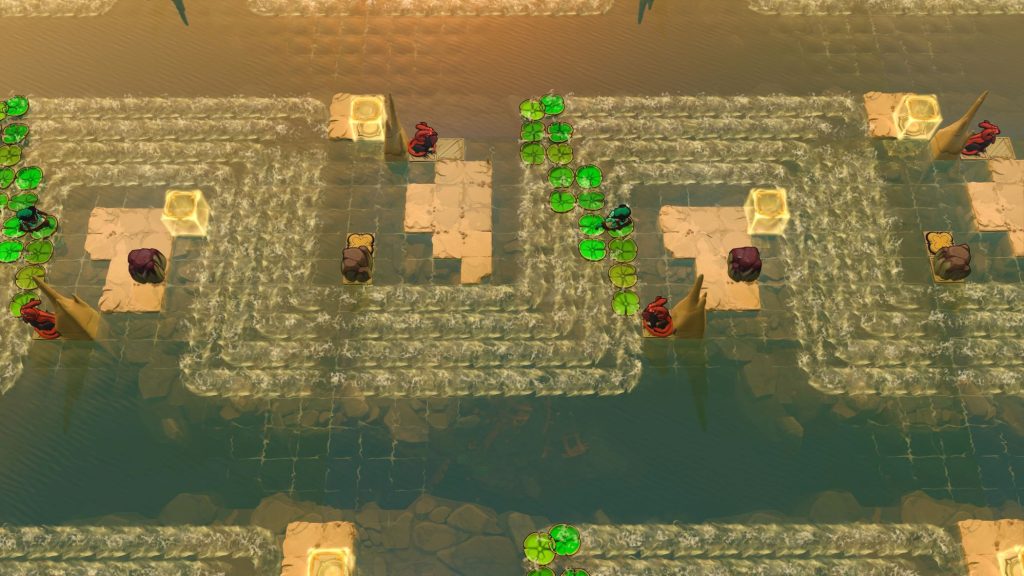
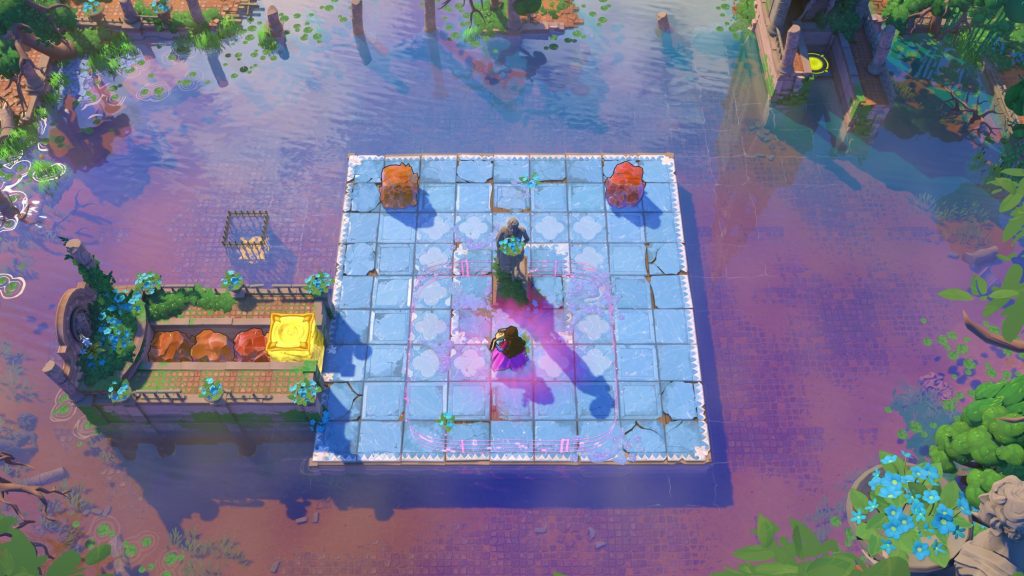
To the South lies “Skipping Stones to Lonely Homes” where large rocks can be pushed off an edge and skipped along the water. They can also ripple against leaves, pushing them along the water. Or they can block or alter the flow of water, opening up new paths for leaves to ride along.
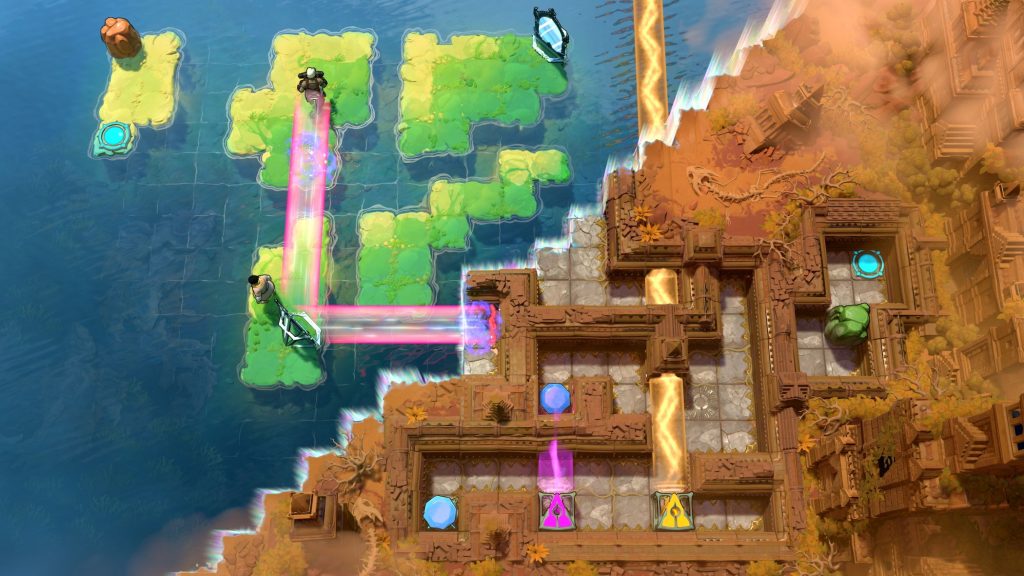
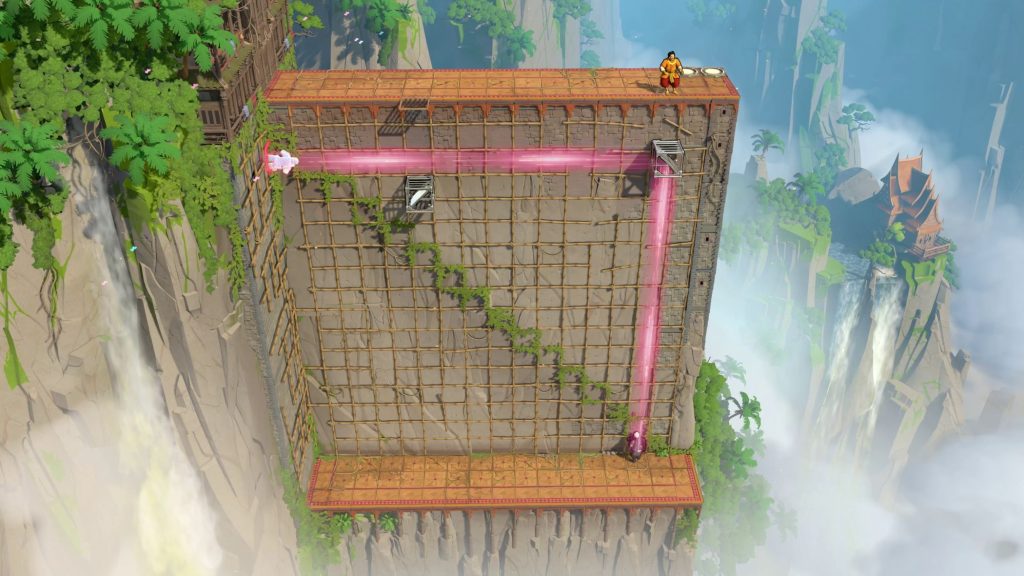
In the West is “Vault of the Beamcasters”. Gems both above and below ground power color-coded beams that empower the player to phase through solid walls, break boulders, or dispel blocks of energy.
Unto themselves, these four “concepts” could be their own game. In fact, these concepts did exist as their own games or variations on them. But Order of the Sinking Star initially acts as an anthology. Players are free to tackle whatever area they please at any time. Deem a puzzle too hard? Come back. Maybe after your brain has had a rest or is allowed to focus on a separate problem it will be fresh enough for an old challenge.
Yet what happens when these concepts collide with each other? The player has been acquiring knowledge, understanding mechanics this whole time. Will those lessons still apply when the lines blur?
Here is where I do not wish to get lost or too in the weeds with Order of the Sinking Star. Would you be satisfied if I told you that over the course of the game these puzzles begin to evolve? Maybe not.
Knowing that Order of the Sinking Star is a game that exists as a dense, unyielding series of puzzles is going to be the biggest gatekeeper of interest. You hate puzzles? You will probably hate this game, even though you should always give most things a chance to surprise you. Love puzzles? You’re likely going to love this to some extent regardless of whether you grow exhausted or not.
But not only would it somewhat ruin the locomotion of the game as each of its elements begin to move into place, it feels like a waste of time to do so. In its initial hours, dozens if not hundreds of puzzles in, Order of the Sinking Star hooks itself into the player. One chain of puzzles ends in an agonizingly frustrating moment where the player can see with their own eyes how to beat it but can’t manage the execution. They shift to another part of the map or deeper into the current segment of the world and effortlessly pass through with nary a thought.
The madness I experienced here is almost comical. The sheer frustration enough to make me want to stop playing for days and weeks on end. Then you move on with your life. Maybe to another game. Maybe to work. Maybe to bed. And then you transition back to that new series of puzzles for a bit and are cocky enough in your confidence, the taste of angry defeat still echoing in your body. Maybe you come out victorious. Maybe you don’t and end up exponentially more defeated.
The point is that Order of the Sinking Star is a constant test. A crucible for the mind. And as the game progresses, the challenges it presents pluck and borrow from each other. They weave concepts around and astonish with creativity. Those “a ha!” moments a banquet when presented to the player. Feeling like an idiot for not recognizing patterns or solutions earlier than you feel you should have.
Layering these emotions and sensations on top of each other is why one plays a game like Order of the Sinking Star. Like a good narrative or particularly awe-inspiring boss fight, puzzles can elicit similar highs and lows, a brutal determination to see it through.
Equipped in this game are numerous tools meant to encourage experimentation and soften failure. With the a click of the touchpad on my DualSense I could reset an entire puzzle from a checkpoint. Or I could press the triangle button and move a step back before I reset. Have a character get hit? Press that button and negate that mistake. Get pissed off but feel like an entire reset is too harsh? Hold down the buttons and watch the past few minutes of your existence play in reverse.
In a number of instances, I found my patience being tested at losing track of how deep into a puzzle I was. A reset felt too punishing but I couldn’t place where I went wrong. The opening of “Vault of the Beamcasters” suffered from this because it features an elaborate set up and solution with no checkpoint in sight. It’s an extremely early brain check. Additional aides like being able to zoom the map and player’s vision out to a down-down view can help make better calculations or take stock.
But please keep in mind: no assistance is offered. While subtle cues in the environment may nudge the player on positioning, the game uses every puzzle to teach a lesson. There are no hints and no way to summon any kind of assistance. Considering the vast ocean of possibility here, I absolutely see the potential for ultimate defeat being too sharp of a pill to swallow for many. Even when deep into the game’s outrageously large map, being intimidated is certainly a possibility even with a handy and clever “fast-travel” option.
Contained within all this is another series of questions constructed by a storyline that trickles out at the pace of the player’s ability to solve the many puzzles here. There’s an anchor story here that exists on the overworld and each of the four concepts has an evolving story as well. Quickly the player realizes that it is all tied together. But the nature of the game also makes a narrative somewhat difficult to follow.
Expertly voiced narration is meant to give all the controllable characters personality in whatever quest or struggle they are hoping to fulfill. But I would be lying if I said I made a significant dent in piecing together what everything was actually about. The game’s colorful fantasy settings are stylized in a way to be appealing but not take center stage. Enough detail is in place for Order of the Sinking Star to look nice but nothing to the degree of what The Witness offered.
Was I vague enough? Good.
It took me little time to acclimate to the loop of payoff and frustration I’m so often familiar with playing any game where the sliding scale of difficulty veers into brutal. Puzzles are in a different school of their own. While there are mechanics here, ones that require timing or coordination, much of the game simply relies on how clever the player is. And regardless of that metric, the most clever of players are still going to struggle where someone like me perhaps didn’t.
You simply cannot walk into Order of the Sinking Star expecting anything outside of hundreds of puzzles waiting to be solved. The game’s first ending is, in fact, passage to more game and more intrigue. Layer after layer are stacked upon each other to mystify and challenge.
Jonathan Blow revels in complexity. Since Braid, his games have used puzzles as an expressive method of telling stories and teaching the player. There are no “deaths” in the traditional sense of the word, no violence. Over the years I’ve watched Blow’s career with appreciation and fascination, seeing him as an important voice in the medium. Being a human, Blow is riddled with complexity and it would do little good to attempt to tackle any notion of advanced understanding of the man’s trajectory over the years. Because what remains is an unquestionable impact on the craft. You can feel the decade of time it took to gestate this game and release it into the world. Those thousand puzzles acting as an archive your mind can scour through until an inevitable stopping point.
Will you ever finish Order of the Sinking Star? If you’re me, it’s hard to say. Will you want to? Absolutely, with every fiber of your being. This is unquestionably one of those rare works. It’s almost impossible to contend with how it was created. How was this dearth of ideas formed into a complex network of well-made puzzles that always say something relatively new? That may just be another puzzle waiting to be solved.
Order of the Sinking Star is a daunting, all-encompassing puzzle game–one naturally expected from Jonathan Blow. With it comes sparks of brilliance, frustration, and inspiration often in equal measure, constantly testing the brain’s ability to overcome.