

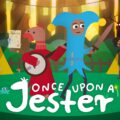
Equal parts original, absurd, goofy, clever, catchy, and sincere, Once Upon a Jester is a gem of creativity that uses hilarious writing and a wonderful soundtrack to punch well above its weight.
At the beginning of the year I played a small microcosm of a game called Techno Banter released by publisher Crunching Koalas. Who would of thought a game about an anthropomorphic bouncer at a nightclub in a dystopian metropolis would have resonated so much with me? And yet it did.
Techno Banter is not wholly profound by any stretch of the imagination. But its concept is so different. It has flecks of other games etched across its facade but delivered in a contained package that just begs for a few hours of your time to experience it. It isn’t too long, has some incredibly striking high points, and gets the hell out of dodge before the effects can wear off.
Though it released three years ago on PC and Nintendo Switch, Crunching Koalas is bringing another similarly unique game to PlayStation 5 and Xbox Series X|S.
Once Upon a Jester is a humble experience. It can be cleared in a handful of hours–maybe three or four if you really stretch its real estate–but uses that time wisely. Much like Techno Banter, its core gameplay conceit is somewhat repetitious but works within the confines of the game, never demanding too much of the player and always attempting to be weird and different enough to make itself enjoyable.
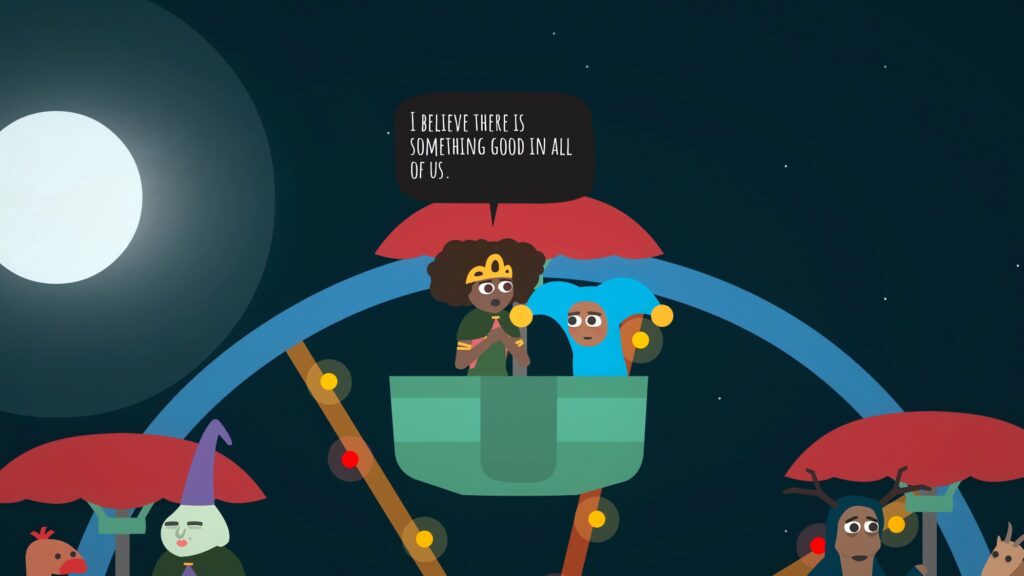
As a primarily narrative adventure, the largest portion of Once Upon a Jester is told through both dialog and song. One might call it a half-musical only because original music doesn’t encroach over too much of the game. It’s a simple story–one told through song, theatrical interpretation, and jokes. Most often, Once Upon a Jester is meant to make the player laugh but frequently enough, sincerity breaches the subtext and those lyrically inclined may feel a tug on their heartstrings and soul.
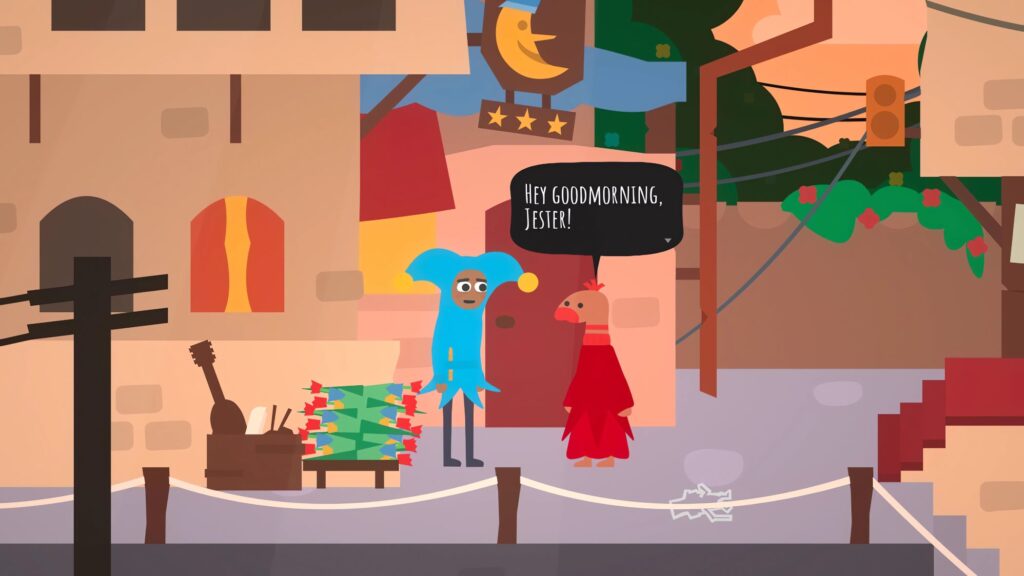
To boil it down simply, the game centers around the duo theater troupe of Jester and Sok, a guy dressed in jester outfit and the other who is an anthropomorphic sock. Yeah, it’s that kind of zany world of chaotic, questionable, and weird NPCs meant to evoke a Sesame Street or Muppets vibe.
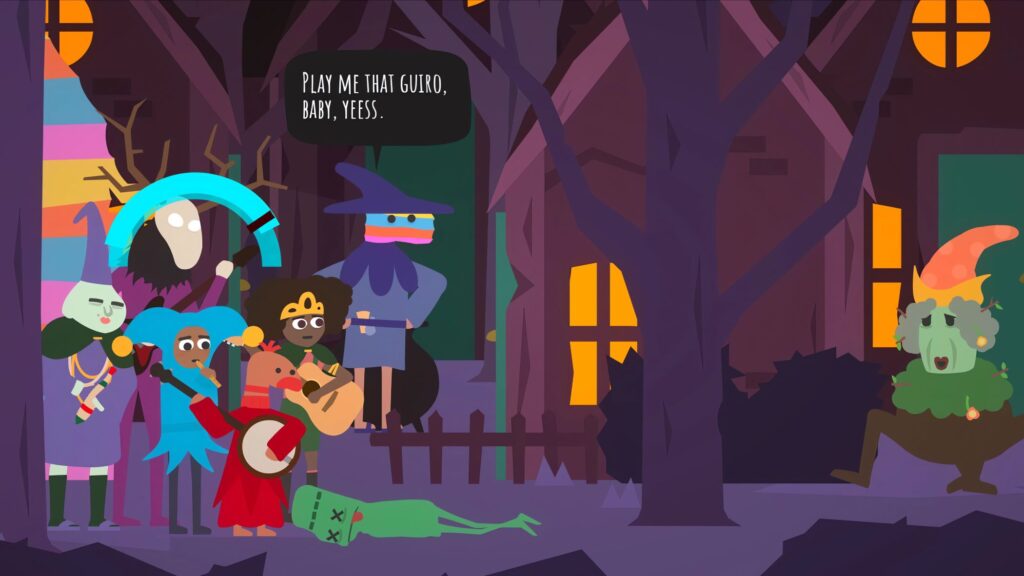
This is a world of childlike wonder, of slightly muted pastels and color. Environments and characters look cut out of construction paper, maybe ripped from a book like Chicka Chicka Boom Boom. Though papery and cartoonish, Once Upon a Jester is wide-eyed with life and vibrancy, instantly inviting and enhancing its playful nature.
Jester and Sok are lazing about their hometown as they’ve apparently been doing since childhood. And when the game starts, they overhear Princess Kirstina announcing “The Royal Theatrical Spectacle”. A performing group who collects 15 bouquets of flowers across three towns will win the opportunity to perform at the Royal Palace? The twist? The biggest diamond in the land is housed there and Jester and Sok plan to win the spot and take the gem. The other twist? Apparently there’s a curse going around that may or may not be caused by the diamond and may or may not be causing the King, Kirstina’s father, to be taken ill.
Once Upon a Jester follows four bite-sized acts as Jester and Sok build up a reputation of performing and eventually team up with the Princess. It is not complex and it doesn’t have to be.
Over the course of the game there are revelations played for comedy, drama espoused to make the game not feel entirely like a joke, and a wealth of improvisational creativity. When credits roll it won’t matter what the end result was because it is played off warmly and humorously, like a cartoon with only tangential lessons to be instilled in the player and viewer.
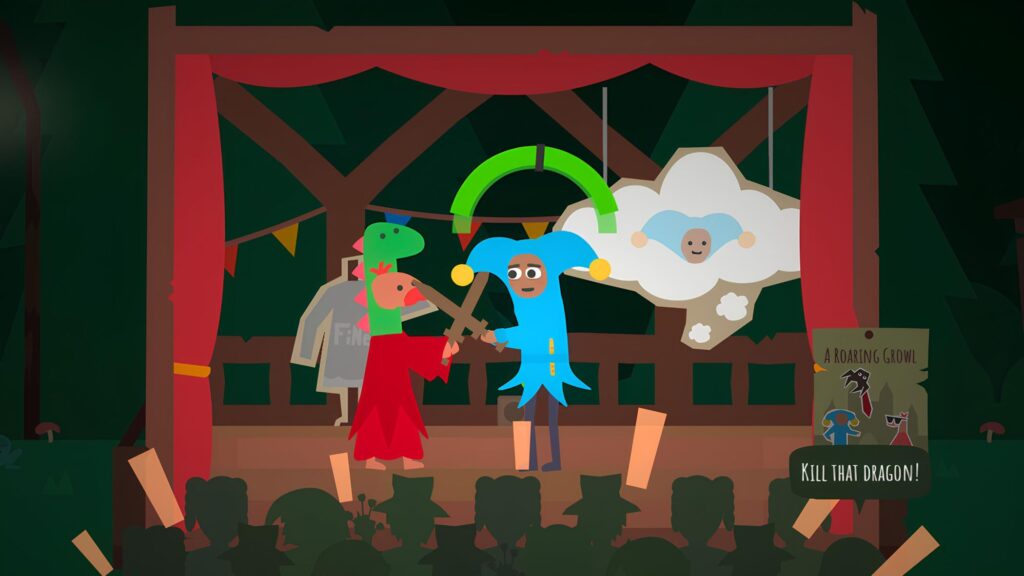
Mechanics in the game are mostly limited and primarily contained to the impromptu performances players put on for the townsfolk. A very remedial method of moving Jester to a cluster of people on the 2D level and observing the images on their speech bubbles gives an indication of what kind of performance they like and dislike for the evening.
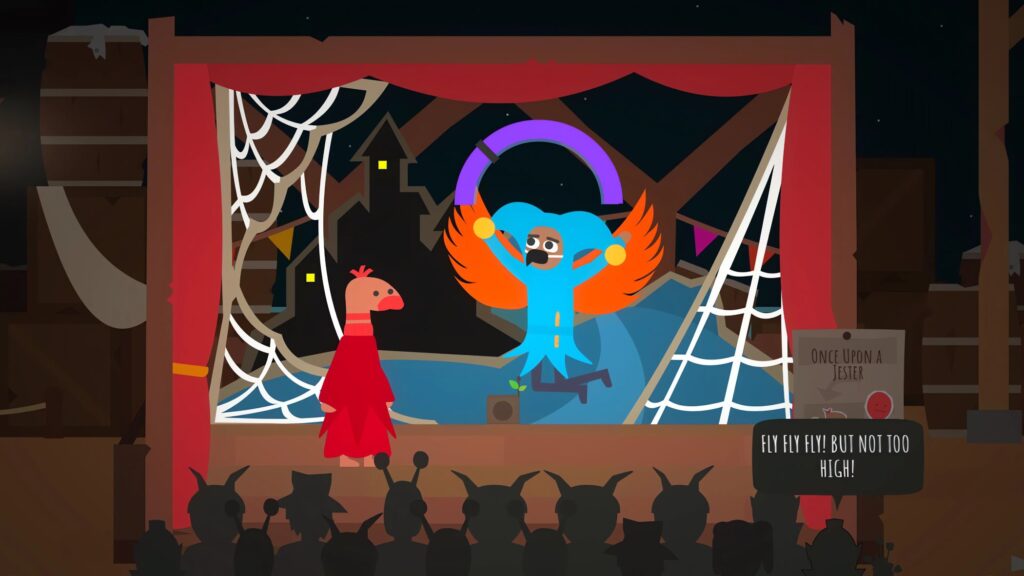
During a performance players have the option of engaging in bits that focus on horror, action, romance, drama, and singing. Perhaps as a dramatic bit, Jester will put on a pair of wings and pretend to be a phoenix. During action scenes he may spar with Sok using a sword. For horror he may chip away at a marble statue and give it tentacles and numerous legs.
Players who choose “correctly” earn favor–and by extension, bouquets–from the crowd who chant and react appropriately based on what is happening on stage. Gasps, jokes, tongue-in-cheek commentary, and dry humor give a sense of reaction, making the short plays feel more alive.
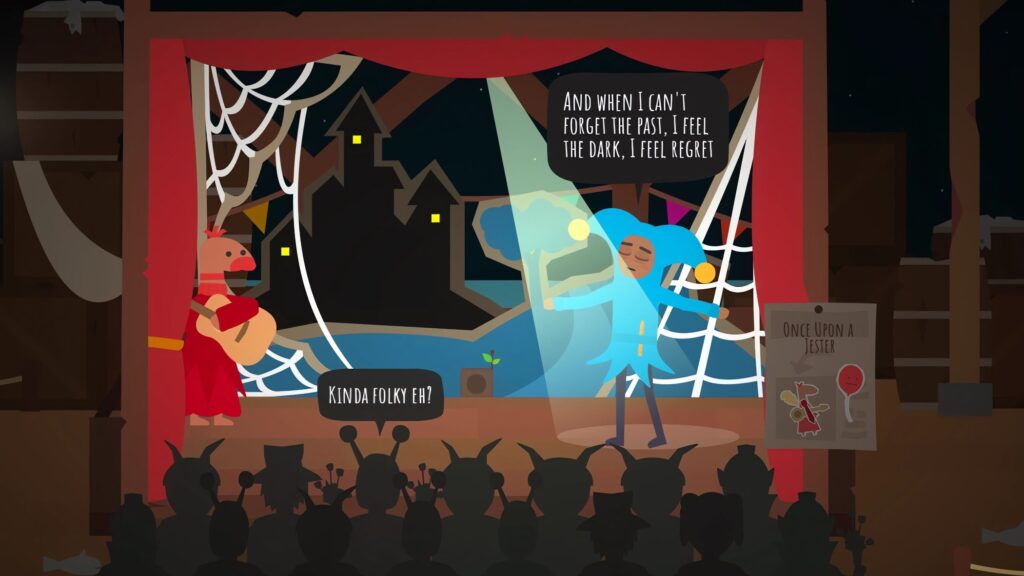
For a splash of gameplay, performances may require players to correctly mimic noises like a game of “Simon Says”. A pendulum swinging over a colored bar indicate when to hold down a press of X. Think less QTE and more casual interaction. While players can certainly fail a specific bit–dropping their sword or failing to scare Sok–it won’t halt the performance, more likely just reduce the number of flowers earned at the end of the performance. And I don’t think Once Upon a Jester truly has any kind of “fail state” and will merely allow the player to churn out performances until they meet the required 15 for that town.
Here and there players will earn stickers for following through with hidden events, pursuing conversations with NPCs and townsfolk, or performing each play with a specific genre. These stickers are used to create posters which are just a silly prelude to beginning each performance and nothing more.
And with only three performances total, Once Upon a Jester could get somewhat repetitive for players seeking absolute variety. But if the goal is to eke out and exhaust all the potential options, there’s enough silly humor in each option that they are all worth seeing out, even if the structure of each performance results in repeated dialog.
For me, frustration did arise when a little over halfway through the game, I quit to the main menu and found I wasn’t able to select “Continue” and only “New Game” or “Options” was offered to me. Were there no auto-save checkpoints? I honestly wasn’t sure what happened. The game wiped all my stickers and acted like I hadn’t touched it before. In total I lost about 1.5 to 2 hours of playtime in a sub 4-hour game. It felt painful. One time a song stopped playing and I only could hear the ambient noise of a train rolling by. A few times dialog felt cut off or interrupted. But the progression wipe was truly crushing. Still, I pushed through and earned a platinum trophy in about five hours despite the game not featuring any easy way to replay bits or skip dialog and cutscenes.
As simple as Once Upon a JesterOnce Upon a Jester review truly is, it’s the humor and music that make it transcend the duldrums of a quirky narrative adventure game that thinks it’s more clever than it actually is.
Would I not have known it going in, it’s readily apparent that the duo behind developer Bonte Avond are musicians. But they are also clever, personable lyricists, voice actors, and writers.
The sum of Once Upon a Jester‘s parts is a bitingly hilarious game with an incredible score that feels eclectic and folksy. The game feels like it was designed by a group of people who got stoned one weekend and wrote and designed and performed a game in totality.
When I first heard laughter at the end of a line of dialog I thought it was a mistake. The same when words were mispronounced from their subtitles. But as the pattern continued, I realized that Bonte Avond weren’t just taking the piss out of players, they were inviting them along for the fun and absurdity. Constantly throughout the game you’ll catch laughter, mumbled words, and incorrect lines just thrown in there. Yet it doesn’t feel forced and purposeless. For someone like me, I found it fucking hilarious.
Once Upon a Jester features a fourth-wall-breaking joke that is likely in the top five times I’ve laughed hardest at a game. It’s not that the moment was stupid (it kind of was), it was that it felt so appropriate and so silly and happened only once halfway through the game. It was this savory morsel of comedy that I ate right up.
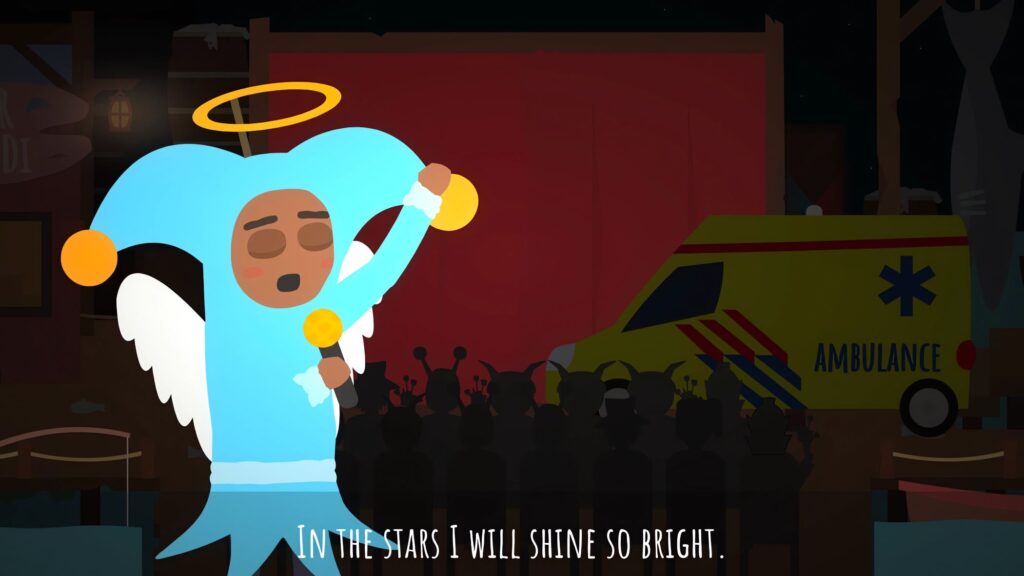
And the songs. Man… As a fan of indie music, Once Upon a Jester‘s 30-second jams and jingles take on a life of their own. They are silly and out of left field. They are sincere to the point where I felt a slight gut-punch of emotion. These are album-worthy tunes (convenient because they are available in that form) that are not only written well, they are performed incredibly. Mark and Kyon of Bonte Avond bring their Dutch accents and charm to a number of the characters, laughing at their own absurd accents that will tickle anyone from child to adult. But their singing voices are humble but maintain a depth and elegance that is molded into the few genres that the game touches upon.
Once Upon a Jester feels curated to be improvisational, much like the theater performances in the game. Bonte Avond obviously had a plan, they mapped out a game with art and writing and programming. But in a way, it feels almost guerilla-style. They are throwing players into their tour bus and taking us all along for the ride, performing to an eager group who just want to be a part of the fun. While short and maybe a bit silly, Once Upon a Jester succeeds because it strives to be different, personable and, ultimately, fun.