
Ninja Gaiden: Ragebound is a near pitch-perfect interpretation of Ninja Gaiden's long-dormant 2D roots. The Game Kitchen has taken its pedigree in the space and crafted a blisteringly satisfying side-scrolling action game that feels at home in any console generation.
Ninja Gaiden: Ragebound effortlessly replicates the old-school fangs of Tecmo’s 1988 classic not by innovating but by staying true to form.
Developer The Game Kitchen–who is also responsible for the fantastic Blasphemous series–understands that the path towards creating a “classic” 2D Ninja Gaiden game isn’t by layering complexity on an already tried and true formula.
The Ninja Gaiden trilogy on the NES is in the pantheon of brutal platformers, among the likes of Battletoads, Castlevania, and Ghosts ‘n Goblins. But what made games of their ilk unique wasn’t particularly in their unfair mechanics or broken design. No, Ninja Gaiden was deviously simple in execution. Ryu Hayabusa remains one of the most agile protagonists of the 8-bit era. He could jump, cling to walls, slash his sword, and use a handful of abilities.
Where Ninja Gaiden tormented players was in its rage-inducing enemy design. Birds would swoop in from the far side of the screen and strike Ryu, turn on a dime, and come back for more. Enemies throwing projectiles would perch on thin platforms near perilous pits, begging Ryu to make a poorly-timed jump. A devious combination of grueling jumps, bottomless falls, and dense enemy combinations that started shaving off more health in later levels meant that caution was a necessary tool.
And, of course, was the fact that Ryu would fly backwards when hit by an enemy. Any player worth their stripes knows this ancient, forbidden knowledge of gaming past. I’m sure the times I died from such malarkey would go into the triple digits.
A few weeks ago I was able to play a small sampling of what Ninja Gaiden: Ragebound had to offer. I couldn’t help but make note of protagonist Kenji not flying backwards when being hit as the foundation of my preview.
Such a simple programming change flies in the face of an entire generation of games and their development teams. What was the ultimate goal of that quirk? Why did so many creators feel it was necessary to have their protagonist helplessly recoil when struck by the weakest and most ferocious of enemies? A bullet or a demon from hell would incur the same penalty?
Sure, the easy explanation is that a cheap death made the game harder, incentivizing a full purchase instead of renting a cartridge for a night or two. But sometimes it felt intentional, even mean. Why would a ninja like Ryu be tossed around so effortlessly?
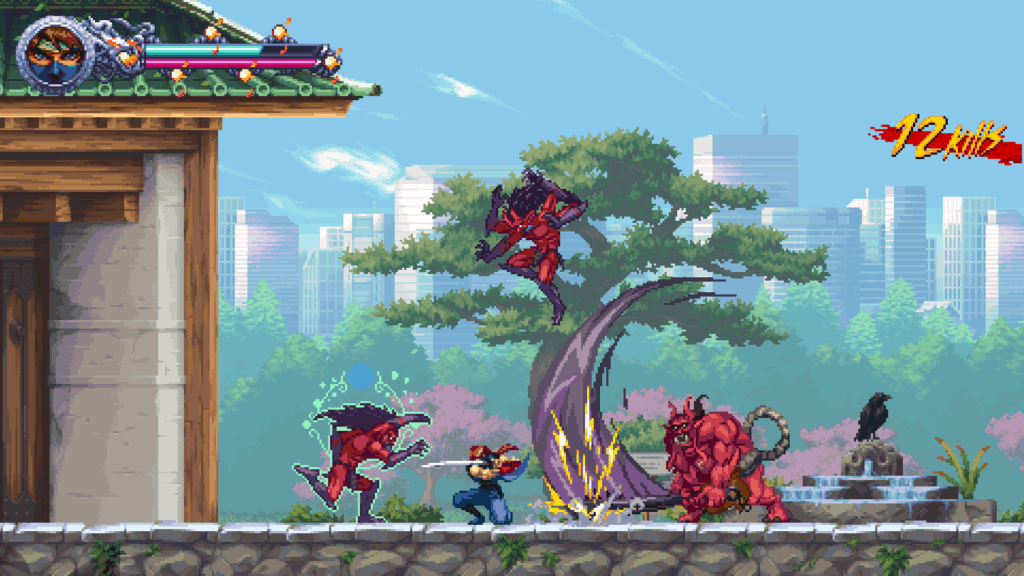
Ragebound is a difficult game, especially in its latter half when players are expected to have acclimated to its handful of quirks. But it never feels wholly unfair in what it asks of the player. Those nervous about difficulty have the option to incorporate some friendly accessibility options such as decreasing the game’s speed, reducing damage received, and stripping knockbacks out. But even here, Kenji being knocked around isn’t egregious, merely an element that stops momentum briefly and encourages caution when jumping over pits.
Much like the original Ninja Gaiden games, Ragebound feels best when the player is in constant locomotion. Anyone who struggled with the NES titles as a youth has perhaps watched various speedruns of the game. As a kid, it would have taken me a couple hours to beat Ninja Gaiden, adding in deaths and the genuine fear that its flood of enemies posed. But the world record stands at 11 minutes and 32 seconds for fastest completion.
I’m not sure if Tecmo designed Ninja Gaiden in a way that was made to be cracked open with damage boosts and flawless gameplay but when watching a speedrun, it feels that way. The brilliance of Ragebound is that it amplifies the sensation of every enemy and hazard being thoughtfully placed to maximize speed and skill. This is a pure action game that empowers the player to master a handful of moves and blitz through challenging foes and platforming feats.
Perhaps my sole gripe with Ragebound is its narrative. Now, I don’t come to a Ninja Gaiden game in hopes of a sensible plot about the way of the ninja. I love that The Game Kitchen maintains the tone of clans of ninjas clashing, demons attempting to take over the world, and government agencies being involved. Ragebound hits those notes and the moment a CIA agent appeared, it made me think of Ryu and Irene.
Where Ragebound falls short is the way the narrative is executed. In 1988, Tecmo’s method of delivering exposition was done solely through flashy cutscenes which, for the time, were absolutely novel. Pixelated images that would sometimes move and shift would be accompanied by text, adding “serious” drama to a plot that honestly didn’t require it. But it gave Ninja Gaiden added flair and charm.
For as much of an homage as Ragebound is, I was surprised The Game Kitchen didn’t lean into these specific roots more. Characters will run onto the scene and the action will pause for dialogue boxes to appear. Occasionally, the character portrait may blow up in size or an actual cutscene may play. But ultimately, it’s safe. I wanted something more bizarre and stylish, perhaps more absurd, in my game about ninjas fighting inter-dimensional demons.
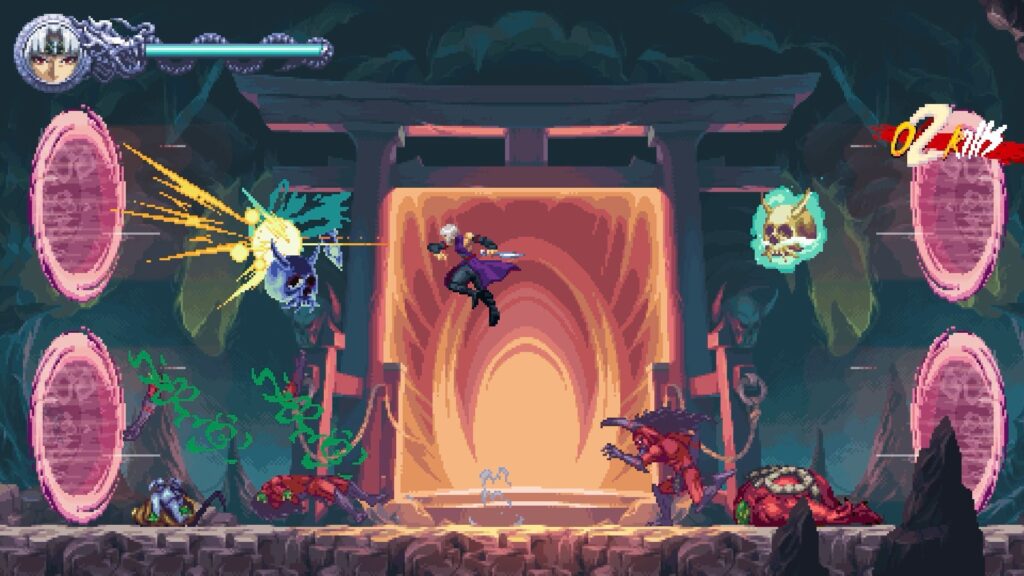
Two elements transform Ragebound‘s action, elevating what would merely be an otherwise satisfying side-scroller. The first comes from Guillotine Attacks, a momentum-enhancing technique that requires to tap the jump button while in mid-air. Doing so will cause Kenji to spin in a flurry, bouncing off enemies and projectiles. This isn’t an uncommon tool in gaming but Ragebound incorporates expertly into the game’s action and platforming.
As expected, there will come times where players will cross gaps and climb heights by merely bouncing up and over pockets of enemies. But more importantly, the Guillotine Attack is used to dispatch foes in the air and set up new paths of assault.
Secondly, Ragebound allows Kenji to become Hypercharged by killing foes with colored auras. When Kenji is Hypercharged, he can instantly kill larger foes that would perhaps take multiple slashes to bisect. While it may sound simple, Hypercharged attacks are weaved into the flow of levels much like Guillotine attacks are.
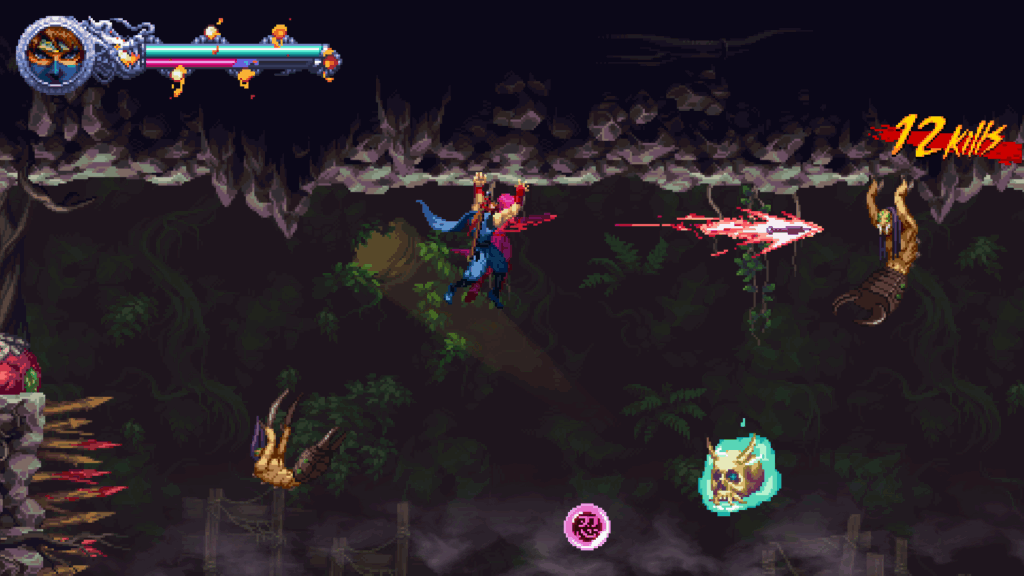
Enemy composition and appearance is clever and frequent. Trash mob ninjas and demons that die in one hit will fly in from all sides of the screen and skilled players will be able to maintain a kill combo throughout the level. Those who are fast and determined will recognize that there is minimal dead air between encounters and losing a combo simply means that players weren’t barreling ahead.
Enemies that act as temporary brick walls can be bounced off of with a Guillotine attack but it’s risky. Instead, players may wait a beat or two and a glowing enemy will appear to set up a Hypercharge attack. The seamless way The Game Kitchen accelerates difficulty and more complex encounters proves the developer is an expert at thoughtful action that isn’t grueling but smart.
These are levels meant to be memorized and understood. While Ragebound can be completed in around 7 hours, enough incentive is added to potentially double that time for completionists. Each level has optional skulls and golden scarabs that may require perfect timing or skill to access. These can be used to purchase modifiers that either aid the player or make the game even harder by increasing damage or causing the level to be reset upon death. Additionally, each level has an optional set of side objectives. Players are tasked with killing certain enemy types, beating a level without taking damage, or performing a difficult feat. Completing some of these objectives can be done on the first try but most will require education.
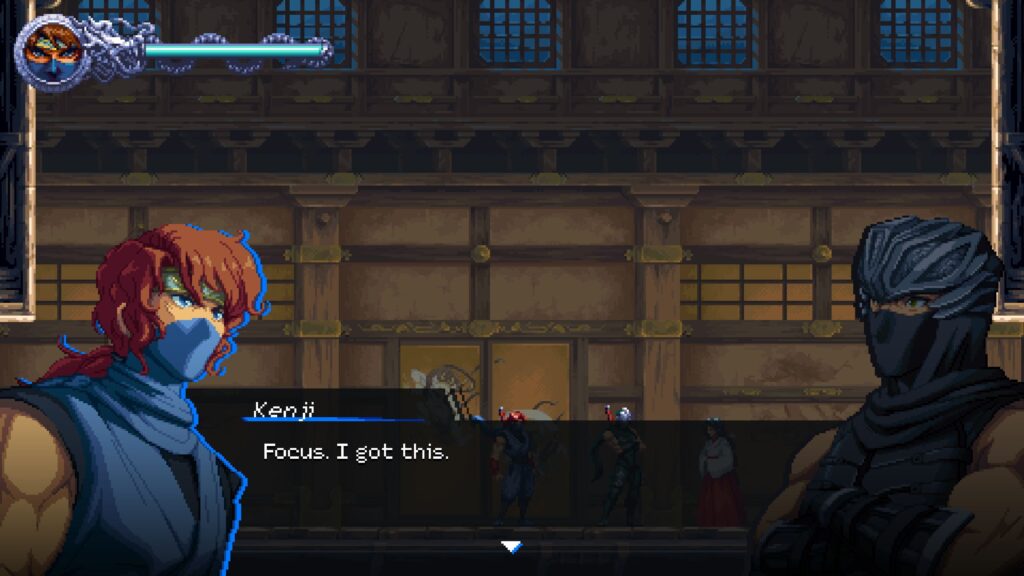
Every aspect of Ragebound is done in service of providing players with a masterclass in speed and agency. And even the incorporation of secondary protagonist Kumori is executed quite flawlessly. Kumori is a member of the rival Black Spider clan whose soul becomes bound to Kenji. Players are given a handful of levels playing exclusively as Kumori to not only flesh out her character but to provide a slight alternative to Kenji’s katana.
Kumori throws daggers, meaning she can attack from a distance while providing a slight timing adjustment to enemies who are quick to close the distance. But when Kenji and Kumori become fused, her repertoire is added to Kenji’s body. Players are granted a Ki meter which allows Kenji to throw a dagger or an arcing blade that can pierce through solid ground. While it’s good for dispatching distant foes, a new Hypercharge aura is also introduced. Blue aura enemies killed by Kenji’s slash will grant him Hypercharge, while the same applies to purple aura enemies killed by Kumori’s weapons. Though it may not sound like much of a wrench in the action, it asks speedy players to be slightly more mindful of how they attack. And over the course of battle, a special meter is built up enabling players to execute a special attack that can either deal devastating damage to all enemies on screen, or perhaps provide a healing aura.
Sections of a level may also involve an impassable gate that is unlocked by sending Kumori into the spirit realm. These parts are purely speed-based, as Kumori’s ability to maintain this state slowly ticks away, refreshing only when attacking thoughtfully placed orbs. These parts of Ragebound are more entrenched in puzzle-platforming than pure action. Kumori may have to time a dagger throw at a floating platform in mid-air to be teleported to it. Or she may have to Guillotine Attack over large distances.
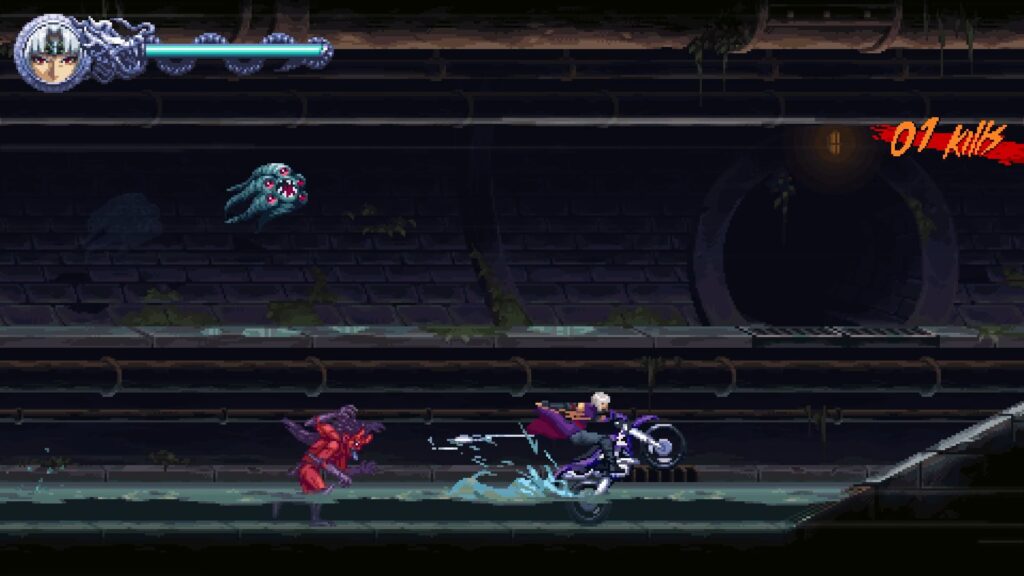
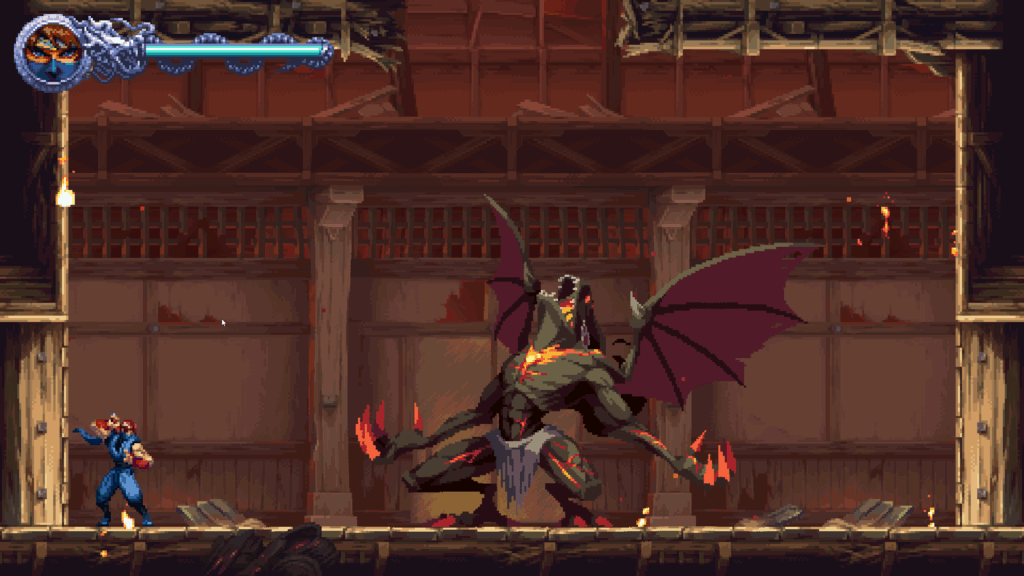
While some players may be exhausted at the sheer amount of jumping and slashing through legions of demons and ninjas, The Game Kitchen has finely tuned Ragebound in a way that allows it to never linger for too long. A few classic vehicle sections hearken back to arcade beat ’em ups. Boss fights are challenging and thoughtful, if not infrequent. And each level has an almost perfect length that doesn’t feel too rushed or too long.
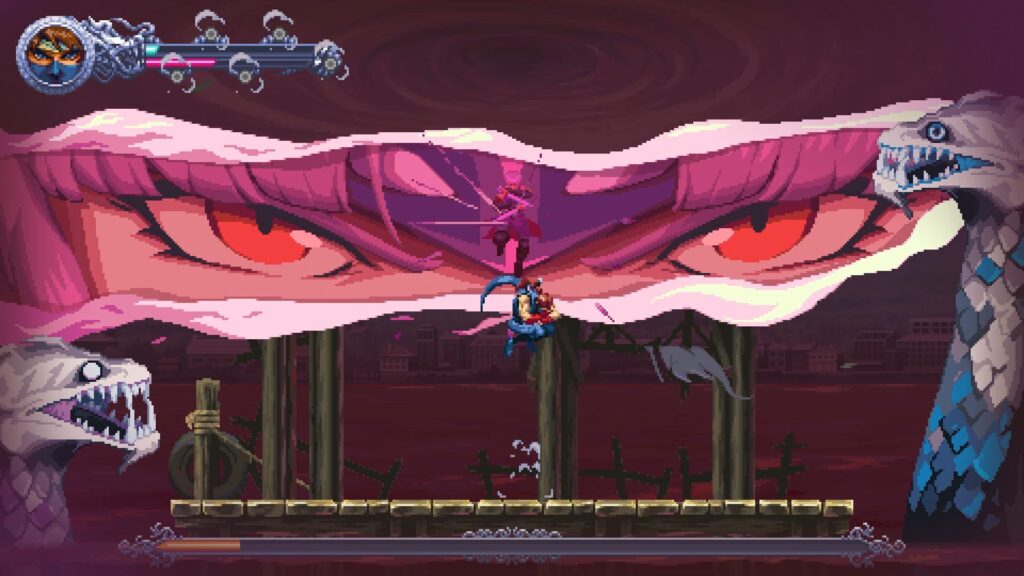
But most crucially, none of this would matter if Ragebound didn’t feel like a dream to play. At no point did the game feel clunky or Kenji feel like he missed a jump. Tight controls are tantamount in an action game requiring precision and careful execution. This is absolutely no exception. Often well-tuned movement comes across as an afterthought merely because the game plays so naturally well that it doesn’t stand out like other elements. Ragebound has impeccable pixel art–as did Blasphemous. The soundtrack is pulsing and rife with Ninja Gaiden callbacks. All these call for attention, unlike the simple flow state one may get in because they don’t grow frustrated by shoddy controls.
Ninja Gaiden: Ragebound is a pitch-perfect action game that revitalizes the long-dormant Ninja Gaiden franchise, smartly calling back to its 2D roots. For a series that was known for brutal difficulty before it became a household trend, it’s wonderful to see a developer like The Game Kitchen use their own expertise to translate decades-old concepts so expertly in the modern day. Blistering speed and challenging, satisfying combat are the hallmarks of any great action game and Ninja Gaiden: Ragebound does not disappoint.