

Motorslice from developer Regular Studio sits between being a great game and one that still needs some work. It is a parkour action game that has some very good intentions in its design, but the execution sometimes trips over itself in a couple of areas. The biggest flaws in this game lie within direction, meaning knowing what you’re supposed to be doing, and requesting the player to use mechanics that are frustratingly difficult at times. Who hasn’t played a parkour game and not been frustrated, right? It’s tough to replicate good mechanics for that type of movement.
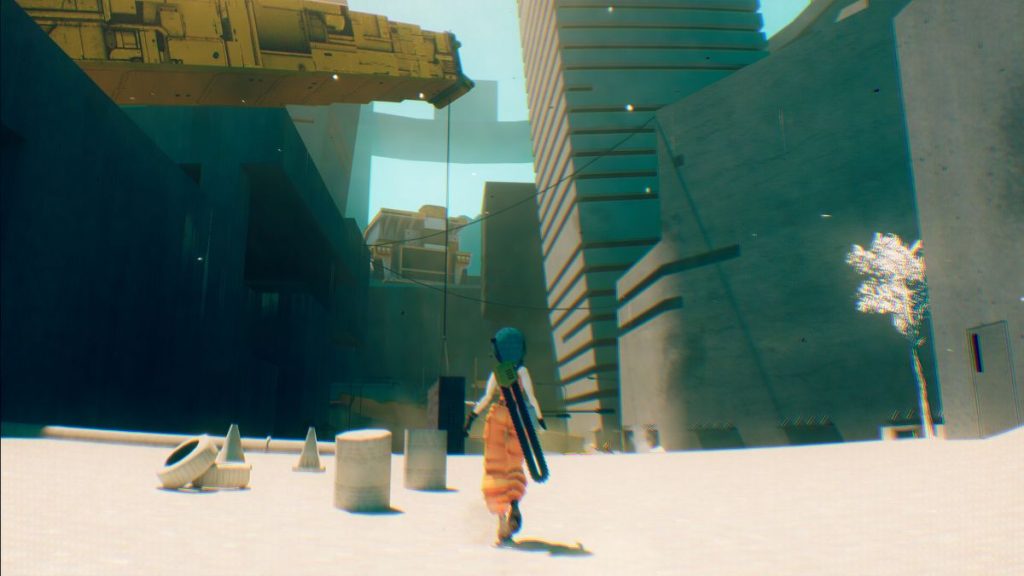
On the positive side of Motorslice lies the world-building and story aspects. The former is evident from the moment you begin the game and can visually feel a barren world where big rigs once brought prosperity and innovation. Every visual aspect of this lonely world that our main character exists within screams George Miller’s influence on human survival. With story, Motorslice’s world-building helps to simplify and build the story that the player can assume throughout, and mostly be right on. I’m a huge fan of narrative and world-building, so this boded well during my time with Motorslice, as it hooked me from the get-go.

Staying with the story, you play as a character that has to traverse the ruins of mechanical megastructures, find rogue machines, and take them out with extreme prejudice. Motorslice does a phenomenal job with setting the tone and theme of what our main character must deal with, as she and her orbie/selfie friend must do the dirty work in order to help save the world, if not only a little bit.
This aspect of the game kept me playing it and pushing through the gameplay’s sometimes relentless frustrations. I wanted to know more about the world and how devastating it would be if the machines continued to rule the world. When a game can create that type of hook and engagement with the player, then there is always going to be something redeeming about it. And the game does a great job with narrative and keeping the attention of the player.
Now, talking gameplay, the game has its good intentions, its faults, and moments of glory. The good intentions of this game rely on the clear fact that someone must have been a huge fan of Mirror’s Edge when it came out, because the parkour in Motorslice is just as demanding with player accuracy, but it felt good when parkour moments were successfully achieved. Parkour relies a lot on player accuracy, strategy, and execution, while challenging the player to juggle all three at the same time. For example, early in the game, there is a moment when I had to traverse the outside of a building on small platforms, and then wall crawl my way across a large gap that, if I fell into, would reset me back to the original start of the level. Hitting those floating platforms perfectly with the wall crawl and hanging on to that crawl until the very last moment was challenging, as my repeated deaths proved. Eventually, I got across the gap and moved to the next section, but having to time the wall crawl right in nearly every aspect of the challenge was a brutal taste of what was to come in the game.
In other words, if you love a good challenge with parkour and everything that comes with it in its unforgiving manner, then you have come to the right place. I can see a lot of Mirror’s Edge fans enjoying the hell out of the necessary jumping accuracy.
In addition to the required accuracy, the game’s world-building adds a bit more trepidation to the experience. The world of Motorslice is of a huge stature and vast in spread, which creates a sense of scale and danger. That only stands to layer on top of the experience and make it far less relaxing, which I assume was the intention. In short, it creates more of a challenge to an already challenging set of scenarios. Honestly, I am here for that type of danger in a parkour game, as it makes sense to get things right when jumping around structures that are huge and towering.
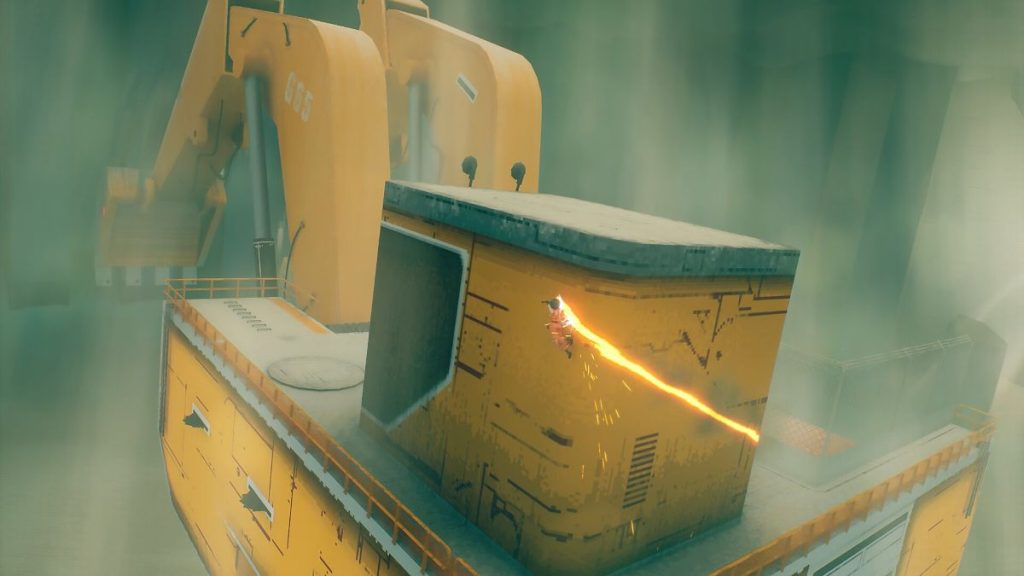
Now, all this said, the part of the game that creates unnecessary difficulty and sometimes overwhelming frustration starts with the actual mechanics used on said challenges. For example, there was a moment during my review when I had to figure out how to get on a ledge without being able to run across a slanted rooftop. The edge was clearly where I needed to be to progress in the game, but to get there, I had to look around the environment, find what could be the closest wall jump to the above location, and try to get the right angle to grab onto the ledge of that platform. The problem with this solution, and which ended up being the solution I needed, is that the camera angle kept jumping back and forth with me, mostly showing my character from the front when they’re jumping off a wall, which would get turned around, and forced me to lose sight of my landing point. It took me quite a few jumps to finally get it right, but I was fiddling with those controls during the entire process, which created unnecessary frustration at the same time. The game has an issue where getting the right angle or working with the camera to gauge distance and place, while jumping and moving, isn’t a completely comfortable process that is smooth. I missed a lot of jumps, fell to my death, and accidentally found myself in the wrong place a lot because of these mechanics.
To compound that frustration, the game also gives little direction and relies on the player to navigate the story and locations. I have mixed feelings about this. On one hand, giving complete agency to the player experience is a dream come true. As a gamer, I want full control over my experience and less linear push, especially for this type of girthy game. It makes sense within the world built for it, and it also springs forth a fair amount of exploration around a gorgeous and haunting world.
On the other hand, this creates some confusion. I had to put down this game a few days ago to go wrap up another review, and when I came back, I had forgotten exactly what the heck I needed to be doing. The game doesn’t give you a quest or purpose indicator, which meant that I had to truly go on a journey and hope I could get back on track with the story. In addition to feeling lost at times, the game also doesn’t do a great job of giving context to what it wants you to do. For example, there was an early moment in the game when I found a robotic orb in a closet and had no idea what I had to do with it. One of the mechanics of the game is sending a pulse/echo out to the world to see the places that were accessible, which does help to navigate the progress, but also delivers no real context for what a player might be looking at. After a while, I understood that orange colors in the pulse meant that whatever the object was that I was looking at had some interactivity to it in some way or form. That helped to navigate the rest of the review experience, but having a simple reminder of purpose, some on-screen indicator that says, “go find all the orbs in the megastructure,” or something similar to that would have helped tremendously. Giving too much freedom to the player will get them lost. It’s like giving no rubric to students on a major project. They will get frustrated and stressed eventually.
Anyway, having been born in the 70s, raised on early console and PC games, I had to feel my way through the dark to find my purpose during that period of time of gaming. It made sense on a lot of levels in ye olden days because people were just starting to understand what makes gameplay good for the player. In this day and age, especially at my age of 50, I need a bit of a reminder of what the heck I am doing. I’m old! I need reminders! Like little digital post-it notes. Players need those types of reminders and push, even the younger ones. Again, too much freedom generally makes people uncomfortable and frustrated at some point.
My only big complaints about the gameplay experience were direction, and sometimes the smooth mechanics. One can work around those, especially the latter, but the gameplay would have been a bit smoother and more flexible had they both come in a bit tighter and more visually accessible.
Complaining aside, all this doesn’t mean that Motorslice is a bad game. It’s a very cool game, especially the boss fights and the tricky common enemies. The game’s ability to deliver gigantic and immersive boss fights with machinery is an absolute treat. It works for this game, it is fun as hell, and it just adds more flavor to the world-building that the devs are trying to accomplish. Even the common enemies that are pedestrian are interesting to tangle with, as much as they are tricky to parry. They’re cool, cold, and the player has to be precise with their parrying to get past such metal creatures, which adds a bit of good challenge to the gameplay.
As for the exploration, the game is so huge that it’s fun to just explore. It makes the game more interesting because of its girth, and much like the enemies, it helps to add to the world-building and connects the player better to the game. The game is big and fascinating to dive into and see where you can lead the main character.
Overall, the gameplay is good, but it needs some work to make it great. I think tightening the controls a bit, allowing for some flexibility with accuracy, and giving some sort of option to see a reminder of the mission during the game would take it even further. As it stands right now, Motorslice is going to be challenging for players, frustrating to others, and at the end of the day, something to return to on a regular basis, even to just make a slight push forward in progress. It’s worth a look.
On that note, let’s wrap up this review.
Conclusion
Motorslice from developer Regular Studio is a huge game that has a thick layer of good world-building that will hook and engage players throughout the experience. It also has tricky parkour that is hindered by loose controls at times, and a shallow sense of direction once the player gets going.