

Luna Abyss crafts a distinctly bizarre, moody universe using the framework of a first-person shooter. Through all its familiar elements it blends genres in delightful and surprising ways, constantly surpassing expectations.
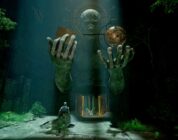
Luna Abyss bombards the player with a cacophony of stimuli. Colorful pulsing particles. Grotesque creatures. Bizarre liminal spaces. Cryptic text. Thrumming music.
In a matter of hours the game morphs its definition, congealing mechanics it has pulled from other discernible places.
At first it’s a work of horror. The player finds themselves in an impossible prison of infinitely high walls, sapped of color and explanation. Viscous black goo coats numerous surfaces while spiked pustules glow a cancerous red. One wrong step and the fall would be seemingly infinite. Down, down, down into this structure lurking under the surface of a blood-red mimic moon that suddenly appeared above Earth.
A hum calls to the player. It grows increasingly pervasive as the dissonance of an unseen choir chants–or screams–louder and louder while the screen distorts. The player seeks out the source, falling and falling down seemingly miles of pipes and tubes. Until emerging into the room of a monolithic eye where it appears as if other pilgrims have long fallen. Waiting is a beast of some sort, on all fours, with a head that looks like an axe. A friend, it alleges, that will help unlock a kind of prophecy.
Luna Abyss rewards our dumbfoundedness. With a double jump. With an ability to sap the essence of foes near-death, consuming their health to renew ours. With a new weapon. With a health upgrade. With a dash.
Because, of course, Luna Abyss is a game. A deeply strange one but a game nonetheless.

Players sweep levels where they are locked in a room until every enemy is dead. Platform challenges test timing and precision. Hidden secrets reward lore and upgrades. Big spectacle moments are meant to dazzle and impress. But where Luna Abyss captivated me was in the steady rollout of of all its pieces. A continuous rhythm of reward, whether it be an additional mechanical twist or yet another baffling display of creativity.
Narratives are allowed to be obtuse. True intentions can be masked by layers of subtext or visual noise that are meant to blossom questions in the player’s head about what is real or what is going on. For a decent smattering of players, I imagine that Luna Abyss will simply be too strange or abstract. Rife with symbology and abject weirdness, I often found my own understanding of the plot frequently obfuscated by the introduction of new characters or the emphasis on particular exposition dumps.
Yet Luna Abyss struck that tingly part of my brain that auteurs like David Lynch has or Yoko Taro with Nier. Players who are enraptured not only by the concept of “weird for the sake of being weird” but of vague, blanket strangeness should find a home here. The game has a tendency to hide its narrative intentions behind oddities like a gargantuan humanoid figure hanging from the ceiling, motionlessly being rocked back and forth; or a floating sphere that has seemingly cracked the world around it.
All the while, the player is walking around an impossibly constructed mega-structure that is underneath the skin of a moon of haunted and mysterious origins. And yet we often forget that is the case.

How is this world sustaining itself? If it suddenly appeared hundreds of years ago, how did humanity make these unyielding corridors and depths and constructs in enough time for them to be inhabited and then unceremoniously overtaken by a deadly Scourge? Each new named location in Luna Abyss proffers the slimmest of answers while also conjuring up new questions. This is a world in which players stumble upon the “Placental Steps” potentially when encountering an omniscient mother figure.
Even when Luna Abyss‘ narrative and world-building was ping-ponging me between one baffling point of discourse to the next, I was enthralled. “What next?” I would so frequently ask myself and then remark back with a “whoa” or “holy shit” as the game responded in kind.
The game drips with proper nouns as if Bungie was on call. It flashes imagery Neon Genesis Evangelion seared into my subconscious decades ago. And for the most part, I felt as if I didn’t have an answer to what was happening or what I was supposed to be interpreting. But I also felt that I didn’t need it.
That’s because Luna Abyss dangles constant carrots in front of the player for them to hungrily gulp up along the breadcrumb trail of awe.

At a modestly swift pace, the game momentarily walls off the player, trapping them in a spectacle. An argument could be made that Luna Abyss has its fair share of slow moments, I could certainly agree with that. However, it’s done in service and sacrifice to the greater good. Though reminiscent of locales such as Control‘s Oldest House, Luna Abyss isn’t as taut or concise. Players will come face to face with a 45-degree angle slope whose sole purpose is to slide down to get to a new depth. Part of me thought this was a trick the developers were playing to hide loading screens but frequently enough, the game would freeze for a few seconds while “LOADING” appeared.
What I think Kwalee and Bonsai Collective sought to do was muddy players’ sense of space. Because there is no fall damage here, drops can be almost comical in length and distance. It truly feels as if we are in the hollowed-out space of an unsettling moon. Empty space stretches for miles, as do walls and machinery. Luna Abyss wants the player to feel like a foreigner in an alien world where nothing makes sense. Where the torso of a humanoid sits atop a turtle-like shell and massive hands are meant to be feet. There’s almost a comfort that nothing makes sense, emphasizing the dream-like hue of what is actually a nightmare.

Few games work with constrained color palettes like Luna Abyss does. Instantly I was reminded of Othercide, a game which embraced grayscale and prominent, emphasizing reds. Luna Abyss shoves players into the desolation of the red Luna’s crumbling and titular Abyss. So much of it is painted with black and grey, sapped of life. But lurking among that absence of color are stark red eyes, glowing-red lights, and the streaking red of the player’s scout rifle. This constant absence of color is meant to invoke a kind of despair in the player, an unflinching uncertainty.
As time moves on, other color washes are generously introduced to bathe the mood appropriately. Pale blues inform the player of a once lush meadow surrounded by crystal-clear water. Purple lasers jut out of endless wells and trace through mines. There are suggestions that this indeed was once a place where humanity existed. Now it’s just a husk in the vein of Rapture but more cosmically horrendous in its disheveled state.

Because of the striking universe it’s placed in, I wasn’t entirely sure what to expect from the mechanics that string Luna Abyss together. While I knew that the game was deemed as a first-person shooter with bullet hell elements mingling around, I grew frequently surprised at the numerous additions used to spice up and add depth to the gameplay.
As Fawkes, players embody a mostly normal protagonist who has been sentenced to 9000+ days of imprisonment. Fawkes serves as a Scout, roaming the Abyss in search of abandoned technology in hopes of completing tasks that will shave days, weeks, and months off that sentence. That number is primarily a framing device and the sentence will be reduced in sync with the pace of the narrative, not any particular actions the player performs in the midst of action.

Because Luna Abyss presents a twisted world where very few things feel rational on the surface, I appreciate that there’s a handful of equally irrational chunks of gameplay that still make sense in the confines of the narrative.
Fawkes is meant to be able to inhabit Wardens, husks that can be possessed by the essence or souls of Scouts that can then navigate the Abyss. Early on, Fawkes’ Warden is destroyed–costing them a penalty of 20 days in their sentence, mind you–and they become a spectral embodiment of their soul. Naturally this allows Fawkes to possess random things in the Abyss such as stationary Watchers that are attached to walls and used to scale heights; or bipedal weapon-machines that introduce mild on-rails shooting galleries.

I couldn’t help but grin at Luna Abyss‘ propensity to reward the player with something different every 20 minutes or so. A constant cycle of churning freshness means that the game never gets stale and often, that’s one of the biggest banes of the shooter genre.
For the most part, Luna Abyss‘ shooting is relatively basic. Over the course of the game, players will have access to four primary weapons that can be easily swapped during combat. Each weapon has different functionality, damage output, and the amount of shots it can fire before momentarily needing to cool down. Holding down L2 on a DualSense activates a generous lock-on so the player doesn’t have to focus on aiming. That’s because this is a game feeding into the bullet hell genre and every enemy spurts constant streams of projectiles in different formations meant to overwhelm the player as they bob and weave in hopes to avoid damage.
Luna Abyss isn’t a traditional bullet hell pressure cooker where every projectile blitzes past the player with speed and deadly accuracy. But there’s enough to keep anyone on their toes. Enemy variety can be a little lackluster when stretched out over the course of the around 10-hour journey but I came to enjoy the bite-sized arenas Fawkes is thrown into and the combinations of enemies that create patterns to weave through.
Cycling through weapons to take advantage of powerful shots is effortless. Numerous tools are granted to the player to raise overall efficiency and the ability to navigate turmoil. A bubble shield can be dropped that has a lengthy cooldown but is great in a pinch to block damage. When enemies are near death, players can absorb them for health or cause their bodies to pop and shoot out projectiles at nearby enemies, offering a fun balancing act should players want.

Unexpected was the amount of platforming challenges the game presents across the breadth of its levels. As Fawkes’ repertoire expands, players are expected to employ their skills with jumping and precision to move past certain challenges. Zany combinations like bouncing between possessed Watchers to dash through gates, or running through decaying platforms while shooting targets that unlock doors.
Luna Abyss becomes a kind of hybrid game that doesn’t want the player to rest on their laurels, constantly challenging expectations through an evolving series of mechanics. And the best part is that it all feels relatively good. Though it may border on hyperbole, I felt echoes of playing Destiny when controlling Fawkes. They certainly aren’t as graceful as a Guardian and at times jumping wasn’t always accurate. But there is a weight to movement and to shooting guns that doesn’t betray the genre. I think a lot of players will be reminded of the newer DOOM trilogy or some of their favorite shooters from the last decade.

By no means is Luna Abyss a game for everyone. I think its strangeness won’t be to the taste of many. It tries things that it doesn’t truly capitalize on. Before hopping into the Abyss, Fawkes has a room where they talk with their master but it serves no real purpose outside of being a transitory place or another non-menu location to read the codex. I enjoyed the voice cast and their Salad Fingers-esque existence but some might be put off by a lack of impressive cutscenes and a lot of talking. Pop-in can be a problem in larger areas but again, the style here is unlike anything else. Really, Luna Abyss is a game that you need to open yourself up to because it offers the same in kind.
Luna Abyss uses the framework of a first-person shooter as an easy pill to swallow down its distinctly bizarre existence. In this universe of gripping, alien weirdness, players may get lost in an obtuse plot that gleefully plays with expectations as layer after layer is uncovered for meaning. All the while, it is a bullet hell that works to feed new mechanics to the player keeping them as equally engaged with the gameplay as they are with the narrative. Though strange, it’s difficult not to be transfixed by what Luna Abyss has to offer.