
While Metroidvania games are a dime a dozen these days, there are a few that typically stand out. One such example is GRIME II from developer Clover Bite and publisher Kwalee.
GRIME II is an action RPG at heart, but it contains a lot of back and forth between locations, huge environments, and interesting boss fights that are worth getting frustrated over repeatedly. In addition, the game contains a complicated RPG backbone that pushes the player to keep going through all the difficulty it tends to throw their way, while slowly leveling said player up to match the uptick of common enemies and power bosses. So, you know, it’s a Metroidvania at its core.
Of course, all is not perfect, as the graphical user interface tends to offer little in HCI-driven direction and can, at times, get caught up in minute details that force the gameplay to stumble a bit. Not at all a deal breaker by any means, as GRIME II relies more on action, logic, and strategy to drive it.
So, get some grime on you, let’s sharpen our weapons and load our mold, and get going with this review.
Grime-driven narrative
I never played the first game, so I don’t have a real good grasp on what the heck is going on, but I will do my best to tell you what I believe is going on in GRIME II. Better than nothing, right?
GRIME II begins with a grime-ridden form being created out of nothing to go out and conquer something. The main character in the story is shaped by grime and mold and has become a new Smithed, also, in a sense, a savior. Their sole purpose is to get through the failed Smithed creatures and try to make their way upward and onward to the surface.
What fascinates me most about this narrative is that it has a lot to uncover to make it work. That means for every boss that players defeat and every NPC character that is met, there are small answers that grow the narrative in a more interesting and correct direction. In other words, it leaves breadcrumbs with every progression in the game that make the journey interesting and keep the story engaging, while the mystery of what is happening unfolds.
Now, that style of storytelling for any sort of medium, video games and/or movies, is a great way of keeping the audience pushing forward, even when the confusion of what the hell is going on tends to push back. The player will want to know more about the story and how it ends. When they are left in the dark and are getting the answers and purpose of the main character’s journey in real-time, it only stands to mean that uncovering what is up means to keep playing. It’s like a murder mystery.
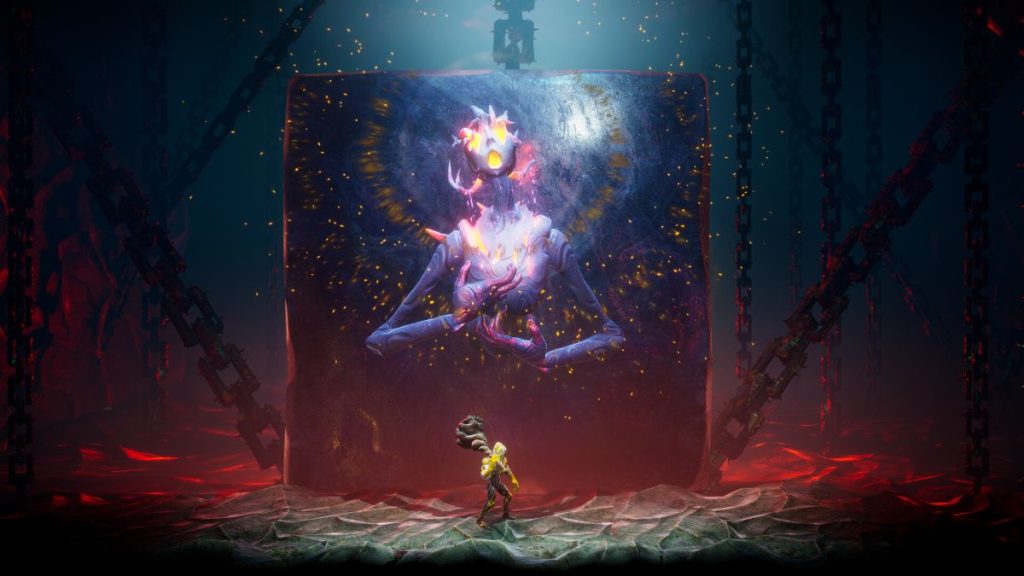
So, even a severely lost player, like myself, who didn’t experience the original game, can still be hooked on this one. I always want to know what the next piece of the narrative puzzle might be to see the entirety of its intentions. GRIME II delivers that intrigue and narrative hook.
Grime-y Gameplay
GRIME II lives in a 2D Metroidvania world, so that comes with a few familiar gameplay attributes that work as expected within that genre. Players will find plenty of back-and-forth traveling, interesting weapons, and defense items that progress the story, as well as make the main character powerful, via a solid skills tree that adds a bit more encouragement to continue, even in the face of many deaths.
Beginning with map size and traversing maps, the game is Metroid on steroids. There are several maps that our main character must jump around in, all filled with enemies and obstacles, and sometimes with logic puzzles that require backtracking. I knew going into GRIME II that the maps would be huge, with the occasional pocket of a new map embedded with each one. The first time I ran into a small pocket, I figured that I was just going into a small room to pick up an item, but when I went into that pocket, it became an equally girthy map that reset the scope of my expectations with map size. It was huge. Just as big as the map I had popped out of, which meant plenty of exploration to be had.
Now, to keep multiple massive maps contained, GRIME II did what it should, and that was to throw in obstacles so I couldn’t access all the areas of both maps easily. That’s a classic Metroidvania move that keeps the overwhelmingly big scale of the map size in check, while also encouraging players to keep moving forward (as well as backwards) so they can unlock the next area. Anyway, the maps are big, they’re beautiful, and they’re unique in the content contained in them. This game will feel big right from the get-go, and players will visit maps repeatedly just to find ‘object whatever’ to open up the next piece.
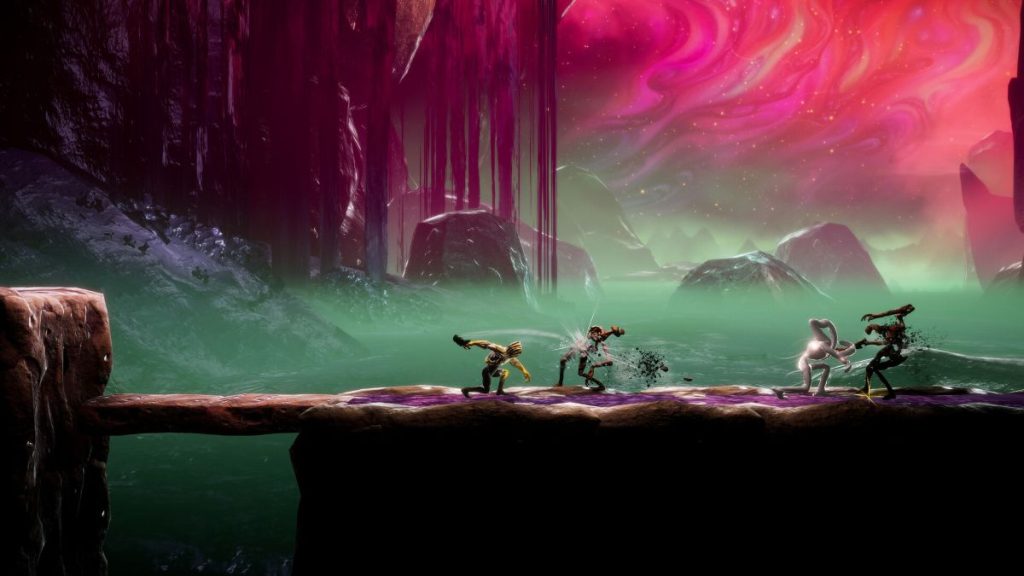
Of course, what good is all that space if it isn’t filled with enemies to smack around with fun weaponry? The creativity of the developers is in full focus with the enemies. Players will find this out right from the get-go, as they will find limbs of ghoulish creatures waving around, spiky turtle-like beings embedded in the ground, and bosses that look like they were created by the hellish dreams of H.R. Giger. They fit the gross environments created for them, and they become more interesting, and somewhat worse (in a good way) as players progress further in the narrative. It’s quite lovely stuff.
While the creativity of the enemies is interesting, there is a fair amount of repetition with them, all related to the common enemies in the game. There are times when the game will throw the same enemies at the character repeatedly, which means there isn’t a great amount of variety as the player progresses through maps. While the enemies are challenging, changing with the environments, and sometimes pop out of nowhere to scare the bejesus out of the player, it never feels like there are enough. Just having a few more variations of creatures on maps would be great, but it never quite gets to that point. So, in short, lots of repetitive beings.
Related, the game also sets the player up for failure with some of the enemy placements. For example, there were a few times when I would have an enemy pop out of the ground, one in the far right of the screen, throwing spiky concrete arrows, and another slowly moving towards me in a turtle-like manner. Having that combination coming at me at once was pure chaos. Juggling enemy speeds, while worrying about dodging projectiles and enemy lunges, is a bit much, especially for common enemies. It’s tough to prioritize one over the other, and it seems unnecessary to set up such scenarios simply to establish a variety or change up the challenge of the game. It’s tough.
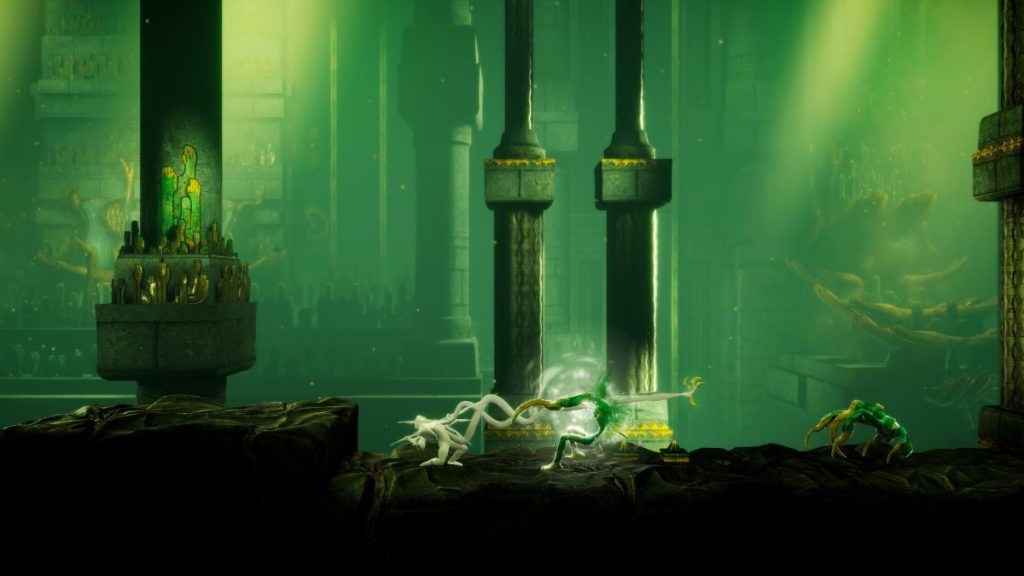
To make matters a bit worse, the game’s controls are patterned moves that require complete follow-through to function, although a player can break the animation by dodging out of it. Basically, once a player starts an attack, they have to wait for the animation to finish before moving on to the next or re-arranging where their weapon is going to hit. This makes the attack process a bit sluggish in its execution and mildly irritating during intense battles. For example, during my fight with the first boss, I had to hit their arms while prepping my position to move out of the way when they launched their attack. Getting in the wrong position and missing their limbs, while becoming out of place, which resulted in a panic-push of my dodge button, was so frustrating. I cannot tell you how many times I landed outside of the attack area and found myself right in the midst of the boss’s attack because I was waiting to see how and if I hit them. There were a lot of deaths from this slow-moving execution of my offense.
BUT! The positive side of this is that it will force the player to strategize before going into a fight, even down to character position, distance, and what weapon is being wielded. The variables involved with attacks become more complicated by these patterned and locked moves. For me, it did irritate me a bit and brought my mindset back to an earlier era of gaming, where animation was far more important than action breaks. Ultimately, it does make for a more challenging time, and one that can be manageable, if not downright addictive at times.
On the weapon side of the tracks, the game features a good variety of weapons, such as axes, clubs, and/or swords. Each has its own set of pros and cons that make weapon decision-making against common enemies and bosses a bit more thoughtful than usual. For example, the first boss fight of the game had me using a giant club. That weapon had a wonderfully massive amount of damage it could deal, but was slower than a Sunday morning when it came to swinging it.
Opposite the club was a stingy sword, which brought its own pros and cons. The sword was more suited for close combat, did less damage, but was less animated and far quicker than the club swing. GRIME II is wonderful for giving weapon choice to the player and allowing them to figure out what is best suited for whatever enemy scenario is ahead of them. In other words, there are a variety of weapons that give way to a variety of strategic ways to use them.
On the defensive side of the tracks, the game does feature different ways to clothe the main character, which come with their own set of attributes as well. From head to toe, there are pieces and parts the player can choose from to best suit our main dude. In addition, the change of armor or clothing is reflected on the character model. Most games of this type just assume the attribute that comes with new armor or clothing, but the developers at Clover Bite went the extra mile to visually represent said change. While not as choosy as the weapon portion of the game, the clothing that our main character dons is equally important. It makes for a good bit of balance between protecting the protagonist while making them dangerous.
Now, on the backend of the game, this gets a bit confusing, especially for noobs like me, as the GUI isn’t easy to understand. The backend of the game features the character’s inventory, weapon choices, which include backup weapons, ways to modify the character’s armor, and a skills tree that is broken into two pieces, all driven by the player finding a surrogate. What is a surrogate? Glad you asked, it’s essentially a resting point, or for you Dark Souls nutcases out there, a bonfire.
When a player arrives at a surrogate, they can use it to transfer XP to upgrade certain character attributes like strength, health, or even dexterity (and other attributes). They can also use the surrogate to shape additional temporary weapons from mold spores collected from fallen enemies. While ‘temporary’, think of them as one-off moves; they can be replenished at every surrogate stopping point. They’re delightfully quick and effective, and add another aspect of offense/defense/help depending on what a player chooses. They are also assigned to the directional pad, so they are easy to use.
Anyway, back to the GUI, for something incredibly visually simple, the organization of the backend can be overwhelmingly difficult to use and/or search for things. I wish the categories were a bit more straightforward and maybe even separated a bit better. And maybe that is just me, and it’s possible that it is, but nothing visually seemed organized. Again, maybe it’s just me. Not a dealbreaker at all, but something I did notice while reviewing this game.
Overall, the gameplay of GRIME II is quite the Metroidvania, as it contains all the usual suspects and attributes found in the genre. The maps are big, the action can be intense and creative at times, and there are plenty of gameplay elements to keep pushing forward through its flaws. I had more of a good time than a bad time, and I will return to this game once I retire from this site.
Now, before I wrap up this review, I need to complement the visuals of GRIME II. It’s a gorgeous game that shows off more than I expected. The environments of the game are haunting and beautiful, and truly show the artistry that the developers were obviously trying to bring to the player. It’s one of the more gorgeous Metroidvania games I have seen in a while. If you have a good enough GPU to run this thing on Ultra, you won’t be disappointed by the ray tracing and small details that were included in its visual design output.
Of course, not to be outdone, the game also features one of the better OSTs that I have heard. Orchestrated, sometimes piano-driven, the music matches the mood of the story and character brilliantly. It’s one of the best aspects of the overall presentation. I would buy the CD or vinyl of this.
Anyway, let’s wrap up this review.
Conclusion
GRIME II from developer Clover Bite and publisher Kwalee is a massive Metroidvania that is driven by its creativity and storytelling, backed up by amazing visuals and soundtrack, and does everything on the gameplay side that you would expect from the genre it lives within. It’s not perfect by any means, but it’s worthy of your time.