

Claustrophobic and eerie, End of Abyss is survival horror through the eyes of Little Nightmares. Section 9 expresses its roots in new ways but still placing the protagonist and player in a harsh world of dangerous paths and twisting secrets.
Despite the absence of ghosts, this sprawling underground complex was haunted. The sickly beige growths on the walls spread like a pestilence, mutating what was once alive. The souls that remain now twisted, forever changed.
End of Abyss submerges players in its hollow, dilapidated world. Color is sapped out, flooded with oppressive dark. Safety is a threadbare promise to the player, a haven they can rarely retreat to.
Section 9 Interactive, the developer behind End of Abyss, is well-versed in stripping players of their empowerment. Founded by former members of Tarsier Studios, the minds behind Little Nightmares, one can easily see those tendrils scrawled into End of Abyss.
The terror of controlling a diminutive figure in a carnival of horrors provides a unique thrill. Six traversed the bowels of the Maw, scampering past slovenly humanoids with an untold craving to spill her blood. The player guided Six in her yellow raincoat through the bulking iron vessel, always feeling like a speck of dust in the belly of a leviathan. In End of Abyss, we are not bulky soldiers with assault rifles strapped to our hips. We are Cel, a humble combat technician with only a rounded helmet to protect us, a yellow-green coat a nod to past triumphs and one of the game’s meager splotches of gentle vibrancy.
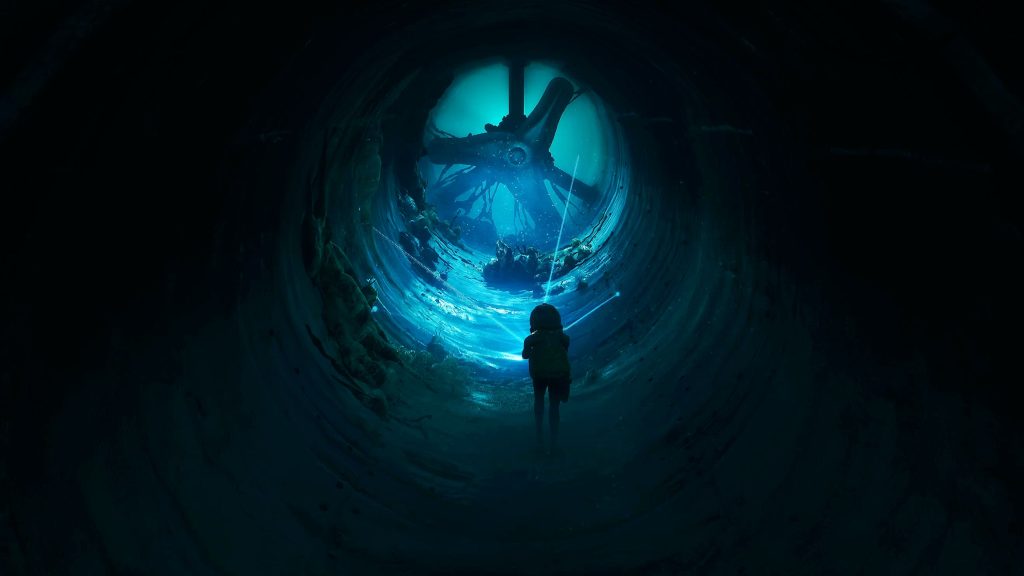
But unlike the Maw’s dingy corridors and industrial mechanisms, Cel is trapped in a futuristic casket.
End of Abyss is an exploration of restraint.
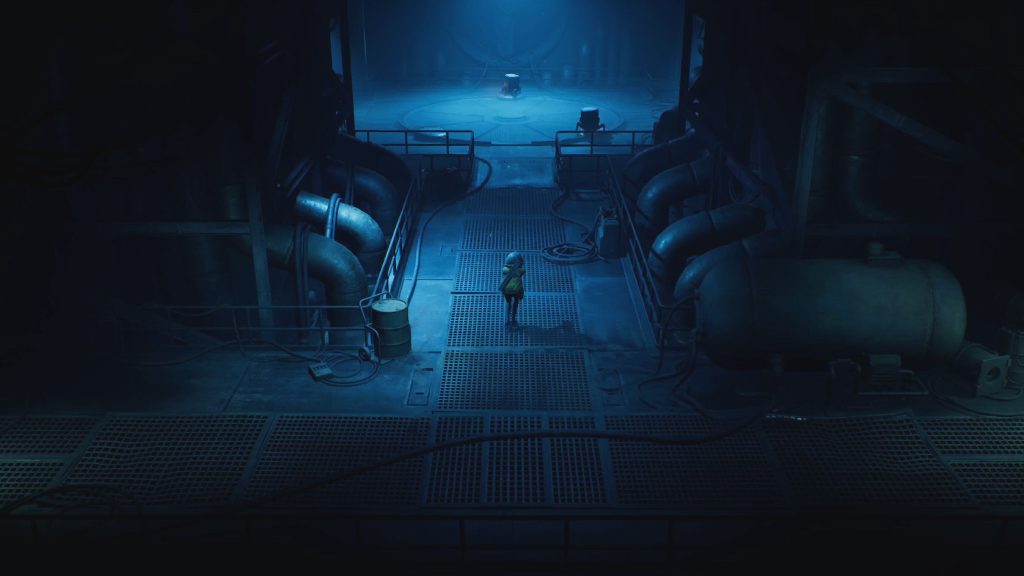
Players who have an adoration for minimalism are sure to find solace in the atmosphere used to construct the game’s horror. Section 9 had a vision of the world they wished to create and it resonates particularly with its color palette. This is an eerie and often bleak game that has the confidence to maintain cohesion throughout its environmental messaging.
Though I wouldn’t call End of Abyss somber, its lack of color and genuine stillness constantly fascinated me. Most of the game is bathed in steely blues and inky blacks, as if this underground world is trapped in a perpetual night and the moon has a sapphire glow. Being a game centralized around tension and horror, there is an unsurprising amount of darkness. Lengthy corridors are barely illuminated with flickering floodlights, instilling a nervous cadence upon passing through a door and entering a new space.
A couple generations ago, developers were a bit trepidatious to make their games visually one-note. I think back to playing the original Silent Hill for the first time on my PlayStation 2. By today’s standards, it’s a relatively unattractive game whose fog is used to disguise rendering but also makes a dreary, foreboding town excessively so. Polygons bled together and it wasn’t easy to figure out where to go. Limited technical capabilities almost necessitated a barrage of palette swaps to give games style and distinction. In the burgeoning days of high-definition visuals, I watched as a confidence returned in making an “ugly” game.
Killzone 2 is one of the best examples of how adjectives like “gritty” and “desolate” could be replaced by “ugly” and “muddy”. Yet Guerilla had a vision of the Helghan world, a noxious planet of industry that required its populace to screech around with their signature masks. And because games could be more detailed and realistic, artistic license could follow. A game didn’t need fantastical worlds of magic or kingdoms of mushrooms to be beautiful or make a statement.
When racing through my 12 hours with End of Abyss, that recollection would certainly be blur of dark, blended with flecks of red, a strip of radioactive olive green, and that pervasive blue hue. But when I sit with it, linger in it… I remember the series of ladders and balconies encircling a signal beacon. I remember the echo of Cel’s footsteps in the infested ventilation shafts. I think of the crackle of fire as it lit up the bodies of husks or the piercing deluge of blood red after igniting a flare.
Cel and her Captain and a handful of soldiers were sent to this place to figure out the domineering science fiction question of “What Happened Here?” Minimal exchanges of dialog in an unknown tongue give little to quantify a time before the player entered the picture. Even when Cel completes an objective, a soldier chimes in with a few words, pauses for a few seconds, delivers a few more words, and then signs off.
This is a methodical mystery that unfolds at an intentional snail’s pace. A smattering of notes often only spell out what the players has already inferred. It isn’t until the game’s end that question are barely answered, or the player actively seeks out everything that more clarity is offered.
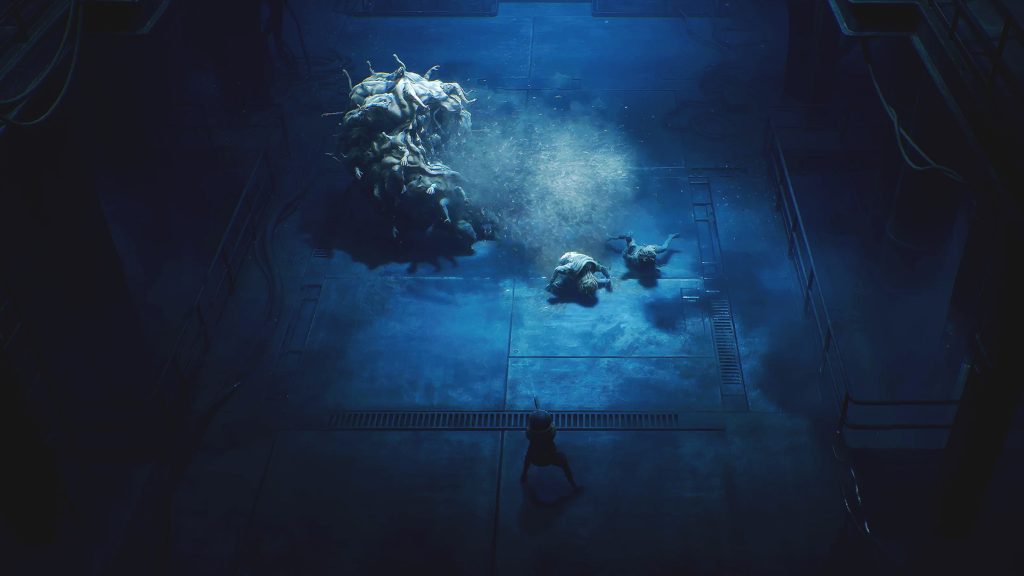
I could shove the phrase “atmospheric” into almost nearly thought regarding End of Abyss, merely because Section 9 emphasizes its role so much. The game asks players to survive and pursue the end goal of understanding. The underground facility–the universe everything takes place in–is all a semblance of futurism but not by much. The game’s constant threat can be interpreted as alien or viral for quite some time and neither answer feels wrong. Instead, the player is meant to chew the scenery and be constantly on their toes. A game like Little Nightmares wasn’t strong because it spelled everything out. By allowing the player to infer large portions of what happened, the mind begins to spin its own yarn–and those tales can be equally as harrowing.
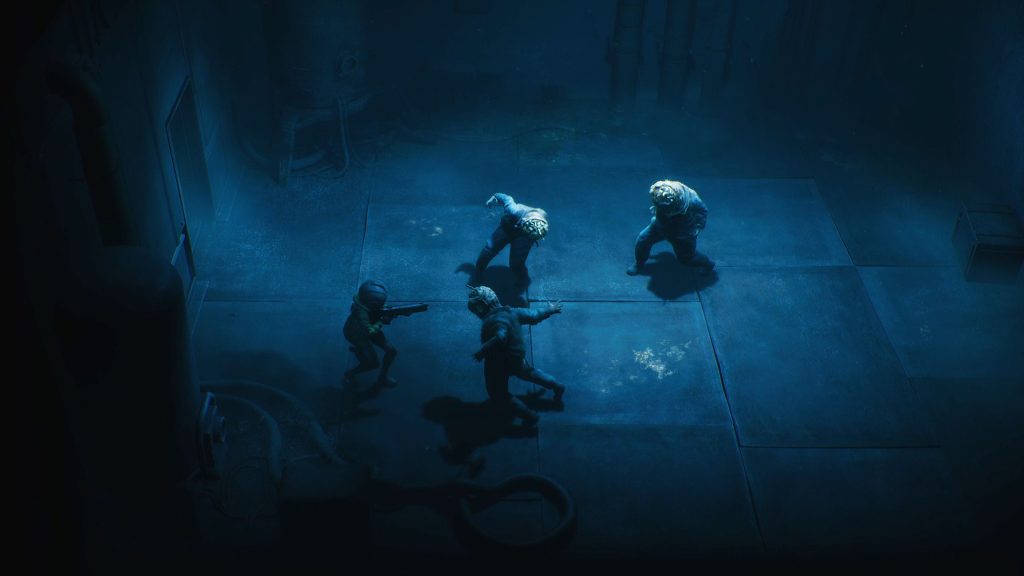
End of Abyss does a wonderful job at juggling its inspirations, too. After a few encounters with these bipedal creatures whose heads have been replaced with constructs of infestation, it clicked: End of Abyss is a survival horror game in the fashion of the original Resident Evil trilogy.
The player fights in numerous tight spaces. Often, the camera is affixed to a certain focal point but does shift itself, following along with Cel. A hybridization of an isometric perspective and fixed camera angles allows Section 9 to be a bit more dramatic and intentional with their direction. While the player can sometimes get a small peek by holding the right stick in a direction, the action is effectively orchestrated in each room. Smaller hallways zoom close to Cell for an intimate shot. Larger areas linger at a distance to encapsulate multiple enemies and points of interest to allow the player to strategize.
But that spark of familiarity occurred especially when these moving corpses fell to the ground for a moment and then got back up. It bee-lined my memory back to when I pumped a zombie full of bullets, groaning to the floor only to rise back up for a another meal of lead. Retreating to another room to insert space between Cel and an attacker, shooting them through a doorway before they even appear was a strategy forged long ago.
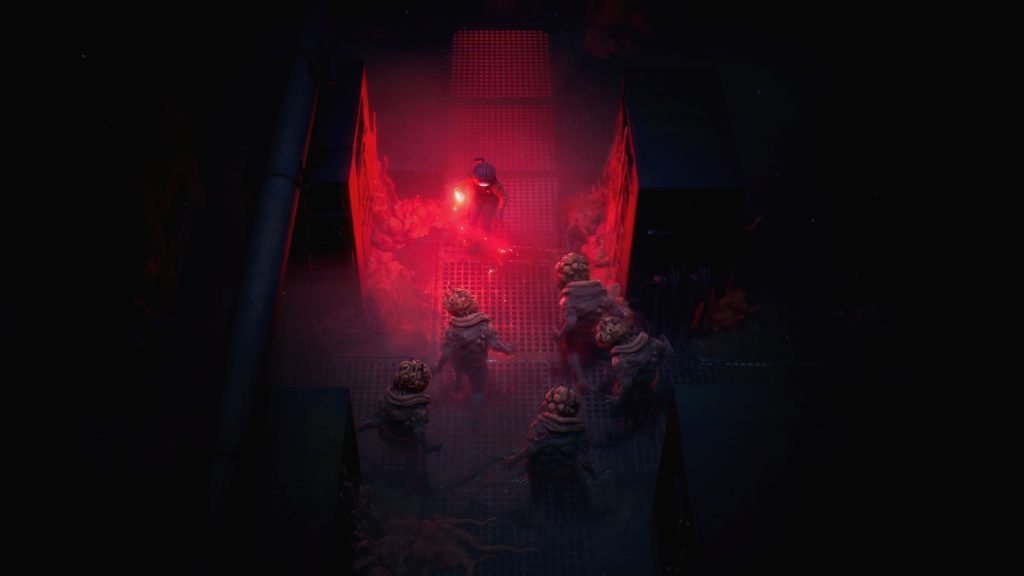
Managing resources isn’t a key component of End of Abyss but it also exists as a reminder of Section 9’s bolder aspirations for this game. Little Nightmares made the player and Six feel somewhat helpless, the spirit of a child in a world of waking nightmares. Giving players weapons but still making them feel small and often helpless works as well.
Combat is a matter of using the right stick to aim and a trigger button to fire but it’s barely a twin-stick shooter. Cel has a very generous dodge–taking advantage of her design as a more lithe combat technician–that works significantly better than running. If I didn’t want to trouble myself with an enemy, I would often just dodge past them, much like Leon, Chris, or Jill would pace a strange circle to juke a zombie away from a path.
At the game’s start, players are given a starting pistol that has infinite ammunition but does require a reload after a few shots. New weapons are found over the course of the game but the ammunition for them must be crafted. The same applies to grenades, flares that can distract enemies, or C4 that blows up weak walls. Players use fragments dropped by enemies to craft more ammo and throwables, along with investing in permanent weapon upgrades.
Enemies stay dead until the player rests at a healing station but keep in mind, End of Abyss does follow Souls rules. I found this out the hard way a few hours into the game. I had trekked a bit across several sections and then died, losing a few minutes of time because Cel was reconstituted at an earlier save point. Players need to go into one of these healing chambers to initiate a soft checkpoint but doing so also refreshes the enemies.
While I appreciate this mechanic because it doesn’t make the game as tedious as it could be, it does have a couple flaws. One, careful players can eventually have a surplus of ammunition for high-powered guns and grenades by grinding out fights to have enemies drop crafting fragments. Two, it shows the inherent power in the game’s starting pistol. Should players stock up for a boss fight or particularly difficult room and die, all ammunition used is gone. I burned through a couple blocks of grenades and shotgun shells to recognize this. So instead I relied on the pistol which I fully upgraded before anything else. The other guns may be strong but don’t feel proportionally worth the risk. I could forgive the pistol’s initial unwieldy spread because it wasn’t like those bullets were precious to me, unless of course they whiffed past a target who was closing in on me.
Despite a number of weird boss fights, pattern recognition is not hard. I came to understand that the focus of End of Abyss was not necessarily in its combat but those moments of helplessness, confusion, desperation, and relief. I would run up to still corpses and knife them a bunch to try and kill them as they rose. I grouped up enemies and snaked them around shelves and machinery, just like I’ve done for years. And for every few relatively calm encounters, the game would lock players in a room to fight for their lives.
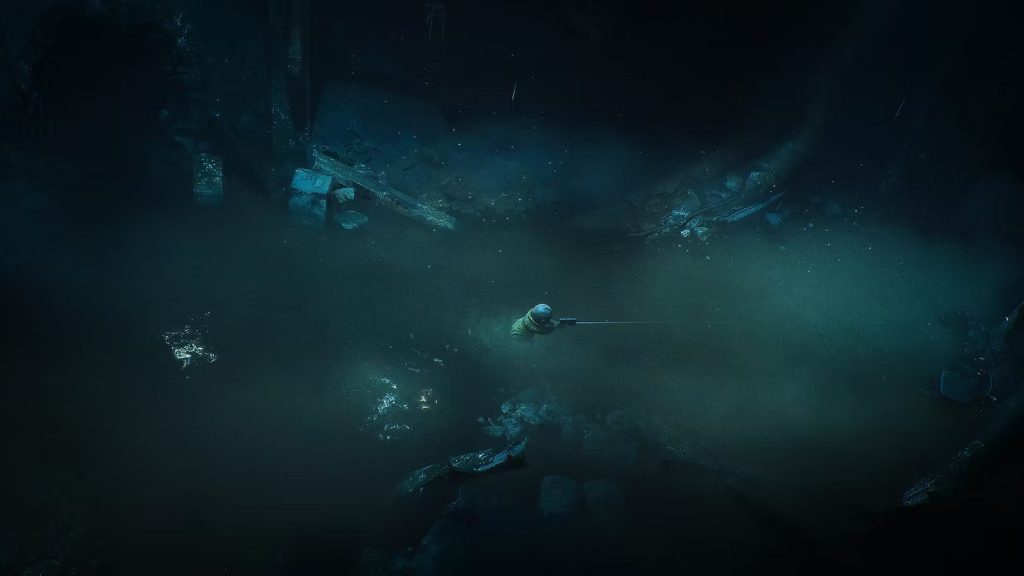
End of Abyss‘ strongest point outside of its oppressive mood and sense of place is that its map benefits from player-encouraged exploration. To complete her mission of slowly restoring minimal functionality to the facility, a few tools will be discovered that open up previously inaccessible pathways. Keycards, a grappling hook, and a crank for bridge extensions help engender a feeling of progression across the game.
Often, the player will be able to make a return journey to an earlier location and gain access to a chest that provides upgrade materials or a health boost. It satisfyingly scratches at the brain to not only crack open those places and check them off the map but also know that exploration is also the key towards unlocking the game’s secret ending.
Though not a Metroidvania by any stretch of the imagination, End of Abyss at times has a tendency to obfuscate where the player may need to go. The map is detailed and much can be inferred to what floor a ladder will lead. But unless the player acquires a good sense of bearings, they may find themselves backtracking through long stretches of the facility, skipping past encounters just to get where they intended to go.
Yet the cohesion of the overall world design makes End of Abyss‘ level and structure a combination of claustrophobic, dense, and enticing. The player hopes walking through a previously locked door will reward with tangible items or a feeling of discovery that another eerie spectacle or question will unfold before them.
During my time with End of Abyss I played in a pre-launch period where two patches and updates were available for the PlayStation 5. I would be remiss to ignore that in this state, the game had a handful of bugs and issues that sought to impede my progress. At one point, the game crashed twice for me in the same place during a particularly difficult fight where the room was sealed upon entering. After killing an optional boss, the item it dropped landed in the air, impossible to obtain–which happened a second time after beating it again. A few invisible walls cropped up that were either visual bugs or outright ones. Near the end of the game, I was seemingly able to skip past a small section and go straight to the end boss. Sometimes the map seems to display incorrect information on which doors are locked. And graphical hitches would show an item box floating in the foreground or the edges of a room not blending properly.
When reaching out to Section 9, I was informed that they are aware of these problems and working on a fix. Despite these problems causing a bit of frustration on my end, it does happen in these pre-launch environments. And I also recognize that they are going to be ironed out and eliminated at release and in the days to come. Because these problems never inflicted any true damage to End of Abyss, it doesn’t color my overall experience yet I do feel it necessary to include that it did happen to me.
There’s a certain comfort in a game that keeps its terror constantly at the perimeter, seeping in only when necessary. End of Abyss proves that the minds at Section 9 have always had a talent for instilling dread in players. This captivating setting will put players on edge not only because its setting is so bleak and devoid of life but because it crafts tension and triumph in equal parts, beckoning to constant doom.
End of Abyss is claustrophobic and eerie, science fiction survival horror through the eyes of Little Nightmares. Section 9 expresses its roots in new ways, incorporating intricate progression and anxious combat into the mix. By placing protagonist and player in a harsh world of dangerous paths and twisting secrets, each new door may open unto a potential flood of horrors and clutched chests.