

Elden Ring Nightreign proves, if anything, that FromSoftware's design fundamentals are confident enough to be malleable in the most surprising of ways. Its punishing pace may initially overwhelm but there is truly strength in numbers.
Hours into Elden Ring Nightreign my confidence had been obliterated.
Nearly a dozen Expeditions into Limveld had resulted in failure. Each successive run I would dread the fall of Night 2, signifying the appearance of the Fell Omen, an aggressively harrowing boss from Elden Ring. I had played enough to know when a run was burnt.
The team hadn’t collected enough flasks to ensure topped-off health. Enough runes hadn’t been claimed to sufficiently level up to stand a chance. Hotspots that rewarded weapons and buffs had been passed by, or simply not doled out optimal gear.
But that feeling of dread was hard to shake. I knew that if it took several minutes to whittle away a quarter of the Fell Omen’s health, the outlook was grim for the Tricephalos, the boss of the third day. If our team was struggling against a singular boss, how could we hope to tackle an aggressive hound that could split into three? The constant failure felt as if I was being thrown into a callous meat grinder that offered no solace.
And then, as it typically does with a FromSoftware game, victory was laid bare at my feet.
Yet that normal feeling of elation laced with triumph had a more acidic taste. It wasn’t because I–a traditionally solo Souls player–felt carried by two others. Neither was it the acknowledgement that overcoming this Herculean task amounted to minimal “permanent” rewards. The itch I simply couldn’t scratch was ultimately a simple one.
I was, more or less, playing Nightreign wrong.
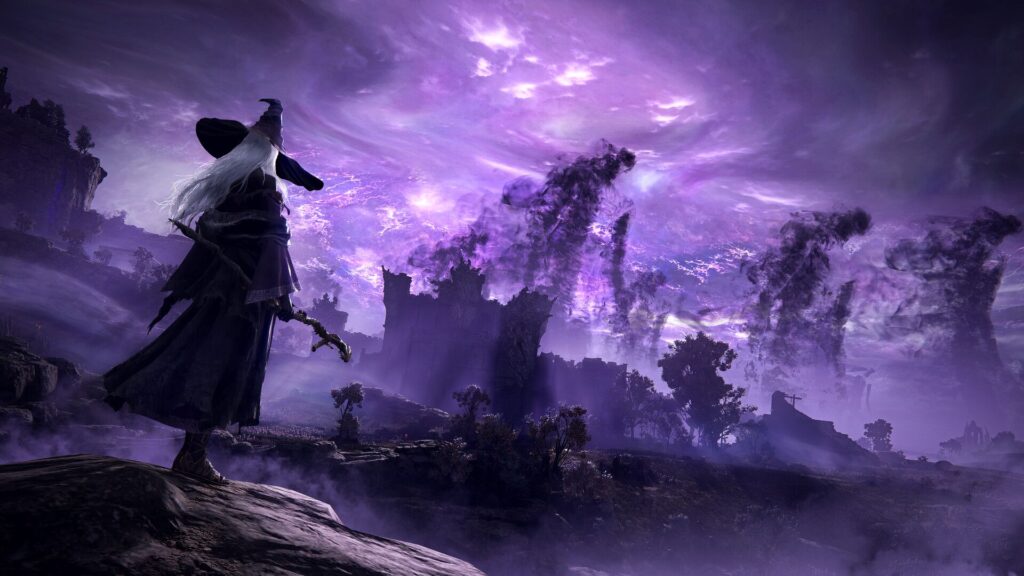
After last year’s Shadow of the Erdtree expansion, most of us likely thought FromSoftware would depart from Elden Ring‘s incandescent glow. The Lands Between deserved a break after such phenomenal and unexpected wins. But the Japanese developer is content to bring players the things they didn’t know they needed.
Decades from now we will look back on gaming as a whole from the last several years and recognize that perhaps as much of a fluke as Fortnite was, it fundamentally altered the status quo–even if it wasn’t the first battle royale game. And when Nightreign was first revealed, many of us instinctually wondered if its diminishing and encroaching circles of playable space were in reverence to a game that is now a menagerie of pop culture icons shooting each other with guns.
Fear not, Nightrein is no battle royale (though The Duskbloods could shock us all). And while it maintains FromSoftware’s undeniable hallmarks, it uses familiarity to engross players in an entirely new rhythm, to wildly successful results.
My revelation that I was playing Nightreign “incorrectly” would ignite in my mind through fits and bursts. I had a general understanding of the game before having my hands on it. As patient as one may wish to be in a Dark Souls or Bloodborne or Elden Ring, pressure eventually comes. Before long, that boss will close the safe distance between itself and the player, lashing out with unruly, unpredictable attacks.
In Nightreign‘s first two days, time is the boss.
Recognizing that bloody truth will save you an immense amount of grief as you come to terms with the pacing of the game. Poor time management can deprive the player of the items and levels needed to comfortably press on to the third day, where a monumentally-challenging boss awaits. After beating Nightreign‘s first boss, I cautiously started another run. Consistently I would make it to the third day, a few times by the skin of my group’s teeth. And numerous times the grotesque, open-maw of that dragon would gnash our health away until there was nothing left. Once, victory was nearly ripped from the jaw of defeat, yet that sliver of health that remained on the boss changed nothing as our flasks had long run dry.
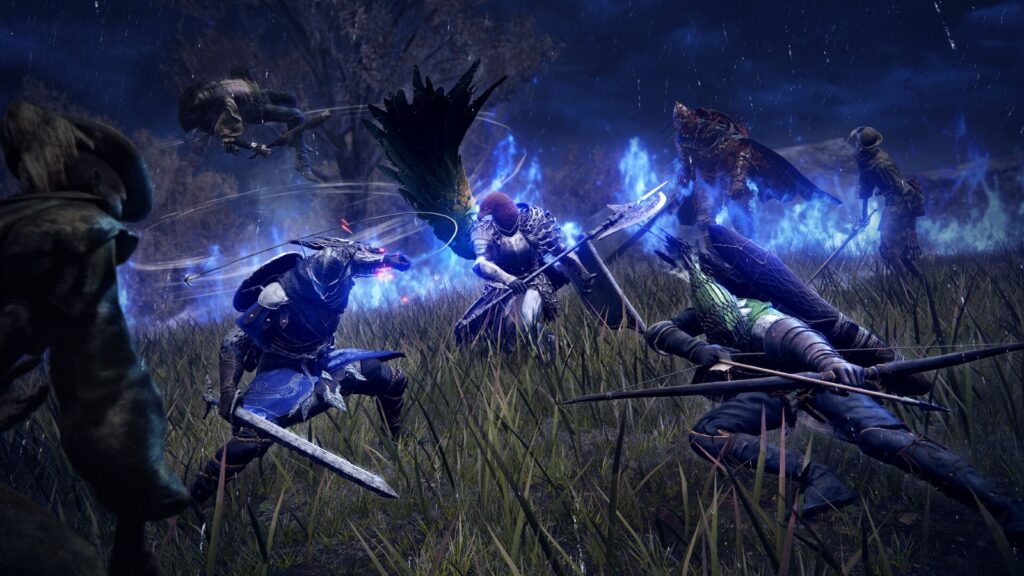
It’s crucial to note that in the lead-up to Nightreign‘s release, my review period was supplemented by a bustling Discord server packed with other journalists, content creators, and Bandai Namco employees. We were all united under the purpose of talking about the game, exchanging strategies, and grouping up together. Our sample size is a microcosm in relation to what will soon be groups of friends struggling and laughing together, forums brewing up strategies, and Souls pros tackling everything solo and at Level 1.
But the camaraderie in this tight-knit group helped expose an obvious truth: as the days and hours went on, we were all getting better at Nightreign, more efficient.
In the throes of the brick wall that had become the game’s first boss, I was seeing others extol their victories, some even claiming they had beat many of the bosses on the first try… those damn Souls content creators being experts in their field.
Perhaps it sounds as if I’m horrible at these kinds of games but I’m actually quite alright at them. While my skills grow a bit rusty and I’m frequently too impatient to really learn all the tells of bosses, I’ve played a significant portion of games forged from the fire of Demon’s Souls.
So I began to distill my frustrations into bad luck. My frequent match-made groups would fly into Limveld and hit camps and churches and take down bosses to be rewarded with a chunk of runes and a magical floating bauble that could be interacted with to claim a weapon or a perk. No collection of perks seemed appropriate enough for the survival of the second and third day. No weapons seemed to synergize with the specific Nightfarer I was using.
Yet these were all excuses.
I learned too late that I was focusing too much on bee-lining to churches to gain an additional healing flask to my maximum capacity. I was too hesitant to fight a boss on the field for fear it would absorb too many of the precious minutes we had to make meaningful progress elsewhere. But I think having those early fears helped significantly because as the days went on, I recognized that they were only inhibiting my enjoyment and my progress.
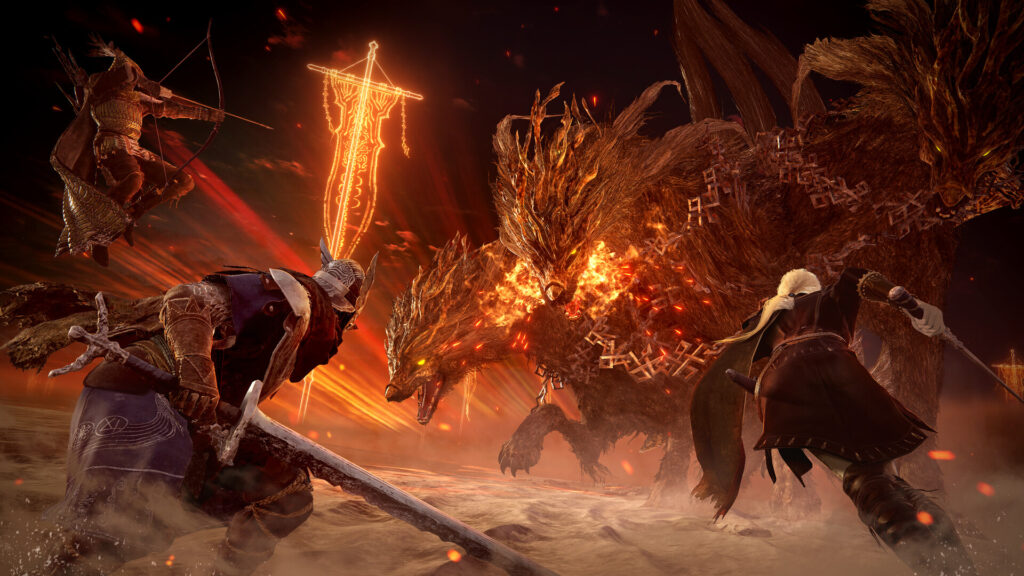
After spending over 50 hours with Nightreign, I don’t feel like an expert. However, my skills have vastly grown over the last week of playing nothing but this game. The proof? I accidentally queued up for the Tricephalos fight and made it to the boss with barely a scratch, ultimately beating the beast in minutes without breaking a sweat.
Common genre stereotypes would want players to pigeonhole Nightreign as a rougelike. The nature of its “random” runs–called Expeditions–and persistent “upgrades” would indicate as much. But really, the only thing to distinguish Nightreign as such is that it is primarily a run-based game.
In fact, Nightreign is that long-storied, mythical thing FromSoftware veterans have been yearning for years: a boss-rush Souls game.
While there are certainly numerous moments that stitch together the tapestry of the three days in Limveld, they all ultimately lead to churning through numerous boss encounters in rapid succession, all to topple the pinnacle boss at the end of the third day. A flurry of spells and blades all boil down to how fast and how efficiently players can learn to plot out their journey to rapidly grow stronger.
From a bird’s-eye view, Nightreign is shockingly simplistic, especially seen through the additional lens of an Elden Ring player. Up to three players descend on Limveld, a stylized version of Limgrave from Elden Ring. Scattered across the map are points of interest that often house a named boss ripped from that sprawling world. If you’re familiar with Elden Ring then most of Nightreign’s design won’t surprise. Elements and landmarks from the Lands Between populate Limveld, as do its enemies, weapons, and spells. I understand if that is disappointing but it all serves the purpose to allow veterans to have a point of acclimation to the rapid procession of what’s to come.
On Day 1 of an Expedition players have the option to go wherever they wish. They are usually deposited near the outskirts of the map and need to choose where the focus is. For players who randomly matchmake with other, Nightreign incorporates a simple system to ping a location on the map–on PlayStation 5 this means hitting the touchpad, using the right stick to find a point of interest, and then click down with the right stick to ping it. Other players can choose to ping a different spot or “agree” by pinging the same spot or holding down the R3 button with the point in view.
And then you run.
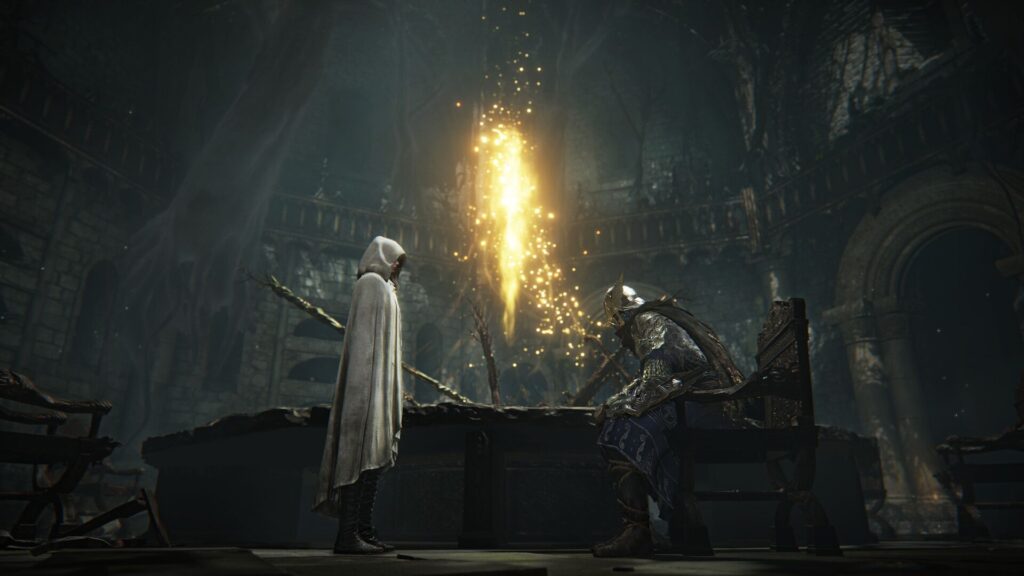
Across Limveld are small pockets of enemies wandering or idling around. Certainly a group of players can demolish these foes in seconds, gathering up precious runes that can be invested in leveling up. And that might be advisable in the opening few minutes of a run while heading towards the first agreed-upon point of interest. Doing so will likely net one or two levels, which is important to grow in strength so a boss won’t kill you in one or two hits. But continuing to chase these minor enemies in perpetuity is a fool’s errand, there’s more worthwhile prey at large.
Part of Nightrein‘s endorphin rush is that it strips away the “fat” of thinking. One of Elden Ring‘s most important features is boiled down into one solitary number. Previously players would have to wonder if they should invest in vigor, or strength, or dexterity. Now, leveling up means having the appropriate number of runes, getting to a Site of Grace, and pressing a button to level up instantly. The process is so simple that it can be done mid-run.
Raising the player level in Nightreign instantly boosts maximum HP, FP, and stamina, along with other attributes meant to make the player exponentially stronger with each level. A new level means hitting harder and living longer.
Players need to be laser-focused on getting to those points of interest to farm bosses. At times, it may be a singular boss like a lion or a troll, surrounded by fodder that will try and get a cheap hit while players are distracted with melting a boss. Other times it may be three stronger units spread over a location. No matter what combination, players will be rewarded with a glowing marker where the boss died. Interacting with it will reveal usually two or three options for reward.
Rewards can include weapons, bonus runes, attribute buffs, or special properties. Do you opt for a 10 percent health boost or a weapon that does more damage and applies poison? Do you want the ability to randomly summon glintblades that attack enemies or grab a dagger that continuously restores HP?
There is a massive economy of weapons and upgrades available to the player and after 40 runs, I was seeing new rewards all the time. As is the nature of randomized rewards, it would be a waste of time to delve too deep into the weeds. Often, players might not realize which reward is better until much later on. Personally, I would only choose a weapon reward over a buff if that buff simply did not apply to the particular Nightfarer I was using, such as a way to improve sorcercies and incantations over a flat boost to my healing flasks.
The ultimate goal of Nightreign is to farm strength with the intention of growing as powerful as possible. And while hitting the level cap of 15 is extremely difficult to do, more powerful weapons are often just as important.
To provide some semblance of guidance, most camps and bases have an icon above them on the map that indicates the potential that a weapon or ability with that particular status ailment will drop. Know that the final boss is weak to poison? Head to the ruins housing a bunch of Miranda flowers and Perfumers for a better chance at a weapon that inflicts poison damage. Want fire damage? Go to the base where Flame Chariots await.
One of the easiest things to do in Nightreign is overthink. Often the smartest strategy is to rush between nearby spots to farm the runes and rewards.
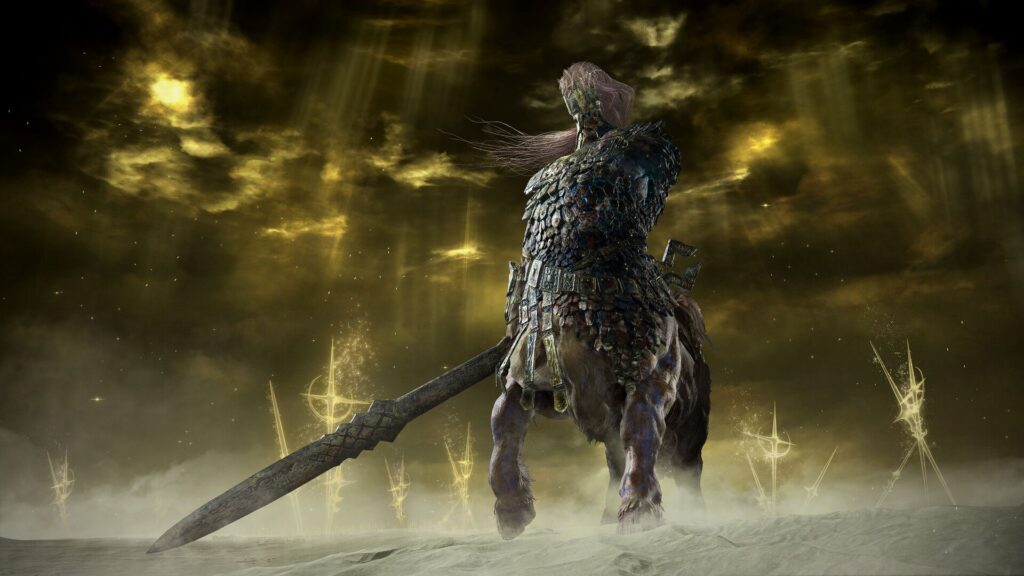
Eventually however, the rains begin to gather, indicating the Night’s Tide. Here the all-too-familiar circle will begin encroaching on the map, narrowing the safely playable space. As the Night’s Tide moves in, players caught in its rain will slowly begin to take damage. The longer they remain, the faster health begins to drain. Luckily, Nightreign not only forgoes equipment weight–meaning players can carry the heaviest weapons in both hands if they wish–but it includes a “sprint surge” dash that technically allows the player to run faster than the Night’s Tide.
A deadly game can play out in Nightreign where the riskier player can not only stay inside the violent storm but mop up bosses or tasks. As our reviewer community became braver, I noticed more and more times we all would agree to live dangerously and fight in the Night’s Tide rather than avoid it completely. Of course, there were times I succumbed to the rains because I got too greedy, or couldn’t find a quick enough route to safety and was short on healing flasks.
Dying in Nightreign is somewhat crushing, especially when caught in the Night’s Tide. Upon losing all HP, the player will fall into a downed state where they have a limited time to be revived. Otherwise, they will die. Death means the loss of a level and any currently held runes. However, players can recover those runes and the amount used to regain the level by returning to their place of death or, if you’re more unfortunate, by killing the enemy that absorbed those runes.
A contingency plan can be in place if a player is caught in the Night’s Tide. By running past any Site of Grace, health and flask charges are instantly refilled, so clever routing can be temporary salvation.
In the event a player goes down, it’s up to other members of the team to revive them. In a somewhat hilarious but stressful choice, FromSoftware forces a downed player to be “damaged” to be revived. A circle with three sections indicates the necessary force required to revive a player, with each full section requiring more damage. But it must be said that this is not a crutch players can ultimately rely on. During the two “farming” stages of Day 1 and 2, even when a player dies there’s a decent chance they can rush back into the fray and reclaim their runes. It’s during the main boss fights at the end of each day where death becomes a problem.
Once a player is downed the first time, their “death bar” only requires a few hits for a revive. Maybe this is four of five slashes of a dagger. Maybe it’s two heavy bashes from a colossal sword. But another down means another section is full, meaning more hits are required, meaning more time needed to keep the distance from a boss. Honestly, attacking a downed player is funny. But it’s also stressful and somewhat imprecise. Players can lock onto a downed partner like they would an enemy but it’s common to accidentally miss a swipe here or there, especially in the hectic action of a fight. And the only way to decrease the time of the downed state is to go to a Site of Grace, which is unavailable during a primary boss fight. And often, if two players are down, it will take the sole survivor incredible luck and skill to revive their compatriots.
As the second phase of the Night’s Tide stirs, a small circle of safety appears on the map, indicating where the final battle for that day will occur. Based on where the group is at the moment, they can choose to try and complete other tasks, or make a mad dash to the day’s final area.
The culmination of each day serves as a kind of skill check for the group. It took little time to know that being at least level 7 by the end of the first day would turn the boss from a struggle to a decent fight. Hitting level 11 or 12 by the end of the second day would leave me feeling confident for the boss of the third day.
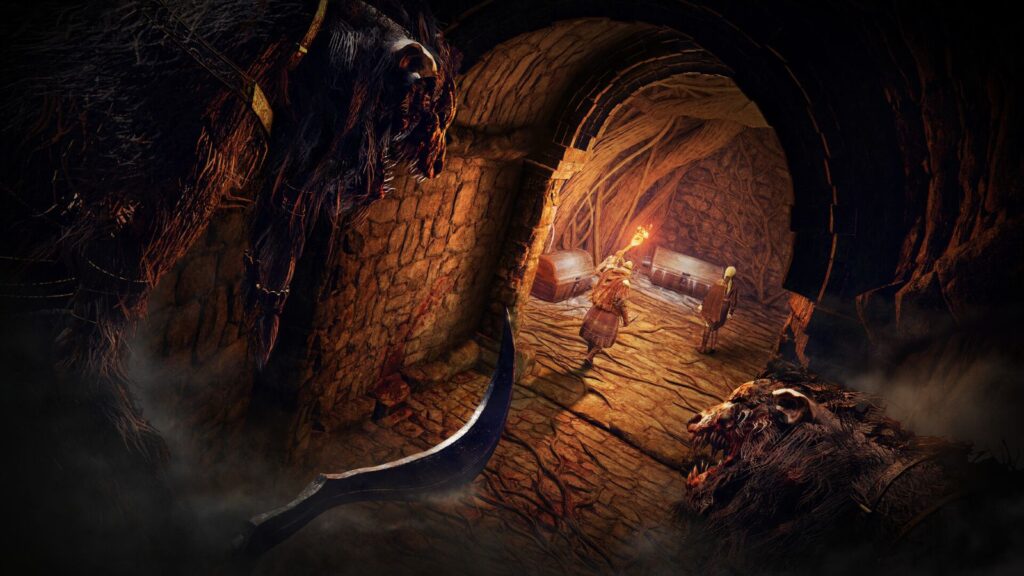
In a way, Nightreign serves as a kind of ode to FromSoftware’s history. The developer’s clever, razor-sharp difficulty has been immortalized in their boss design, which long ago hit the triple digits regardless of how some fights feel slightly similar. While players can expect a number of Elden Ring‘s bosses to show up, anyone who has closely watched coverage of the game knows that a few bosses from the Dark Souls games have somehow made their way into the world of Elden Ring, which is sure to delight lore fiends.
More accurately, Nightreign works to eliminate a lot of the friction between bosses. This is not to say that exploration has been stripped from the formula but it has certainly been condensed. Limveld is a large area but its focus are the dozens of points of interest populating the map. After a point, I had grown to become intimately familiar with routing in Limveld. Though I was no expert, I understood the logic behind the most effective ways to earn runes and burst at the seams with gear and buffs. It may take away from some of the “magic” of exploration and discovery but those elements are of a lesser concern here. Players will find ways to take shortcuts, including using spiritstreams to launch themselves onto towers and beyond danger.
Nightreign is fundamentally meant to be played with three Nightfarers in a group. Yes, one can play the game solo and enemies won’t have as daunting of health bars. But bosses and other encounters in these game are designed with a team in mind. If it were so desired, all three members of a team could strike out on their own and survive with enough skill. Regardless of where an enemy was killed on the map, runes are shared with everyone (though players can activate individual buffs to acquire more). But to earn item drops or flasks, players have to interact with those specific altars and points.
Additionally, most bosses are designed in a way to keep multiple players on their toes. Before an end-day boss spawns, a small prelude fight will occur that usually plops multiple foes in the circle. Maybe it’s a ton of spiders, maybe it’s a clutch of ghost warriors, or it could be giant rats. And then when the boss arrives, players can often expect them to have support. The Tree Sentinel will have two other riders accompany it. The Duke’s Dear Freja is an easy target but not when a bunch of spiders are skittering around as well. And need I remind you of the Tricephalos that splits into three at multiple points in the fight? Thankfully, the player who has caught aggro from the main boss will have a red circle over their body so it gives the other two players the chance to take a breath or conjure up a barrage of attacks from behind.
Though it’s easy enough to imagine hardcore Souls veterans tackling Nightreign by themselves, I understand the inclination of those who don’t want to rely on others and play the game at their own pace. But the game is simply not designed with that pace in mind.
Lacking a real sense of discovery or the depth of leveling, Nightreign is immensely satisfying when three players rush into a situation and absolutely demolish a group of enemies. Health bars are still massive in some encounters but there is a justifiable sense of progression and power when it’s three players in the same world at the same time, not the concept of other players entering each others’ instances and then leaving. When I played Dark Souls 3 the Dancer of the Boreal Valley felt impossible. For some reason I simply could not beat her and I actually gave up playing the game for a few weeks because I became so frustrated. Do you know how good it felt to be surprised by her presence at the end of Day 2 and tear her to pieces without a thought because two other people helped me? It was fantastic!
In true FromSoftware fashion, the new bosses designed for Nightreign–called Nightlords–are spectacles of their own. Felling a Nightlord is the sole task of Day 3 and it shows. Players familiar with Elden Ring and Shadow of the Erdtree should be somewhat acclimated towards the developer’s propensity for multi-part boss fights. Nightreign is absolutely no exception.
Depending on the skill of your team, these fights can be relatively short but also extensively long. Learning their patterns can also be slightly more difficult because another try takes more effort than a simple jog from a bonfire. Most have seen the Tricephalos fight. It acts somewhat like Sif from Dark Souls or other four-legged combatants. And while it may seem like FromSoftware should be struggling for ideas at this point, one of the Nightlords felt like something ripped out of a MMO raid in terms of mechanics and complexity.
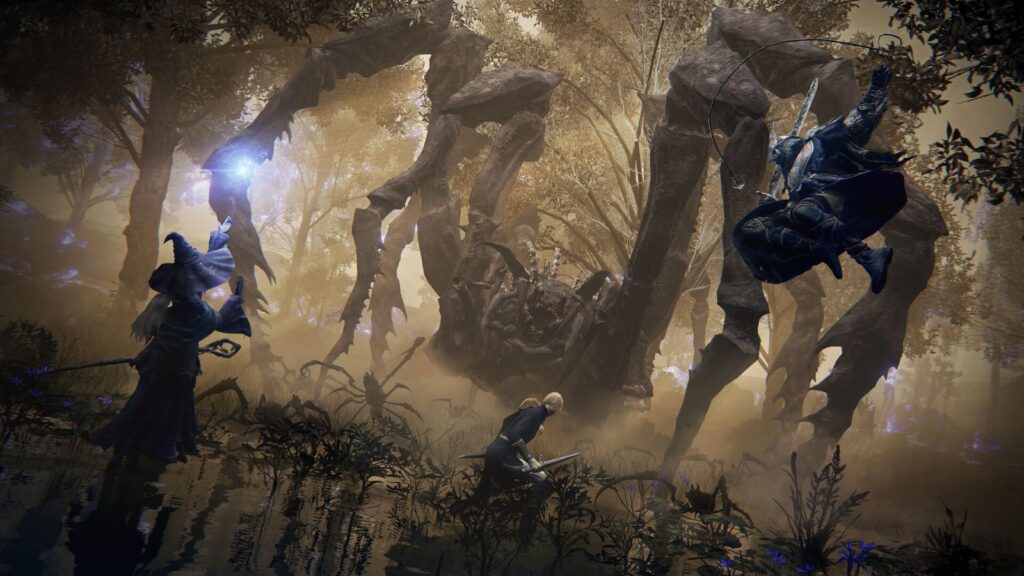
The real challenge of these fights isn’t just in gearing up for the encounter during the first two days. It’s in understanding how to make each person in your team not a liability. Players understandably will want to keep their distance in many instances of a Nightlord fight. But what if that Nightlord spends too much time hopping between targeting players so that there’s no good opportunity to close in for damage? And what kind of team composition is needed for victory?
The eight available Nightfarers in Nightreign feel surprisingly different to play, especially when leaning into their particular strengths. FromSoftware has designed these characters to be flexible enough to use any spell, weapon, or ability. But despite that, each Nightfarer still has their affinities towards dexterity, strength, arcane, and intelligence. Do you really want the magic-wielding Recluse to use a halberd especially if it only scales with strength?
Nightfarer flexibility ensures that players aren’t completely screwed out of options when picking weapon rewards. But each Nightfarer also comes with a passive ability, a Character Art, and an Ultimate ability. And it’s in these three aspects that their different qualities truly shine.
My go-to Nightfarer during a large portion of my playthrough was with the Duchess. She starts with a dagger and is best when leaning into dexterity and speed. Her Character Art allows her to instantly “rewind time” and deal 50 percent of damage given to any enemy by anyone in the party from the last few seconds. Just nail a critical hit? Pop that Art. Activated bleed with massive burst damage? Rewind. Her Ultimate is very situational, turning all characters invisible meaning enemies will no longer target the team. This is perfect for a clutch revive or giving everyone a bit of breathing room. The Duchess also has the best dodging ability in the game, meaning there were a few instances in boss fights where I could stall long enough to activate my Ultimate and save the team.
The Wylder is a great melee class for beginners because he has good health and strength scaling, preferring to use greatswords. His Character Art is a claw shot that can pull enemies in or allow him to swiftly close distance. His Ultimate is a massive damaging blast that can be charged up, allowing it to stun a boss out of a potentially devastating attack or quickly revive downed characters. The Guardian favors halberds and is able to significantly tank hits by having increased poise when his shield is up. His Character Art is a somewhat flimsy whirlwind attack that can knock over smaller enemies but doesn’t cause a lot of damage. His Ultimate is essential because it launches him into the air and then delivers a downward slam for massive damage and an instant revive for fallen comrades.
The Raider is meant to be a colossal force that uses raw strength and is more capable of using the heaviest weapons. When taking damage his Character Art allows him to deliver a stronger headbutt that can’t be interrupted by attacks. His Ultimate produces a massive stone pillar from the ground that can damage but also provide temporary relief for anyone on top of it. Another favorite Nightfarer of mine is the Ironeye, the bow and arrow class. In Nightreign, players don’t have to worry about arrows because they are infinite! So it was my delight that Ironeye was extremely effective effective not only because his Character Art opens up a weakpoint on enemies to make them take more damage, his Ultimate is a massive charged bow shot that can hit multiple targets, revive players, or stun a boss.
Players wishing to incorporate magic into their Nightfarer can use the Recluse’s abilities to gather magic energies from both players and enemies. Whenever an enemy is struck with a damage type, the Recluse can absorb that affinity, regaining FP and building up towards a Magic Cocktail. These Magic Cocktails can be activated when three affinities are absorbed and can be combined in various ways for extremely powerful spells, especially if players can memorize and master her unique ability. The Revenant is another specialty class who is more powerful playing the sidelines. She has the ability to summon unique spirits that will fight with the team, pulling aggro and causing damage. In smaller scuffles, dead enemies have a chance to be revived as ghosts that will briefly engage as well. Finally, the Executor rounds out the specialty classes by employing the use of a “cursed blade” that is able to deflect melee attacks. The cursed blade is vaguely similar to Sekiro‘s implementation except after a point, it can unleash a charged attack. While the Executor’s Ultimate allows him to turn into a beast and dole out extended damage, the riskier playstyle of his melee deflections makes him a dark horse in terms of viability.
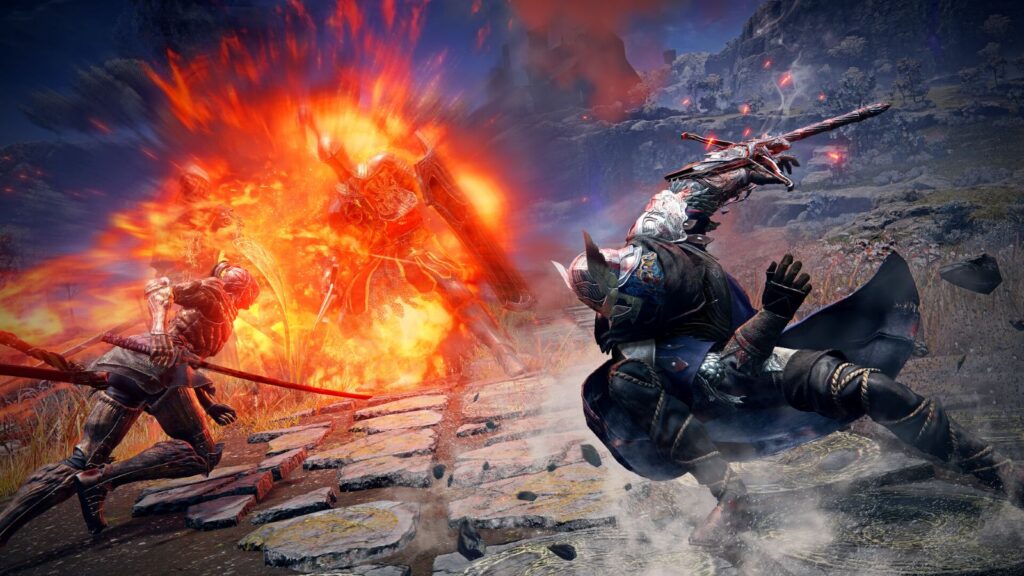
FromSoftware smartly allows players to use any combination of Nightfarers they wish. If the review Discord is anything to go by, three Ironeyes are extremely effective against a lot of the Nightlords. While any grouping can be viable, there are good synergies to be had when players opt for traditional support and damage roles, especially considering how challenging some of the bosses can be.
Some may have noticed my absolute lack at discussing the narrative so far in Nightreign and that’s simply because it is significantly simpler and more straightforward than any previous game in FromSoftware’s catalog. The Nightlord is capable of destroying the land of Limveld, which has obvious connections to the Erdtree and the Lands Between. The Nightfarers have gathered to stop the Nightlord from ending everything. It’s as simple as that.
Only a handful of cutscenes play out in Nightreign and I was perfectly okay with it. To supplement a narrative, each Nightfarer has their own Remembrances players can unlock. These character stories are slowly revealed by undertaking Expeditions as a specific Nightfarer, unlocking pages in a journal that can be read. Eventually, players are asked to relive a Remembrance which takes them to the hub of the Roundtable Hold in a different state where they are meant to speak to another character or search for clues to progress their story. Continuing their narrative thread usually relies on conducting an Expedition and going to a certain spot in Limveld to collect an item, kill a boss, or survive all three days. While these Nightfarer stories are modestly touching, interesting, or jovial, they simply do not contain the depth found between the lines of the rest of FromSoftware’s catalog. And despite that, I can’t say I missed the lack of narrative entirely because that simply isn’t the game Nightreign is.
But I feel as if it’s time to address the elephant in the room: outside of a flood of bosses at a rapid pace, what does Nightreign offer to keep players coming back for more?
Personally, this was part of my issue with the game during my early struggle. Traditional roguelikes find ways to reward the player with currency that can be funneled into permanent upgrades that strengthen a character and increase the odds of survival.
Whenever a player wins or loses an Expedition, they are rewarded with Murk and Relics. Murk is simple to understand. Eventually significant amounts of it are used to purchase wardrobe changes for the Nightfarers. But regularly, players can invest Murk at a shop to buy emotes, Relics, and Relic containers.
Players are able to acquire red, yellow, green, and blue Relics. These Relics can then be placed in three colored slots in a vessel the Nightfarer has. Starting out, each Nightfarer has only one container. Once players defeat the Tricephalos, the other Nightlord bosses open up and the shop’s inventory expands. Completing Nightfarer Remembrances also rewards Relics, Relic containers, and wardrobe changes.
But players shouldn’t entirely rely on Relics to drastically change their power in Nightreign. Relics are meant to be supplemental growth, eventually acquiring a set few that synergize best with a Nightfarer and their build. Players may acquire “worthless” Relics that do something simple like increase a specific kind of spell or ability. “Better” Relics flatly increase attributes like strength, dexterity, and arcane. The best kind of Relics can have up to three bonuses, including ones that apply to a specific Nightfarer. For Duchess, I found Relics that would increase the effectiveness of her character art, boost her dexterity, and sought out ones that amplified dagger attacks. When a Nightlord is defeated, they will drop a unique Relic once. Relic containers allow players to have more options when assigning colors or may include a slot that any color Relic can be placed in.
I’m of two minds with the Relic system. On one hand, I don’t think it feels overly substantial in allowing a player to survival all three days, an efficient run is the most ideal way to have that happen. But good Relics can help! And on the other hand, if Relics were too good, it would rob some of the inherent challenge from Nightreign, making the player stronger simply because they eventually acquired enough Relics and didn’t improve their skills.
Yet this also puts Nightreign in a precarious spot because what does a player do when they’ve cleared out all Nightlords and Nightfarer Remembrances? Well, that is an interesting question.
I think some players will lament the fact that Limveld as a map is mostly static outside of four unique Shifting Earth events. Over the course of the game, the player will be notified that the Limveld is shifting, indicating that going into a run means that one section of the map will be changed. Perhaps its a volcanic crater in the upper center that is dangerous to navigate. Maybe the frozen tundra will arrive and give players an opportunity to fight a massive dragon at its peak. A scarlet rot infested wood constantly harms the player while a mysterious walled city can form in the lower left corner.
These events are certainly interesting, beautiful, and offer a challenging twist. Remembrances may require Shifting Earth events to be completed and unique rewards are in store for taking the time to visit them during the first two days. But these are currently the only alterations to Limveld.
Players may also encounter a few opportunities where a powerful boss might suddenly appear or a unique event may add intrigue to a part of the map. And while these things may add new rewards, they don’t ultimately change the final goal.
Asking Nightreign to tack on modifiers to enemies or trip players up in other ways would perhaps throw the upgrade economy awry. Relics would need to be more powerful to offset the increased difficulty. Too many changes to the map would make runs less precise because near the end of my journey, I had them down to a science. It’s a tricky balance FromSoftware has struck because in a style of game like this, there’s a decent amount of possibilities, ones that could wreak havoc on what feels like a relatively fair game.
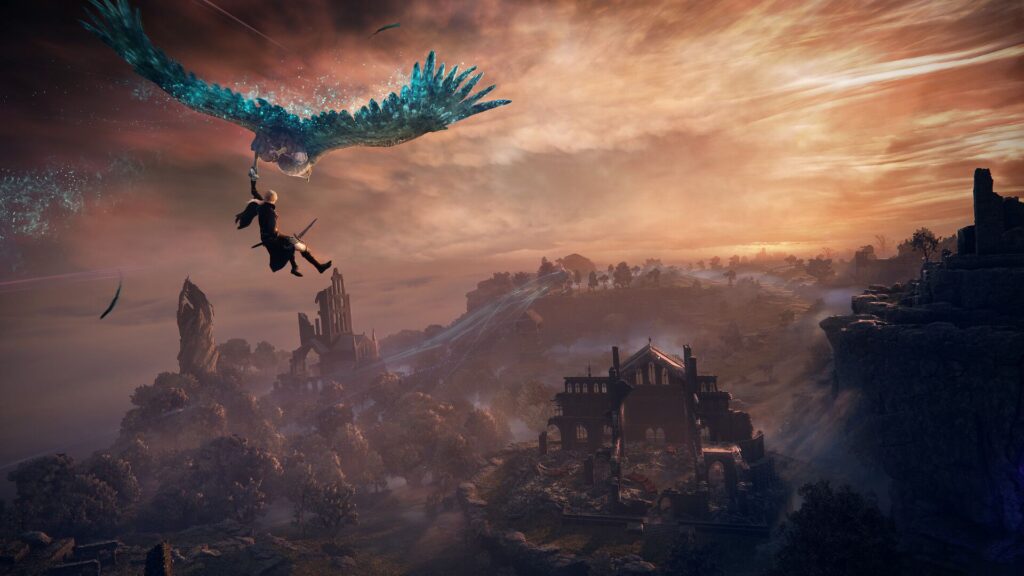
Of course with all that in mind, I’ve watched content creators come up with new challenges for FromSoftware games for years, finding new ways to make its games feel fresh. The time crunch and random nature of Nightreign could make that harder but not impossible. Because so much of Nightreign worked so well, I don’t think its unsurprising to want more of it. The game had minimal technical issues outside of loot drops and enemies occasionally not working or spawning under the map. Players couldn’t matchmake if more than one had a Remembrance active. But as always the music here is exceptional. The main theme while running through Limveld changes with actions and pushes the player forward while every Nightlord theme has a grace and majesty to it. Hell, I think the limited real estate makes Nightreign look and run better than Elden Ring.
Many are likely to wait impatiently for FromSoftware to release some kind of content roadmap which, in all honestly, sounds weird to even type. But if any studio were to do it right, it’s the people who have consistently delivered for over a decade. There are plenty of things Nightreign could be but what’s here are 45-minute to an hour roller-coasters of phenomenal action, steeped in combat forged through years of thorny challenge.
Elden Ring Nightreign is a thrilling rush. FromSoftware has taken their masterclass gameplay and constructed an entirely new and exhilarating loop. Despite forgoing familiar elements that made Elden Ring truly special, Nightreign maintains the essence of its wonder, empowering players by fulfilling their dream of an onslaught of challenging, brilliant boss fights, only prohibited by your own skill, ambition, and deadly efficiency.