


DOOM: The Dark Ages dials back the complexity of Eternal, hoping to capitalize on what made DOOM a household gore fest. Hordes of enemies are meat under the player's boot in yet another evolved take on the classic arena shooter.
DOOM: The Dark Ages sees the journey of id Software’s modern-day DOOM revitalization complete a perhaps unexpected full circle.
Leading up to the game’s release, id has emphasized The Dark Ages‘ inspiration was classic DOOM, that groundbreaking shooter from 1993. 2016’s “reboot” served to bring the framework into the modern era. Spectacular visuals allowed the gory kills to become cinematic. Gunplay was feverish and challenging. Levels were oversized arenas packed with secrets. DOOM Eternal was a confident product, amplifying the elements from the reboot and adding new layers of complexity.
Putting a finger on what makes The Dark Ages more distinctly “OG” DOOM lies not in what it takes away or adds from previous games but what it cements over the course of its 22 blistering levels. There’s a notion of the player to stand their ground. In fact, it’s pasted on one of the loading screens after a player’s death. Across multiple games from a number of eras, DOOM has always been about two diametrically opposed forces clashing against each other with overwhelming power.
The DOOM Slayer and the legions of Hell. For over 30 years they have clashed. And for over 30 years the Slayer and the Player have overcome those odds.
Musing on the notion of an arena shooter, it’s easy to see why DOOM was such a popular brand. Wolfenstein had its Nazi-killing catharsis, sure. But DOOM placed the semi-invincible Slayer against Hell itself. Demons would become disemboweled after soaking up the game’s numerous methods of dispatch. All the while they attempted to close in on the player, whether with fangs or their own weaponry. Look back on that 1993 version and remember the frenetic movement of darting around levels of varying construction. Tight corridors meant to choke the player with Imp fire and Cacodemon blobs. Large, open rooms where Barons of Hell, Cyberdemons, and Zombies would flood the space with their slow-moving projectiles to give the player just enough breathing room to think.
The Dark Ages channels DOOM‘s fascination with momentum, not just as a mechanic for killing things efficiently and staying alive, but as a part of the franchise’s unique power fantasy. Outside of shooting, the element that should stick with players is the gargantuan presence of the Slayer. In terms of video game protagonists, he is meant to be the pinnacle of strength, casually ripping the jaw off an otherwise invincible deacon of Hell. His footsteps shake the Earth and the slightest drop of more than a few feet causes the ground to quake and nearby fodder demons to explode from the impact.
When traversing a level in The Dark Ages or running marathons around waves of enemies, the permanence of the Slayer’s momentum is almost intangible in its satisfaction. Moving and running and existing as him feels serene in its power. id trademarks his speed with bursts of air during a run but also makes the player recognize the power with the sound design emphasizing both bulk and grace.

And that speed is both necessary and freeing when tackling the biggest “arenas” that id has created to date. The evolution of tech has allowed DOOM to become bigger and more interesting since 1993. The Dark Ages makes a noble attempt at open levels and succeeds quite well.
For me–and likely many other players–the secret sauce to a game like DOOM is the variety in its encounters. As expected, over the course of The Dark Ages, the challenge will not only increase but evolve. Part of this certainly comes from brutal enemy composition. A handful of secrets or side areas will trap players in a confined space and throw the toughest and most chaotic enemies at the player. Rewarding survival by the skin of the teeth with upgrade currency or a collectible.
But early on The Dark Ages shows that id has taken the notion of an “arena” and sewn multiple together into a hellish neighborhood. In his preview of the game earlier this year, Nathan noted it reminded him of Destiny and I find that to be an apt comparison. Bungie did a phenomenal job of creating compartmentalized spaces that tied combat and discovery together, using hot spots where quests and public events would unfold. If id were to make a looter shooter, The Dark Ages would be an obvious framework.
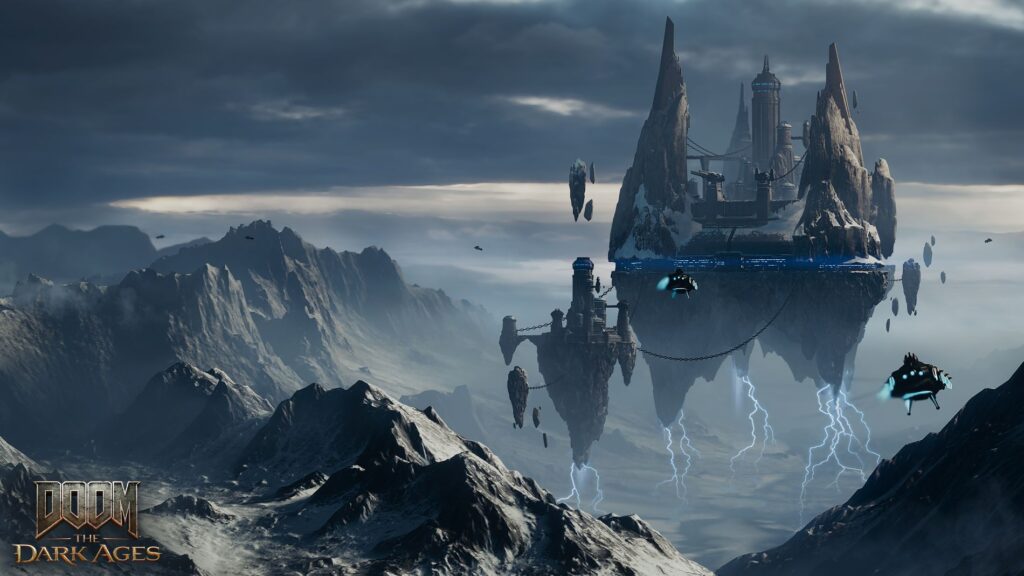
While id lays the foundation in the first level by tasking players with eliminating multiple objectives spread across a small-ish space, it’s not capitalized on until a bit later. In hopes of fighting back Hell’s forces, the Slayer comes to the outskirts of the capital city and must take out artillery to prevent an energy wall from crumbling. In totality, most of these open-ended levels are focused on the Slayer taking down multiple encampments and allowing the player to choose whatever approach they wish.
Though not groundbreaking in concept, these looser, interconnected arenas not only house secret areas but well-constructed avenues of combat. Across the whole of The Dark Ages players will grow in familiarity with the pace of an encounter but the terrain is always different. Reflecting on the countless fights I had, it’s impossible to ignore id’s implementation of varying trickery to keep fighting fresh. Raised platforms and columns can obscure vision or house a demon, slopes snake around to cut off pursuit but allow the player to maintain crosshairs, and long sight lines provide perspective.
It’s in these open zones where players can splatter the corpses of fifty or more enemies all on screen at once, showing the ferocity of the game’s engine and its ability to refuse to buckle under the weight of so much organic shrapnel. One of The Dark Ages‘ most satisfying feelings is being locked into a space and zoom around. The Slayer never lurches as the sludgy bass and razor sharp guitar riffs of the metal soundtrack blare. Slayer boots stomping and the wind rushing like a bullet train through the flesh and bone barricade of a demon’s grey matter. This is thrilling, challenging stuff. And when the music settles and the area is empty, players can sweep up and collect any health and ammo they made need.

The Dark Ages revels in its simplicity and I think most fans of DOOM wouldn’t have it any other way. If DOOM Eternal would have a fault, it would be that id tried to do too much–that and its platforming was a bit clunky because the Slayer simply isn’t Mario. And trying to piece my memory together of the previous two DOOM games, the pace is not drastically different. But I do think The Dark Ages is easier than Eternal merely because the player has less to juggle and some of the “unfair” enemies are stripped out of this concoction.
Playing on Ultra Violence difficulty, The Dark Ages had a ferocity I wholly expected. Death was not infrequent but being a whisper away from the clutches were. Players can use Life Sigils as a way to revive mid-fight or go back to a checkpoint, usually resulting in having to chew through one or two fights depending on where death occurred.
To curb the encroaching difficulty spikes, players are meant to explore levels with an extremely generous map that exposes where secrets are. By collecting gold and two types of gems, the Slayer’s arsenal can be upgraded to make him brutally efficient.

The Dark Ages‘ selection of a dozen guns contains a few hallmarks including the Super Shotgun, Pulse Rifle, and Rocket launcher, some with retooled names and looks. But also introduces numerous guns befitting the techno-medieval setting. A Skull Crusher gun literally grinds up runic skulls for a wide blast of constant damage. A gun that shoots an energized ball and chain is slow but devastating to enemy armor. Yet it’s when these guns are upgraded that they truly become more than ways to turn Hell into viscera.
Players can upgrade the rocket launcher so that splash damage actually heals the Slayer. The Combat Shotgun can set enemies on fire and make them spew shards of armor. A variation on the Skull Crusher can fire rapidly and cause damaged enemies to eject health and ammo. And while these guns are ominous in their power, taking up about a sixth of the screen’s real estate at times, it is really up to the player to be conscious of their arsenal. While I personally found my handful of favorites for the last few chapters of the game, players more skilled than me are going to be more mindful of hot-swapping not only weapons but those of a similar class. On a DualSense, pressing square can switch weapons of a class, like the Combat Shotgun to the Super Shotgun. Pressing R1 will swap to the last equipped weapon while holding R1 slows down time and pulls up a weapon wheel.
In the chaos of gameplay, it can be easy to panic and forget the unique abilities each weapon can have, especially after one or two upgrades are invested in it. But generous ammo drops scattered around an arena try to push players towards navigating away from their comfort zone, especially when enemies come packed with armor.
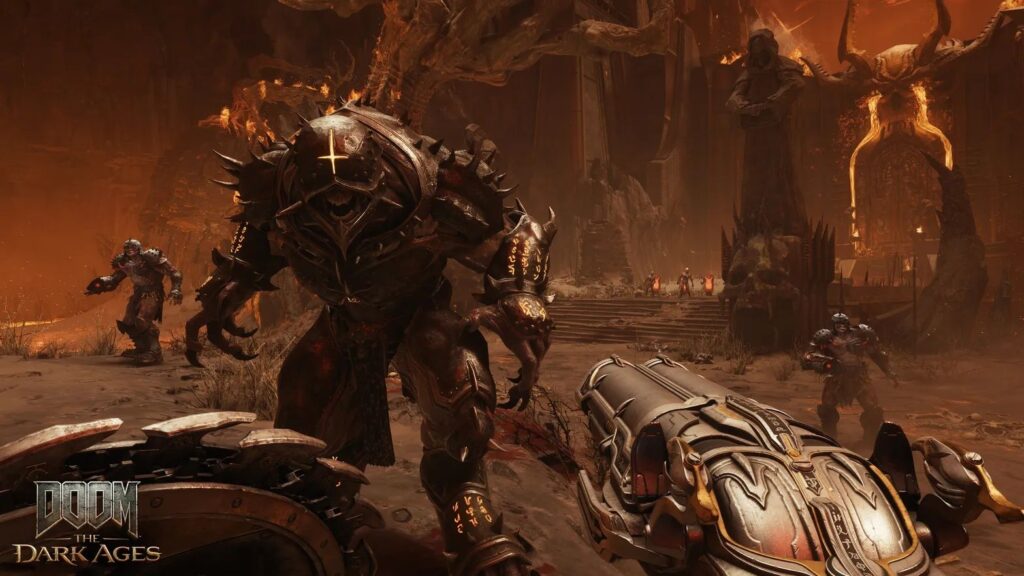
The Dark Ages‘ biggest change comes from the Slayer’s Shield Saw, an absurdly appropriate replacement for the chainsaw that is as brilliant as it is cool. Combat in the game is intrinsically linked to the Shield Saw, not only because it is a permanent tool but because it is used in conjunction with every other element in the game.
At the most basic use case, the Shield Saw can protect the Slayer from enemy fire, soaking up hits before its guard is broken and needs a cooldown before being used again. The Dark Ages introduces metal armor to enemies. Before true damage can be inflicted, armor must be stripped. That is done by providing a barrage of weapon fire until the armor glows bright red and hitting it with the Shield Saw. This adds a flair of complexity to a fight because it requires the player to prioritize targets, especially when multiple armored enemies are attacking.
When an enemy is armored, they also cannot be pinned down by the Shield Saw. While fodder enemies are torn asunder in and instant when thrown, larger enemies will actually be stunned, writhing in agony as the Shield Saw grinds and chews into their body. Players can use this opportunity to wipe out smaller foes or, for a brief moment, run in and blast away with a shotgun. Holding down L2 and then hitting R2 causes the Slayer to charge forth with the Shield Saw like Superman and bash an enemy, often providing breathing room or zipping to the intended target. Additionally, the shield saw can be incorporated into traversal and the solution towards accessing varying secret areas.
Coupling the effectiveness of the Shield Saw, most enemies have a “Hell Surge” which is a glowing-green melee or projectile attack. Waiting until the last moment to block with the Shield Saw will parry a Hell Surge, preventing damage. In the case of an enemy’s melee attack, this will briefly knock them back for a blink-and-you’ll-miss-it window of opportunity to punish. For projectiles, they will launch back at the enemy, damaging them. As the game progresses, the Shield Saw can be equipped with runes that activate an ability when a Hell Surge is parried. Be it a stunning burst of lightning, homing daggers, or an auto-turret that shoots at enemies, it’s another tool in the belt.
Lastly, the Slayer can equip one of three melee weapons–a gauntlet, flail, or mace–that require charges to execute but usually result in devastating damage and added benefits when upgraded.
Having been in the midst of Clair Obscur: Expedition 33 before playing The Dark Ages, I felt surgically equipped to parry attacks with the Shield Saw. A number of demons in the game will come at the slayer with multiple attacks that can be blocked in succession, adding to the invincible power fantasy. Poorly timed blocks can shave off health but worse yet, when the Shield Saw is on cooldown, it can’t be thrown or used to block.
As enemy composition grows, id has a proclivity towards lining an arena with enemies that shoot slow-moving bursts of energy, akin to the original DOOM. But then fast-moving units that close-in require a thrilling situational awareness that feels fair rather than overwhelming. Unlike DOOM Eternal, The Dark Ages works to incorporate moving between enemy groups but always being laser-focused on the Slayer’s ability to stand his ground in the proper hands. Combat feels frenetic, busy yet it never gets to the point of overwhelming, having to juggle different mechanics. That’s not a condemnation of Eternal‘s phenomenal combat, just praise for id’s ability to make The Dark Ages the third entry to feel different enough, despite being cut from the same cloth.
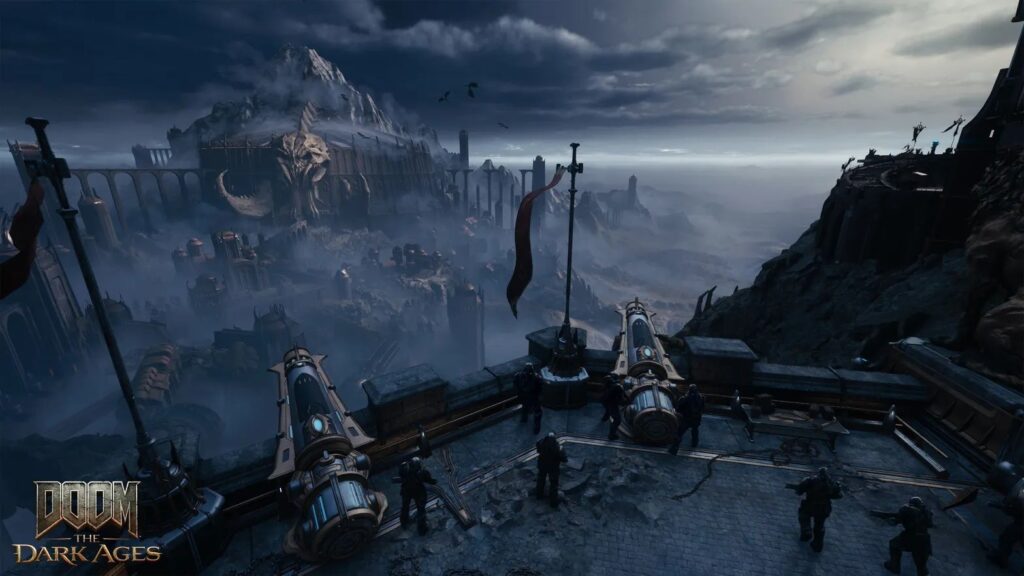
Unsurprisingly, I’ve beaten away my typical desire to bring up the narrative first as I am wont to do. DOOM has never been about story, it’s been about slaying–ripping and tearing. id has remained cheekily aware of this fact and does their best not to create too much friction between the story and getting players to the action. The Dark Ages feels like another excuse to give players cool shit to look at while they nimbly eviscerate demons.
Taking place further back in the overall DOOM timeline, The Dark Ages attempts to give context to the Slayer’s origins that were introduced in the prior games. But this is set before Hell came to Earth, before Mars was overrun by clueless scientists and corporations. As such, it allows id to blend the timeless denizens of Hell with a brush of magic and a bucket of Army of Darkness. Yes, this is medieval DOOM and it does it well. Familiar enemies are given a slightly different skin that applies to the setting. There’s still technology, there’s still mysticism, but it’s all backdrop for the action.
As the Slayer, players are tied to the Makyr race until they are not. They are fighting against the demon Prince Ahzrak who is trying to unleash Hell. The flavor is the same it’s just in a different substance. Narratively and perhaps visually, the most fascinating thing The Dark Ages does is take players to The Cosmic Realm. Yes, that Lovecraftian lair of psychosis and insanity, where tentacles are the size of skyscrapers and The Old One waits. id dipping their toes into this beloved setting shows that the developer is capable of making anything badass. In fact, I can imagine a future DOOM game set solely here… though it may need a splash more color.

Fundamentally, The Dark Ages is a pinnacle DOOM experience, just like the prior two games have been. On PlayStation 5, the game runs exquisitely. If there was stuttering or slowdown at any point, I don’t remember it. This is a visually stimulating shooter set at a breakneck pace, capable of populating the screen with more enemies, projectiles, and hunks of meat than every before. While I had a handful of audio glitches where sound would either be far too loud or the scraping sound of a box wouldn’t stop playing, the strangest annoyance was pulling up the map screen in the middle of movement, exiting out, and having the Slayer’s momentum stopped, requiring two directional inputs to get him moving again.
A gracious implementation of difficulty accessibility also ensures that The Dark Ages can be as hard or as easy as the player wishes it to be. While I stuck with Ultra Violence difficulty through the campaign and didn’t change any of its elements, it’s important work id is doing to make sure that players can find something that wrings the proper amount of challenge they wish to have.
As enjoyable as DOOM Eternal‘s multiplayer was, I’m not upset it isn’t here. But I do lament that The Dark Ages is literally just a single-player campaign and dryly so. Once a mission ends a results screen pops up and shows any collectibles missed. Players can hit a button and go directly back to the main menu rather than moving on the to the next chapter. Levels don’t effortlessly flow into another but they do load fast. While in-level challenges and weapon-specific challenges exist, The Dark Ages really would have shined had id given players a handful of unique challenge arenas with bespoke rewards, modifiers, or victory requirements. Some secret areas do provide these moments but they are stuck inside a level. I imagine fun ways of incorporating a single weapon into a combat encounter or throwing numerous Hell Surge-ready enemies at the player.
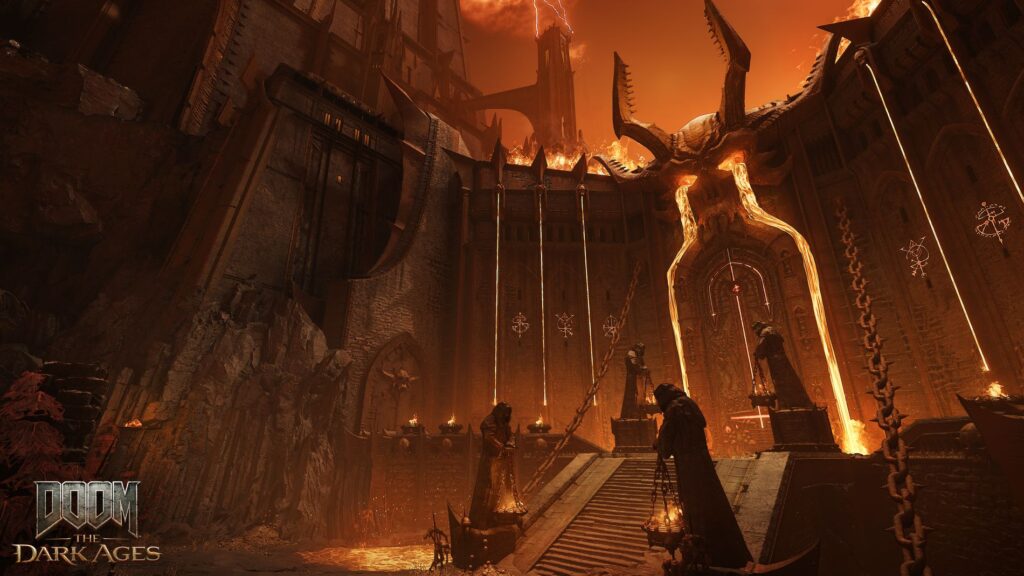
And being strictly a level-based game does give The Dark Ages some glamorous, awe-inspiring settings. A forge located inside the decayed remains of a miles-tall demon. The literal guts of an ancient God. The front steps of a cathedral in Hell. The handful of available boss battles are challenging and engaging. Tougher fights requiring players to whittle away mobs before being able to kill a leader spice up encounters.
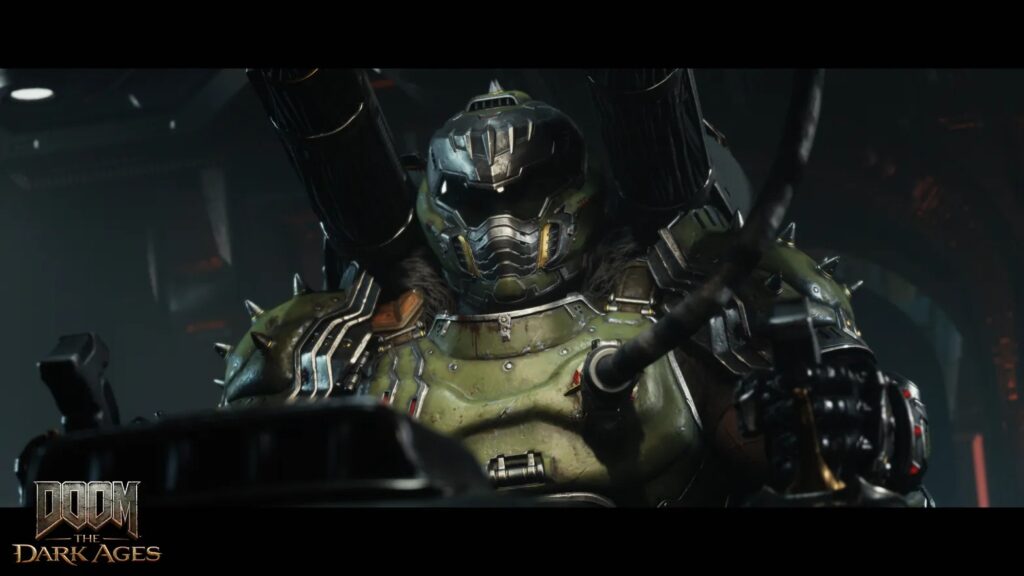
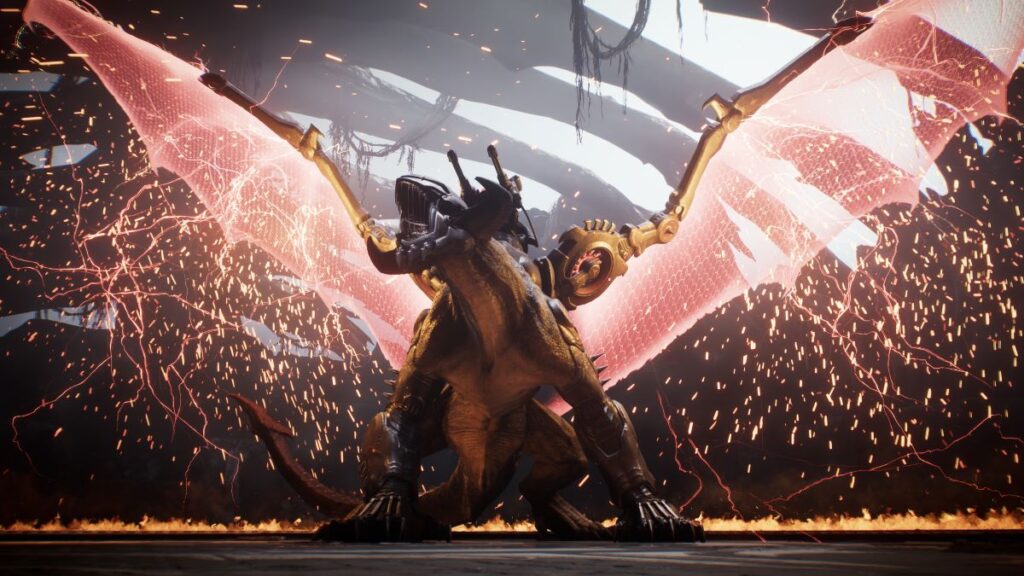
While cutscenes have drama and action, there aren’t distinct “set-piece” moments. Instead, id opts for sections where the slayer pilots an enormous mech or a beastly dragon. The mech sections are mainly straightforward and a good excuse to have fun beating the ooze out of demons. And the dragon-riding sections have their charm as well but trade spectacle for complexity. Both these distractions aren’t overused and primarily focus on generous well-timed dodges to down foes. Having a pace and personality of their own adds to the overall package even though they are simplistic. But often, it’s just nice to have a ridiculous time.
Had id recreated the identical formula of its past two accomplishments, The Dark Ages wouldn’t truly falter. And if the idea of shredding through a few thousand fiends of Hell as the primary carrot on the stick doesn’t sound engaging then players aren’t going to get much else. But for fans of shooters, id yet again presents serene, visceral, near-perfect gunplay in one of the best packages available.
DOOM: The Dark Ages is a thrilling, feverishly-paced slaughter, the one thing most DOOM fans crave with each entry. Forgoing the brutal complexity of Eternal, id Software has stripped the formula down only slightly, making the Shield Saw one of the franchise’s best additions since glory kills. In the voyage towards reclaiming the roots of 1993, DOOM again shoves arena shooters into the future.