

Now, I get it. Now, I get why my wife and son play Stardew Valley all the time. Cozy games are so positive and mesmerizing.
Well, welcome to the next Stardew Valley.
Discounty from developer Crinkle Cut Games has the chance to become the next Stardew game. It’s a cozy game that is led by the player maintaining, expanding, and running a supermarket called Discounty. Filled to the brim with activities to keep your brain going non-stop, this thrill-ride of grocery proportions has so many pleasant moving pieces that it’s tough to criticize it. But, as a critic, I must, and I do have some minor gripes.
Anyway, Discounty begins with your character arriving in town to take over a grocery store management position. Your goal is to build up your product, talk to townsfolk to build relationships, and then build your customer base through various methods. At the same time, you must follow along a linear storyline filled with quests, button mashing, basic math, and a small amount of intensity.
Let’s start with the basics.
The core gameplay in Discounty is simply running a grocery store. You’re tasked with bringing out your product, placing it where it needs to go to be seen, and then keeping up with supply and demand. Keeping the shelves stocked while pushing customers through the line and out the door, and making them happy, is the core gameplay. But that core has a lot of moving pieces around it.
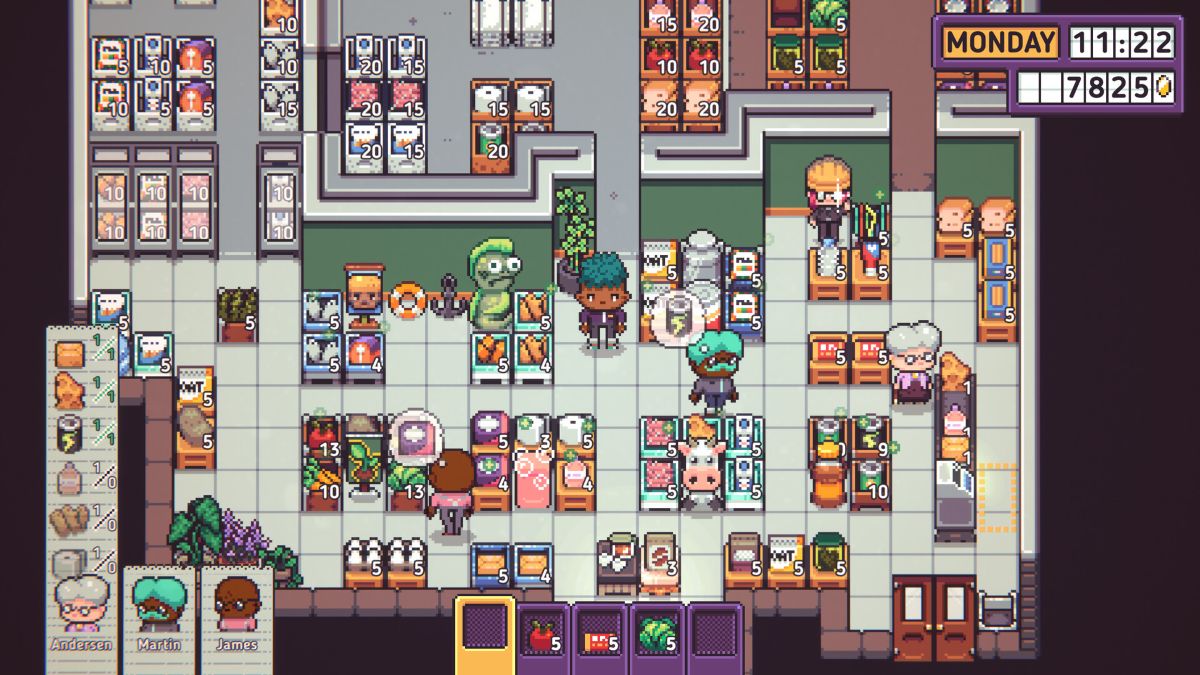
The first layer of moving pieces involves keeping up with your stock in the backroom. You must be careful not to run out of products, or you run the risk of pissing off your customers and potentially losing them. Juggling that isn’t too difficult, as the game gives you a clear division of your store and your stock. In addition, refilling that stock means just ordering it on a computer in the back and watching it instantly appear from a very nice delivery person. As the game becomes bigger and more complicated, so does the process of keeping up with the goods and making sure you’re ready to pay for more when the time comes. It’s a balancing act, but a fun one, especially if you enjoy handling multiple tasks at once.
And of course, it gets bigger.
To get more supply, you must make more money. To make more money, you must keep your customers happy. To keep them happy, you must do everything above. To keep the above going, you must build relationships in town, not only with residents who are potential customers, but also with suppliers who can bring you new and exciting merchandise for your grocery store.
Staying with the suppliers, they are not easily pleased. The game institutes a quest system through said suppliers in a quid pro quo sort of way. They ask you to do something to prove you deserve their product, and you must achieve it to expand your product selection. Since this game was built for a younger audience in mind, it provides you with ample amount of time to get all of this done. For example, selling Xmas fish at your market that would not normally move, if you do this, then you get access to fresh fish that is normally sold only to the supplier for their selling purpose (monopoly!). The game throws a lot of these scenarios at you in the form of quests, but doesn’t press on you to complete them quickly, which is nice for a younger audience just getting their feet wet with this type of game.
Once you begin to gain supplier trust and customer loyalty, the game then asks you to expand your store. You can’t fit everything in a small space, so it throws a real estate quest your direction. That involves a lot of ping-ponging around the cityscape, taking quests from suppliers and bankers, and making you earn every single square foot of the new digs. It’s quite exhilarating to see it in motion, and it’s addictive as hell once you see the fruit of your labor.
As this is all going on, the game steers you into truly sitting down and thinking about store design and how to get your customer their product as quickly as possible, with the possibility of catching their eyes with new items you might introduce. This aspect of the game is when you will understand how methodical and addictive the gameplay design was and how effective it becomes quickly. You will want to sit down and think about what your customers want, while taking note, and using marketing gimmicks, such as a plastic cow or a large soda bottle, to entice your customers to pick up products. It’s ridiculous how engrossed one becomes when trying to figure out all of this. The game is impressive because you slowly engage and hook yourself into the role of a storekeeper who is dying to succeed.
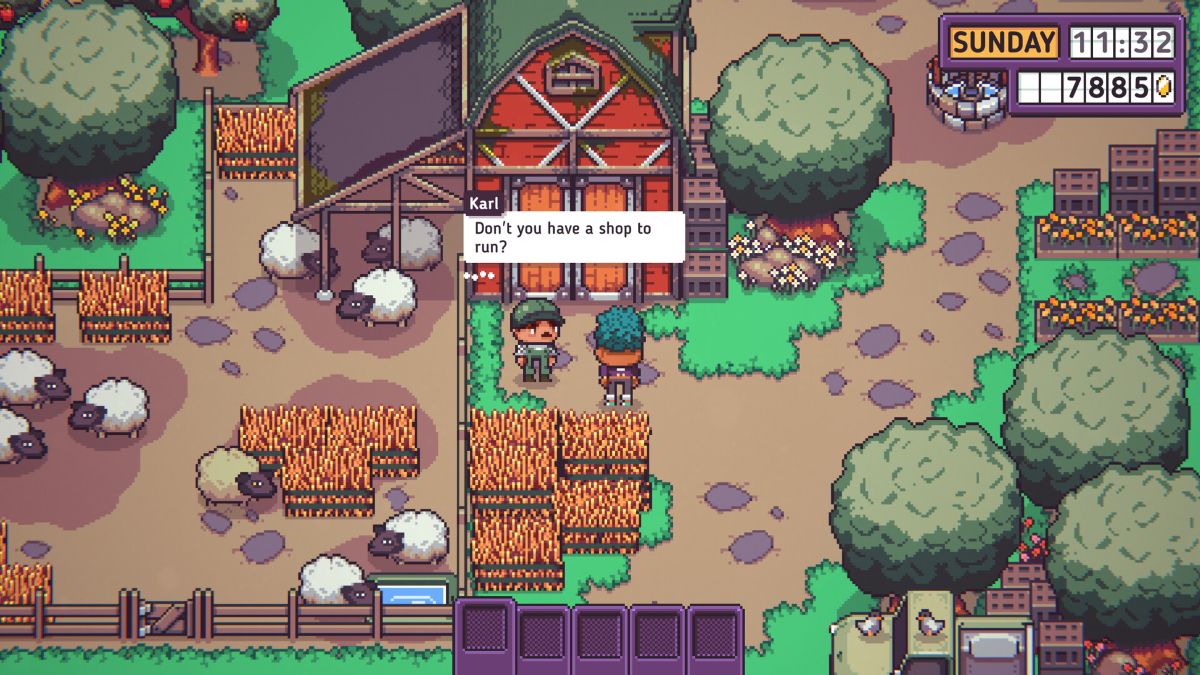
It’s positively ridiculous how quickly you can fall into this game. From simple sales to strategic store design, the game pours its intentions on thick and is relentless in releasing one’s attention. I had to break away from this game to start this review, and I’m sure I will be returning to this once I catch up on my gazillion reviews that I have underway. It’s that addictive.
Now, you would think that the hardest part of the above process would be restocking goods while customers snatch them up, but that’s not too bad. You can have several products on your person waiting to be shelved when the time comes. You just must keep an eye on the sales trends and make sure you have the right ones equipped. The game does a good job of making sure the gameplay is intense once customers roll in at a designated time, but eases up when it comes to simple planning. You can strategize to prepare for restocking shelves on the fly without needing to run to the backroom for more goods. You can do that too, but it’s not immediately necessary.
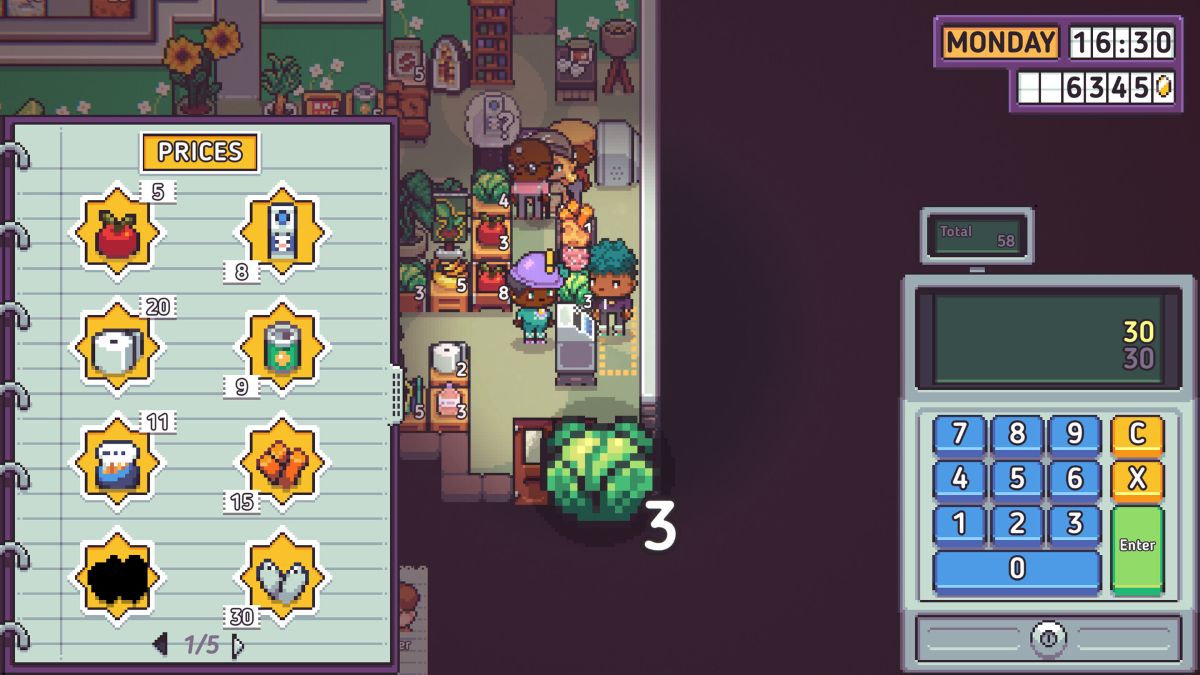
The biggest hurdle I have run into with this game is having to do math on the fly, as well as seeing how much of a product someone is buying. While the game does its best to give you a heads-up with customer intention, as it shows you the grocery list of the customers one by one, once the chaos of several customers starts, you will quickly lose attention to any single one. The game does its best to account for this by putting a small number on the bottom right of the product as it comes down the checkout belt, but sadly, multiple products get jumbled, and sometimes it’s difficult to read the quantity of the item. Without that quantity, the checkout can be disastrous, which means you have the potential to make a customer unhappy. This aspect of the game may frustrate a younger gaming audience who probably hate math.
I found this tiny roadblock to be somewhat annoying. The solution to help with the quantity on the checkout belt would be putting the number on the stage-left side of the product rather than on the right. It would help with solving math problems quickly. As it stands, it’s a bit of an annoyance, especially if you have planned so well that nothing should be going wrong.
As you continue with the game, building up your presence and store, your product line begins to expand as you meet your daily goals. You’re given goals/challenges to meet daily, which can stretch out to multiple days. These can be selling X amount of meat or keeping X amount of happy customers happy. Once these types of goals/challenges are met, then you earn points, which can be used to expand your product or your capacity to carry extra products for restocking.
And you thought this was going to be an easy-peasy, simple grocery cozy game, right? It’s positively a wonderful experience from beginning to end. My only other complaint, other than quantity placement on the checkout belt, is the speed of the dialogue. While I enjoy a good narrative pushing things along in a cozy game, this one, at times, takes a while to spit out what it’s trying to say. I like world and character building, but at my controllable speed. It’s a small gripe, though, as the story and characters do give you good context and beef for your narrative burrito.
Overall, I have loved the complication this game provided and its constant and gradual payoff as you delve deeper into its grocery madness. This is a fun and addictive cozy experience with little to no issues. If you like Stardew Valley, then you’re going to love Discounty.
Let’s wrap up this review.
Conclusion
Discounty from developer Crinkle Cut Games is an addictive and ever-expanding cozy game experience. It has enough quests, activities, and grocery store madness to keep you occupied while you take a break from Stardew.