

If you’re still on the fence about Denshattack!, I’ll leave you with this: Denshattack! is the type of game worth keeping installed on your hard drive. In short bursts, it has just the right amount of high-octane stylish platforming needed for winding down after a long day. In longer-form settings, it rewards those in it for the long haul with exhilarating tricks, multiple forms of mastery, and satisfying high-score chases. It’s a must-play of 2026, especially if you’ve been hankering for a Tony Hawk- or SSX Tricky-inspired locomotive fever dream with outstanding art design and soundtrack.
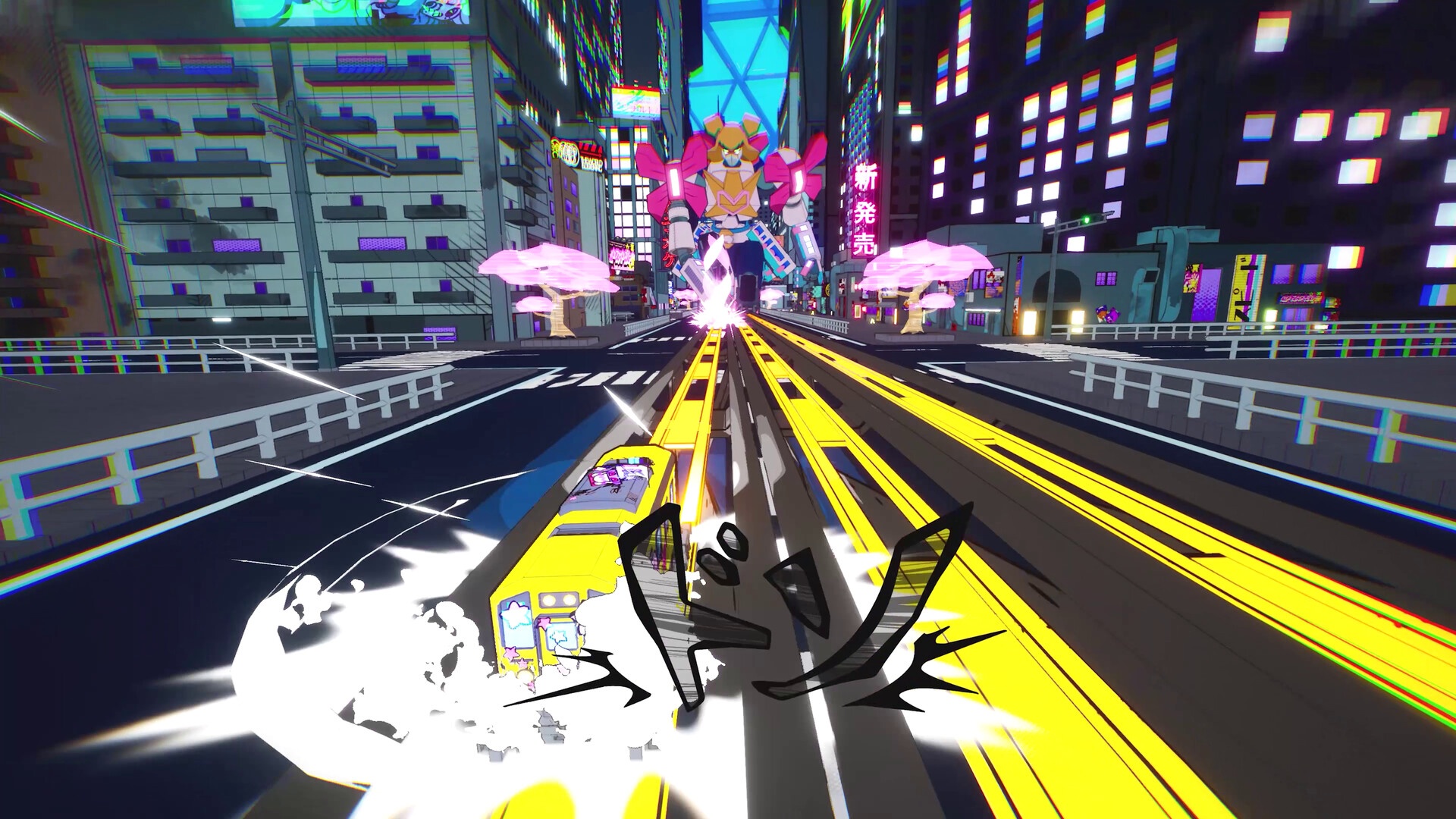
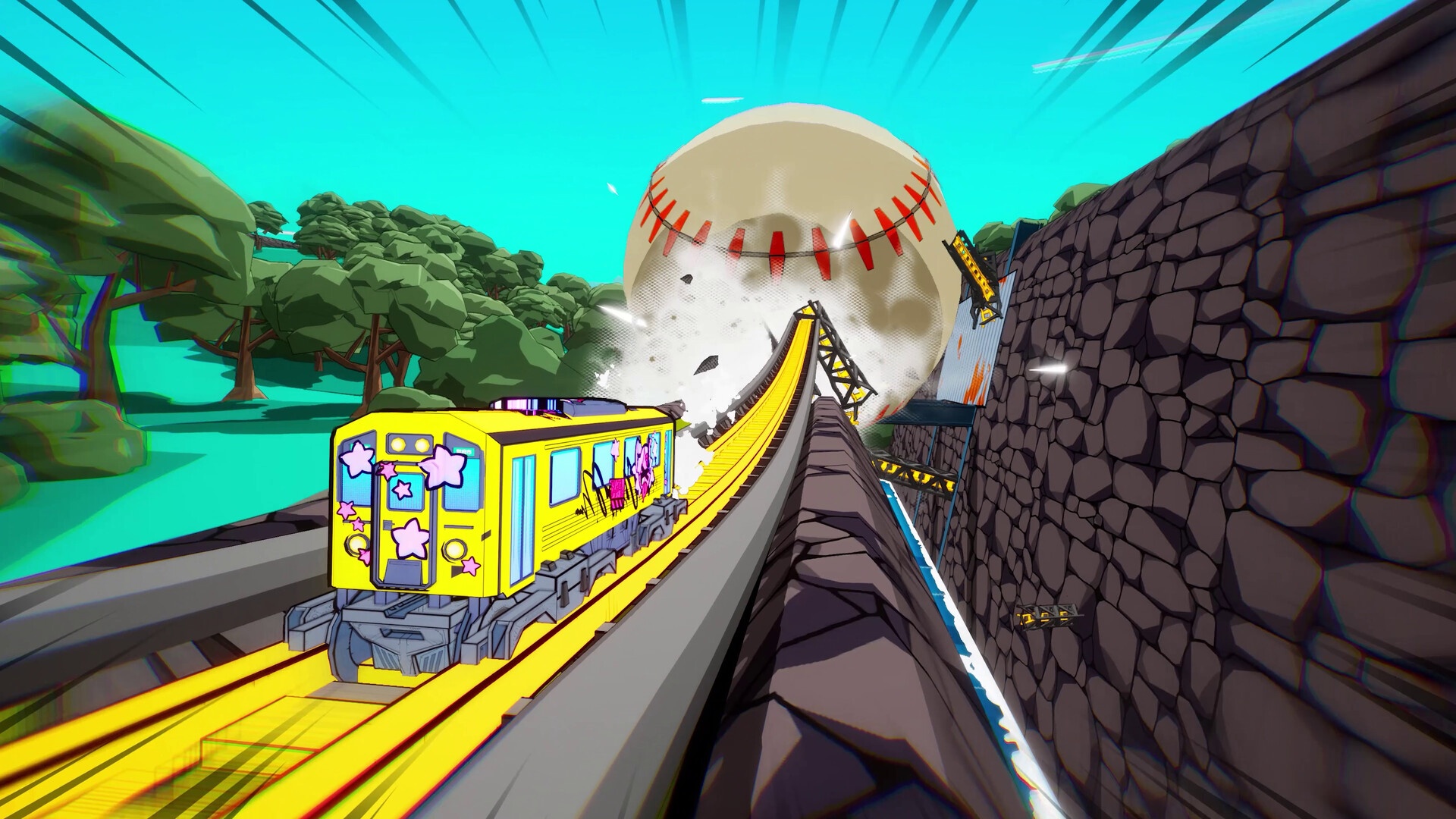
Where do I begin with talking about Denshattack!? Where should I begin? Should I begin by talking about riding a train track out of an active volcano (inches away from being melted to bits)? Should I begin by talking about kick flipping over a castle from one rail to another, just narrowly missing a massive baseball that could only have been thrown by Godzilla himself? Or…should I talk about how I (as one train) took on five trains that morphed together to create a feminine Megazord by commandeering its jet-propulsed hand to send it careening into the Megazord’s body, thus finishing it off in one fell swoop.
Maybe you should just stop reading and go play it. It’s easier for me if you do, as I can write (and spoil) at little as possible about this year’s must-play indie game. Well, I want to write more, and I will, but do know that Denshattack! is a wild ride of epic proportions.
 It’s rare to come across a game that fully embraces its chaos by throwing more, more, and more at the player without violating the boundaries of its in-universe logic or waxing redundant. Where too many games fall just short of hitting their creative peaks, developer Undercoders and publishers Fireshine Games and Boltray Games have employed the “Yes, And” improv perspective with creating Denshattack! This perspective yields a level of creativity I would expect from the likes of Keita Takahashi (of Katamari) and Hideo Kojima (of Death Stranding and Metal Gear Solid). Controlling a train and performing ridiculously stylish tricks is the baseline experience: The context in which these tricks take place dramatically evolve throughout your playthrough. By the end of the story, there’s little surface your train hasn’t styled on. The baseline has moved so far upward that Denshattack!’s first levels feel like the game’s least creative yet most restrictive spaces.
The first levels aren’t actually boring nor restrictive, mind you. I say all of this to highlight the immense creativity and nuance that is sewn into the fabric of Denshattack!’s fifty-or-so levels and celebrate the fact that every single one of the levels is unique in its own way. From their design to their objectives to their scaling chaos, the only thing repetitious about the game is the relatively library of tricks in the in-game “Trickopedia.” It is for these reasons why I loved reviewing and playing Denshattack!: It’s a platformer-meets-trick game designed exceptionally well.
 Denshattack! takes place in a dystopian post-apocalyptic Japan where most of its remaining population were sent to live in domed cities. Emi Araki, a ramen delivery-person living outside the domes, encounters an underground network of gangs and rebels who enact gravity-defying and reality-bending tricks with reimagined Japanese trains (called “Denshattack”). Emi’s journey starts out tame in the form of seeking companionship and becoming the best Denshattacker, but it ends up pitting her and her friends against a sinister megacorp.
I’ll be honest, I wasn’t convinced about the story. I was more focused on playing the game. The already-limited worldbuilding present in the beautifully-drawn cutscenes was enough to satisfy my need to know more about this world. Imagine my pleasant surprise to see fully animated and voiced cutscenes full of heart, charm, and emotional color.
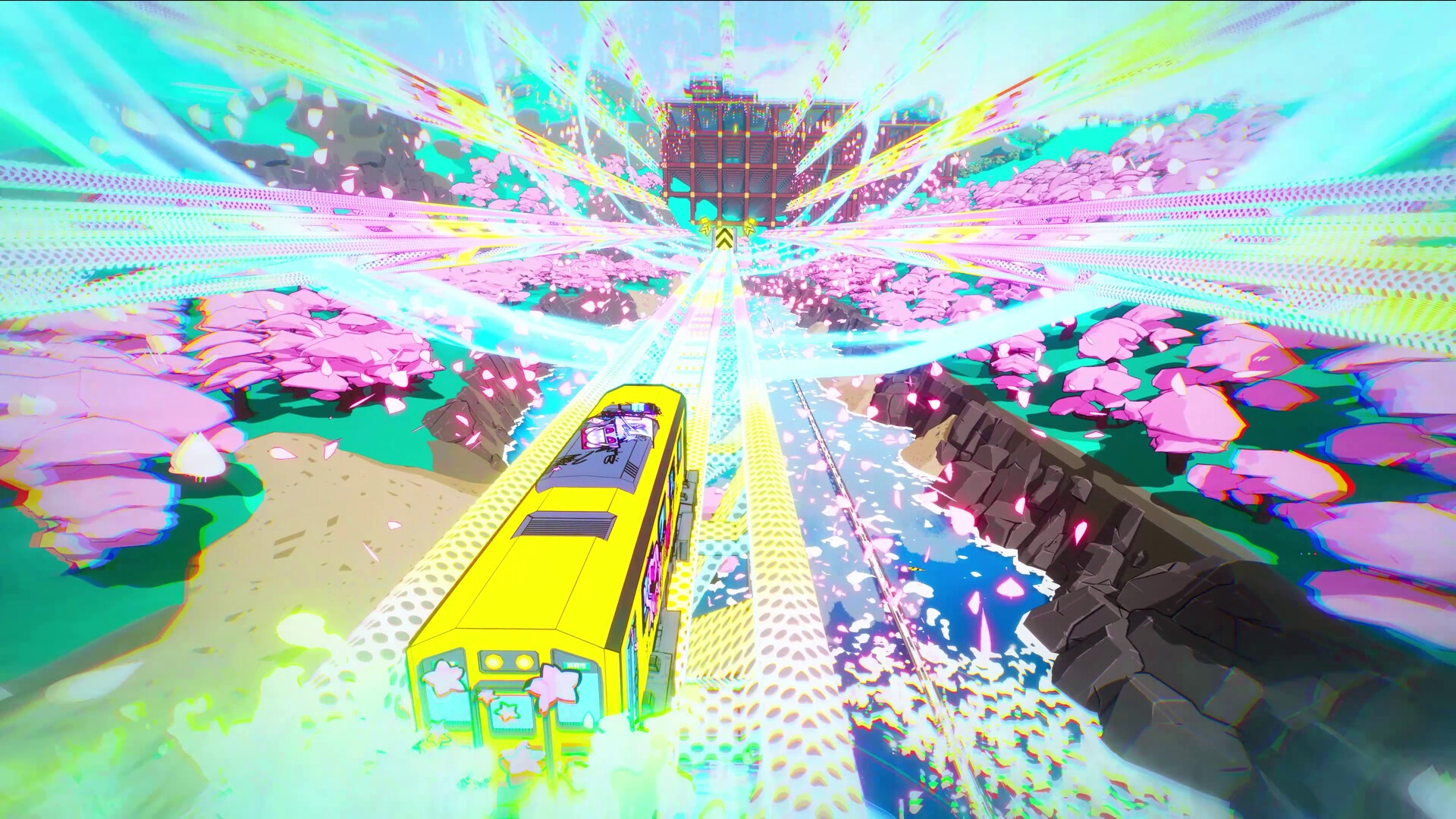
If you’ve played anything like SSX Tricky or Tony Hawk’s Pro Skater, Denshattack! will feel delightfully familiar. You control a fast-moving train, taking it through the remnants of a cel-shaded Japan. Incoming obstacles on the train tracks had me jump from train track to train track. Big loops gave me a short window to flip my train around and pull off 360 tricks that I attempted to enact on my fingerboard when I was a teenager. After several levels, I had the freedom to get off the tracks and slide through tunnels and across icy ravines. No surface was safe from my little train.
Denshattack! is packed full of content. It’s a Thanksgiving feast of novel levels, sights, and sounds that push the envelope of game design that kept me fully engaged for hours on end. I moved around across Japan on straightforward levels alongside others with unique win conditions. Denshattack races pitted me against 30 cars; if I knocked into them, they would fly into oblivion ala Burnout Paradise. Trick levels required me to hit a high score in order to proceed (don’t worry – scoring is easy to do once you get the rhythm down). Objective levels had multiple looped segments, allowing me to complete smaller-form individual objectives in perpetuity until I chose to slam the brakes. I couldn’t believe that by the fourth chapter, every level in front of me had its own flavor and distinctness. After defeating the seventh boss (which is the standout boss battle of the game by significant margins), I was fully convinced that I’d reached the game’s creative peak. I was wrong – there was so much more creativity and chaos to go.
Mastery exists in many forms, which is a massive benefit to those in it for a casual experience. Beyond the neon collectibles scattered throughout each level, unique per-level challenges existed to test my mettle. These ranged from doing a very specific type of trick, collecting additional collectibles, or even getting a high chain of trick combinations. There’s even a time-trial challenge in each level for speedrunners who want to fly through the game. As such, Denshattack! can be enjoyed by just every type of player out there.
 I appreciate this approach to mastery quite a bit. Even at the game’s most difficult, I was able to complete each level without being kneecapped by artificially punishing guidelines. It wasn’t until one of the final levels where I was forced into starting over because I needed to place in the top 3 of a race – redoing the level once had me in the top 3 no problem. Being awarded bronze (and or sometimes no) medals didn’t feel the best, but it gave me room to return to a level with a new train or better grasp on the trick mechanics assuming I wanted to do so. With the gradual progression of new mechanics being introduced alongside new content being unlocked,
Moving onto the soundtrack, Denshattack! clears the vibe check with ease. The tracklist is stacked with the Avengers of Modern Gaming Audio, featuring Tee Lopes, Sean Bialo (who contributed to Rita’s Rewind), Takenobu Mitsuyoshi (Virtua Fighter and Shenmue), Richard Jacques (Jet Set Radio), Shoji Meguro (classic Persona), and so many others. From the first few minutes, it was clear to me that the tracks were thoughtfully crafted to align with the story beats and levels.
By the end of my 11-hour playthrough, I had completed the main story in its entirety. I had found all seven onsens (unlockable levels that featured conversations between the cast and provided a glimpse into their backstories and relationships with each other), acquired all but four of the unlockable trains, completed three of the zines, and earned silver ranks in most of the levels. As much as I tried, I never once completed a level at the gold rank, but I didn’t find myself explicitly wanting to replay levels in attempt to get a better score. Will I want to after this review period, most likely yes. Is there something else I want from Denshattack!…absolutely.
I’m unsure where Denshattack!’s story can go from here, as the story ends on a relatively conclusive note. There was little to compel me to return to completed levels beyond chasing high scores. I personally wanted to unlock more content, but there wasn’t much of a post-game. Heck, there wasn’t even a fully open-world playground where I could pull off trick after trick to my heart’s content. If there’s a world in which Denshattack! gets some post-launch content, I would love a trick space. If there’s a world in which a fully fledged sequel is in the works, I can envision a World-Tour-esque followup that has the player travel the world and trick off of the Egyptian pyramids, Chicago’s Cloud Gate (the Bean!), or even the Great Wall of China. The possibilities are endless.
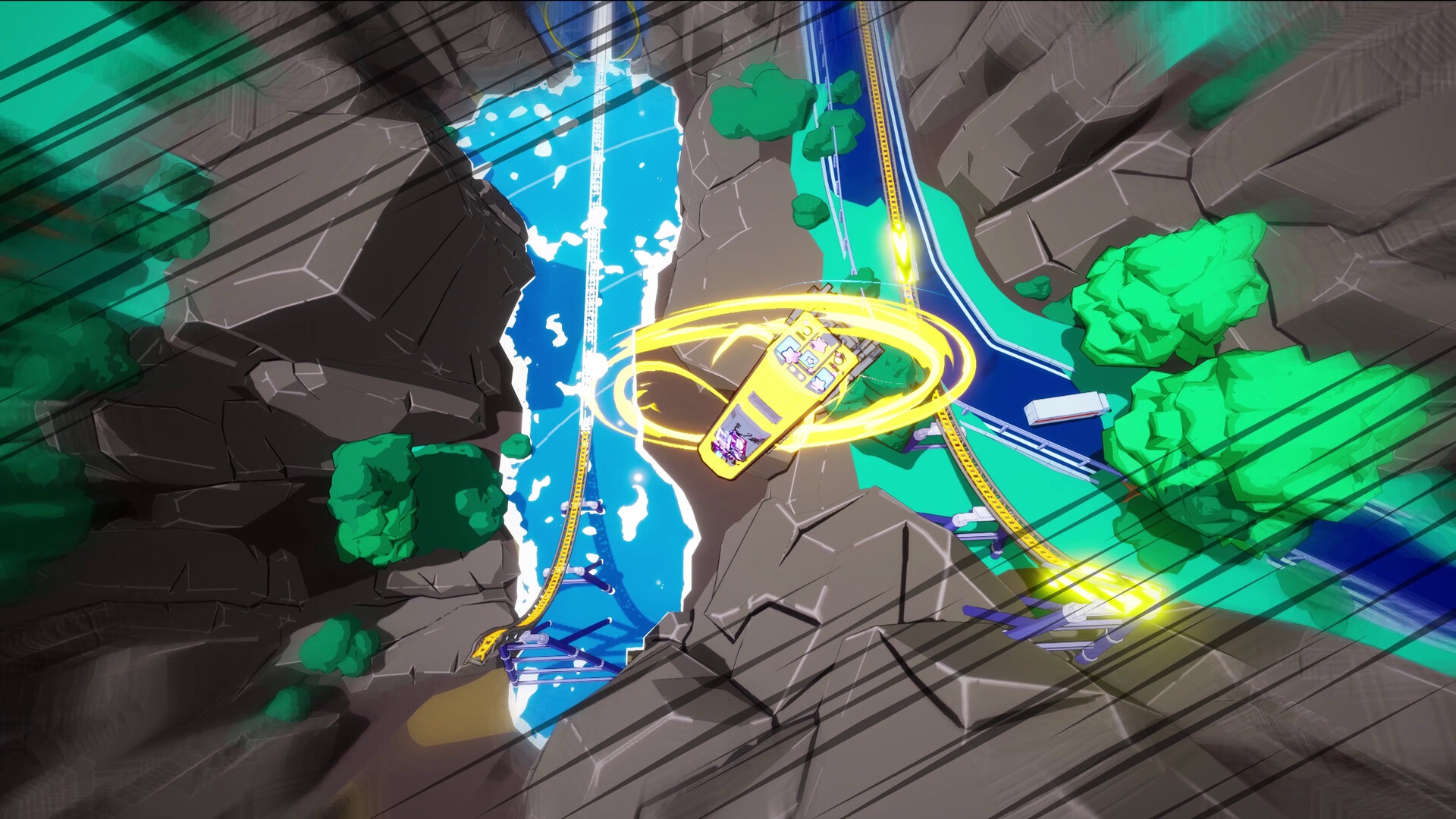 Beyond that…I’d love some more levels overall, especially those that severely deviated from the traditional point-A-to-point-B with as many tricks as possible in between. By that, I mean the novel Denshattack! levels – like more explosive races, more timed trials, some rhythm-inspired levels (a specific boss battle comes to mind), and more trippy experiences like the “blindfolded” level that felt more like a restyled WipEout than anything else. It’s because of these levels where I missed games from racing IP that have since been left to pasture.
I could go on, but you’re better off playing the game. Let’s wrap things up.
If you’re still on the fence about Denshattack!, I’ll leave you with this: Denshattack! is the type of game worth keeping installed on your hard drive. In short bursts, it has just the right amount of high-octane stylish platforming needed for winding down after a long day. In longer-form settings, it rewards those in it for the long haul with exhilarating tricks, multiple forms of mastery, and satisfying high-score chases. It’s a must-play of 2026, especially if you’ve been hankering for a Tony Hawk– or SSX Tricky-inspired locomotive fever dream with outstanding art design and soundtrack.