


A little bit of tactical gaming never hurt anyone.
Demonschool from developer Necrosoft Games was released on November 19th on PC and consoles, and has been surprisingly entertaining the last week or so, as I reviewed it. Touted as a tactical isometric role-playing game, this turned into more of a tactical turn-based experience with a fun story, rather than a gradual progression RPG. That’s not a knock, as it was incredibly addictive regardless of RPG aspects. It certainly wasn’t the reason to show up to play the game.
The downside to this tactical side has been how much it trusts the players to make decisions. Occasionally, the game will have main characters hunting for people or items, but it doesn’t quite trust the player enough to let them hunt on their own. The game leads the way in this area, which makes it less controlled by the user. To boot, it’s quite linear with its pathways, which isn’t a huge deal, but it can be felt through the gameplay.
So, mark up that pentagram, prep for a fight, because we’re diving right into the scrum with this review.
Story
Faye and her band of Demonschool dropouts (they didn’t drop out, but it sounded fun to write) are given multiple tasks to take down baddies, recover demonic items, and try to prevent the world from total demon domination. Which, of course, could mean the end of the world as a whole. No pressure.
While this game also wears a JRPG moniker on its description, it doesn’t bring the typical chatty-Cathy JRPG experience. The story of Demonschool is easy to follow, well-segmented so that no part seems too long between action moments, and features well-written characters. And that last part is vital for connecting with a game like this, because typically, there isn’t a lot of character development in JRPGs. However, thanks to what feels like a well-built set of narrative acts, the characters get to grow and thrive as the story goes through its rollercoaster hills of calm and chaos. For example, Faye, the leader of the group of students, is presented at every turn as a reckless, head-first into a fight leader. From beginning to end, she is defined this way, and her entire character is beautifully built through well-written dialogue and action. She never strays from that personality.
When a game can keep that kind of consistency while telling a competent and complete story that doesn’t feel long in the tooth, then you know writing was given its fair share of focus during development. Letting characters shape themselves through story moments that make sense and good narrative design means that the story is well-built for the gameplay it entertains.
Anyway, Faye is enjoyable, as are her companions, as the game does a good job of putting enough exposition in the dialogue to build the world and characters, but doesn’t prolong it unnecessarily, where the player might be wondering when the action is going to begin. It’s paced precisely how it needs to be, as well as delivered with good writing that features plenty of personality.
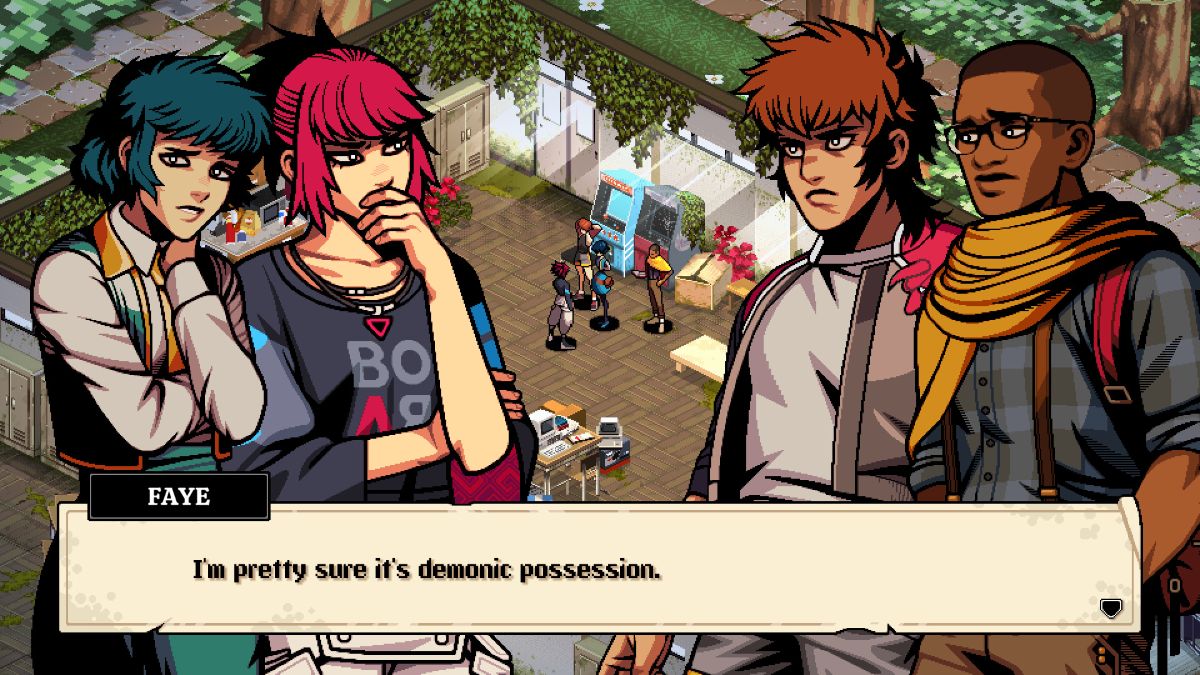
In addition, the story holds its cards well, so that the player can wonder with the characters what the heck is going on at this Demonschool. The story does a masterful job of building intense moments, angles of distrust with side-characters, and just enough pull to keep players wanting more. By all accounts, it is a horror-thriller with a healthy hunk of suspense.
Ultimately, the story leads the gameplay, as it should.
Gameplay
The gameplay with Demonschool is more about tactical patterns and cool boss encounters than it is about common enemies causing too much of a ruckus. For a typical tactical, that is something positive, as players should be focused on how to get through a fight rather than who they are fighting. And players should be rewarded with a good boss fight at the end of each stage of the story.
When encounters begin in the game, players are thrust onto an isometric restricted fighting map that they must strategically find the best route to win. On the top end of the map, there is a border for the players to get to once an enemy death count has been met. For example, there might be a fight where the player must take down 22 enemies to open their end of the map. Should they kill 22 enemies, one player on the team needs only to get to the top side to close the demon portal that brought the baddies, and any demon left on the map will be sucked back into the portal, thus ending the round. Much like communism, on paper, it looks easy, but it’s not at all.
Players will find that right out of the gate, the game’s enemies will not ‘take it easy’ on them. Enemies will calculate space and movement; should you get too close to them, they will relentlessly attack the player’s characters until they’re dead. The enemies have been given a good injection of intelligence to try and figure out player moves, and they don’t care if players are new to the game or not.
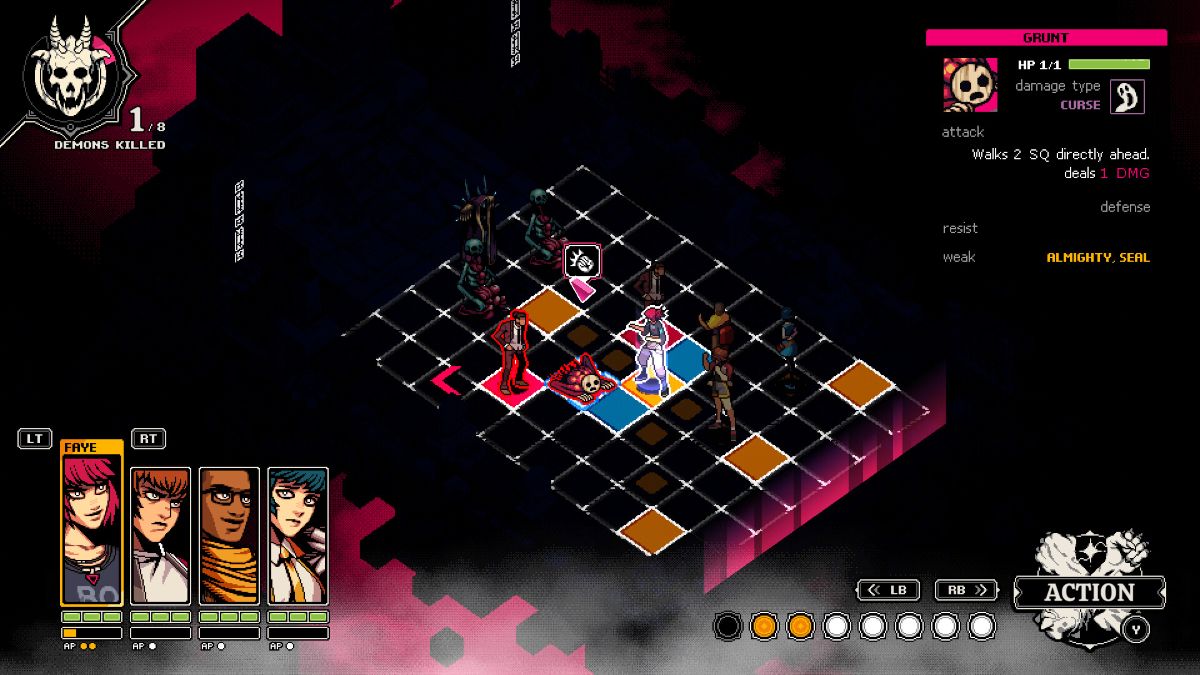
Once players get through that initial frustration of constantly dying, the game will force them to refocus on strategy and character attributes. The latter of the bunch is important, as players will come across a variety of different characters to help them, and each has their own style of offense or defense. The trick with Demonschool is trying to mix and match the best characters and locate the best patterns to take down the enemy. For example, there was a fight I went into in an audio/visual room of the school. Scattered around the map were televisions on rolling stands, as well as fire extinguishers waiting to be punted toward enemies. While the obvious move was to shove those televisions and extinguishers toward the enemies, the game forced me to strategize how I was going to heal my characters, should things go sideways, and how to balance out my offense and defense characters. I also had to figure out what the best movement was going to be implemented with my characters to ensure the appropriate count of enemies could be achieved, and a clear path to close the portal could be kept in sight. Cognitively, it was engaging and enthralling, even though it was a difficult learning curve at the forefront of the gameplay.
Now, to keep that strategy consistently fresh, Demonschool features a good number of enemies that have their own movements to take into consideration when planning an attack. Some demons make their way down the map in a straight line; even if you’re near them, they won’t turn and attack. Some demons come packed with poison that can explode on contact, and they shoot out poisonous streams all the way across the map. There are even some that will trap characters with a chain, preventing them from moving or attacking, and the player must break the chain to free the trapped character. There are more than just three, but players will run into these a lot once the initial hurdle of the game is passed, and the need to figure out more strategic movements will increase.
Mixing up the enemies and giving them different styles of attack helps make the game fresh from beginning to end. It also means that fights aren’t just throwaways, which is great for a game that balances story and tactics. While you will certainly find some repetition in the game with enemies, there are enough to feel like they’re obstacles. I’m stunned by how well they were built and even more stunned by how I didn’t feel bored even in the face of repeating baddies. It’s quite impressive how well they are built and executed.
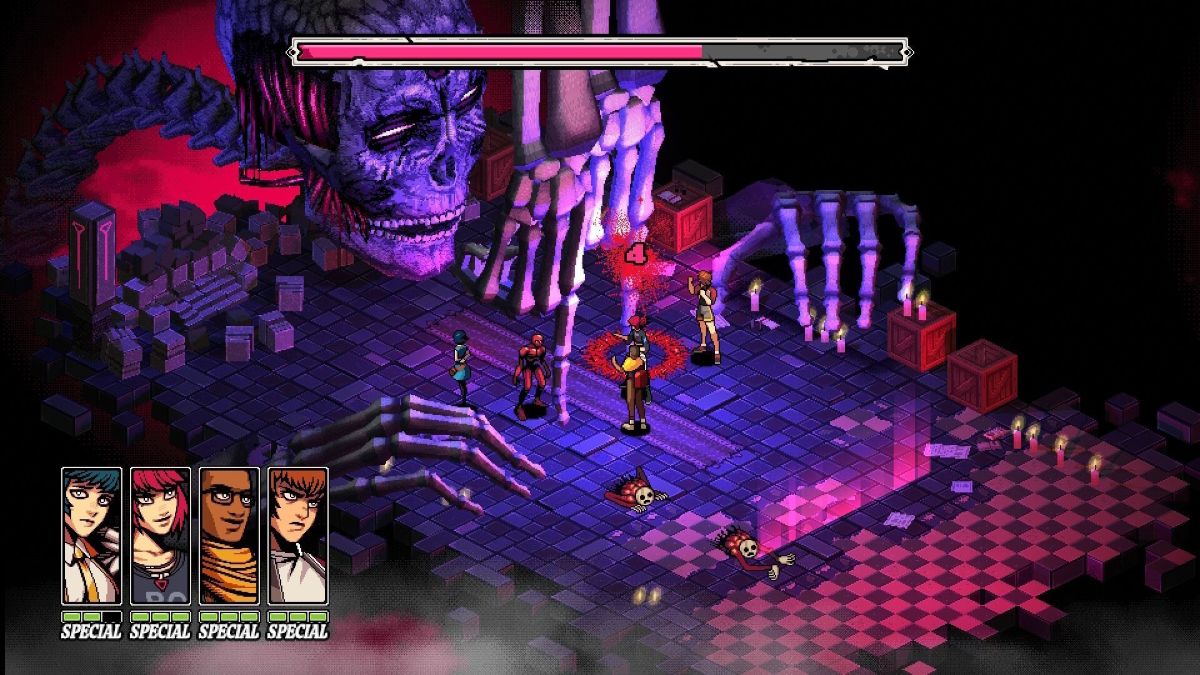
Of course, the only true break players get from these common enemies is with the bosses. The bosses are not identical in any way to the common enemies. Players will see from the first boss, who is a giant television monster that throws sets, keeps transporting to different spots on the map, and wreaks havoc at every given point. This first boss sets the tone for how creative the game can become with its boss fights and what players should expect as they progress. Each boss fight brings new ways to use old strategies and never feels boring. Some of these boss fights last up to 40 minutes, so that is proof that they’re not easy, nor are they like normal enemy encounters on normal maps. The boss fights up the need for great strategy and improved tactics.
With the combination of good story, characters, and fights, is there a fault with this game? Well, I would have loved to have a bit more RPG in my tactical, as upgrading a character typically comes through purchasing moves and buffs from the local market. And those upgraded abilities, once they’re purchased, require two players to study together to unlock and implement. I love the school-related theme to upgrading abilities, but it just doesn’t seem efficient or traditional. I know, I know, it’s okay to break tradition with new ideas, but only if they make a good impact on the gameplay. This method of ability acquisition and upgrades just feels a bit distant from the gameplay. Maybe it’s my expectations not being met, but it feels off.
Ultimately, I just wish there was a little bit of leveling during the game that was not player-driven. Think Dragon Quest, as enemies are killed and XP is built, at some point, the gameplay will level up the character without getting user input. I wish that Demonschool worked this way. But it doesn’t, and how it works now isn’t bad, but it just puts the fighting at the forefront, and the reliance on purchases and character pairing to unlock abilities doesn’t feel as involved.
Now, the one aspect of the game that I thought was shortchanged was how they treated the mysteries in the story and how much control they gave the player. As the story and fighting drive the game, the former will throw elements of ‘seek and find items’ at the player. For example, there is a moment in the game when a teacher asks Faye and her group to acquire a VHS tape that, when viewed, will kill the viewer in three days. To get to the point where the group locates the VHS, the story requires them to search for people based on clues given in conversation. Instead of letting the player investigate around town, the game just pushes the mystery along for the player, not giving any real control for the user to search for clues and solve verbal puzzles. It’s linear in this way, and I think it’s a missed opportunity for a minor amount of exploration and a heavy amount of additional cognitive stimulation for the player to feel involved.
Those complaints aside, what you do get with Demonschool is a classic and well-constructed tactical turn-based fighting experience that will keep you engaged from beginning to end. It will also entertain you with strong characters, a fantastic story, and multiple reasons to come back and play again.
On that sweet note, let’s wrap up this review.
Conclusion
Demonschool from developer Necrosoft Games is a wonderful tactical turn-based fighting game that will entertain players thanks to a strong story, good strategy-led map designs, and enough characters to create multiple paths to approach fights. While it needed to be a bit less linear and more user-controlled on the story side of the tracks, it’s a fantastic experience from beginning to end.