


Codex Mortis is able to deliver what players crave from a horde- and wave-based auto-shooter. Even its story missions offer something different. But its all glued together by AI and prompts.
“Chat GPT write a review of the PC game Codex Mortis.”
Codex Mortis is a surprisingly ambitious take on the survivor-like formula, combining frantic bullet-hell action with deckbuilding, roguelite progression, and a wonderfully grim necromantic theme. Developed by GROLAF, the game puts you in control of a necromancer who fights enormous hordes of undead while building increasingly ridiculous combinations of dark magic.
At its core, Codex Mortis follows a familiar Vampire Survivors-style structure: move around an increasingly chaotic battlefield, survive waves of enemies, collect resources, and become progressively more powerful. What makes it stand out is the deckbuilding layer. Before each mission, you construct a spell loadout from the abilities you’ve unlocked, meaning that success isn’t just about reacting quickly—it also depends on putting together a build that works.
That system is the game’s biggest strength. Different schools of magic can be combined to create synergies, while the booster-pack progression continually expands the pool of spells available to you. A summoning-focused build can flood the battlefield with undead allies, while other approaches can revolve around blood magic, explosions, or other destructive combinations. When everything clicks, watching a carefully constructed build turn a seemingly impossible horde into a screen-filling massacre is extremely satisfying.
The sheer amount of content is another positive. The full release expanded the game to ten schools of magic, 31 heroes, additional levels, and both local and online cooperative play for up to four players.The result is a game with plenty of room for experimentation, particularly for players who enjoy theory-crafting builds and replaying runs to discover stronger combinations.
Visually, Codex Mortis embraces a dark pixel-art aesthetic and an isometric presentation. The style suits the subject matter well, although the huge number of effects and enemies on screen can occasionally make the action difficult to read. Performance and optimization also appear to be areas that could use additional attention, with some players reporting frame-rate drops and input-related bugs.
The game’s biggest weakness is that some of its systems can feel rough around the edges. The sheer number of abilities and combinations can be exciting, but it can also make individual upgrades feel less meaningful when the screen is already overflowing with effects. There are also signs of the game’s relatively modest production values in its presentation and polish.
Still, Codex Mortis deserves credit for doing more than simply copying the survivor genre. Its deckbuilding mechanics give each run an additional strategic layer, while the necromantic theme provides a strong identity. Cooperative play is another welcome addition, particularly for anyone who enjoys turning these chaotic games into a shared experience.
Verdict: Codex Mortis is an entertaining and inexpensive roguelite for fans of survivor-likes, bullet hells, and deckbuilding. It isn’t the most polished game in the genre, but its combination of spell crafting, progression, and ridiculous on-screen destruction makes it easy to lose a few hours experimenting with increasingly broken builds.
Pros
-
Addictive survivor-like gameplay
-
Interesting deckbuilding system
-
Lots of spell combinations and build experimentation
-
Strong dark-fantasy/necromantic theme
-
Solo, local co-op, and online multiplayer
-
Plenty of replayability
Cons
-
Some rough edges and bugs
-
Visual effects can become overwhelming
-
Optimization could be better
-
Presentation is less polished than the genre’s biggest titles
Final Score: 8/10 — Recommended
______
“Damn, an eight out of ten, really? Okay.”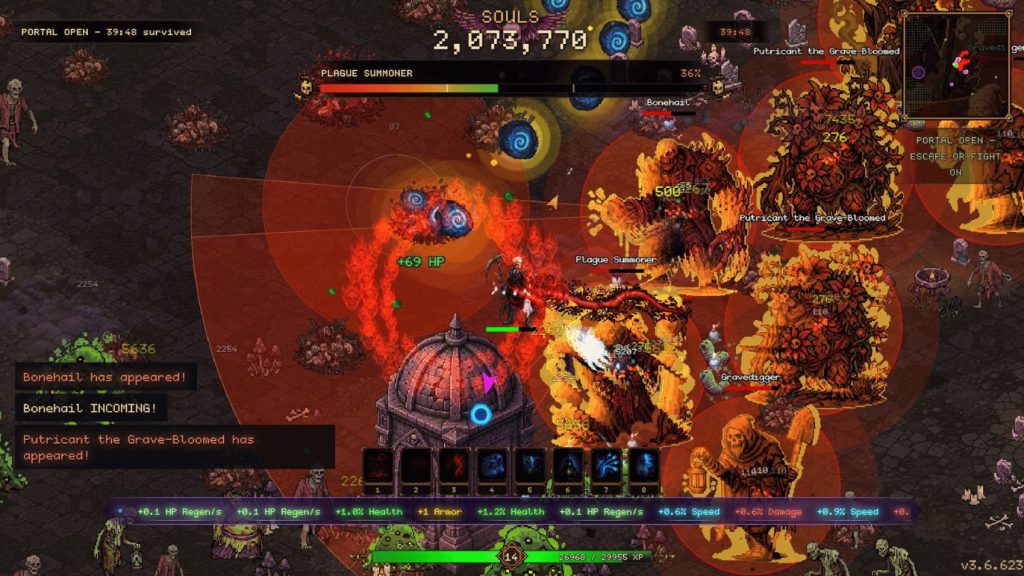
And here’s the thing, yeah I kind of get it. Codex Mortis is relatively interesting in the massive space of games vying for what Vampire Survivors wrought. Wave-based hordes of limitless enemies eventually butt heads with the player’s hopefully overwhelming power and luck through item synergies and careful weaving through hit boxes.
I started out playing Codex Mortis by diving into its story mode. It was here that I got a little hooked. There were objectives to complete, bosses to slay–not just a wash of waves and survival. The first stage had me collect pages of the titular Codex Mortis in hopes of combating a Dead God whose influence was corrupting the world of whatever dark fantasy bullshit often happens. Each time I collected a page, a difficult boss-like elite enemy spawned with a generous pool of health. In the midst of the dozens of enemies shambling to my position, I now needed to avoid the red MMO-like pools that indicated where an attack was landing.
After all the pages were collected, a final boss and a portal appeared. So I rushed to the portal and immediately died. Oh… damn. I thought I had more health than that. I did the level again. This time seeking out ritual circles that required me to kill enemies inside of it for a bonus while also making the enemy horde harder. Eventually I grew too strong and was killing enemies before they could even get inside. Summoned the final boss, walked to the portal, dead. Ah. I had to kill the final boss before I could go in the portal. Then why have it appear at all?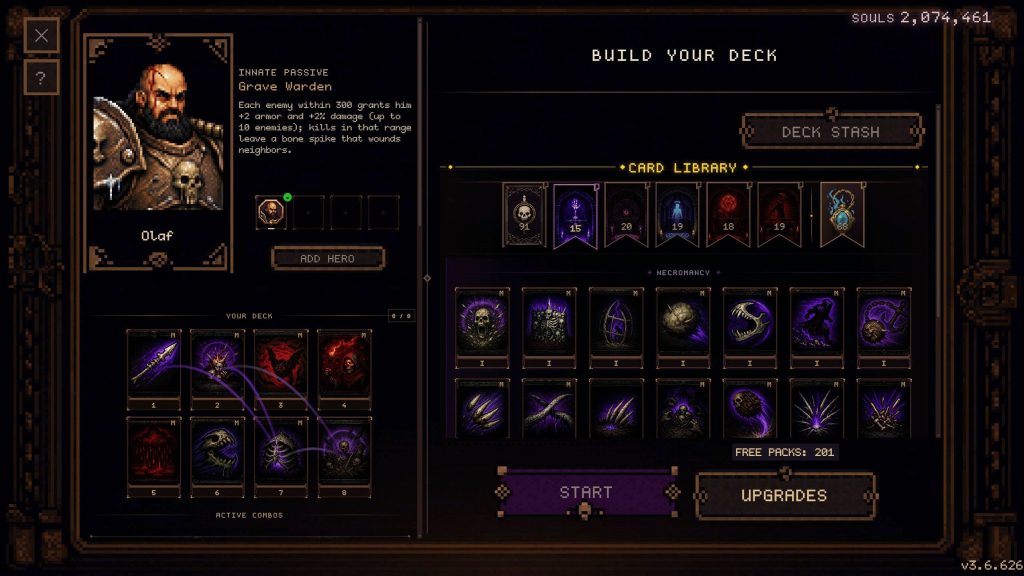 Despite the cacophony that is also the bread and butter of this genre, I felt myself having a good time. Death was understandable because this is also a game where players need to grind out gold and experience to unlock new skills and passive benefits. Here, that came in the form of new cards that acted as attack spells, fragments to eventually increase my deck size, new artifacts that gave bonuses, new heroes that could be added to my team and wander the battlefield with me and, of course, card packs that could be cracked open to reward new spells or provide duplicates that would fuel upgrades of owned cards.
The system works and while it is an amalgamation of numerous other titles I’ve played, it hadn’t really been done in this combination that I’d come across. After a couple hours, however, it started to grow a little busy and hectic. At the time I was playing before the release of Codex Mortis‘ 1.0 version that would soon unlock multiple schools of magic and heroes for new spells and abilities. But I already had a deck that was kind of sweeping through the battlefield and I was barely noticing a tangible difference. Things were dying a little bit slower with each higher difficulty but not by much. Would dozens of new cards feel that different?
At the final boss of the story, I had to dial down the difficulty because the boss was casting lines of damage that were extremely difficult to avoid and also killed me instantly. I mean yeah, it was cool that the fight also teleported players to miniature versions of the levels and objectives from earlier chapters but I was getting frustrated.
Once the story was done, what I mostly had left to do was grind out Mortis levels through exponentially more expensive gold costs to help me grind out exponentially harder difficulty levels. None of this is unfamiliar and I imagine most of us have particular tolerance levels for these types of things.
And then I browsed around the internet about Codex Mortis.
“100% AI” was the obvious red flag that began to fervently wave in my eyes. What do you mean? Earlier this year I had received a beta code for Codex Mortis but simply didn’t have the time to put into it. I was intrigued though because I’m a genre stan and everything I was looking at seemed cool.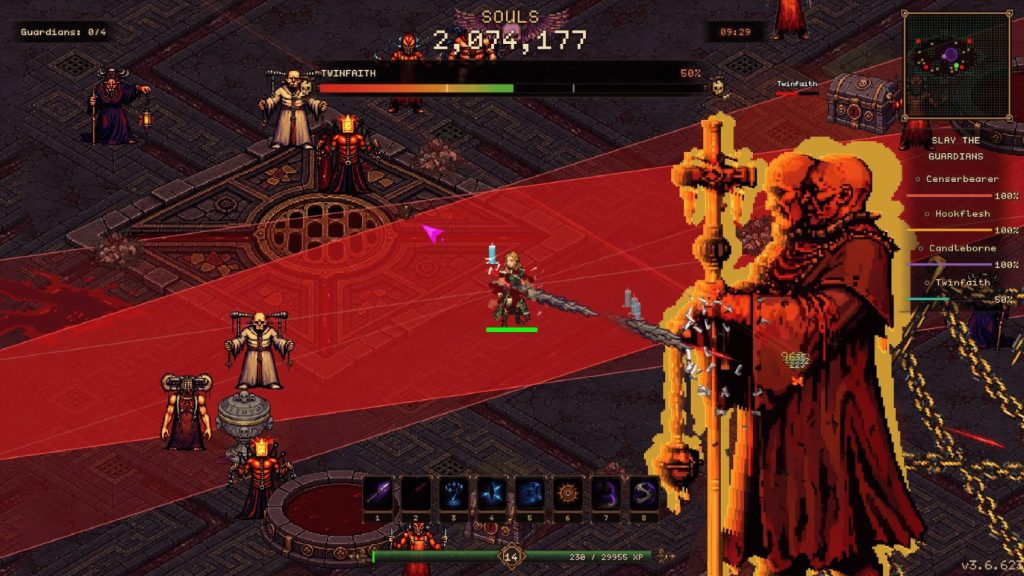 But even today on the page I initially saw providing information about game, assets, and contact information there was no indication this was a game made using AI. I browsed emails I had received about the game. The first made no mention of AI until a description of the developer GROLAF:
“GROLAF is a solo game developer pioneering AI-driven game development. Founded on the belief that AI tools can empower creators to build experiences previously impossible for small teams, GROLAF uses AI across the entire development pipeline – from code and art to music and design.”
Alright, okay but does Codex Mortis use it? That was an email from back in May. Ten days before the end of Early Access on September 24 I received another email, no mention of AI until the developer description.
My metered positive feelings about the game began to transmogrify into something else. I stepped back from the casual, distracted entertainment I’d been having from Codex Mortis and began looking at the game more critically. And considering I was reviewing it, it felt appropriate. But I could also feel my thoughts twinged with the stink of AI.
I needed more time. Needed to piece together my opinions and critique a bit more.
And there it was, hovering below the ChatGPT review of Codex Mortis that received an 8.0/10.
“If you’d like, I can also turn this into a Steam-style review, a more critical professional review, or a short 200-word review suitable for a gaming website.”
“Write a critical professional review of the PC game Codex Mortis.”
“Absolutely. I’ve leaned into a critical, publication-style review rather than a promotional one, including the game’s unusual AI-development angle without letting that substitute for evaluating the game itself.”
CODEX MORTIS Review
A competent survivors-like that understands the formula, but rarely challenges it.
Score: 6.5/10
There is an unavoidable question surrounding CODEX MORTIS: what does it mean for a game to be made almost entirely with generative AI?
It is an interesting question, but it is not the question a game review should answer. Games ultimately have to stand on their own. Whether its art was drawn by a human, generated by an algorithm, or assembled by a particularly caffeinated intern, CODEX MORTIS still has to be fun.
Fortunately, it is.
Unfortunately, it is also difficult to shake the feeling that CODEX MORTIS is more interesting as an experiment than as a finished game.
Developed by GROLAF and published by CRUNCHFEST, CODEX MORTIS is an isometric survivors-like that combines hordes of enemies, automatically triggered attacks, roguelite progression, and a deckbuilding system built around dark magic. The September 2026 release expanded substantially beyond its Early Access incarnation, offering ten schools of magic, fourteen levels, 31 heroes, and both local and online cooperative play for up to four players.
The result is an inexpensive, surprisingly deep little game that can produce some genuinely entertaining runs—but which remains conspicuously derivative and occasionally underdeveloped.
A Familiar Formula With One Good Idea
Anyone who has spent time with Vampire Survivors and its many descendants will understand CODEX MORTIS almost immediately.
You enter a battlefield, enemies pour in from every direction, your attacks largely take care of themselves, experience and resources accumulate, and your character gradually transforms from vulnerable necromancer into an ambulatory extinction event.
The difference is what happens before the battle.
CODEX MORTIS puts considerable emphasis on constructing a spell deck. Rather than simply selecting upgrades as they appear during a run, players assemble their available spells into a loadout and take that strategy into battle. The game’s schools of magic are designed to interact, encouraging players to search for combinations rather than simply selecting whatever upgrade has the largest number attached to it.
This is the game’s smartest design decision.
It gives the otherwise familiar survivors formula an element of preparation. A run becomes partly about execution and partly about testing a hypothesis: What happens if I build around this combination?
When the answer is “something spectacular,” CODEX MORTIS is at its best.
The Problem With Watching Numbers Go Up
The trouble is that the game’s underlying combat system is considerably less interesting than its deckbuilding layer.
Like many survivors-likes, much of the moment-to-moment action consists of positioning yourself correctly while your character automatically unleashes an increasingly absurd collection of attacks. There is skill involved in movement, target prioritization, and knowing when to take risks, but the deeper strategic decisions frequently happen in menus rather than on the battlefield.
That isn’t inherently a flaw. Vampire Survivors demonstrated how compelling this structure can be.
But CODEX MORTIS doesn’t quite possess the same level of elegance.
Its battlefields can become visually chaotic, with enemies, projectiles, summons, spell effects, and damage indicators competing for attention. The spectacle is occasionally impressive, but spectacle and readability are not the same thing. The more powerful your character becomes, the easier it can be to lose track of exactly why you are winning—or why you suddenly died.
This is particularly unfortunate because the deckbuilding system deserves a combat system capable of exploiting it more aggressively.
Buildcraft Is the Star
If CODEX MORTIS has a compelling reason to exist, it is the pleasure of discovering a build that breaks the game in exactly the way you hoped it would.
The game’s magic schools provide distinct approaches to combat, and the expanded release gives players considerably more room to experiment than the original Early Access version. Booster packs gradually expand the spell collection, allowing subsequent runs to be built around a larger selection of possibilities.
This creates a satisfying feedback loop:
play → earn resources → unlock options → construct a better deck → attempt something more ambitious.
It is familiar roguelite architecture, but effective.
The problem is that not every combination feels equally worthwhile. Some choices can feel like incremental variations on the same basic strategy, and the game’s balance can become less convincing as difficulty rises. Community discussion around the endgame has, for example, raised concerns about the Mortis difficulty curve and the amount of soul investment required to make certain abilities viable.
That suggests an underlying problem: CODEX MORTIS has plenty of systems, but systems alone do not guarantee meaningful choices.
Co-op Helps
The addition of local and online four-player co-op is one of the game’s more welcome features.
It also exposes an important truth about CODEX MORTIS: this is arguably more entertaining as a social toy than as a deeply demanding action game.
Watching one player’s build become absurd while another desperately tries to survive the same swarm creates the kind of emergent nonsense that works particularly well in co-op. The game’s relatively straightforward controls also make it easy for newcomers to understand what is happening without requiring a lengthy tutorial.
That accessibility is a strength.
It also means experienced players may eventually find the mechanical ceiling rather low. Once you’ve understood positioning, build construction, and the game’s major systems, there isn’t an enormous amount left to master mechanically.
The AI Question
It would be dishonest to review CODEX MORTIS without addressing its production methodology.
The game has been explicitly marketed around AI-driven development, and that has generated considerably more discussion than the game itself. Earlier coverage focused heavily on the use of generative AI for elements including programming, artwork, and music.
There are two easy mistakes to make here.
The first is to dismiss the game simply because AI was used to create it.
The second is to treat its AI origins as evidence that the game represents some revolutionary new form of development.
Neither position is particularly useful to a player deciding whether to spend time with it.
The more relevant observation is that the game’s production method appears to be reflected in its weaknesses. CODEX MORTIS often feels like a collection of competent solutions rather than a strongly authored work. Its individual components function, but the overall experience can lack the distinctive personality and careful refinement found in the genre’s best games.
Earlier reviewers have noted similarly mixed impressions: the foundation is entertaining and the build possibilities are substantial, but interface problems, follower AI, pathfinding, and presentation have all been points of criticism.
That is the real lesson here.
AI can apparently help produce a functional game remarkably quickly. But producing something functional and producing something memorable are very different achievements.
Presentation: Functional Rather Than Distinctive
Visually, CODEX MORTIS goes for pixel-art dark fantasy, which is an entirely sensible choice for a horde-based game.
It is also a crowded field.
The aesthetic communicates “necromantic survivors-like” effectively, but rarely gives the game a visual identity strong enough to separate it from its influences. Earlier coverage similarly described the presentation as serviceable rather than exceptional, with the soundtrack providing atmosphere without matching the genre’s strongest examples.
This matters because CODEX MORTIS is competing in a genre where production values are not necessarily expensive, but personality is essential.
A tiny game can look rough and still be unforgettable.
CODEX MORTIS sometimes looks rough and simply looks rough.
The Value Proposition
This is where the game’s considerable shortcomings become easier to forgive.
At launch, CODEX MORTIS was priced aggressively, and the full release currently remains inexpensive. Steam’s current listing shows a regular price of $3.99 before its introductory discount, while the game has accumulated a broadly positive user rating.
That changes the evaluation considerably.
At $40, CODEX MORTIS would be difficult to defend.
At $20, it would be competing against substantially more polished roguelites.
At roughly four dollars, however, its flaws become much less consequential.
You are getting an entertaining survivors-like with a genuinely worthwhile deckbuilding hook, extensive replay potential, and multiplayer for the price of a fast-food meal.
That is a compelling proposition.
Verdict
CODEX MORTIS is neither the future of game development nor the disaster its most enthusiastic critics might suggest.
It is, more prosaically, a pretty good little game.
Its best idea—the pre-run spell deck—adds welcome strategic depth to an otherwise familiar survivors-like formula. Its progression loop works, its co-op implementation broadens the appeal, and its low price makes experimentation almost effortless.
But the game rarely escapes the gravitational pull of its influences. Its combat is familiar, its presentation is functional, and its balance and interface still reveal rough edges. Most importantly, it lacks the sense of authorship that makes the best games in this increasingly crowded genre feel special.
The irony is that CODEX MORTIS may ultimately be more important as a demonstration of what AI-assisted game development can currently produce than as a game people will remember years from now.
But that doesn’t make it worthless.
For players who have exhausted the better-known survivors-likes and want a cheap new toy to dissect, CODEX MORTIS is easy to recommend. Just don’t mistake an impressive development experiment for a genre-defining masterpiece.
Final Score: 6.5/10
Recommended for: fans of survivors-likes, build experimentation, roguelites, and inexpensive co-op games.
Not recommended for: players looking for major mechanical innovation, polished presentation, or a game that meaningfully transcends its Vampire Survivors lineage.
__________
Okay, alright. That feels better. Thanks ChatGPT. I’m glad I’m helping guide you and myself towards these opinions.
My intention here isn’t to be a holier-than-thou, sniveling elitist who blanket disavows AI and its capabilities.
Unfortunately and ironically, a lot of what that review spoke to are things I would agree with and say to a degree. Codex Mortis scratches at the animal part of your brain that these types of games do. You watch numbers go up and you feel powerful. They don’t have sprawling stories or intricate systems that require you to be wholly invested in. And because of that, it’s enjoyable, of course it is.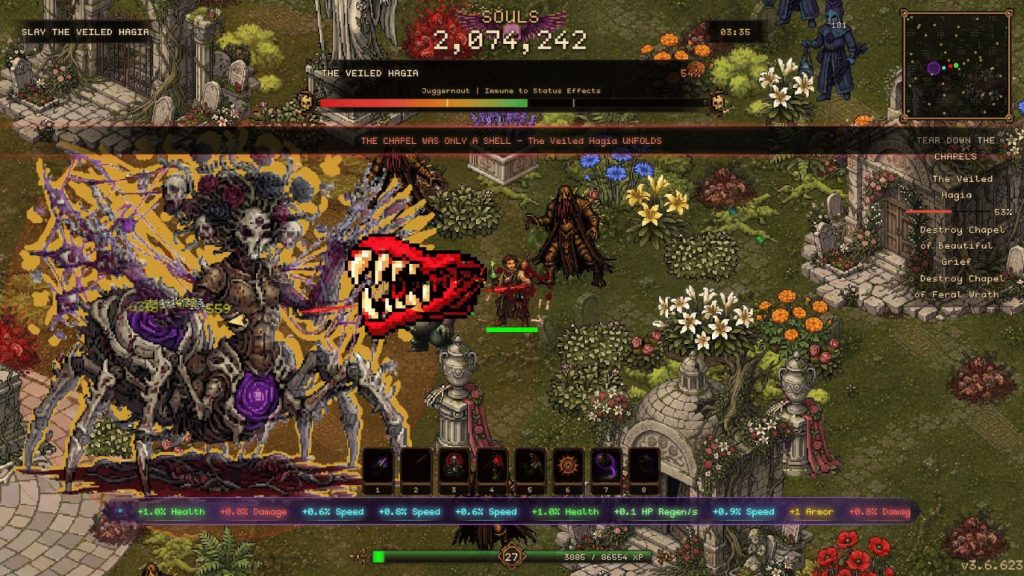 Then you crack it open with the acknowledgement it was crafted with AI and it lays bare the issues. There is seemingly something hollow about the game. It checks off boxes but it primarily does just that. You wonder what exactly is wrong with this picture. Why enemies and characters lack personality. Why the game opts for performative moody darkness in its setting and story. Why there are so many spells that can be used.
It’s junk food. It’s popcorn. Those empty calories that taste so sweet on the tongue and fill you for a moment but you’re left craving something done with a skilled hand. One that knew when to edit and what looks best.
So I went to the third email I had received about Codex Mortis, this one came out on the day it left Early Access and contains a vastly different narrative and attitude.
“The AI-Made Game the Internet Told You to Hate Is Out of Early Access, and Now It Has Online Co-op” it read at the top. Well, honestly, the only reason I knew it was AI-made was because I found out on the internet.
The email continued: “Nine months ago, PC Gamer’s headline called it “a milestone for slop everywhere.” Today CODEX MORTIS leaves Steam Early Access with the biggest update in its history. It is the necromantic survivors-like deckbuilder that made headlines as the world’s first 100% AI-developed game. Version 1.0 is available now on Steam for Windows, Linux and Steam Deck at $3.99.”
It detailed a lot about the development of the game and even provided a link to a YouTube “documentary” GROLAF had made about the process. There was some cheekiness about the game being referred to as “slop” and what could be seen as a bullet-point defense of how AI was used.
GROLAF was quoted as saying, “This was a hobby project, after hours. Looking at its scale, I don’t know if I could have carried it through without AI. I still use my experience as a lead developer every day. Define the task, delegate it, review the result. I’m still leading the work. The contractor has changed. We’ve had asset flips, Unity slop, Unreal slop. To me, the problem is lazy execution. The tool alone doesn’t decide the quality. Like a typewriter or a car, AI is a tool. What we make is up to us.”
There’s a lot to unpack here. And maybe a lot of it will feel targeting, unfair, or a lot like bitching about a thing’s mere existence. I fully recognize that I’m not going to change the conversation about Artificial Intelligence and its impact on the world around us based on a review on the website Digital Chumps dot com.
But when I read that second ChatGPT-generated review, it doesn’t make me feel great. For something that took a few seconds to run through whatever data center and impacted the environment in whatever way, it could have certainly made my job easier. I could have copied and pasted that review and tinkered with a few sentences or words here and there and called it.
It has some clever turns of phrase and doesn’t entirely feel soulless because the technology is getting better. I’m sure if I used a version that I had to pay for, it would read even better. But I can’t do that. I would spend as much time fussing about with the AI review than I would writing one and still feel hollow on the inside. Because ultimately, it was not something I produced. It was so I could get the job done with minimal effort and time and move on to the next thing.
As you might be aware, I could do this with literally any game I’ve ever played and build an empire of reviews written by AI just to populate a site and give me some form of nebulous credence at best. But for what? So I can fuel my own ego? Get more free games to play without having to deconstruct them critically?
Yeah, it’s the easy way out. And a lot of what GROLAF says reads as the easy way out. 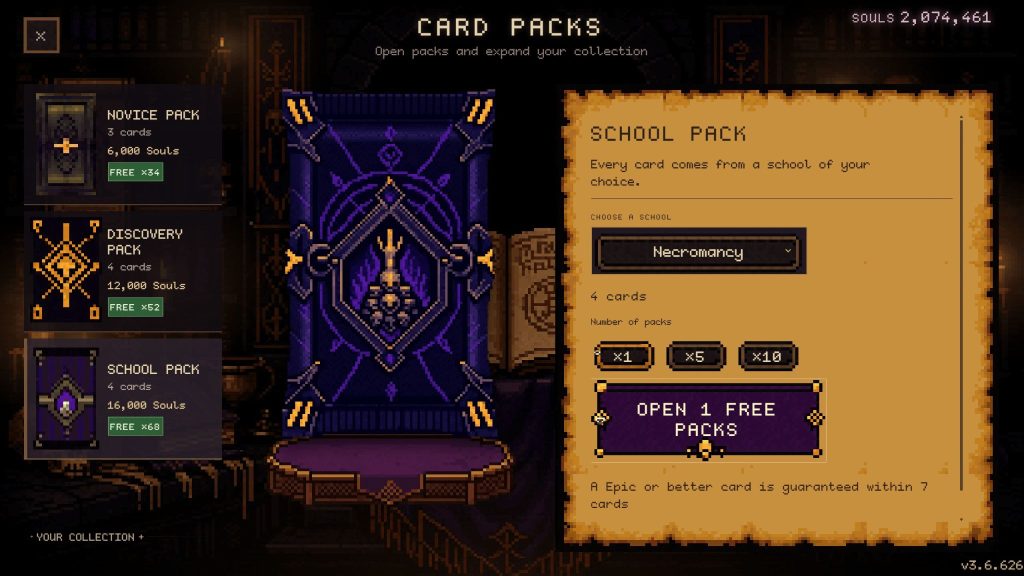 I want to go back to those first two emails that indicated this was likely an AI project:
“GROLAF believes AI tools can empower creators to build experiences previously impossible for small teams, and uses AI across the entire development pipeline, from code and art to music and design.”
poncle started Vampire Survivors as a solo developer. The team has grown into double digits but how successful has that game been? Team Cherry is primarily three members and while it takes them years to release a game, how incredible have they been? Or I think about Super Meat Boy, Fez, Braid, and other games featured in Indie Game: The Movie. Countless teams of meager sizes have made incredible works and devoted their livelihood to it.
GROLAF makes their intentions clear. Codex Mortis is a hobby project. And while they use AI as a tool, what is that tool actually tinkering with? Did they have other jobs while working on Codex Mortis?
If you ask me, it sounds like a game where passion was on the back burner.
And if so, what’s the point? To make money?
We all do things we don’t want to do in order to make money. I work a 9-5 job and consider writing about games a hobby but also a second job that I would prefer if it actually could support any kind of livelihood for me. As I said, I could collect codes and have AI write my reviews and maybe eventually I would get flagged down but hey, I’m just a guy on the internet and I could use a different name or something, right?
Better yet, I could ask AI to make me a game.
I watched the “documentary” where GROLAF describes the process of getting Codex Mortis from an idea into a functional state. How they constantly used AI creation tools and altering prompts to belt out what kind of result was desired. GROLAF acted pissed and defiant at the tools to get them to code and write script in a certain way.
Yet there’s one thing to note: it means the game isn’t 100% AI-made.
Isn’t that kind of the point here? Isn’t that the marketing of it all? But as much as you may want, human input was still required. GROLAF intervened on how many occasions? Tailored the AI to work in a specific manner how often? Even if the answer is “a tiny bit” it still defeats the thesis.
Codex Mortis is an experiment in using AI tools to maximize game development. And yes, in and of itself that’s fascinating. And to me, it’s fascinating in the same way where I can see how long I can go without water or how high I can jump off a building from without dying or how many times I can listen to Ed Sheeran without jumping off a tall building and dying.
But where is the line ultimately drawn?
I don’t know. Maybe I should try one more time.
“If you want, I can also make this harsher and more editorial, in the style of a major PC gaming publication, with a sharper verdict and a 7/10 or 5/10 scoring rationale.”
“Write a harsher and more editorial review in the style of a major PC gaming publication, with a sharper verdict and a lower scoring rationale.”
“I’ve pushed this version toward a tougher editorial verdict: less impressed by the feature count, more focused on whether those systems actually produce a compelling game”
___________
CODEX MORTIS Review
A $4 experiment that mistakes having more systems for having better ones
Score: 4.5/10
There is something almost perversely appropriate about CODEX MORTIS being advertised as a “100% AI-driven” game. It is a game assembled around an intriguing concept, stuffed with an impressive quantity of systems, and yet somehow conspicuously short on the one thing that matters most: a strong reason to keep playing.
CODEX MORTIS is a survivors-like deckbuilder in which a necromancer wades through enormous undead hordes, automatically firing spells while the player concentrates on movement, positioning, and build construction. The full release boasts ten schools of dark magic, 200 spells, 31 playable heroes, fourteen levels, mutations, booster packs, and four-player online co-op. On paper, it sounds like an embarrassment of riches.
In practice, it feels like someone emptied a box of perfectly serviceable game mechanics onto the floor and called the resulting pile a design.
The price is low—currently $3.99 on Steam, with a discount at the time of writing—which prevents CODEX MORTIS from becoming an outright bad recommendation. But cheap does not mean criticism should be suspended. The game is functional. It is occasionally entertaining. And it is frequently, frustratingly, boring.
The Survivors-Like Problem
The first problem is one CODEX MORTIS cannot solve with another hundred spells: we’ve played this game before.
The survivors-like formula has become one of PC gaming’s most crowded subgenres. The basic structure—move, auto-attack, collect experience, choose upgrades, become absurdly powerful—is now so well established that a new entry needs either exceptional execution or a genuinely compelling twist.
CODEX MORTIS has the twist.
Its spell-deck system is a good idea.
The problem is that it doesn’t fundamentally transform the experience.
Before each mission, you construct a deck from the spells you’ve unlocked. Different schools can be combined, while mutations modify how individual abilities behave. The resulting buildcraft is easily the game’s most interesting component.
But once the battle begins, much of that carefully constructed strategy collapses back into the familiar survivors-like rhythm: move around the arena, avoid enemies, watch numbers explode, and wait for the machinery you’ve assembled to do its work.
The deckbuilding promises a strategic game.
The combat delivers a screensaver.
More Content Isn’t More Depth
The full release’s headline numbers are impressive: ten magic schools, 200 spells, 31 heroes, fourteen levels.
They are also slightly misleading.
A game does not become deep because it contains 200 things.
It becomes deep when those things create interesting decisions.
CODEX MORTIS frequently confuses quantity with possibility. There are combinations to discover, certainly, but the sheer volume of abilities doesn’t necessarily make the decision-making more sophisticated. Some upgrades feel less like meaningful strategic choices and more like different flavors of numerical escalation.
The result is a peculiar form of buildcraft where the pleasure comes primarily from discovering what breaks rather than understanding a finely tuned system.
Breaking a game can be fun.
It isn’t, by itself, good game design.
The UI Is Fighting You
Perhaps the most damaging flaw is that the game doesn’t always communicate its own systems particularly well.
This is especially problematic because CODEX MORTIS has chosen to make its deckbuilding and progression systems central to the experience. If players have to fight the interface to understand what they’re equipping, unlocking, or combining, the supposedly deep buildcraft becomes an obstacle rather than an attraction.
That criticism isn’t merely theoretical. Steam community feedback has included complaints about confusing loadout/deck interfaces, controller problems, unclear hero unlocks, and frustration with the game’s booster-pack progression. One player described the post-update interface as difficult to understand and reported that controller interaction was effectively broken.
Those are particularly damaging complaints for a game whose selling point is its customization.
The interface should be the game’s translator.
Instead, it occasionally feels like another boss fight.
Booster Packs: A Strange Choice
The booster-pack progression is perhaps the game’s most questionable design decision.
The idea is straightforward: earn points during runs, spend them on packs, and expand the collection of spells available for future decks.
Conceptually, that creates a nice long-term progression loop.
In execution, it risks feeling like progression for progression’s sake.
The player isn’t necessarily unlocking something because they accomplished a meaningful challenge. They are accumulating another layer of currency and opening another container of content so that the next build can have more options.
One Steam player described the pack system as resembling a gacha or gambling mechanic and argued that it didn’t meaningfully improve the gameplay.
That’s harsh, but the underlying criticism is fair: when a game already has a compelling core loop, additional progression should sharpen it. Here, the progression systems sometimes feel as though they’re compensating for the lack of excitement in the underlying loop.
It Doesn’t Look Bad. That’s Almost the Problem.
The full release’s move to an isometric presentation was a substantial visual overhaul, with redesigned character sprites, enemies, and environments.
The problem isn’t that CODEX MORTIS looks terrible.
It’s that it rarely looks distinctive.
The dark pixel-art aesthetic does exactly what you expect. Skeletons look like skeletons. Necromancers look suitably miserable. Magic explodes across the screen. The game has successfully assembled the visual vocabulary of dark fantasy.
But there is little sense that it has anything particularly memorable to say with that vocabulary.
And because the screen can become an explosion of enemies, projectiles, summons, and spell effects, visual spectacle occasionally works against readability. The developers themselves acknowledged this problem when discussing cooldown changes, noting that abilities firing every frame had made fights difficult to read.
That’s revealing.
The game has spent considerable effort making its combat more spectacular while simultaneously having to find ways to stop that spectacle from becoming visual noise.
The AI Isn’t the Problem
The game’s AI-driven development is impossible to ignore because CODEX MORTIS itself doesn’t want you to ignore it.
But here’s the uncomfortable conclusion: the AI controversy is more interesting than the game.
Whether generative AI is an appropriate tool for game development is a legitimate industry debate. It raises questions about authorship, labor, aesthetics, originality, and what players should expect from the people making their games.
None of that automatically makes CODEX MORTIS good or bad.
What matters here is what ended up on the player’s screen.
And what ended up there is a game that often feels assembled rather than authored.
The distinction is important.
There is plenty of evidence of iteration. The developers substantially reworked the game into an isometric format, added five schools of magic, expanded the roster to 31 heroes, added 100 new spells, introduced online co-op, and continued making balance and interface changes based on player feedback.
This isn’t an abandoned AI-generated curiosity.
Someone has clearly put work into it.
But CODEX MORTIS still lacks the kind of strong creative identity that makes the best small games memorable. Its systems frequently answer the question “What else can we add?” when the more important question is “What should we remove?”
Four-Player Co-op Is Welcome, Not Transformative
Online multiplayer for up to four players is a useful addition to the full release, alongside local co-op. The game even supports players reconnecting to an ongoing session after disconnecting.
And yes, watching four increasingly ridiculous necromancers turn an undead army into a field of particle effects can be entertaining.
But multiplayer cannot manufacture depth.
It can make a mediocre game more amusing with friends, and CODEX MORTIS benefits from exactly that effect. Yet the fundamental gameplay remains relatively passive. Once your build is functioning, there isn’t a great deal of mechanical mastery required beyond staying alive and making sensible positional decisions.
The best survivors-likes turn that apparent simplicity into something hypnotically compelling.
CODEX MORTIS too often turns it into something merely hypnotic.
The $4 Question
Here is where the review becomes complicated.
CODEX MORTIS is currently a very cheap game. Steam lists it at $3.99 before the current discount.
At that price, its shortcomings are easier to forgive.
If you’re a fan of survivors-likes and have a few dollars to burn, you could certainly have worse ways to spend an evening. There are enough spells, heroes, combinations, levels, and multiplayer options here to justify the asking price on a purely quantitative basis.
But value isn’t the same thing as quality.
A four-dollar game can still be dull.
And CODEX MORTIS is dull more often than it should be.
Verdict
CODEX MORTIS is a fascinating experiment wrapped around an ordinary game.
Its deckbuilding system is promising. Its enormous spell catalogue provides plenty of opportunities for experimentation. The addition of online co-op is welcome, and the developers have clearly continued to expand and revise the project rather than simply releasing an AI-generated prototype and walking away.
But none of those facts changes the central problem.
It isn’t particularly fun.
At least, not for particularly long.
The combat lacks the precision and immediacy needed to carry the experience. The deckbuilding isn’t consistently deep enough to compensate. The interface gets in the way of systems that should be intuitive. The presentation is competent but anonymous. And the sheer quantity of content sometimes feels like camouflage for a core loop that hasn’t been refined nearly enough.
The game’s greatest irony is that its most interesting feature isn’t the game itself. It’s the question of whether AI can produce a commercially viable game.
CODEX MORTIS provides a qualified answer: yes, apparently it can produce something playable.
But playable is a spectacularly low bar.
The game doesn’t need another magic school, another hero, or another hundred spells.
It needs a reason to care.
Final Score: 4.5/10
The verdict: CODEX MORTIS is worth investigating as a curiosity and perfectly defensible as a $4 impulse purchase. As a game, however, it is an overstuffed, under-refined survivors-like whose most compelling ideas never quite escape the shadow of its more successful predecessors.
Buy it if: you love survivors-likes, enjoy theorycrafting, or want to see what an AI-driven game actually feels like.
Skip it if: you’ve already had your fill of Vampire Survivors clones and expect genuinely innovative combat or polished systems.
__________
Tools like ChatGPT are often merely that. A tool is often something that can help a person or animal complete a task more efficiently or painlessly.
A screwdriver is a tool that would easily allow me to remove a screw from a wooden board. Mostly likely, I would not be able to do it myself. Even if I fashioned my bones or teeth or wit into a device that could loosen the threads, it would still be a tool I made. I could splinter the wooden board against a wall but that would be like scratching an itch using scalpel.
A tool does not have an agenda. But that screwdriver could be used as a spear to pick up a steak or stab someone in the skull. Changing its purpose but still being used as a tool for one deed or another.
GROLAF exalted AI as a tool to help Codex Mortis be brought to fruition.
Ben Sheene used AI as a tool to help write a review about Codex Mortis.
GROLAF used GROLAF as a tool to guide AI, to dictate what they wanted from it and Codex Mortis.
AI used Ben Sheene and countless other people and artists to compile its vast network of data that was then used to compile the review about Codex Mortis developed by GROLAF.
GROLAF directed AI, coaxed it to produce the results that they wanted, the Codex Mortis they wanted to create.
BEN SHEENE used AI to write three separate reviews of Codex Mortis, all with a specific agenda.
Yet I’m not writing any of my actual thoughts with any sort of agenda. While I do feel quite passionate about all of this, I don’t wish to come across as mean-spirited. I don’t think I have. As a matter of fact, I feel as if I’ve been pretty matter-of-fact about the issue.
Those three AI reviews have all raised extremely valid criticism and praise of Codex Mortis, all that I share. But each time I asked it to be more critical. Considering that my first prompt was literally described as promotional praise, I think that’s okay.
However did you notice the common threads, dear reader?
The $4 price point is definitely interesting. It makes me think of Codex Mortis almost like a version of donating blood or running a few Door Dash deliveries from time to time.
$4 is tempting. It’s not a lot of money. And for the price you can get as much entertainment as a terrible movie. Or you can just see what all the fuss is about. For GROLAF, they will get a cut. I don’t know how much Steam takes or how much AI tokens or whatever the hell is used cost. But if this game was supplemental income, then sure, go off.
That shrewd price point also makes it easy to file away. “Eh the game wasn’t great but it was only $4.” “Man, that wasn’t too bad for $4 and I play a lot of those games anyway.”
But my personal opinions and the ones ChatGPT culled from also introduce the notion that more does not equal better. It’s easy to tell an AI to pummel the player with options and things to do. But should you?
Codex Mortis is a kind of embarrassment of riches, if you consider a loaf of white bread, a jar of mayonnaise, and two slices of ham as an embarrassment of riches for your sandwich party. All those spells and options congeal together to where nothing matters if you find a good enough build. The flurry of skeletons and demons and necromancers is cool until you realize they are all flat and a pastiche of ones and zeros rather than grey matter.
What’s more damning is the truth of the entire matter: “the AI controversy is more interesting than the game.”
GROLAF made this game. AI helped.
BEN SHEENE made this review. AI helped.
But where Ben Sheene used AI in a facetious, somewhat derogatory way, GROLAF used it like Mad Libs. A blank page. Fill it in. And when new blanks appear, fill ’em in.
Codex Mortis likely started out as a seed germinating in GROLAF’s head. “I should use AI to make this game,” they likely said in a similar fashion to this cat:

And over the course of however many months, Codex Mortis was made through a result of a human massaging AI prompts, coaxing results and intervening when something didn’t work right.
So… not “100% AI made”, right?
And even in all those AI-made reviews, there was a hesitancy to truly dismiss that aspect of the game. Almost like it was self-aware and not wanting to dismiss its own existence.
But the problem is that AI is controversial because it is understandably a source of harm.
Yes, we are getting into this now.
GROLAF, whether they are cognizant of it or not, are using Codex Mortis as a justification for mass layoffs across multiple industries, skyrocketing prices of technology, farmlands being destroyed, corporations profiteering while workers feel the brunt of inflation, and creative bankruptcy.
I posit again, how big were some of those indie developers I mentioned? How beloved is a game like Clair Obscur: Expedition 33 in comparison to something made with a significantly higher budget? Developers are absolutely incorporating AI into the work pipelines but some of them are doing it at the cost of flesh and blood employees who are then laid off to scour for a job in an industry that is becoming more and more unstable.
So what that your game is mostly made by AI? What happens when an idiot like me asks AI to make a game and in a reverse The Price is Right charges $3 for it? Then we start running into actual slop. Creatives unable to make things and be paid for it because someone asks a computer to do it. And consumers seem to continuously reject the notion of AI across the dogshit flyers businesses use on Facebook to the atrocious advertisements on Twitch to the soulless drivel that masquerades as art.
At what point does it feel worth it?
In GROLAF’s “documentary” about making Codex Mortis, they mention the pushback on making an AI game. But also bring up a moment when, during Early Access, the Internet personality/livestreamer Asmongold played the game and it created an uptick in active players on Steam.
I think this was the moment that I knew it would be difficult to mask my deeper feelings about Codex Mortis and the catacomb of more significant questions it all contained.
Asmongold is a deplorable human being who uses his platform to dick-ride controversy. A person who started out focusing on video games and found increased wealth and attention focusing on culture wars.
The ilk of Asmongold and others like him wield controversy because they know it will bring views, both detractors and supporters. He uses identity politics to spread hate and division in a political environment where it’s easy to do so. It’s disgusting and pathetic and hopefully one day, people like him will fade into the obscurity they so well deserve.
But until then, their opinions and support should not be propped up. It’s shocking for me to think that at one point the streamer helped run a gaming publishing company, considering the metric he uses to judge games is fundamentally broken, built on the back of racism, sexism, and numerous other piss baby ideas.
Seeing GROLAF highlight the moment where Asmongold propped up the game simply didn’t sit well with me. Much like creating Codex Mortis, did the developer take a back seat in seeing the streamer for anything outside the numbers he brings in? Okay, silently take the small victory but don’t give it any daylight. Because, unfortunately, it makes me have thoughts about character and things like that which are simply not appropriate for a review about a video game, “AI-made” or not.
Stranger so is that over the past several days I’ve kept my eye on Codex Mortis, trying to gauge its reception. At the time of writing, it reached an all-time peak of 69 players yesterday. Nice, not so much.
When this review goes live, it may be the only one populating OpenCritic and Metacritic.
So I wonder, as an experiment, does Codex Mortis succeed or fail?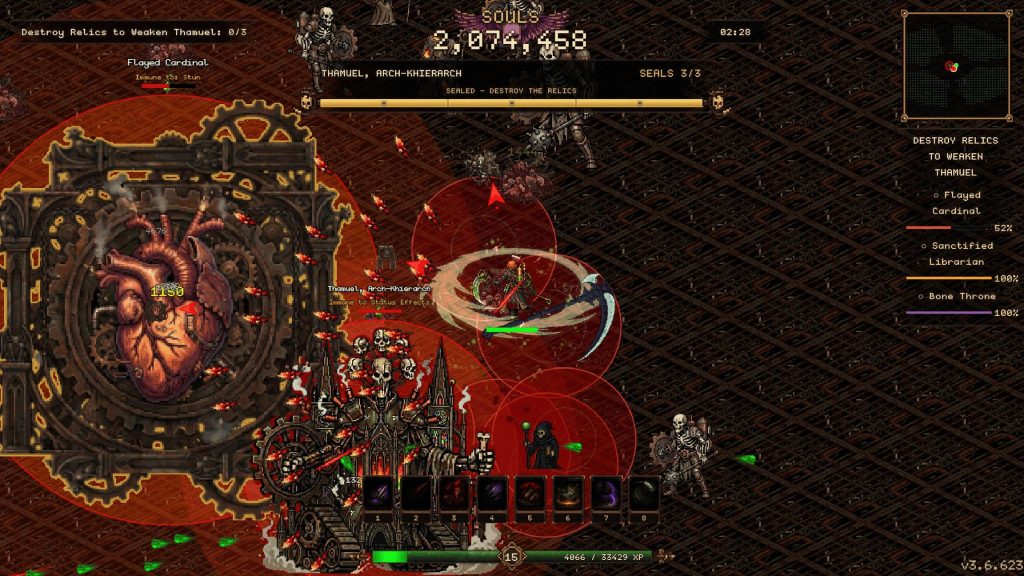 We can say GROLAF didn’t entirely make a game using AI. Hell, even if they did it would take other humans to publish it or make PR for it and help put it out on Steam. But it is a game that, on the surface, has redeeming qualities but those are muddied by the circumstances of its creation. It’s like if people cared about Madonna’s mom more than Madonna. Or the drum set Phil Collins used when recording “In the Air Tonight”. Or the breakfast burrito Ben Sheene ate this morning before typing up this review.
The AI controversy is more interesting than Codex Mortis itself. And is that the point? I don’t know.
A few days ago I had an alert about a game called Kidnapped Simulator. It sounded kind of interesting despite the atrocious name.
“Kidnapped Simulator is a first-person psychological horror game where you write your own replies to the serial killer holding you captive. Your words shape the encounter as you search for a way out.”
The description, visuals, and concept intrigued me. And I almost, almost was willing to look past that the responses were generated by a custom AI engine. And then, today, while looking up GROLAF for this review, I noticed they are also responsible for Kidnapped Simulator.
Ah, okay.
I didn’t need AI to approximate, calculate, or generate where my interest immediately leaned with Kidnapped Simulator and I won’t for other games made in a similar fashion. Even if the concept works, I’d simply rather not. Not for $4. Not for less.
There are so many games that come across my way every single week. Games I will never play and ones that will likely struggle to reach an audience of many players. And that probably pervades our entire industry to the point where I’m sure a large portion of studios are feeling nervous. And even compared to those games I will never touch, they hold more value than something like Codex Mortis ever can because people made them and they are expressions of passion, desperation, excitement, creativity, and the desire to entertain.