


Call of Duty: Black Ops 7 presents a gargantuan amount of content meant to satisfy players of all stripes. While the story can't rival last year's roller coaster, Treyarch's masterclass gunplay stretches across numerous modes with unified progression.
My greatest fear with Call of Duty: Black Ops 7 was that it would become another Modern Warfare III.
Modern Warfare III was haunted by the omnipresence of Call of Duty: Warzone. While Activision’s battle royale cash cow and Fortnite rival has proven to be successful, it was never meant to sustain the foundation of Call of Duty‘s other pillars. Swiftly into Modern Warfare III‘s campaign you could feel how single-player missions were carved out from the sprawling expanse of Warzone. These “Open Combat Missions” were meant to provide the player with a large sense of freedom, providing a custom pace in how missions and objectives were completed.
But that play towards open-concept fun was mostly hollow. Players could rush the objective and forget any semblance of experimentation. Worse yet, the campaign lacked any kind of cinematic punch, ill-fitting for a franchise that usually worked to impress, even if players abandoned single-player once the credits rolled. Despite having an extremely engaging multiplayer spoke, Modern Warfare III felt rushed. It didn’t help that in the year prior, Modern Warfare II had released, marking the first time in years that a Call of Duty sub-series had back-to-back releases.
Black Ops 6 felt like an apology. Its campaign was one of Call of Duty‘s best. Not because it was particularly bombastic or profound but because it strived to be weird, much like Black Ops 3–one of my favorite in the franchise–chose to be. It is as if Treyarch tapped into what Call of Duty players want the most years ago. The developer’s work is frequently beloved and is often marked by throwing even the kitchen sink at players.
But like many, I didn’t expect Black Ops 7 to be 2025’s Call of Duty game.
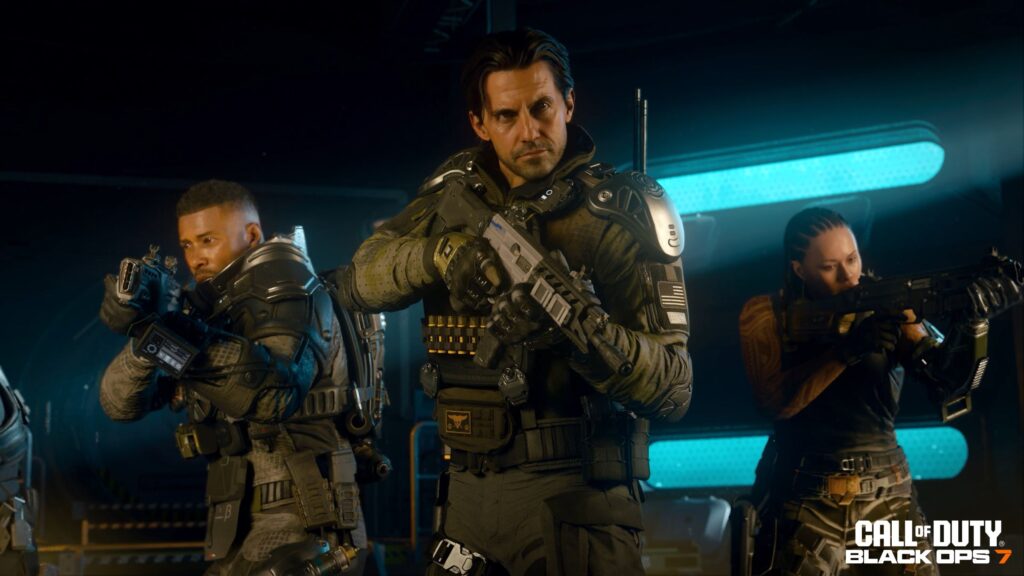
While Black Ops 7 does commit the sin of reusing a vast, open-zone map for a number of campaign missions, it’s done in service of a greater whole. It might be cynical to judge this year’s entry less harshly for a similar ploy as Modern Warfare III but there are fundamental differences between the two products and their campaigns.
Strangely, Black Ops 7 picks up after 10 years after the events of 2012’s Black Ops 2, the first Call of Duty game to dabble in the future which, in the fiction of the game, was the year 2025. But players need not remember the events of a 13-year-old game, just that it features familiar names. Supposedly developed at the same time as Black Ops 6, it makes sense that Black Ops 7 also features Troy Marshall who is significantly older than he was in the 1990s.
David Mason, son of Alex Mason, is now played by Milo Ventimiglia, who commands this metered performance quite well. As the leader of JSOC, Mason and his team are tasked with figuring out why a video of Raul Menendez–who was killed in Black Ops 2–is now making new threats of chaos. Shortly into their mission, Mason and his team of four–which also features the return of Michael Rooker as Mike Harper–are infected with The Cradle virus from the last game. Across 11 missions, players fight inside the psyche of Mason’s team, battling their inner demons and working to contain The Cradle’s spread across the landscape of Avalon.
Black Ops 7‘s narrative has a number of fascinating moments that work to craft connective tissue across the fabric of the Black Ops universe. But this is a tale of two halves: custom-crafted missions and those stapled onto the sprawling map of Avalon.
Players will find themselves diving into contorted, nightmare-like highways to chase down a lead. They will fight off parasitic insects and nightmare soldiers in haunted gulags and storage containers. But they will also wingsuit and grapple around a countryside that features recognizable multiplayer maps and story beats that aren’t entirely cinematic. During these “Cradle” missions of a distorted reality, Black Ops 7 tries to get as weird and heady as possible, evoking the strongest moments of last year’s campaign. But during the Avalon runs, there’s a sense that Treyarch and Raven are prepping players for the meaty “Endgame” that happens right after the final mission closes, on-boarding them with the concepts and mechanics that will come into play to ensure the campaign experience doesn’t entirely end.

Black Ops 7‘s campaign looks and sounds phenomenal, as expected from any Call of Duty game at this point. But the story did have me scratching my head a bit throughout. As much as I adore Kiernan Shipka, her character Emma Kagan, the CEO of the technology conglomerate The Guild seemed to exist purely to provide robots and heavily-armored humans to shoot. And while I understand the efforts made to bridge the many decades the Black Ops story has covered, I’m not entirely sure how Kagan acquired The Cradle and I don’t know why Marshall was the only returning face from the timeline.
Having run through the campaign with a degree of thoroughness, there was sometimes a sense that I had missed something or a reveal had merely gone over my head. But I still had a relatively good time engaged in the action. Swapping between weapons, tearing through dozens of enemies, and engaging in some relatively bizarre boss fights certainly made Black Ops 7 one of the most unique Call of Duty campaigns merely because it was offering me so much to do.
Still, I was left wondering what the future of Call of Duty campaigns will be like. If Battlefield 6 is any indication, money can be thrown at a single-player campaign to have a high productive value and the game will literally provide players the means to uninstall it, saying it will free up space. Are we entering an era where the prestige Call of Duty campaign is dialed back, instead providing a way to familiarize players with game modes that persist?
For years I used to solely play Call of Duty for the campaigns. Even when Call of Duty 4: Modern Warfare came out, I played multiplayer for a few dozen hours, likely not even hitting my first Prestige. Now? I’ll play a few hundred hours of multiplayer at minimum. Though I do wonder what Infinity Ward and Sledgehammer Games are cooking behind the scenes, the groundwork is being laid for Call of Duty entries that further try and shake up the campaign experience. After all, Black Ops 4 infamously had no campaign.
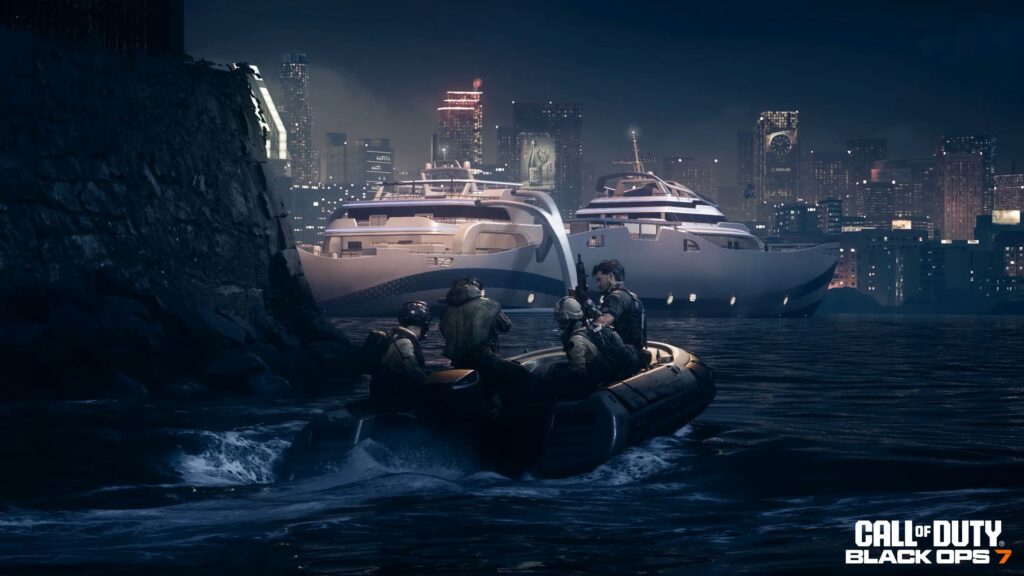
One reason why Black Ops 7 gets away with its campaign being less than cinematic is because for the first time since Black Ops 3, the entire thing is playable cooperatively with up to four players. While Black Ops 3‘s Specialists made its multiplayer a classic for me, the cooperative campaign made it unforgettable. Despite Black Ops 7 not having as twisted or as memorable a story, it’s obvious that cooperative play was fundamentally important to this year’s experience.
From the open zones of the Avalon missions to the sheer number of forces grouping behind cover and corridors, there’s something about engaging with the phenomenal gunplay with friends. The cauldron of shotguns, LMGs, pistols, assault rifles, grenades, explosions, and powers all clashing in an open kill-box make for some of the most thrilling combat Call of Duty has had yet. While there isn’t necessarily any need for coordination, it’s a blast simply completing these missions with other people.
But because Treyarch doesn’t want the campaign experience to button itself up, for the first time ever an “endgame” experience has been introduced to Call of Duty.
Taking place on the Avalon map–which is ripe to be its own locale for Warzone–a squad of up to four players will drop in and start the journey to grind for power. Deemed the Endgame, this content acts mildly similar to an extraction shooter of the franchise’s own DMZ mode. The expansive map is littered with objectives like escorting a robotic D.A.W.G., killing high-value targets, wingsuit-chasing crimson butterflies, defending a shipping container, and killing all manner of thing.
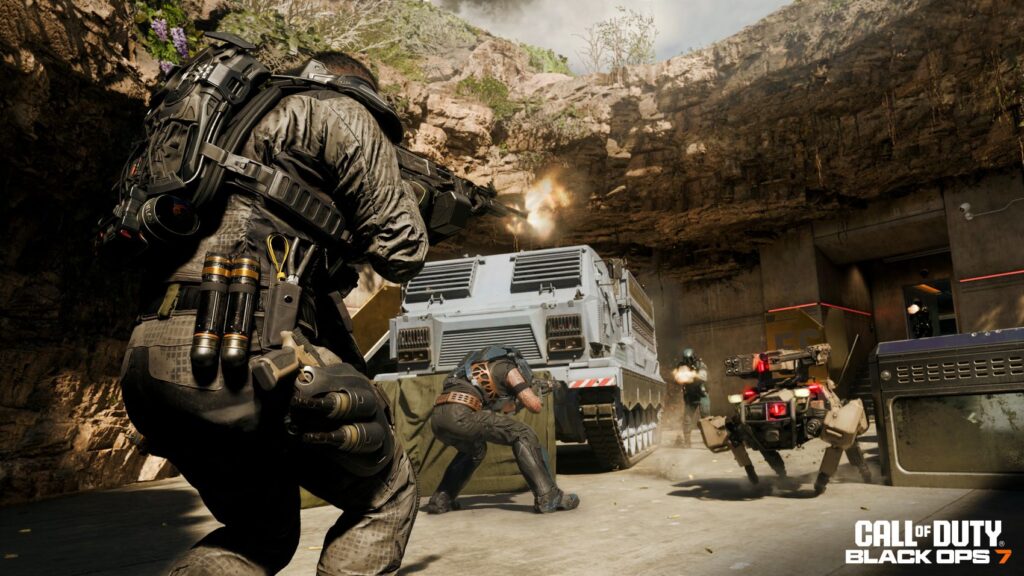
Lessons learned in the campaign are carried over into Endgame. As players completed missions, stats like base damage, speed, and health went up. Along the path, weapons could be upgraded in rarity so by the end of the narrative, players were wielding epic gear. Avalon and the Endgame are meant to be engaged at the pace players want. The goal is to complete missions and kill enemies to constantly raise their soldier’s combat ranking. When going up in level, players can choose between two perks that make them overall stronger. Faster reloads, automatically regenerating armor, swapping weapons faster are just a handful of the dozens of perks that players can permanently graft to their character to make them stronger.
Ultimately, the goal of Endgame is to power creep into higher difficulty zones that feature stronger opposition. And eventually, players will complete a final boss of sorts that acts as a soft ending to the Endgame content. The twist is that if players die, they will lose their combat ranking, effectively acting as a wipe, and must grind up levels again. Only by successfully extracting will your level be preserved for the next infiltration into Avalon.
Endgame is something entirely new to Call of Duty. And while the tasks and missions themselves weren’t exactly grandiose in nature, the content was a blast to play because it simply felt like more PvE content that isn’t centered around Zombies, which rapidly escalates in difficulty. At its current iteration, it would take several hours to grind up to the appropriate level to take on Avalon’s final boss. But I’ve also seen a taste of what’s to come with Endgame and it has left me extremely excited for its potential. As the mode evolves with Black Ops 7‘s seasonal content, players should expect public events where everyone on the server can join in to fight ridiculous bosses, along with puzzles that will likely not be easy to solve.
Because Endgame incorporates human soldiers, robots, and creatures pulled from Zombies, it’s not meant to be taken too seriously. But another advantage baked into Black Ops 7 is that every activity players engage with features cross progression. This means that the campaign, Endgame, Zombies, multiplayer, and Dead Ops Arcade 4 all fuel a player’s overall experience gain. Calling cards, camos, and daily challenges are all offered through these modes and Black Ops 7 features a few tools to help players see what they have just unlocked or what challenges they are close to completing.
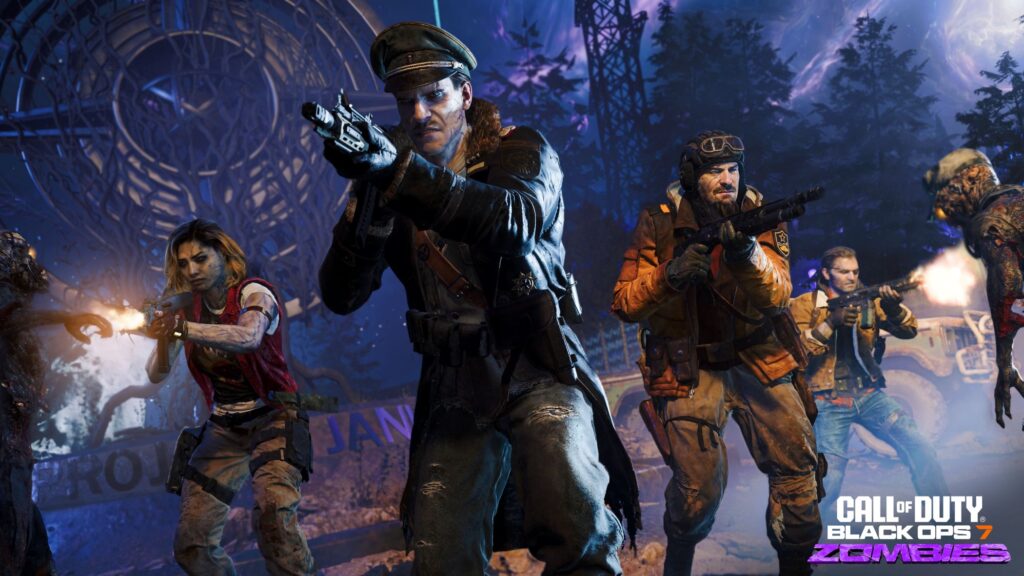
Of course, it wouldn’t be a Treyarch Black Ops game without a substantial Zombies mode and Black Ops 7 doesn’t disappoint. While the fundamental mechanics and loop of Zombies mode has just about been perfected, this year’s mode “Ashes of the Damned” is one of the best Zombies entries in years. Taking inspiration from Black Ops 2‘s “TranZit”, Ashes of the Damned introduces a Wonder Vehicle named Ol’ Bessie that players drive around an interconnected map.
Rather than a large map that opens up by unlocking new doors and paths, Ashes of the Damned has players driving Ol’ Bessie around a handful of mid-sized locations in hopes of completing whatever obscure Easter Egg that has been hidden away behind bizarre tasks. Each smaller map–whether it be a humble farm, a rocket launch pad, a 1950s-inspired diner, or a cabin by the lake–feel contained in a way that makes them manageable.
By hopping in the Wonder Vehicle, players drive deadly paths ripe with zombies and hazards that threaten to break down the car. One player can drive while the others can shoot out the windows or even ride on the top. Brave groups will be able to split up across all the sections and search for clues while still earning points into upgrading their perks and abilities. But should players wish, these smaller maps can also be sectioned off as simple wave-based survival rounds of traditional Zombies.
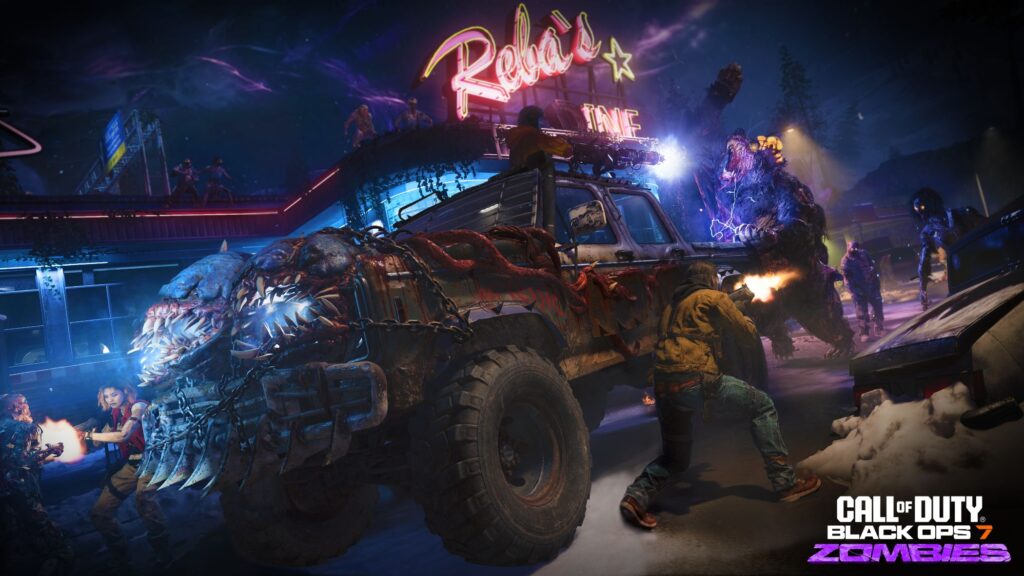
In due time, likely 24 hours, the community is likely going to solve the Easter Egg and unlock all the secrets of Ashes of the Damned. And while this particular incarnation of Zombies isn’t a sea change for the mode, it retains the tension and insane narrative players should have come to expect.
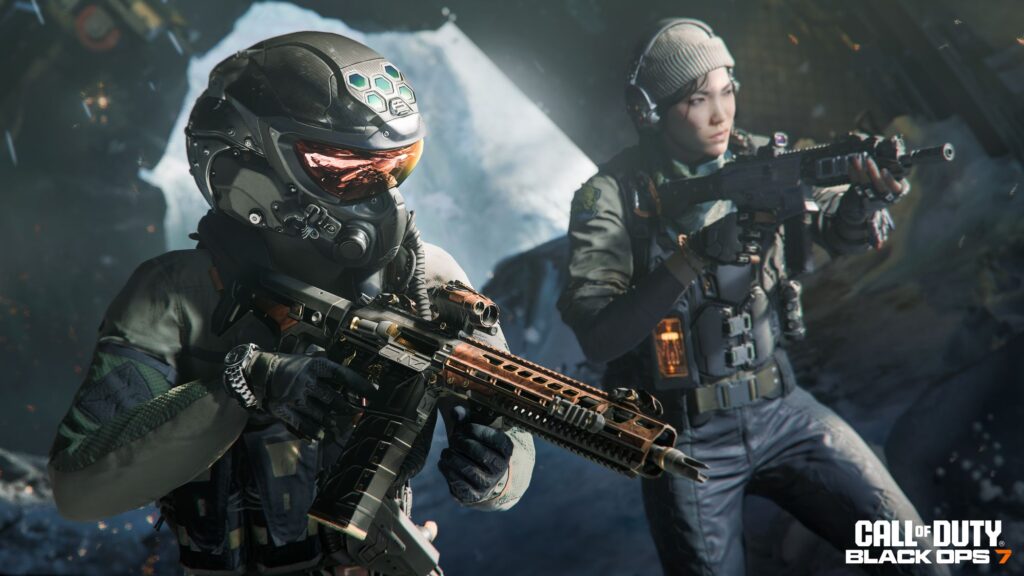
As with zombies, Black Ops 7‘s multiplayer represents more of a refinement rather than an evolution. One of the biggest improvements is the ability to “overclock” both scorestreaks and equipment. By completing tasks for these items, players can add an additional bit of functionality. Maybe a the fuse will be longer on a grenade, maybe it will stun for longer. The perk specialties have also been enhanced and players can make a hybrid perk specialty class or focus on three perks of one class to be granted a special ability.
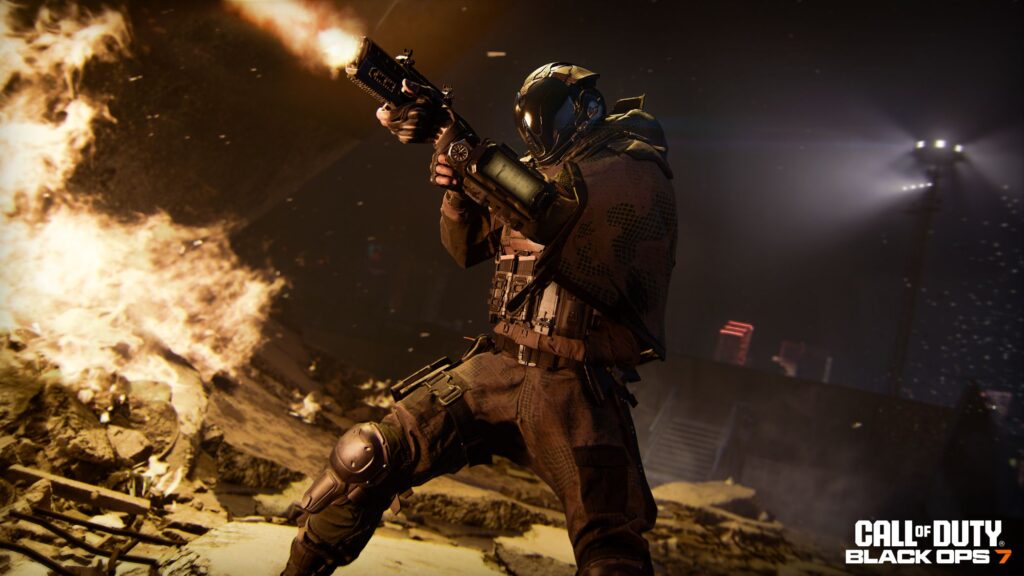
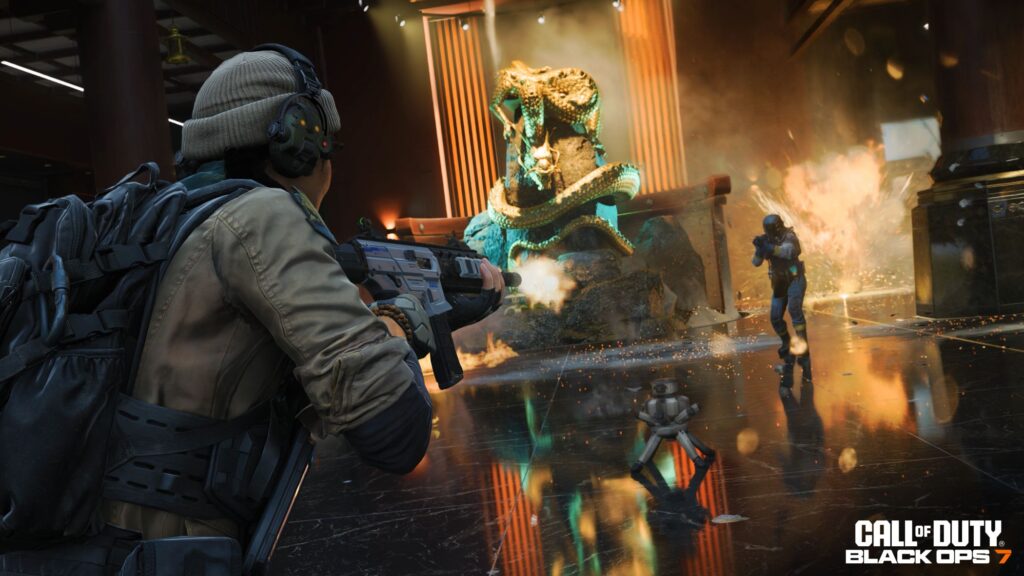
A roster of over 30 weapons presents a bevy of options for players who want to play around with what feels best. But I think the highlight of Black Ops 7‘s multiplayer are its 16 maps that incorporate small, medium, and large layouts. I think of the Japanese-themed “Toshin” map with it’s cutthroat “B” capture point. Or “Homestead” with it’s deadly cabin or even the return of “Hijacked” with a modern coat of paint.
To say that this is one of the strongest lineups of launch maps Call of Duty has had in years would be an understatement. But what makes it even better are the small refinements Treyarch made to improve the overall experience. Tactical sprint is now locked behind a perk and the expert movement found in Black Ops 6 has been slightly toned down or only available to players who make certain sacrifices in perks. Omnimovement still feels amazing but a mild wall jump allows for some tricky spaces that agile players will take advantage of.
And, of course, not having skill-based matchmaking will prove to be a massive change for Call of Duty with Black Ops 7. For years, the push and pull of getting locked into these constant grinds of fighting against players of a similar skill may just be done. In doing so, matches might be one-sided at times but it presents an opportunity to go back to classic Call of Duty standards.
This embarrassment of riches is capped off with Dead Ops Arcade 4, that familiar mode that everyone should play. I have always been a fan of the absurdity of Dead Ops Arcade and Treyarch’s loving embrace of the mode. This time around, the mode feels particularly expansive as players can choose between a shorter, casual difficulty or a normal mode that takes several hours to complete by sweeping them across every map the mode has to offer.
Presented from a top-down perspective, Dead Ops Arcade 4 acts like a twin-stick shooter where players walk over coins, cash, and weapons to blitz through constant swarms of zombies and try to best a zombie gorilla. Yeah, it’s not supposed to make that much sense. By purchasing power-ups, players can have saws swirling around them, chickens that fire bullets, and even become disoriented by temporarily switching to a first-person perspective that allows for full movement of the Black Ops 7 mechanics. Bonus rounds show off kart racing and side-scroller shmups because why not? And again, even when playing Dead Ops Arcade 4, players earn progression towards their overall level.
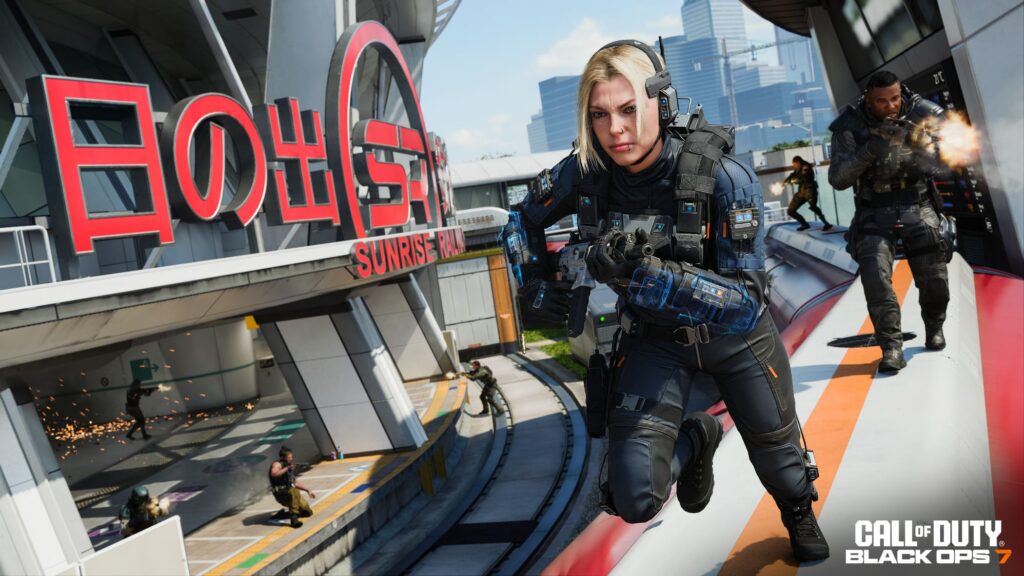
Despite the small fumbles of the main narrative in Black Ops 7 and that a lot of its content feels familiar if you’ve played Black Ops 6, it’s hard to ignore the value proposition here. This is a massive game and it is packed with the prestige most have come to expect from both Treyarch and Raven. And the idea that every mode can be played with up to four friends means that Black Ops 7 is a co-op blast. Effort has been made to give players every opportunity to engage with the game long term and as the seasons evolve, as will the reasons to keep coming back to activities like Endgame and Zombies.
Call of Duty: Black Ops 7 features some of the strongest launch content a Call of Duty game has had in years. The best part? It can all be played with friends and everything you do counts towards overall progression. But more importantly, the stellar maps and addictive Endgame provide ample ways to play Call of Duty how you want to. Incorporating best-in-class shooting to all these modes means that each pillar of Black Ops 7 is satisfying, exciting, and challenging. This may be the hardest Call of Duty to put down yet.