


Atomic Owl is a beautifully drawn and well-orchestrated platformer that wavers between a punishing retro 2D sidescroller and a roguelike. If it had made a bolder stab at one of those genres, perhaps its gameplay would feel meaningful. For now, there are other roguelike platformers that are deserving of your time.
Atomic Owl from developer Monster Theater is a classic case of a retro-inspired, 2D action platformer that looks amazing in the trailers, but falls somewhat short in its execution. Before getting into that criticism, it’s worth praising that Atomic Owl looks unlike any other modern platformer. It stars Hidalgo, a shinobi owl whose companions had been corrupted by demonic powers. Hidalgo befriends a talking sword who floats alongside him on his journey throughout Monster Theater’s gorgeously designed futuristic Japan.
Platforming staples are available right from the start of Atomic Owl, like double jumps, wall jumps, flying upwards, and dashing. It also gives Hidalgo access to four weapons: a throwing hammer, a sword, a chain whip, and a slow yet sturdy broadsword. Yes, all of this is unlocked from minute one of Atomic Owl, giving Hidalgo access to multiple tools as he takes down tengu after tengu. Admittedly, it was a pleasant surprise to have this much at my disposal so early, but that pleasant surprise turned into disappointment as very little additional mechanics were unlocked throughout my playthrough.
Instead, Atomic Owl has heart – lots of it. It kicks off with mostly voiced cutscenes and worldbuilding comprised of crisp and detailed pixel art. The zoomed out gameplay perspective frames Hidalgo in a synthwave-inspired Japan with small motifs peppered in the background. It’s a treat for the ears, as well, because of the catchy chiptune soundtrack. It’s clear that Monster Theater had invested quite a bit of time in creating a game that passes the vibe check for old-school players like me.
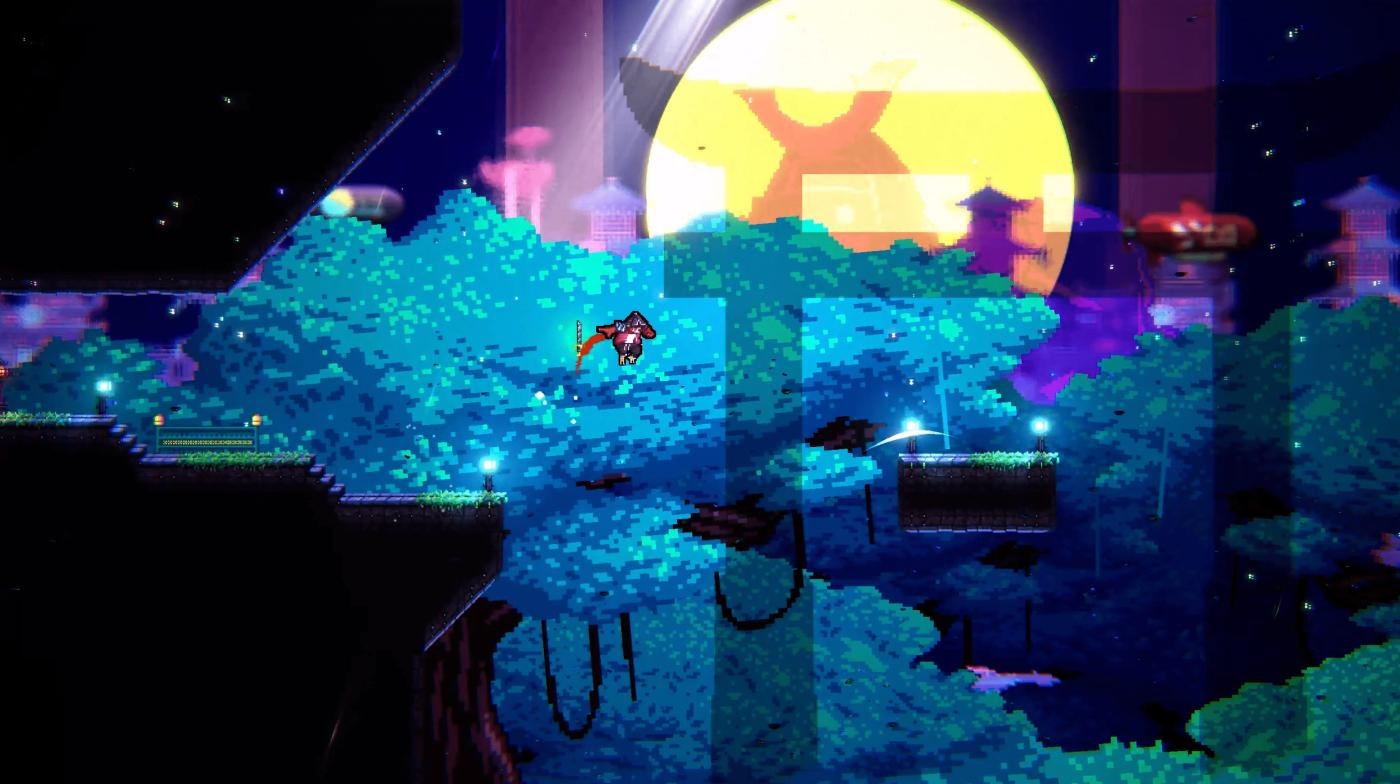 When it comes to the platforming, Atomic Owl follows a traditional progression path. Levels are massive and slowly introduce new mechanics and threats, fully taking advantage of Hidalgo’s winged prowess and abilities. While the creative platforming is welcome, the zoomed out perspective and level size fall prey to wasted space. This is especially true in the first few levels where enemies are concentrated within very specific windows while some areas are void of enemies, threats, or platforms. With the zoomed out perspective, the levels’ real estate needed to be better utilized to give players more of something to enjoy.
Perhaps the most glaring issue in Atomic Owl is its attempt at offering a roguelike experience. At the start of the game, Atomic Owl gives the player the option between a traditional 2D platformer with checkpoints or the developers’ intended roguelike mode. When enabling this roguelike mode, I had assumed that there would be variance across runs in the form of randomized levels, different enemy patterns, or other changes to keep things fresh. This was not the case. Starting a new run meant that I had to simply start over…and run through the exact same level, same enemy placements and NPCs and all. The only difference I encountered across runs was coming across upgrades at different times.
 To say that I was disappointed in the roguelike mode is an understatement. I was frustrated at how everything was the exact same across runs. The fact that I couldn’t access the optional challenge rooms after completing them the first time rubbed salt in the wound because those levels were incidentally the most challenging, yet most fun. After my fifth run I became bored with the first world altogether.
Good roguelikes should change things up across runs to keep players on their toes; not doing so runs the risk of a boring gameplay loop with diminishing returns for players looking to beat the game. Atomic Owl is constructed around the idea of a roguelike that tasks the player with running through the same game from start to finish with minimal variations, save for a health bar that grows in maximum capacity across subsequent runs along with some persistent stats that can be bought.
In 2026, there are roguelike of every flavor imaginable available on the Steam Store let alone on Nintendo’s console. I understand that Atomic Owl is a labor of love amongst a small team of talented individuals, but it’s hard to ignore that the roguelike mode (the developers’ intended mode, mind you) is in need of love. If there were variable enemy placements or shifting levels, I’d be more forgiving. But, there are too many missed opportunities on the gameplay design front that warrant calling out.
 As a platformer, Atomic Owl has the right bits that celebrate the early PlayStation era of platforming designs. Playing Atomic Owl as a traditional platformer (the mode that isn’t the developers’ intended mode) is frankly the best way you should play it. It’s unfortunate that the gorgeous pixel art, synthwave aesthetic, and music are overshadowed by bigger issues. Regardless, it can be easily completed in a little over 9 hours (less if you figure out the predictable enemy patterns and luck out on hitting the Wing Fragments that add damage over time to Hidalgo’s attacks).
Atomic Owl is a beautifully drawn and well-orchestrated platformer that wavers between a punishing retro 2D sidescroller and a roguelike. If it had made a bolder stab at one of those genres, perhaps its gameplay would feel meaningful. For now, there are other roguelike platformers that are deserving of your time.