


Dotemu, Guard Crush, and Supamonks have knocked it out of the park with Absolum. Its combat is satisfyingly stylish, encapsulating traditional side-scrolling beat ‘em up combat with the variability of endlessly fun roguelike gameplay. Punishing difficulty aside, it’s worth taking the time to explore the depths of its world and creatively defeat enemies in more ways than one. Absolum pushes the envelope of beat ‘em up game design to new heights, worthy of your consideration as we enter this holiday season.
“Death is just another step on your journey.”
These were the words that Mother Uchawi and her Root Sisters whispered to me when I perished at the hands of some magic-hating minion of the Sun King Azra. These were the words that comforted me when I perished run-after-run.
Absolum is a gorgeous and deeply engaging “rogue ‘em up” from the developers Guard Crush, Supamonks, and Dotemu. If Dotemu rings a bell, it should; Dotemu is the publisher behind recent retro-inspired releases like Teenage Mutant Ninja Turtles: Shredder’s Revenge, Metal Slug Tactics, and Streets of Rage 4. This time, though, Dotemu isn’t remixing an existing IP from the 90s. They’ve created an original IP and layered it onto a modern roguelike that’s been blended with retro sidescrolling. All of it is contained within an environment that looks and feels like it came out of a comic book, and it’s just glorious.
In the world of Talamh, the Sun King Azra has taken control of the world and eliminated wizards from the population. The high enchantress Uchawi, along with four rebels, seek to challenge Azra’s oppressive regime. Uchawi keeps the rebels alive in their repetitive trials by reviving them and granting them a smidge more power in hopes that they eventually succeed.
 Absolum plays like any other side-scroller in Dotemu’s library, albeit broken up into rooms like a typical roguelike. Enemies enter the screen and attack the player; upon enemies’ defeat, Uchawi rewards the player with currency or an elemental boon that lasts until the player perishes (which they assuredly will – it’s a roguelike, remember?).
The four rebels play vastly differently, utilizing unique attacks and abilities. Galandra, a blade-wielding necromancer, feels like a traditional stiff melee attacker. Karl, the dwarf, mixes up hand-to-hand combat with explosive weaponry. Brome, a frog wizard, has a collection of traps and magical spells that can clear rooms but struggles with close quarters combat. Cider is the most nimble of the bunch, utilizing a hook to bring herself into close range (think a reverse Scorpion from Mortal Kombat) and weaving through enemies.
While Cider felt the most thrilling to play because of her agility, I had the greatest success with Galandra for most of my playthrough with her spectral weapons. A later upgrade granted her a summoned sword that would fight on her side, acting as my sidekick as I pummeled enemies into oblivion.
Tech, pressure, and clash are Absolum’s version of advanced combat. These abilities involve juggling enemies, timing attacks based on very specific tells from enemies, along with following up with other attacks to create longer-form combinations. The timing element took me far too long to master, but once I had some semblance of when, not just how, to attack, it felt like I could achieve my character’s potential in no time at all. Admittedly, I never felt like I had mastered the clash element, as I often avoided augmenting my clash abilities by deferring to upgrade my standard attacks just so I could ensure that I would get some use out of what I had chosen on my run.
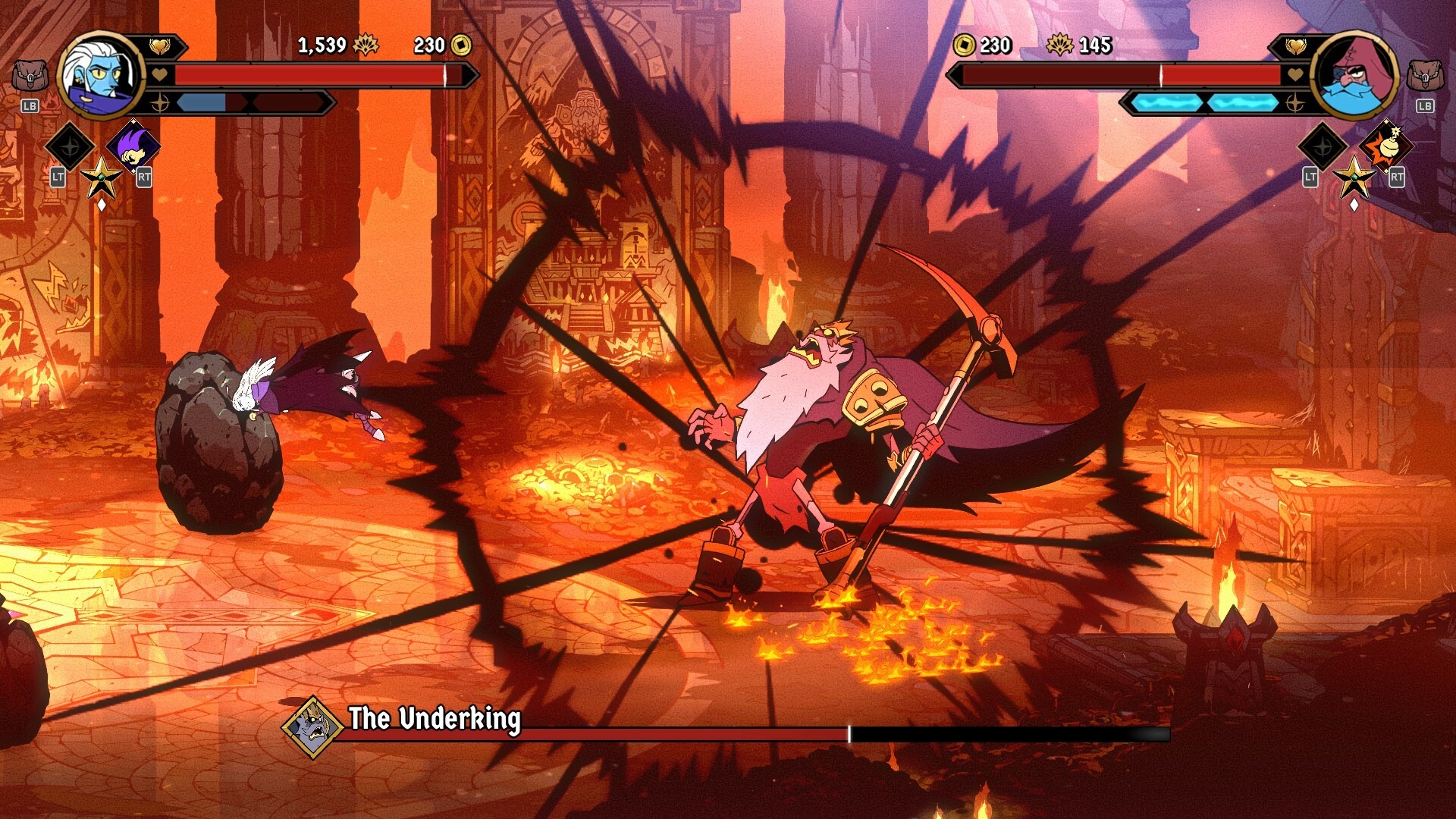 It takes a while for the combat to click, but once it does…woah. The right combinations of boons and leveled-up abilities resulted in satisfyingly massive chains of attacks. While some characters may feel more fluid than others at first, there comes a point where inputs naturally flow into one another thanks to the augments that modify, not replace, my attacks.
Absolum avoids tying a character’s sole source of power to elemental boons. It also ensures that the temporary elemental upgrades that are obtained are not overtuned to the point of seeking out two or three of them run after run. If anything, Absolum avoids giving the player access to too many rerolls by first locking the feature behind a level up reward and then limiting the number of times one can reroll rewards by requiring payment of crystals (required for permanent perk unlocks) for doing so.
Absolum rewarded me for my persistence in ways that few roguelites have done thus far. Beyond greater power fantasies, each new run had a chance of changing up the world in new ways. For instance, a typically friendly village would randomly become hostile, bombarding me with grenades at the village’s entrance and giving me rotten food as a gift. Another worldly variation featured a handful of NPCs giving me a direct hint as to where I could go next to conduct a ritual (the process of unlocking a new batch of elemental abilities).
It’s these moments of “randomness” (even if they’re scripted to appear after specific conditions are met) that keep Absolum from going stale well into its tenth hour. It’s not as lore-rich as say, Hades, but it sure as hell keeps players on their toes to discover some new path or difficulty modifier despite losing time and time again. Its evolving world was an excellent motivator to keep me trying again, just so I could see what was available to me and how my actions in prior runs had impacted the future.
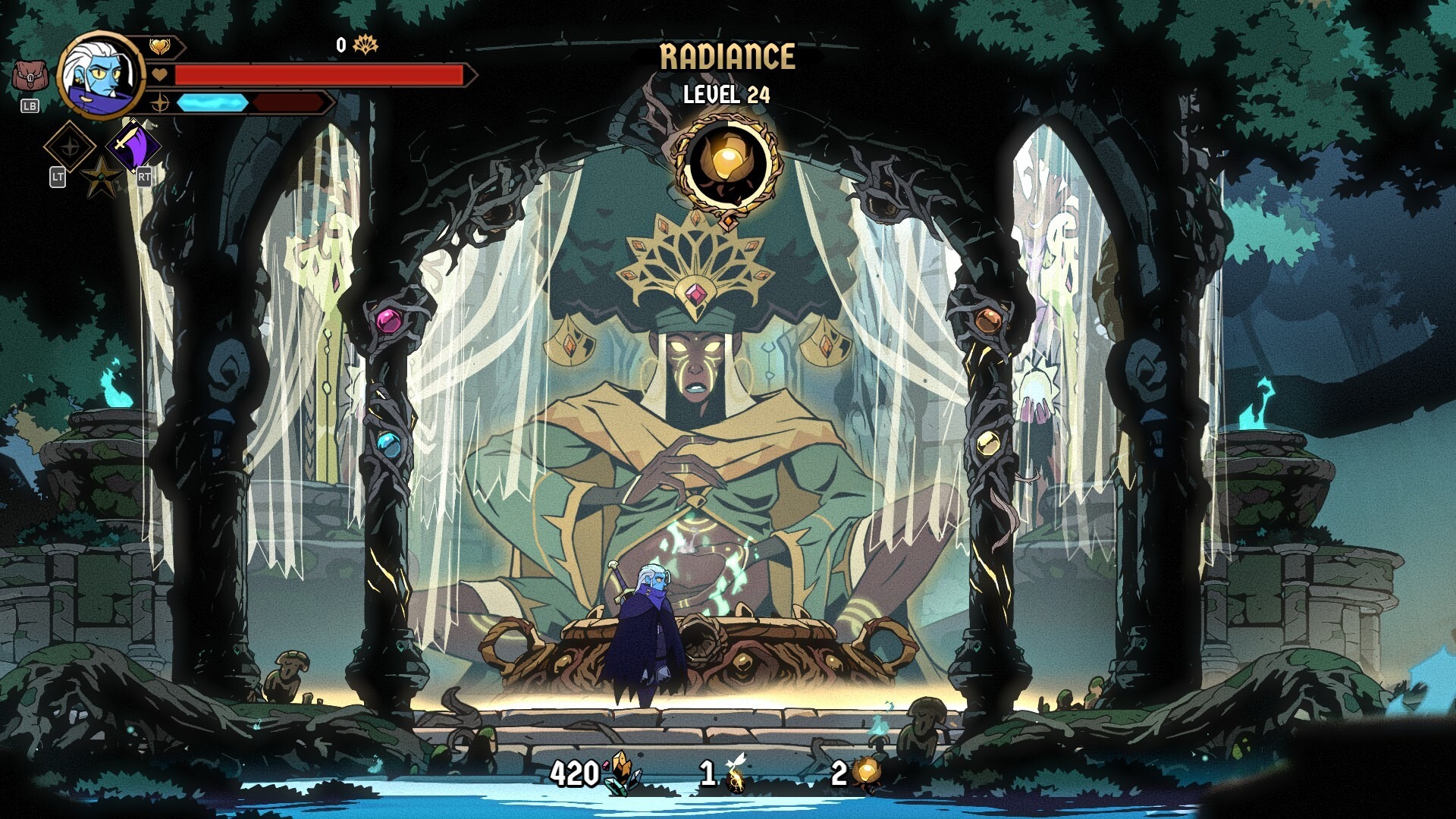 The biggest obstacle facing Absolum is its boss battles. While they’re not as cheesy and artificially difficult as, say, Dragon is Dead or The Last Faith (the latter of which is intentionally difficult for the sake of being a souls-like), they present a challenge that requires the player to cast aside their habits of bum-rushing groups of enemies and watch out for very specific windows to focus on a single enemy’s weakpoint. It feels almost counterproductive to the beat-em-up mantra of literally mindlessly slamming enemies to the floor. I can see an argument that the bosses are strategically placed gates that limit aimless advancement, but they feel more difficult than they should.
Beyond that, however, the traditional roguelike power fantasy exists just as you may imagine. In between runs, crystals can be spent on small permanent stat boosts (like maximum HP, a revive), additional elemental powerups, and even character-specific attacks that can be taken into battle in future runs. These rewards soften the crushing blow of being defeated over and over all the while giving the player an additional set of tools that can be used to succeed, even if those tools won’t come in handy until later down the line.
The roguelike experience of Absolum is one of a satisfying power curve, one that requires persistence along with mastery of its combat. By avoiding offering variance for variance’s sake, there’s room for players to become innately familiar with Talamh’s outcasts through trial and error. If one character’s playstyle doesn’t feel “right,” another character’s kit can help you get far enough to unlock enough content to make the entire cast strong.
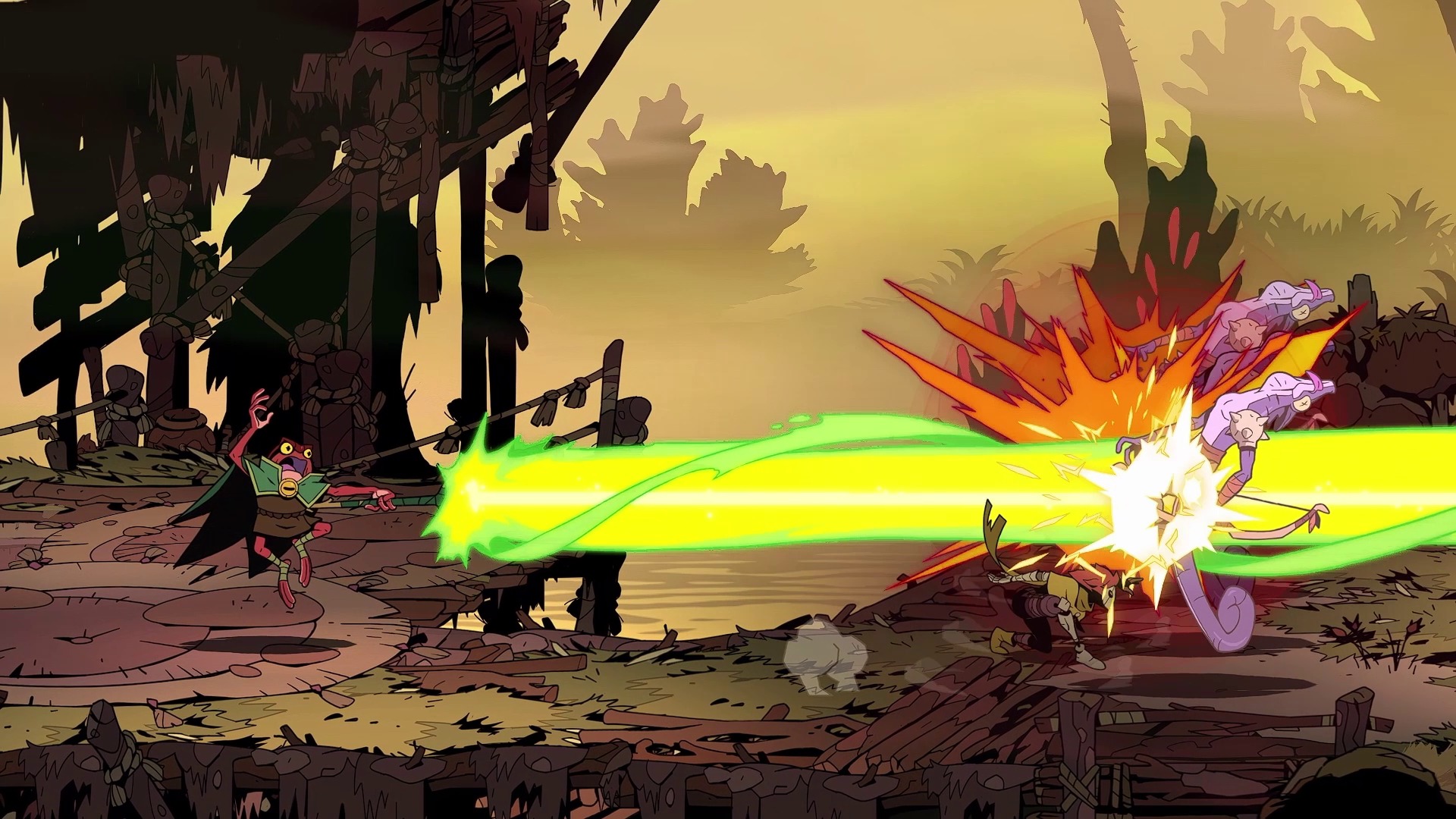 Before wrapping this review, I want to call out how much I loved Absolum’s soundtrack. I was aware that some heavy hitters in the form of Gareth Coker (from Ori and Prince of Persia), Yuka Kitamura (from Dark Souls and Elden Ring), and Mick Gorden (Doom Eternal!!!) made the game’s soundtrack, but I wasn’t expecting this level of audible chocolate. Every single biome’s music not only felt appropriate for the biome’s thematic, but elevated that thematic to make it real. I cannot wait to listen to the soundtrack when working – it’s a treat!
Absolum’s entire thematic is stylish beyond all get out. From its hand-drawn thematic to its comic-inspired dialogue with speech bubbles to its picturesque landscapes, it excellently utilizes the 2D space in creative fashions to illustrate the grandiosity of its world. The combat might be contained to a linear plane, but the world outside of that arena beckons the player to gaze upon it once combat has concluded.
Dotemu, Guard Crush, and Supamonks have knocked it out of the park with Absolum. Its combat is satisfyingly stylish, encapsulating traditional side-scrolling beat ‘em up combat with the variability of endlessly fun roguelike gameplay. Punishing difficulty aside, it’s worth taking the time to explore the depths of its world and creatively defeat enemies in more ways than one. Absolum pushes the envelope of beat ‘em up game design to new heights, worthy of your consideration as we enter this holiday season.