
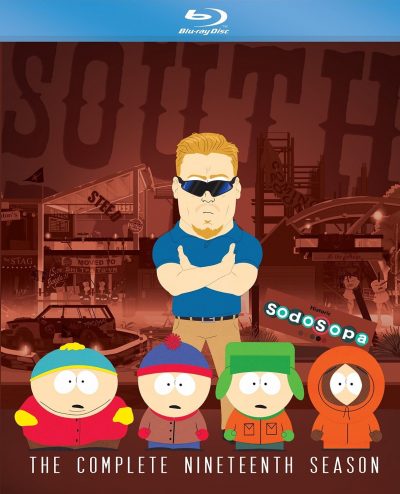
What change, you may ask? In case you haven’t seen the show in a while, it’s went through some reformatting of sorts these past several years. Removed from the early heyday of really high count batches, the year was split into two seven chapter installments in the spring and fall. But show creators Trey Parker and Matt Stone further whittled down the offerings with a single, ten episode spurt which started in 2013. That tempo has been retained over the past three years. Despite my opposition to less Park (considering my admission to being a lifelong fan), the smaller sets have produced really good to amazing results that has enriched the potential “staying power” of the show. With season 18, Parker, Stone, and the rest of the writing team experimented with continuing a handful of narrative threads across the length of the year. Instead of a complete story and character reset after each 22 minutes of runtime, some things were allowed to “breath” for weeks and months at a time. Most notably was the revelation that Randy Marsh, town geologist and comedic gold mine, was living a double life as New Zealand singer-songwriter Lorde. For 19, this idea gets extended. While many of the ten shows do explore their own solitary statements, the narrative core is consistently explored, explicated, and extrapolated. This solidarity is established in the opening moments of ep. 1901.
“Stunning and Brave” introduces a new inhabitant. Principal Victoria has been removed from her post at South Park Elementary in favor of PC Principal. PC embodies the social justice warrior movement. As a standard American Caucasian male, he proclaims to adjust the sordid racist, homophobic, xenophobic, and culturally misappropriated tendencies of the town citizenry in a dysphemistic diatribe at an impromptu meeting in the cafeteria. His opening treatise shows the occasional counter productive nature of the SJW cause. With solid, good heart-ed intentions or not, many folks (note: not most, but a large number) from these groups are very regressive in their own right. While being self appointed stalwarts to the injustices of U.S. culture, rights, and liberty, they often times fail to see or outright ignore their bigotry and hate mongering. Internet based virtue signaling echo chambers fuel these misguided intentions to the point of becoming an angry QWERTY mob looking for binary blood. And their myopic outlook blinds them of the original reason for their distaste and the people that are real victims of systemic inhibition. That IS PC Principal. He, and fellow members of PCU, an ad hoc frat-ty organization of similar minded 20 something white men, often lash out in sophomoric, sometimes inimical means when eavesdropping upon conversations they deem to be out-of-line. Prime example is the first showdown between Principal and South Park’s most vile soul, Cartman. Eric tries to frame PC for child molestation. While making his intentions known, he uses chauvinistic terms like “salesman” instead of “salesperson.” PC proceeds to beat Eric to a pulp for this relatively benign turn of phrase. Additionally, when Kyle openly admits he doesn’t find Bruc. . . I mean Caitly Jenner to be a hero, he is hazed by members of PCU by tying him to a tree, shaving parts of his non-Hassidic Jewish afro, and emblaze his face with crudely flaccid drawings in permanent marker.
In season’s past, the production crew would have found some humorous, perhaps dismembering, way to dispatch of PC Principal at episode end. As stated earlier, it’s a new day in the sleepy mountain town. He, and his “organization” stick around throughout the entirety of the season and becomes the galvanizing force of the roughly three and a half hours. Instead of the usual uproarious opposition to an outsider that is trying to change their way of life, the people, lead in large by Randy, decide to embrace this alteration in language and acceptance. “The City Part of Town” highlights this best. To symbolize their corrected states of mind, South Park administration applies, and surprisingly gets accepted, for a Whole Foods. As a way to “sweeten” the deal, Mayor McDaniel decides to break ground on a new district: SodoSopa. Gentrification to the max, this area anchored by aforementioned Whole Foods features state-of-the-art apartments, chic dining options, and other exciting shopping excursions, all (quite literally) in the back yard of the McCormick’s house, the poorest part of town. Owner of City Wok, Tuong Lu Kim, sees his business take a nose dive in consequence. So with the same work ethic and resolve he showed building a wall to keep the kids save from Mongolians years before, he creates the new-new Shi Tpa Town, with even more pompous regale and hollow idolization of progress. The run wasn’t completely devoid of single chapter bits outside of the persistent carry-overs. “Tweek x Craig” showcases the two boys as the center of yaoi pieces that are popularized seemingly overnight by the Asian girl students of the school. Through the lenses of hipster framed acceptance glasses, adults of Park are excited to have “their” first openly gay child couple, despite the fact that no one other than Kyle stopped to research yaoi and realize these depictions are fictitious with no regard for the actual preference or orientation of the art’s individuals.
Another one-off is my personal favorite of the season, “Naughty Ninjas.” Kenny and Token innocently start pretending to be ninjas within the now dilapidated medium rise structures of SodoSopa. When the other boys catch wind of the juvenile pretend opportunity, a full fledged organization is created with no intentions other than to practice assumed combat maneuvers and high pitched warrior noises. When the adults see what’s going on, they fall under the hasty impression the youth have resorted to becoming members of the Islamic State, and it’s up to veteran Officer Barbrady to quote “shoot some kids.” The last three episodes are a Matryoshka doll of a story. “Sponsored Content,” “Truth and Advertising,” and “PC Principal Final Justice” follow usual three part-er logic under the larger season umbrella. Jimmy Valmer, a staple of trusted journalism, is informed of a plot against South Park in the form of innocent little Leslie, a fellow student who may or may not be the evolution in advertising. With the advent of Internet based entertainment options, ways to keep ad revenue steady have seen a shift in recent years with banners, pop-ups, spam, and those nascent “lists” at the bottom of featured articles that are littered with purchased messages. Over the course of the hour, many revelations about the new look Park are brought to the forefront, as well as the origination of PC Principal himself.
As with every Blu-ray iteration of the show, presentation is very solid. The patented construction paper based art style with surprisingly adept colors, backgrounds, and lighting look great in 1080. Better yet are the sound options of Dolby TrueHD 5.1 mix or TV friendly Dolby Digital Stereo, which is perfect for more modest two speaker or sound bar setups. The bonus content section features the usual #SocialCommentary option, where informative/interesting tid-bits appear at the bottom of the screen during the show, and about five minutes worth of cumulative deleted scenes. The big draw for this set is season commentary. Parker and Stone spend the better part of a half hour chatting about the over arching ideas for the season, how last year sort of set the template, and an episode-by-episode breakdown of how it all fits together. There is also a trailer for the upcoming South Park based Ubisoft RPG The Fractured But Whole to round out an improved extras section.
