
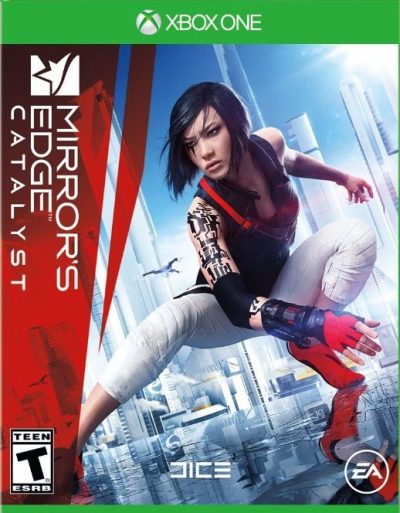
Another Mirror’s Edge seemed like an idea continually fixed to the horizon. Its absence wasn’t as dramatic as Final Fantasy XV’s winding course or as solemn as The Last Guardian’s sabbatical, but rather purely disappointing as a venture of untapped potential. In EA’s class of 2008, both Army of Two and Dead Space were followed by two sequels. Mirror’s Edge seemed more uncomfortable on EA’s bottom line, a vicious irony in spite of praise from critics, fans, and public statements from executives. A first-person parkour game drenched in sleek Euro futurism always felt like such a cool idea but, either financially or mechanically, a sequel to Mirror’s Edge couldn’t materialize.
On the grounds of abstract existence, Mirror’s Edge Catalyst is a win for the hopeful and the exasperated. It still, however, has to transition from wish fulfillment to functional game — an endeavor made all the more challenging by its insistence on being a huge, mission-packed open-world game. This facet of Mirror’s Edge Catalyst is arguably as interesting as its existence, as it takes comparatively small and intimately designed level-based game and transitions into a wide open fantasy and/or nightmare of possibility. It’s strange to take a (considerably) niche title and afford it the same engagement principles of Grand Theft Auto or Assassin’s Creed, and it’s even weirder to try it with movement as the primary hook.
While focusing around movement and momentum may seem like an outlandish concept, it’s really the backbone of many open-world games. Assassin’s Creed and Infamous are all about blunt-force climbing and graceful decent. Just Cause 3 pushes a grappling hook to its logical extreme, incorporating its versatility in nearly every challenge. Grand Theft Auto literally revolves around grand theft auto. Such is the mission of Mirror’s Edge Catalyst, which constructs a tight and deliberate world for the explicit pleasure of tasking the player with getting through it.

Mechanically, not a lot has changed about how Mirror’s Edge’s protagonist, Faith, moves around the rooftops of Glass. There is no run button—she’s a runner, she’s always running, this is a default—and it doesn’t take long for the player to perceive peak acceleration. There’s also a handy slide move for ducking under pipes or into vents. Every part of Catalyst is a task of moving from point A to point B with necessary considerations for efficiency of route and technical execution. Faith can leap off rooftops and land safely below, side-kick up adjacent walls, and perform a perfect arc in a wall run across gaps in the floor. Catalyst, like the original Mirror’s Edge, is focused on the sensation and experience of building momentum and applying it as skillfully and gracefully as possible.
Catalyst has a modest skill tree that guards moves like a tuck-and-roll (disorienting but useful for keeping momentum after a huge jump) and a quick 180-degree spin (employed for fast front-to-back wall accents, like Mario’s wall-kick but in first-person), but these are unlocked quickly. A skill tree is a puzzling inclusion in Catalyst, especially for how nominal some of the other upgrades are, and feels like a concession to the gaming landscape of 2016. Progression must be measured, and the best Catalyst can come up with is to dole out variable numbers of experience points so the player can fill out its skill tree.
Navigation presents a challenging juxtaposition. Catalyst presents Faith (and all of her outlaw runner compatriots) with Beat, a sort of cybernetic upgrade that forces a sleek red line that clearly dictates Faith’s path to each objective. This is handy if you just want to get somewhere, but also kind of antithetical to Catalyst’s presumed objectives. Following the path, while mechanically challenging for newcomers, strips the player of intuition and freedom. Mirror’s Edge, a game about the speed and efficiency of momentum-based performance, is best operated with the patience for experimentation. As with anything else, creating your own path is more enjoyable than following someone else’s.

Ironically, the concept of exploring and applying your own path is most valued in Catalyst’s extremities. Side missions, populated everywhere along Glass’ rooftops, are often rigorous time trials that demand extraneous exploration. Only on absolutely perfect runs could I follow Beat’s line and qualify under time. Whether you’re in a simple time trial or operating inside Catalyst’s fiction by safely (read: no huge jumps) smuggling packages, figuring out any way outside the path was more effective and rewarding. As a bonus, completed times are automatically filed into a leaderboard, which should do well to stretch Catalyst’s legs.
I saw Catalyst’s story missions as one part tutorial and one part tour of its serene and dazzling environments. Depending on how much time you spend with the game, it can either be the entire experience or an elongated introduction. Scouring through Glass and its assorted mini-districts teaches the player about sliding down 45-degree ramps, operating a sparsely used grappling hook, and transitioning control from aggravating and awkward to a smooth and natural extension. Outside of the grappling hook, which is mostly used to solve longer-scale navigation issues, Catalyst felt mechanically identical to its predecessor.
The exception, and the one area where Catalyst ultimately feels compromised, is in it strange proclivity for combat. Faith doesn’t have the option to handle a gun this time (this is both smart and crazy, it’s a noble decision that I can’t believe a game of this size was allowed to push forward with; compliments to whoever won that meeting), but in its place is a hand-to-hand combat system that’s as awkward as it is clumsy. Faith can dish out a series of concordant kicks and punches to disable an aggressor. Before they fight back, Faith can “shift” to the left or right, which is Catalyst’s way of locking-on and z-targeting around an opponent. From there, Faith can unload more attacks from invulnerable positions until the target collapses. It’s essentially stunted circle-strafing around an opponent.

For its part, Catalyst makes efforts to expand its combat dynamic. Burlier aggressors eventually come with range-friendly rifles, disrupting fist-punching upgrades, or as charging brutes. Sometimes these guys require additional patience, but often then can be dispatched with the quickness and ease as the regular henchmen. Building up momentum and launching off a higher plane is almost an instant success, a facet aided by your opposition’s inability to produce stable footing. Opponents fall over like dominoes, cascading into one another as some kind of damage multiplier. This is actually in line with Catalyst’s goals of building and applying momentum, but in practice it look silly. If it were something like Superhot, where combat was assembled and performed as a stylish abstraction, it may fare a bit better. As presented, Faith spin-punching her way through a room full of guys or literally murdering people she flips over a railing looks and feels ridiculous.
With very few exceptions, however, the player is presented with the opportunity to ignore Faith’s opposition and run right past them. This is actually encouraged by building up Force, a bar at the bottom of the screen that calculates Faith’s current momentum. Faith is invincible when the bar is full, allowing her to plow right through and around swaths of bad guys. This is consistent with Catalyst’s ideal objective, always keep moving, but it also presents a visible paradox. If I can run past or straight up cheese most of these guys, why are they here? Quite frequently Catalyst even breaks down into some sort of pseudo crime game, complete with a cooldown meter once you get out of sight of prowling VTOL’s. Survive and you’re rewarded with a few hundred experience points, but more often than I not I found it more convenient to leap off a building, commit suicide, and restart free of that distraction.
Catalyst’s practice of combat is a flawed but decent take on an unsolvable problem. A game all about visceral movement and the sensation of momentum should never have to slow down, and stopping to fight off packs of guys is usually a hassle. And yet, it’s understandable as a byproduct of a modern open-world game. The size, scale, and the presumed budget of a game like Catalyst all but demands some form of physical conflict, and it’s a concession in order to feel publically competitive with other open-world games. Well it’s not that bad seems like an absurd rationalization (maybe it is!) but it didn’t feel mortally injurious to Catalyst’s assumed objectives.

The amount of extraneous activities in Catalyst is absurd. Certain measures, the courier missions and time trails, are understandable and seem in line with Catalyst’s goals. The others—there are more than 500 total collectables—exist for the sake of justifying an open world. Yellow swirling bits of data leaking out of something are in obvious places 90% of the time. There are chips that have to be ripped out of dubious fuse boxes, audio-logs to be collected, and lost courier pick-ups scattered about the city of Glass. Opting out of this doesn’t seem to hurt much, I finished Catalyst’s skill tree by just picking up what I ran across, making their inclusion ancillary.
Further exceptions are granted in Catalyst’s more overt side missions. Grid notes are pure-platforming challenges that place Faith in a small vertical room lined with lasers and challenge her to creatively ascend to the top. Billboards, which Faith can hack and “spray” her insignia, offer a similar challenge, but operate purely out of Glass’ open world. Side missions for another of Noah’s crew, Plastic, task Faith with collecting a small number of objects in a contained area against a time limit, and I personally found these to be some of the most demanding in the game. As is the running theme with Catalyst, there’s enough of a proper challenge without getting wrapped up inside presumed obligations.
Acting as a spiritual prequel to the original Mirror’s Edge, Catalyst finds Faith fresh out of “juvie” and instantly back on the mean streets rooftops of Glass. She’s a runner, a messenger of sorts that operates outside of the jurisdiction of the fascist-ish society within Glass. Bound to her mentor Noah and competing against his new protege, Icarus, Faith stumbles into a vaguely cyberpunk plot drowned in cliché and ripe with antagonist-sparked cynicism.

Catalyst’s story tries to combine the high tech low life mantra and a latent fascination with the ills of corporate capitalism. It’s about as cool in 2016 as Hackers was in 1995, which is to say not at all and feels like a hard swing toward I don’t know, what are the kids interested in?. Characters routinely spout dialogue composed of vague nonsense terms laced with mortal consequence. A plot device is introduced and executed with laser-guided accuracy. Influential figures present Faith with different ways of fighting back against a nefarious corporation called KrugerSec. I don’t even think Faith has an identifiable arc, aside from knowledge the player can glean almost immediately, and when Catalyst wraps up (and sets up sequel) I wasn’t sure what had been accomplished.
A reliance on tired plot devices and overwhelming predictability is unfortunate in light of Catalyst’s character choices. Its cast is one of the most diverse I have ever seen, neatly placing characters of different skin colors and genders into untraditional and unexpected roles. Faith herself is attractive by way of her confidence and her actions, but isn’t presented or intended as sexualized character. That, alone, is a considerable step forward in a medium fighting an uphill battle against female representation. The remaining cast looks as if they could be participating as an undiscovered country in Eurovision, which, while neither positive nor negative, certainly is something.
More important, dominating, and effective is Catalyst’s city of Glass. If Mirror’s Edge had distinct levels of light, surface, and color, Catalyst has entire districts that express passion in the same visual spectrum. Glass’ dominant white rooftops are composed of harsh angles and illuminated with deliberate accents of yellow, purple, and myriad shades of blue. Chic apartments, an abundance of blossoming cherry trees, Ikea-overloaded business operations—hell, even air ducts, construction zones, and sewers—carry more sophistication and style than its peers’ concept art. This is no city that I can picture anyone actually living in, but, based purely on the effect of absorption and the ease of exploration, hopping across the city of Glass doesn’t allow the player’s eyes to tire easily.
There are two ways of looking at Mirror’s Edge Catalyst. As open-world game indebted to the expectations of 2016 and obligated to ensure a safe path alongside countless objectives, it can feel as trite, distant, and fatigued as Watch Dogs or Far Cry Primal. If allowed room to breathe and the ability to ignore distractions, however, Catalyst’s leaps toward momentum, movement, and the freedom to express both across gorgeous landscapes connect with dramatic power. When it’s not trying to be like everything else, there’s really nothing like it.