

I forgot how much fun it is playing a top-down, 2D action-adventure game, especially one with a hefty dose of The Legend of Zelda: A Link to the Past.
Of course, Under the Island from developer Slime King Games is not Nintendo’s The Legend of Zelda: A Link to the Past, but it feels very influenced by that Nintendo classic. It hits all the right beats with just enough story to motivate the player to go on a fun journey, adds just enough action to keep one’s attention firmly in check during the adventure, and features a good dose of puzzle-solving and back-and-forth journeying to remind gamers how good we had it in the early 90s. While certain parts of the game can be a real head-scratcher, the wide-open world given is fun to explore and experience.
So, let’s get our hockey sticks taped up and get right into this review.
In Under the Island, players will take control of a young teen named Nia, who has begrudgingly been forced to move to a new island away from her friends. Bitter and dead set against looking for new friends, Nia soon finds herself in the midst of a mystical island history lesson, and a mysterious god-like figure, who asks her to save the island from a giant wave before it’s too late. Nia is tasked with finding gears scattered throughout the island so that the island can protect itself from the giant wave and thus save the island’s residents in the process. Armed with a hockey stick and her sharp wits, Nia takes on the new task and hopes to rid the island of everything that curses it in hopes of preventing mass destruction.
Wow, that is a tall task of a tale. Anyway, the narrative fits the gameplay well, as this is a classic 90s role-playing game dilemma where the main character must save the world from ultimate destruction. I’m certain that every RPG from the 90s contained this, including The Legend of Zelda: A Link to the Past, which Under the Island seems heavily influenced by.
Outside of the narrative, the gameplay goes along with Link’s 90s adventure. Nia is a hockey stick-swinging knight who must work her way through lots of unusual and unique enemies, meet plenty of unique and unusual residents of different types of lands, and must journey through puzzle-driven caverns and places in hopes of unlocking smaller steps toward fighting a major boss that contains a gear. I hope you enjoyed that descriptive and accurate run-on sentence as much as I did writing it. No regrets.
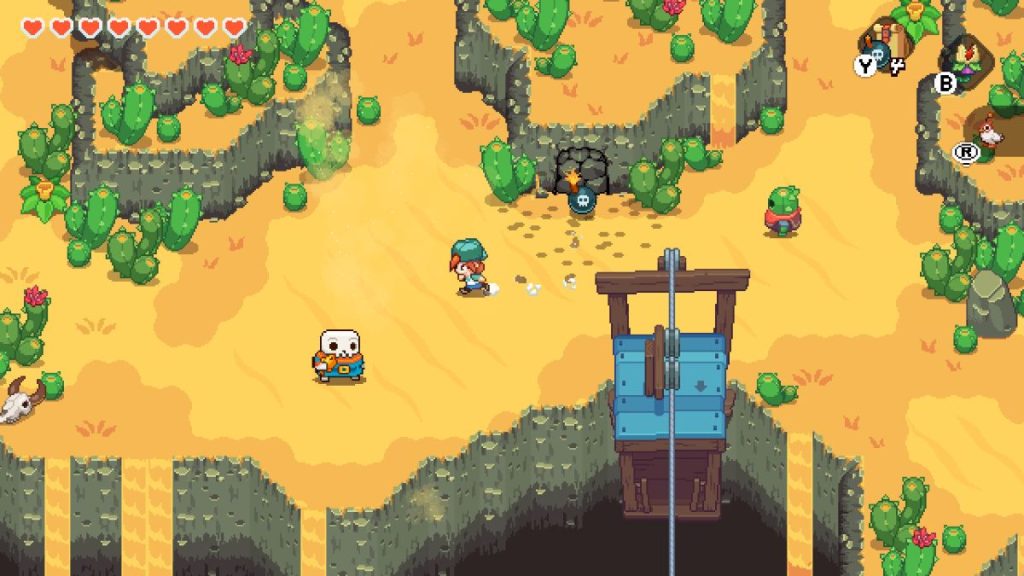
All the above paragraph combined means that this game is fun as hell. It heavily harkens back to a simple action-RPG structure that made games like The Legend of Zelda: A Link to the Past such a long-term treat to enjoy. The action portion of Under the Island is a replica of A Link to the Past, as the player will go around swiping at bushes to find objects and take down enemies with simple button-pushing hockey stick swipes. There is even an opportunity to hit chickens and sheep in the game. Players can’t kill them, but they’re fun to hit, especially without the Zelda repercussions. Anyway, the action is simple, and it’s fun because it doesn’t halt the gameplay like a turn-based RPG experience would; it quickly progresses it and allows the player to avoid action most of the time, if they want to avoid it.
Of course, that’s not the only part of the gameplay that makes Under the Island a treat to enjoy. The other element borrowed from games of the past is how it mixes in logic-led puzzles. As Nia continues her adventure to discover gears all over the island, she will run into caverns that contain action puzzles. These puzzles could require Nia to blow up a rock, use a particular weapon to activate or open a door, or simply ask Nia to move a stone to gain access to the next bit of story and gameplay. Most of these places will be plagued by enemies and give multiple things for the player to juggle.
The puzzles aren’t simple by any stretch of the imagination. They hit early and hard with what they ask from the player, and they can be real head-scratchers at times. For example, there was a moment in the game when I gained an idol that shot flames out of its mouth. It could hit and light rows of plants on fire, which was the first-level intended purpose of the product. Anyway, on the same level that I acquired said weapon, Nia became trapped in a room that consisted of a plant bridge that would quickly disappear as she walked over it, a small in-between space that featured a floating island that connected to another plant bridge, and at the end of that path was another locked door. Literally, I was trapped between two locked doors and a floating island that connected two plant bridges that would quickly disappear if I walked on them. I must have stayed in that room for 10 or so minutes trying to figure out how the heck to open either door. While the game provided a hint of how to use said new weapon to progress, the lighting plants on fire hint, that hint led to an extremely subtle and easily missed solution. Once I found it, it was easy to leave the room, but the initial and random way I originally found it was just that – random.
Nearly all the puzzles work like this in Under the Island, as most will be random happenstance and will require locked-in attention to find solutions for. Is that a bad thing? I’m not exactly sure, but it certainly is a challenging thing. At the very least, these types of puzzles in the game help to break up action moments that make the experience more than just a hockey-stick-swipe ordeal. They require the player to think beyond just constantly smashing a button. On the other hand, these puzzles can be quite frustrating, especially as the game progresses. The puzzles will become more difficult and will require laser-focused attention by the player to complete/solve. And there is nothing worse than getting stuck in a puzzle without an easily recognizable and viable solution. Good luck with the desert stage! That one is a doozy.
Now, all that said, that doesn’t mean the puzzles don’t complement that action perfectly. In fact, once a puzzle is figured out, players will feel accomplished and motivated to keep playing the game, even though it’s a guarantee that the next set of puzzles will be even more difficult. As much as it is an uphill battle, it’s a fun trade-off from just swiping action. It will challenge players and make this game far deeper than expected. I can dig that, and I dug it during the gameplay. That doesn’t mean that I didn’t have my moments of ‘what do you want me to do now?!’ because I had plenty of those. Both gameplay elements do drive the entire experience. While puzzles might be more time-consuming, the action helps bring that down just a smidge.
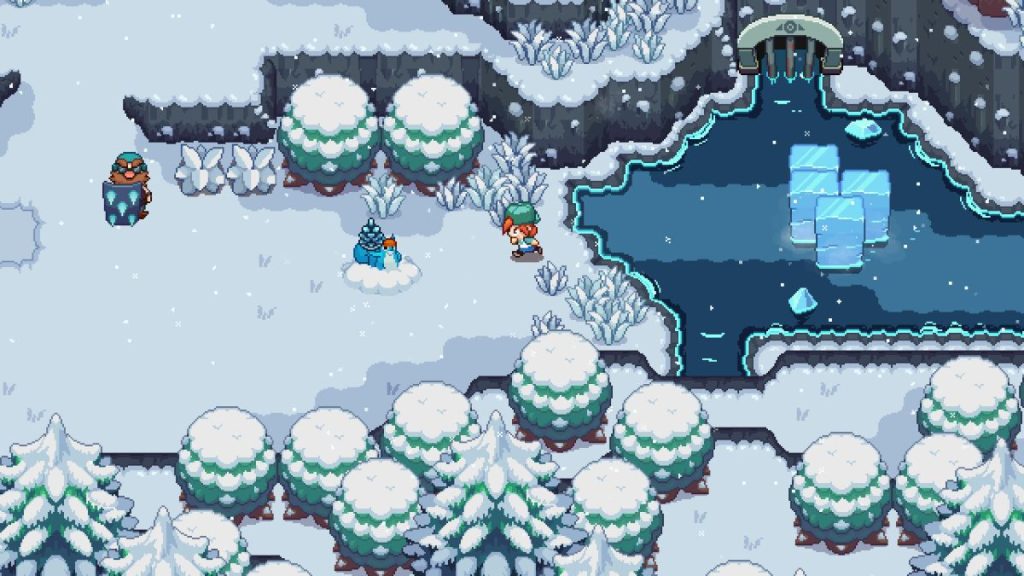
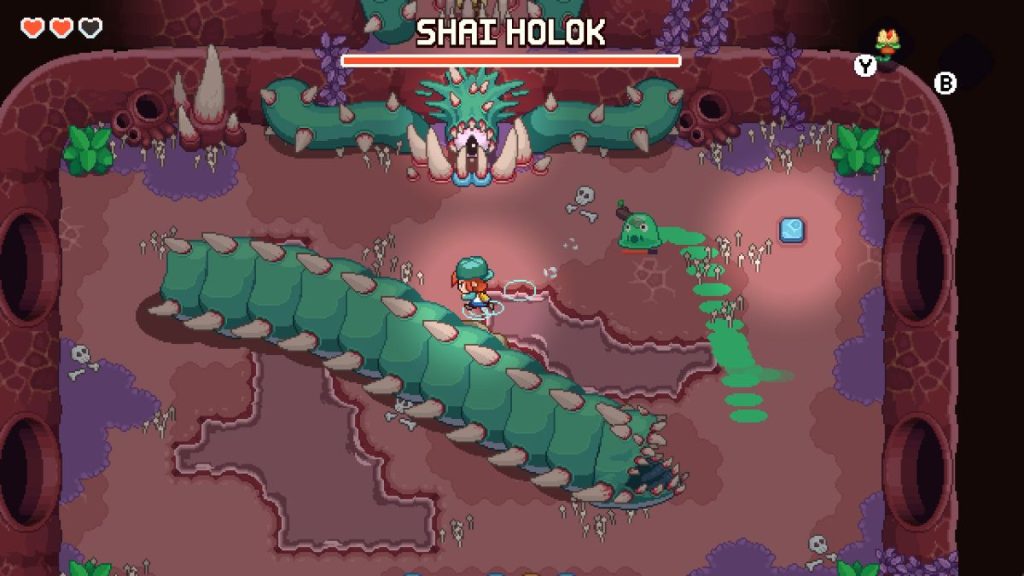
What also helps balance out the frustration of difficult puzzles are the enemy types and boss fights. The devs did a great job of creating a huge variety of monsters to go up against, as each section of Nia’s journey will find her in different lands, going up against unique enemies that bring their own style of action. The game will also throw in mid-boss tier moments that help sharpen a player’s action skills against different enemies that offer a variety of fighting styles. For example, at some point in the adventure, Nia will have to face a bickering octopus couple living in an ice cave, who are preventing another character from moving forward with their life. This encounter will have twirling octopi on ice and will force the player to deal with these violent spinning beasts, while also dealing with avoiding slipping and sliding on an ice bridge. The level will also have icy waters surrounding said bridge that will hurt Nia should she fall into it. This scenario is difficult; it makes the action more intense while also throwing in a unique fight that fits into the narrative and is necessary for Nia to progress. The game does its best to throw in these types of mid-boss tier fights to make the action part of the adventure more prominent and give a variety of scenarios that make it more than just a button-smashing experience.
So, how many of these moments should a player expect from Under the Island? Well, once the player accesses the game’s map, the possibilities will expand quickly. The map in this game is huge. Players will see lots of possibilities, as well as get a gauge on how big Under the Island is overall. When I was four hours into the adventure, I was only barely one-third the way through the map. There is a lot of adventuring to be had, and a lot of new and exciting enemies and puzzles to bring into the fold. The devs did a great job of making this adventure worth the time players put into it, as this has a Zelda-sized feel to it.
Now, before I wrap this review, I would also like to point out how none of this game feels like a waste of time. Typically, playing a game of this size means that there will be moments of lull that are just thrown in for the sake of it. During my time with Under the Island, nothing felt forced or unnecessary. The game scattered its puzzles and action intentionally in every part of the journey. For example, when Nia runs into a roadblock, and there will be plenty during exploration, the obstacle isn’t there for the sake of irritation; rather, the obstacle is there for future solutions, which will automatically pique a player’s interest to keep exploring for a potential solution. Plenty of RPGs in the early days did this, where the game might say ‘you can’t get through this area…yet’, only to have a solution later on and an ‘aha!’ moment to open more of the game up. Every aspect of Under the Island is built on that intention, as nothing feels like a waste of time, and there will be plenty of ‘aha!’ moments when the player gets to return to that one obstacle they ran into four hours ago, and now has a solution for it.
Under the Island constantly keeps the player’s attention refreshed on the content and purposefully adds obstacles, even random ones that Nia encounters, that have a solution now or later. That will force the player to take everything in and consider whatever ‘next step’ is in the adventure to be born from a potential obstacle they ran into early on in the game. I love it, and it feels non-linear in its design, even though it probably is more linear than I suspect.
Overall, the gameplay is action, puzzles, collection, and a lot of good back-and-forth. It’s exactly how an action-RPG worked back in the day, and it’s just as good now.
On that sweet note, let’s wrap up this review.
Conclusion
Under the Island, from developer Slime King Games, gives a firm tip-of-the-hat with its design and execution to games like The Legend of Zelda: A Link to the Past. Under the Island contains good action, sometimes difficult puzzles, and a hefty amount of exploration to keep one’s attention firmly locked into the gameplay. The difficulty of some of the puzzles might feel a bit unbalanced and heavy, in comparison to the action, but the payoff feels worth that trouble.