


Minimalist yet poignant, The Berlin Apartment offers a handful of narrative vignettes allowing players to experience the tumultuous history of Germany across the decades. Though brief, its stories pack an emotional punch that won't be forgotten.
For 15 minutes straight, The Berlin Apartment had me in tears.
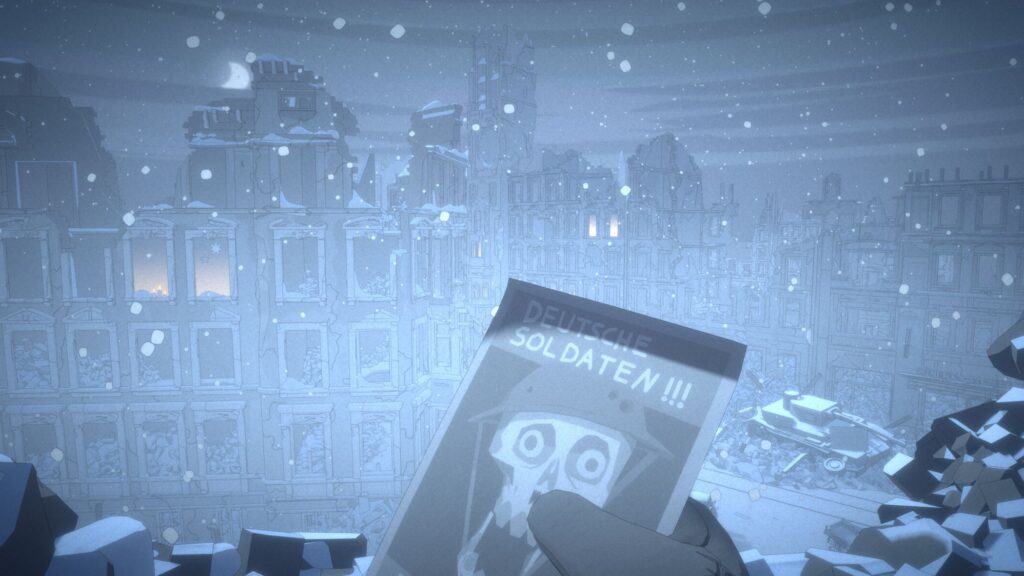
The game had completely disarmed me, transforming a World War II story from mildly touching to gut-wrenching. After 30 years of narratives about one of mankind’s most pivotal periods, it feels like I’ve seen or played it all. But apparently The Berlin Apartment had a trick up its sleeve.
But that moment in 1945 is but one story that developer Blue Backpack crafted for its humble, time-hopping narrative.
The Berlin Apartment is one of many games I’ve played in my 10+ years writing reviews that gladly nestles itself into a box, attempting to convey a narrative made more impactful by interactive elements. Gameplay isn’t brandished about. Light mechanics are introduced to instill some variety but, ultimately, it’s all about the characters, the world, the themes.
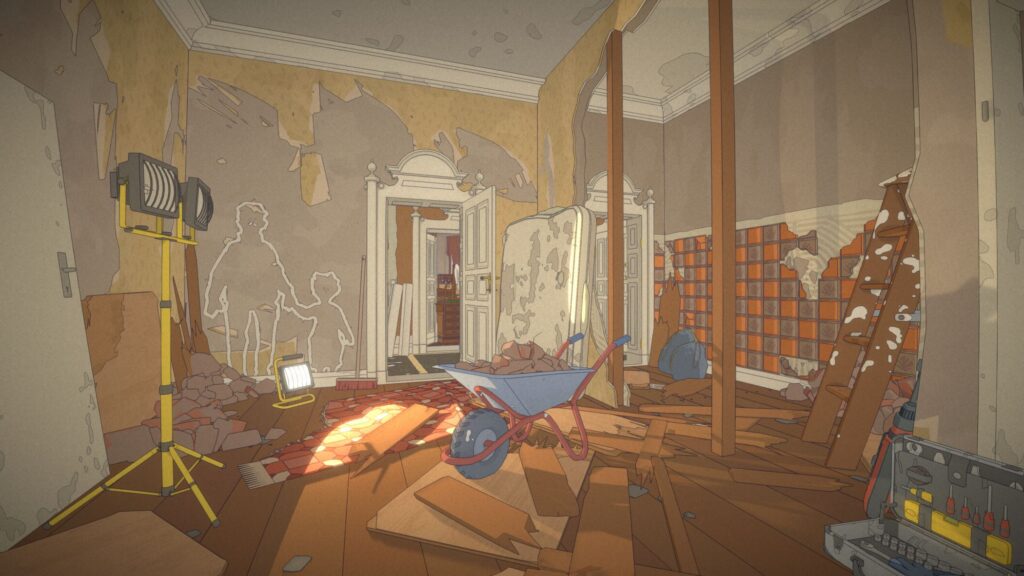
Developer Blue Backpack presents The Berlin Apartment like an anthology series. The present day acts as a framing device allowing players to glimpse into a century’s worth of stories all set within the confines of an apartment in Berlin, Germany.
Most of us are likely aware of the name “Berlin” and a sliver of its context in history. The Berlin Wall being the most omnipresent point of reference. But I admit, it’s been a long time since my brain has attempted to dust off world history, remembering the ins and outs of major, pivotal historical moments outside of their larger impact. Being the capital of Germany, the deep significance of Berlin can’t be ignored. One of the most populous cities in Europe and the world, Berlin felt the ripples of World Wars for centuries.
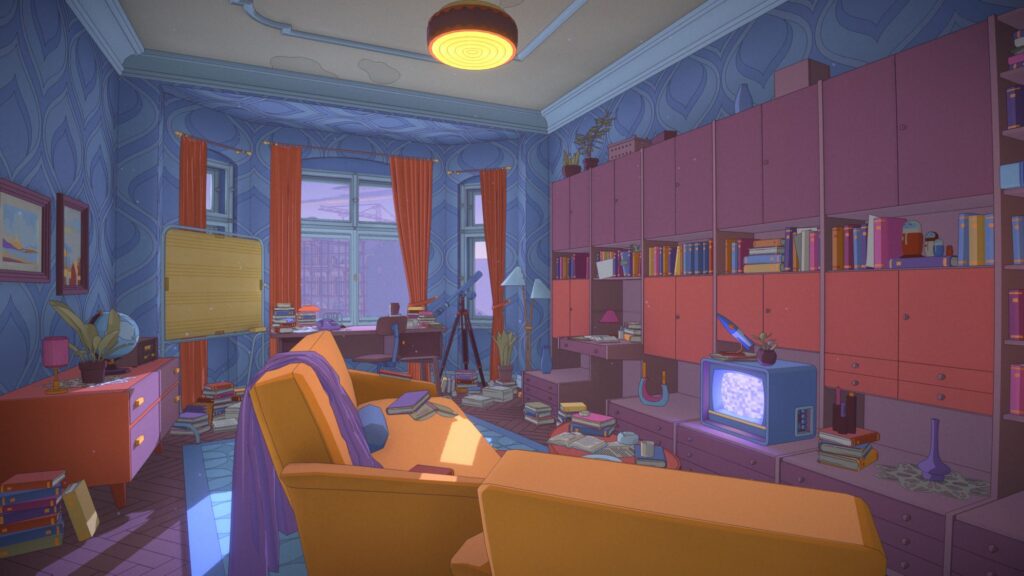
While some of that strife is reflected in The Berlin Apartment, players are by no means required to be history buffs or even well-versed in Germany’s past. Blue Backpack is a German developer and uses the game as a piece of interactive entertainment not necessarily to educate but to reflect on its people.
The game opens with the young Dilara joining her handyman father Malik who has been given the job of remodeling and refurbishing an apartment in Berlin. Over the course of the renovation, Dilara’s child-like curiosity leads her to discover relics of the apartment’s past, small time capsules alluding to the history of former residents. As an effort to humor his daughter, Malik tells four stories about these people spanning across four separate decades.
One of the interesting things about The Berlin Apartment is that the player is never made explicitly aware of whether or not Malik’s stories are based on some knowledge he possesses or merely lofty fiction meant to inspire Dilara. But Blue Backpack roots the game in history and reality, merely taking artistic license with a dusting of magical realism possibly meant to evoke Dilara’s youthful interpretation of these “true” stories.
The Berlin Apartment takes us from the 2020 framing of Malik’s renovation, to 1989 right before the Berlin Wall was torn down, to 1945 in the aftermath of World War II, to 1933 during the troublesome period between two Great Wars, and finally to 1967 in the midst of the Cold War and the divide between East and West Germany.
In total, The Berlin Apartment will take players about three to four hours to complete and maybe upwards of five if they would like to do everything (i.e. get all achievements). While longer than most theatrical films, I would understand the hesitancy of players wishing for a meatier game. Narrative-driven adventures always run the risk of being far too brief or far too long, becoming mired in expository dialog and gameplay.
I will certainly admit that The Berlin Apartment could have done with at least one more sequence, if not two. Not merely because it would have dramatically extended the length but because Blue Backpack was confident enough to make a 15-minute section of its game one of the more emotionally impactful experiences I’ve had in the medium. But merely adding a new section does not guarantee it will be as profound as that one. And there’s something to be said about mining too much from the same source. Yet Berlin has existed across numerous decades and only five were chosen here.
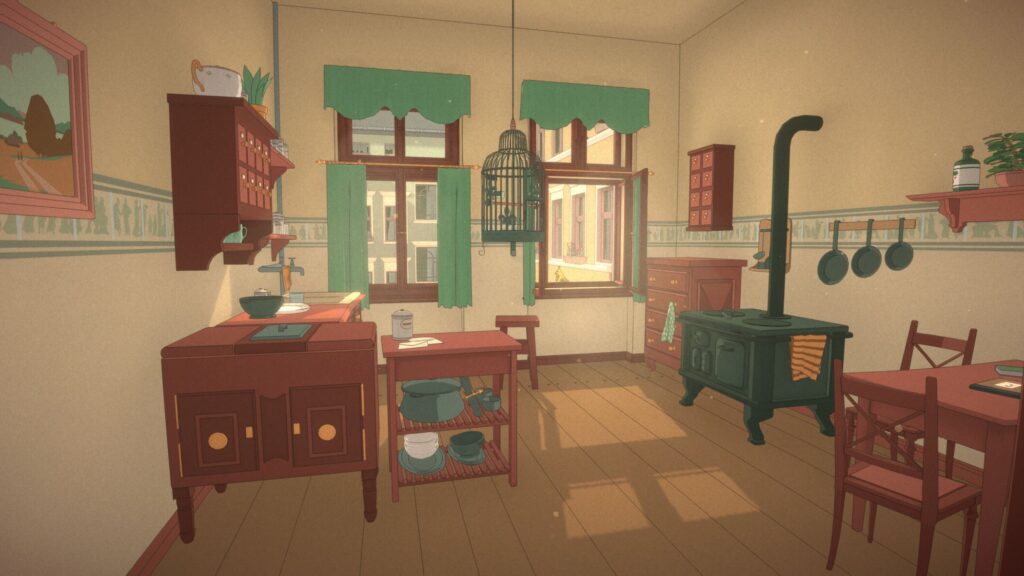
But ruminating too much on length is somewhat of a distraction. There are simply players who reject this genre outright because it provides little in the ways of action, puzzle-solving, and mechanics. The Berlin Apartment, like others before it and yet to come, may very well work as a short film or mini-series but would lose that crucial interactivity. These games are not only vessels to tell a story with, they act as a way to bring players into the drama and feel that they are a part of it.
Each vignette of The Berlin Apartment features a slight mechanic that isn’t walking around and inspecting objects and engaging in dialog. In 1989, players throw a paper plane across the Berlin Wall and guide it towards a distant window. In 1945, they collect objects in a basket and place them across Christmas displays. In 1933, they hunt for personal items and arrange them in a suitcase in an impression of Leon Kennedy. In 1967, there’s a bit of dialog choices and branching narratives.
After each section, players return to 2020 where Dilara uses those same mechanics in a different way. Additionally, while the remodel is ongoing, she can help her father out by breaking tiles with a hammer, drawing and painting on the walls, and throwing away garbage. No, none of this is by any means complex but it is all meant to tie together the whole experience into the 2020 framing device, making Dilara and the player feel like the memories and events of the past have in a small way influenced the present.
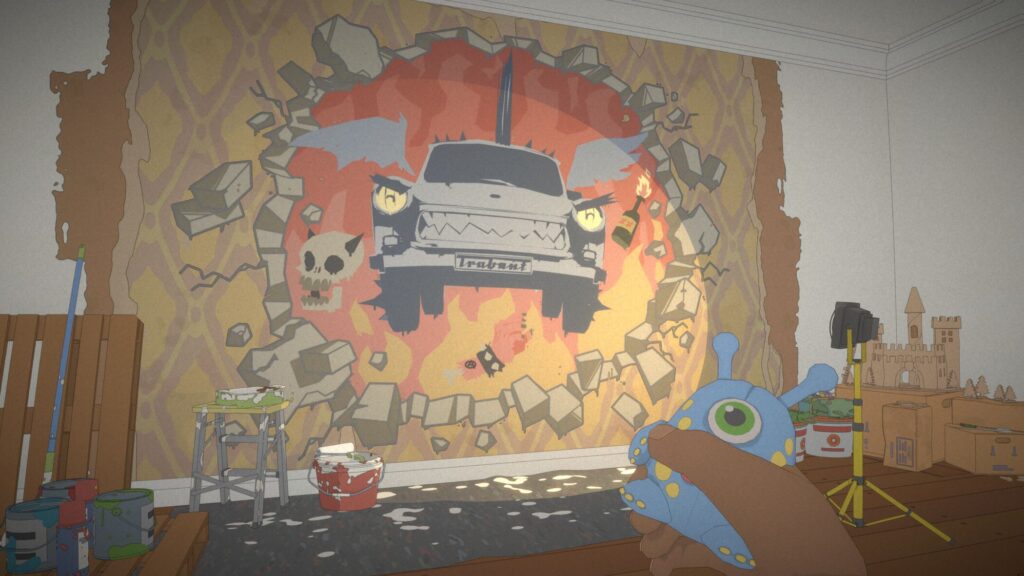
Because The Berlin Apartment is so heavily reliant on narrative, it’s quite difficult to expand upon too much because spoiling anything would dull any kind of joy the player may receive by playing themselves. This isn’t to say that Blue Backpack has inserted any overt drama into the game. Instead, these four vignettes are about the people inside them and their response to a troubling, uncertain world.
In 1989, Kolja is dealing with the isolation and uncertainty of living in a city divided by a wall. His roommate has left and he feels cut off from normality, oppressed by the government and constantly arguing with his communist fish. Interspersed with sincerity, drama, and hope, Kolja’s tale was a strong opener and maybe the longest. In 1945, Mathilda is trying to bring cheer to her family in the bombed-out remains of the apartment. Players go from Kolja’s multiple rooms to the freezing cold of one bedroom shared by Mathilda, her brother, and her mother. This was an incredibly emotionally harrowing journey to go through because it took the framing of World War II and brought it into the perspective of a child just trying to survive and have hope on Christmas. As she places objects around her home, a light grows, making the space warmer. But as the story continues subtle revelations unfold for the player–ones that ultimately left me in tears.
Josef in 1933 is an old man who has lived his life and tried to bring happiness and community to Berlin after the end of World War I. But being Jewish, tension is mounting and the player takes Josef through his last moments in the apartment. Finally, Antonia is an author in 1967 attempting to write a science fiction novel without allowing the Soviet state to have too much input into her creative process. The player helps choose the destiny and content of her novel, navigating Antonia’s creative interpretation of the space around her.
While Kolja, Josef, and Antonia’s vignettes can feel a little long, I appreciated the way Blue Backpack used the time period to frame these personal journeys. Though heavy on dialog, their meanings are layered and rife with important historical and emotional context. Here, there are lessons not only in humanity but the failings of governments, authoritarianism, prejudice, and the impact of trying to divide people.
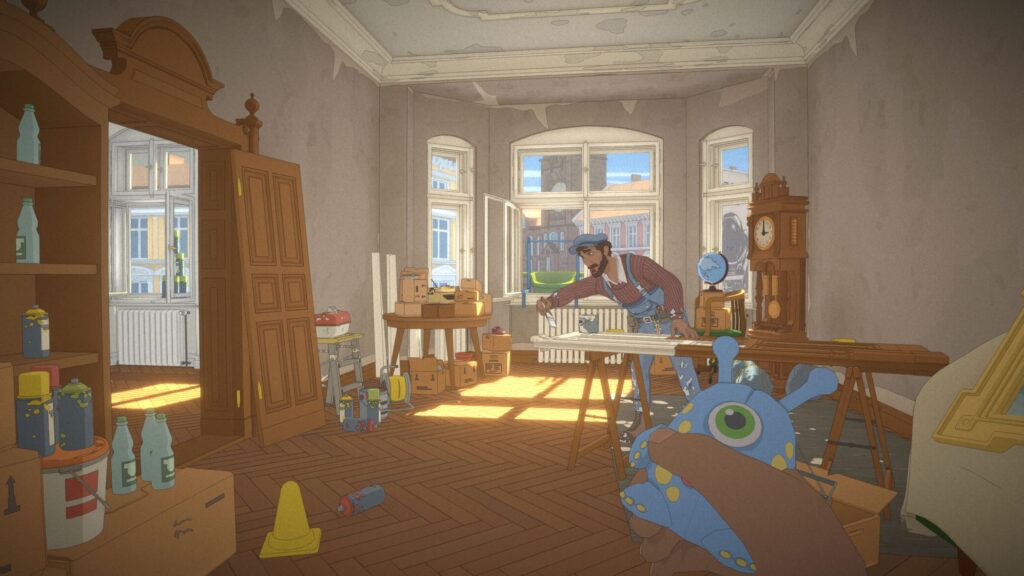
Over the course of The Berlin Apartment, the player is able to look outside and see the changes in the world through a small window. The thread of 2020 shows how the apartment shrunk and expanded over time. And when players step into the shoes of one protagonist they may make note of the significance of that space or bedroom or bathroom.
There are overt messages and themes here but nothing is forced down the player’s throat. No attempt is made to vilify any character, rather the world around them is often seen as the oppressor. It’s the individual that is the innocent, while the establishment that shaped them and the world is seen as a malignant force.

Its drastic colors and attempts at stylish artistry bring a calming tone to The Berlin Apartment. While the game has some texture clipping and once the framerate plummeted after Dilara broke too many tiles, none of it really pulled me out of the narrative. Most of the voice acting is strong from the English cast but the German certainly makes it more immersive.
The Berlin Apartment–even with its brief runtime and lack of meaningful gameplay–offers poignant narrative vignettes across its minimalist approach. Taking place entirely in the confines of a singular space, players will experience decades of tumultuous Germany history, reflecting on humanity and the strength of the individual even when entrenched in oppression. It’s in these types of games where an emotional gut punch is one of the deepest mechanics a developer can provide to its audience, leaving them speechless at the mercy of a narrative.