

This game has some legs.
The 7th Guest Remake from developers Vertigo Games and Exkee has returned to Steam, this time as a non-VR experience. For players not interested in the VR aspect, the game still packs plenty of entertaining puzzles, a solid story, and a reason to believe that developers can breathe life into old games.
Let’s talk.
Story
While I won’t give away too many details of the story, let me just say that the essence of the original tale is firmly intact. The story still has Stauf as the main villainous character who invites guests over to his homestead, has them ‘disappear’, and then invites a 7th guest to figure out the mystery of the house and the aforementioned occupants.
Spirits are everywhere in the house, even before the guests possibly become them, and the story still unfolds as puzzles are solved. The story is wildly fantastic, and nothing was wasted in its multi-act narrative, as the original six guests who entered the house show who they are, what nastiness exists in their past, and why they relate to Stauf and his haunted mansion. The player’s presence as the 7th guest shows them the role in this play, as their job in the story is to find out what happened to the previous visitors and what else is going on that makes the house so unsettled and haunted.
The remake tells a more sinister story than the original and brings better writing and acting to the fold. In addition, the full-motion capture of actors lies somewhere between ‘those are real actors’ and ‘those are great motion captures,’ emphasizing the unfortunate ends of each of the characters’ stories. The fact that Vertigo Games felt the need to sharpen the original up, get in some talented actors, and bring the story up to date with the times is a great primer to how much they passionately cared about the project. They did a superb job on the narrative side, and it all translated well to the platform.
Choice virtual reality experience
This is the part of the game that surprised me the most. It’s easy to put together a story using the groundwork laid out 30 years ago. The difficult part of a VR experience is translating the original gameplay that people hold near and dear to their hearts and doing it justice on a new medium. Vertigo Games knocked this out of the ballpark in many ways.
Starting with movement, which is key to a good VR experience, Vertigo Games allows the user to jump around with spots and/or move around using thumbsticks. The latter of the bunch will most certainly make you motion sick, which isn’t uncommon for VR experiences these days, but the former is a great choice to avoid that result. Either movement type the player chooses, they’re still in for a treat, and nothing feels like it gets short-changed thanks to how the environment is constructed, colored, and what ambiance comes with those combinations. These are basic starters for any good VR experience, but the devs seemed as if they weren’t just going to let you get away with avoiding taking in the environments; they made certain you felt what they were trying to create within their environments.
No matter how the player moves within the game, they’re going to get a healthy dose of story-reinforced environments all around them. Right out of the gate, the player will row their way to the shores of the mansion. Sitting, standing, or moving, the player will have to grab an oar and get to the shore. That first moment sets the tone for establishing how beautiful the rest of the game is going to be and what type of interactivity you are going to get delivered in the devs’ quest to get you in the mood to play The 7th Guest VR. The developers seemed focused on making sure that you were never taken out of the experience of the story, a key factor in getting players hooked on any game. By forcing the player to function within this creepy VR environment and by making nearly every action taken harken back to the story Vertigo Games was trying to tell, The 7th Guest VR guarantees that nothing is wasted. And that is a sentiment that is reiterated again and again through interactive environments and how the gameplay works. And make no mistake, Vertigo Games’ efforts to bring that haunting Stauf story to life begin with the environments.
The environments are very much alive here. The girth of the mansion is present, and the old, broken-down feel of the mansion is everywhere, from cobwebs to dust that is ever-present in the air around the player. Whether the player is jumping or moving smoothly, they’ll feel every aspect of the old house and the coldness of the ghosts that present their woeful tales. Everything feels alive as much as it feels dead, and to pull the player into a VR-based story, that is what you want, and that is what this game delivers visually, audibly, and everything in between. If the VR version of this game had a smell option, players would certainly think that Vertigo Games would emulate a moldy, dusty home to punch up their nose to reinforce what their quest is on this journey. Again, nothing is wasted.
The movement, story, and environments complement each other in such a delightful way. You don’t feel like you’re playing a VR game; you feel like you’re trying to solve some Poirot mystery that has twisty turns all around. The VR completeness of the game delivered with this trio of delights helps to sell its purpose and, as stated previously, hooks the player in and engages them. That’s before the player even discovers the bells and whistles of the actual gameplay. I cannot state enough that Vertigo Games found a way to deliver a complete movement and environment package that pulls the player in. This is the first VR game that I’m wowed by, and that doesn’t feel like a gimmick. The gameplay is perfectly structured and set up, especially when the actual ‘interactive’ part of the game begins.
Interactive Parts
There are two ways for a player to look at this portion of the game. The first is that they’re only getting puzzles and nothing else in the VR experience. They wouldn’t be wrong, but thanks to the previous jibber-jabber, it’s hard to avoid feeling like you’re a part of the story and within the creepy environment. It’s impossible to avoid it, so when players get to the actual interactive portion of the game, it’s just another piece that adds to the rest. And that’s the second way of seeing it, another layer of icing on top of an already sweet experience.
The puzzles play within the story, as was the case with the original. They attach to the previous six guests and bring a variety of cleverness to the gameplay experience. For example, the first set of puzzles players will encounter is based in a dining room. The dining room is introduced by the story, in which the previous guest entities enter and lay out their confusion about why they have all arrived at Stauf’s manor, while also laying out clues.
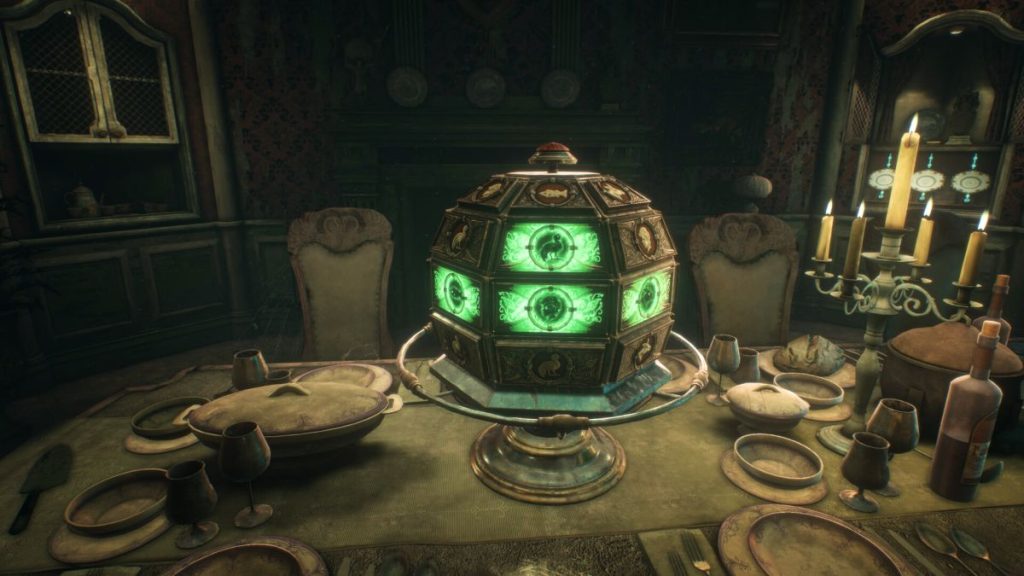
The dining room puzzle revolves around finding plates, unlocking more puzzle pieces on the dining room table, and then ultimately unlocking a very difficult centerpiece that reveals the next step in the story, and which unlocks more rooms in the mansion to explore. Outside of the chitter-chatter that the previous guests provide, the gameplay invites the player to explore and take in the environment while also asking them to find a starting point. The room itself is gorgeously crafted, where paintings hang around, cabinets lie accessible, and everything tempts the player to truly open their eyes and explore. Nothing is ugly or undercooked; everything is built with devious and beautiful intentions in mind. And this is how the entire game goes with all its puzzles. The game wants you to pay attention to the effort given to the environment. It wants you to feel like you’re trying to solve a mystery. And when you run into a roadblock in the form of a puzzle, it wants you to get involved and find the solution. It’s the perfect VR exploration package.
As for the puzzles, they were tough, a sentiment that the original always carried, as did the sequel, The 11th Hour, which was just an impossible game. Anyway, The 7th Guest VR makes puzzles visually appealing and well-designed for a VR environment. For example, there was a puzzle where I had to move a figure from one end of a game board to another while avoiding touching or repeating lines that I had created. The puzzle was kept firmly in the range of where I could comfortably reach and didn’t require too much physical effort to get involved with. Most VR experiences want to put your arms and muscles to the test, as if you need a reminder that reality is simulated, but with The 7th Guest VR, the devs seemed to understand that there are a lot of puzzles for players to traverse, so tiring them out may not be the best bet for bringing a good gaming experience. The puzzles were more tricky than strenuous, which made for a better time, as I had to use my big muscle brain instead of my muscle arms.
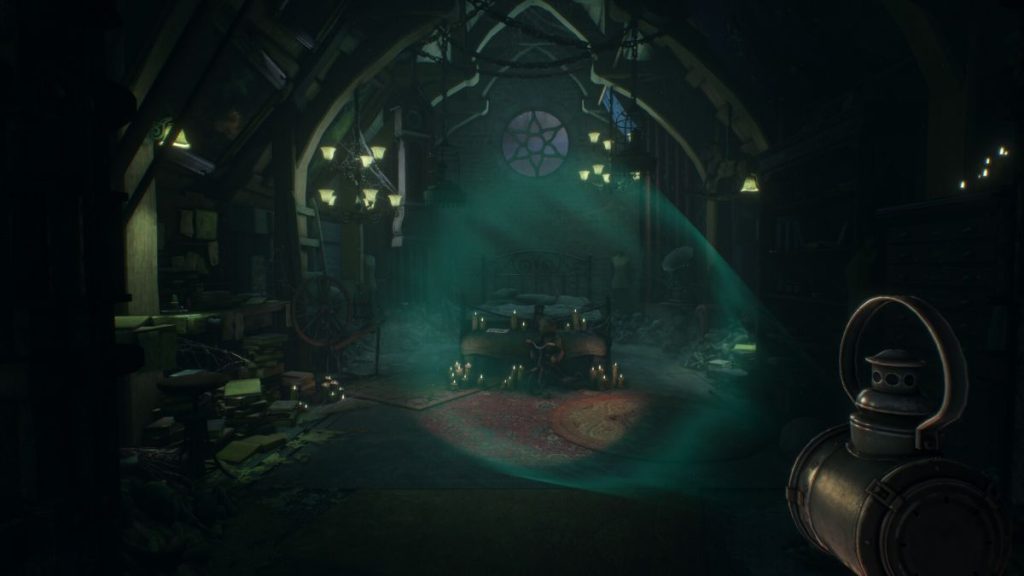
Now, to enhance the interactivity of the game, the player gets tools to work with along the way. The biggest and coolest tool is a lantern that does two things: 1) turns back time to fix a broken item, and 2) shows off the past form of whatever it shines upon. This tool is impressive as it shows off how much detail Vertigo Games put into The 7th Guest VR game. For example, one puzzle had my character exploring a bedroom that held several paintings, a marble floor, and other furniture items. When I shone the lantern light on an item, say the floor, all the dust and faded-out colors of the marble cleaned up instantly. In real-time, players are able to see what an object looks like before it ages. That was visually cool.
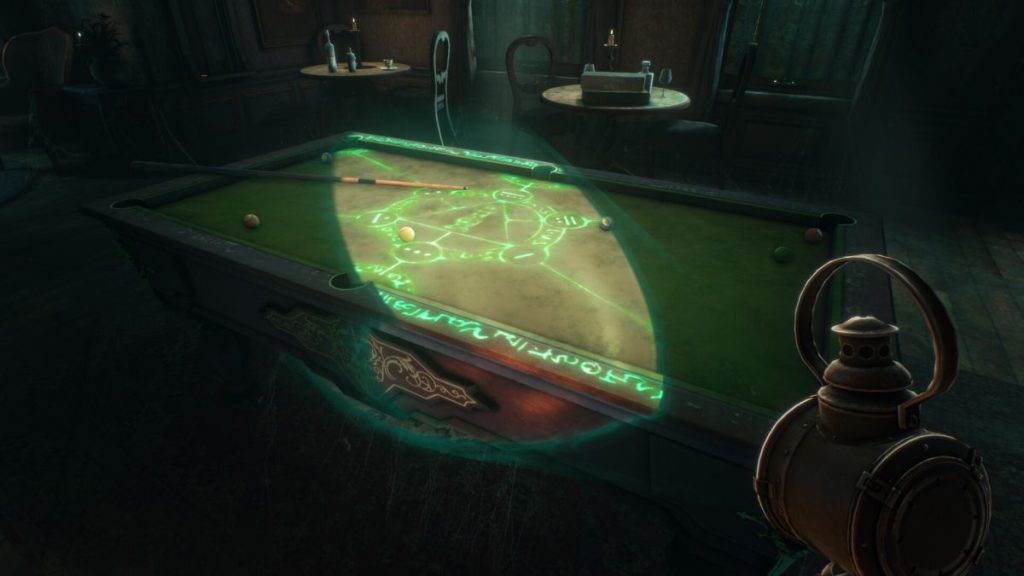
To emphasize that cleaning even more, when I pointed the lantern at the paintings in the room, the images on the paintings instantly changed to something unnerving. While this tool was more than just a way to show off how cool the devs’ creative talents were, the fact that players will get a cleaned, instantaneous version of anything was just another reason to search an already interesting VR set of environments. The lantern had practical uses as well, such as the previously mentioned fixing tool, and served as a black light in a sense to show off additional puzzle clues all around that may not have been previously seen. Regardless of function, tools like the lantern were great examples of gorgeous stuff that works well with the VR experience.
As a whole, the gameplay is engaging and enjoyable. While the game might be a once-through that you revisit sometime down the road, the initial experience presented with The 7th Guest VR is one of the best VR gameplay experiences I have had to date on the VR medium. Generally, I don’t want to quickly return to a VR game once I get tired of it. With games like Beat Saber or BoxVR, those are wonderful ways to have short experiences, and most of what I have played in VR has been based on short experiences. With The 7th Guest VR, I walked away with a different perspective.
This feels like a game that was well thought out and that had a firm grasp on how to deliver a solid VR experience to the player that they would want to revisit for narrative and interaction reasons. It’s just a different experience than any other VR game that I have run into, and at the very least, it gave me hope that VR is more than just a gimmick, which has been my feeling for the last decade with the medium. I want games like this, and I want encouragement to revisit and replay VR games later down the road. Again, this is the first game that gave me that feeling.
If it’s not your bag…
If VR isn’t a player’s choice of gaming, then they are in luck. Included with the VR version of this game is the non-VR version of The 7th Guest Remake. While the immersion aspect brought to the gameplay experience is a bit pulled out in the translation, the non-VR version actually works well.
For the past few nights, I have been playing the hell out of it to see what was subtracted in the translation, and the only thing I can see, outside of the immersive-ness of being in a creepy mansion and moving one’s hands around to solve puzzles, is that I don’t have to strap a headset on and pray I don’t bump into furniture.
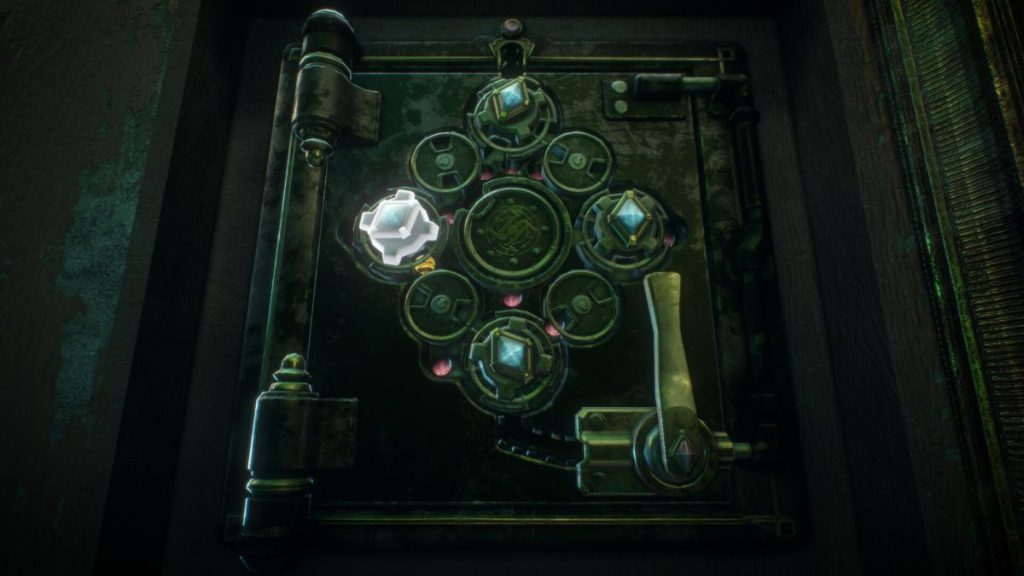
The puzzles translate well to the non-VR version of the game. It’s like going back to the early 90s, as approaching puzzles and solving them is just a hoot. Sure, you don’t get to see dust in front of your face or feel the uncertainty of the environment, something that VR brings to the player when done well, but the creepy factor is still there, and the good challenge of puzzle progression is firmly intact.
Anyway, it’s a darn good option for players who don’t enjoy a VR experience or own a VR headset. The gameplay is still incredibly engaging, fun, and challenging.
The inclusion of both types of games for under $20 is insane. This game is worth at least $49.99 in my opinion, and that’s mainly due to age. But opening up both options for players, non-VR and VR, and making it under $20 is an absolute steal. If you were ever wondering why Steam is so popular, then this is a good example.
Anyway, let’s wrap up this long-winded review.
Conclusion
The 7th Guest Remake in VR and non-VR is exceptionally entertaining. The game contains a beautifully unsettling storyline, challenging puzzles, and various ways to be creeped out. It’s a gorgeous remake that is worth a look.