
My God. I think I have found the new Balatro in my life. NOOOOOOOO!!!!
Ah, well. Welcome to StarVaders from developer Pengonauts. This game is a roguelike deckbuilder with some turn-based aspects to it that begin simple and innocent but soon give way to complicated strategic gameplay that is tough to put down. Trust me, I have tried.
So, without further delay, let’s launch our ship and take a trip through this wormhole of a review.
Strategic Gameplay
StarVaders contains gameplay that is filled to the brim full of options, power-ups, cards, and different ways to approach and play it. When I first began this review journey, I played this a few times and felt like it was a bit repetitive in these categories and somewhat empty in others. I was concerned that this game would be one-dimensional and lose its flavor quickly, much like Fruit Stripes gum. Thankfully, this game turned into a type of Hubba-Bubba experience.
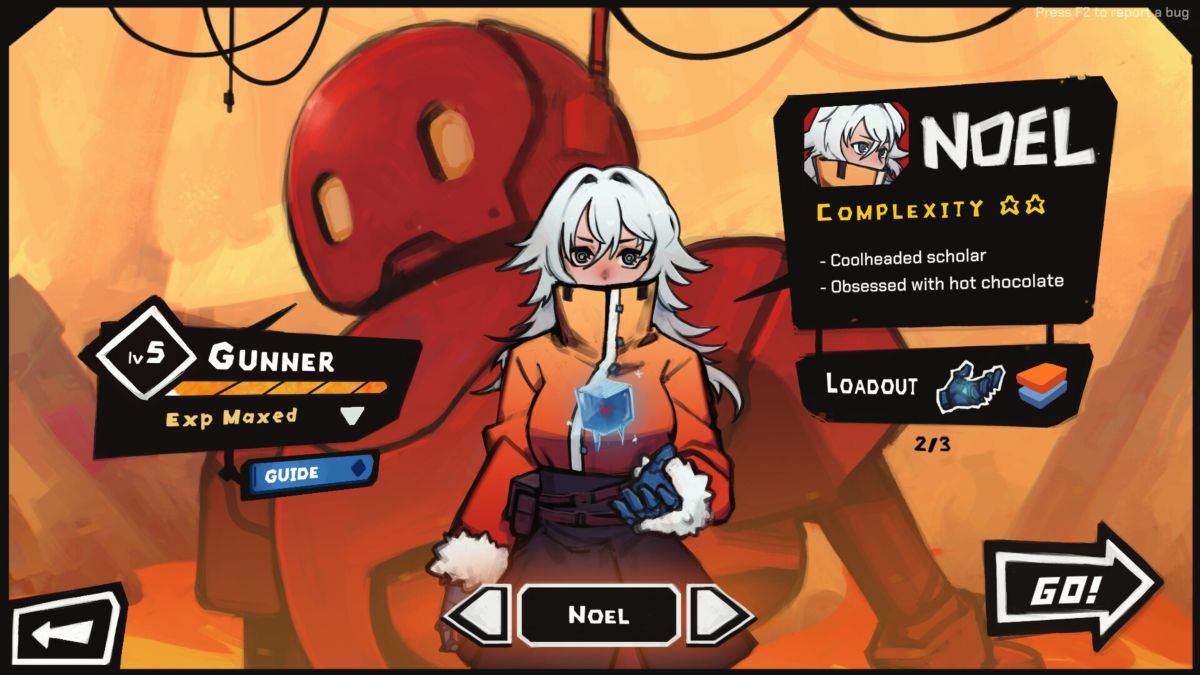
As the minutes turned to hours, and hours turned to even longer hours, the game started showing its hand (literally and figuratively). When you begin the game, you pick a mech type, which is initially one, but as you progress, it turns into three. From there, you pick a player (up to three) to choose from and then round out the menu system by choosing a difficulty to begin the game with.
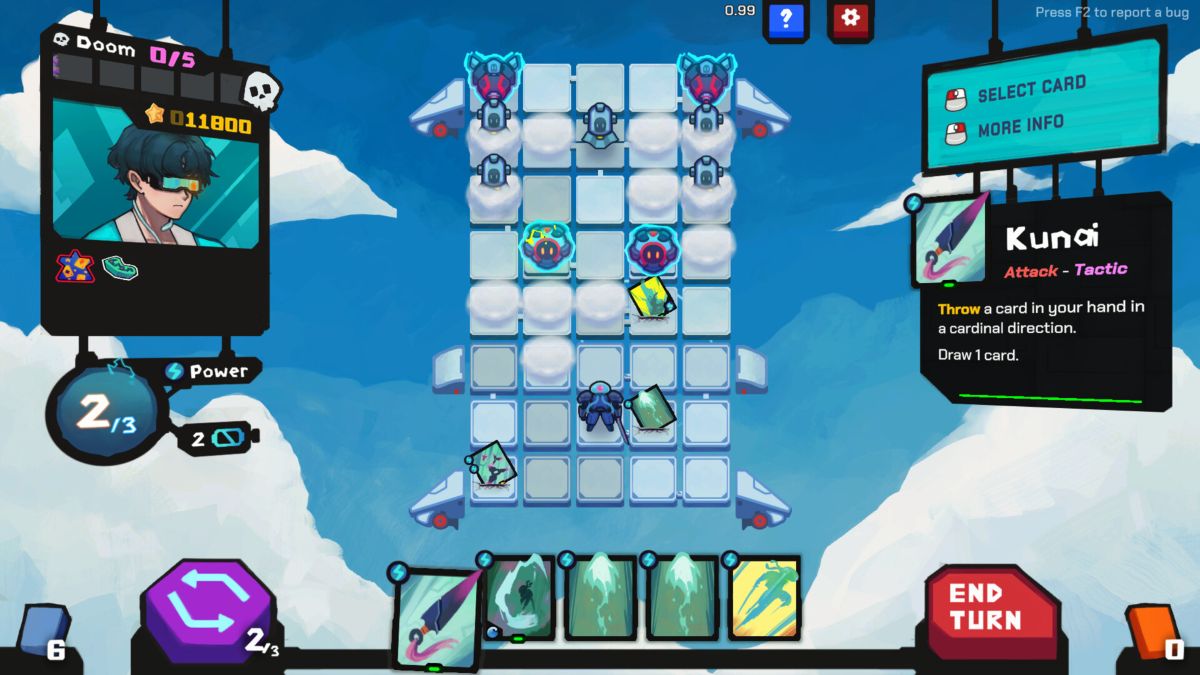
Once the menu choices are made, you’re presented with a handful of cards where you can only choose two. These randomly laid out cards could be movements, attacks, or something in between. Each one comes with a heat cost from the mech that your player is controlling, and you only have a certain amount of heat that can be used before the mech overheats. This is akin to any deckbuilder card-based game where you must deal with a point value that allows you to play a certain number of cards. To make things complicated, there are cards with more heat points, and which are typically stronger than ones that contain a single heat point. While you can choose a powerful card, you might end up taking down fewer enemies or setting yourself up for bad strategy.
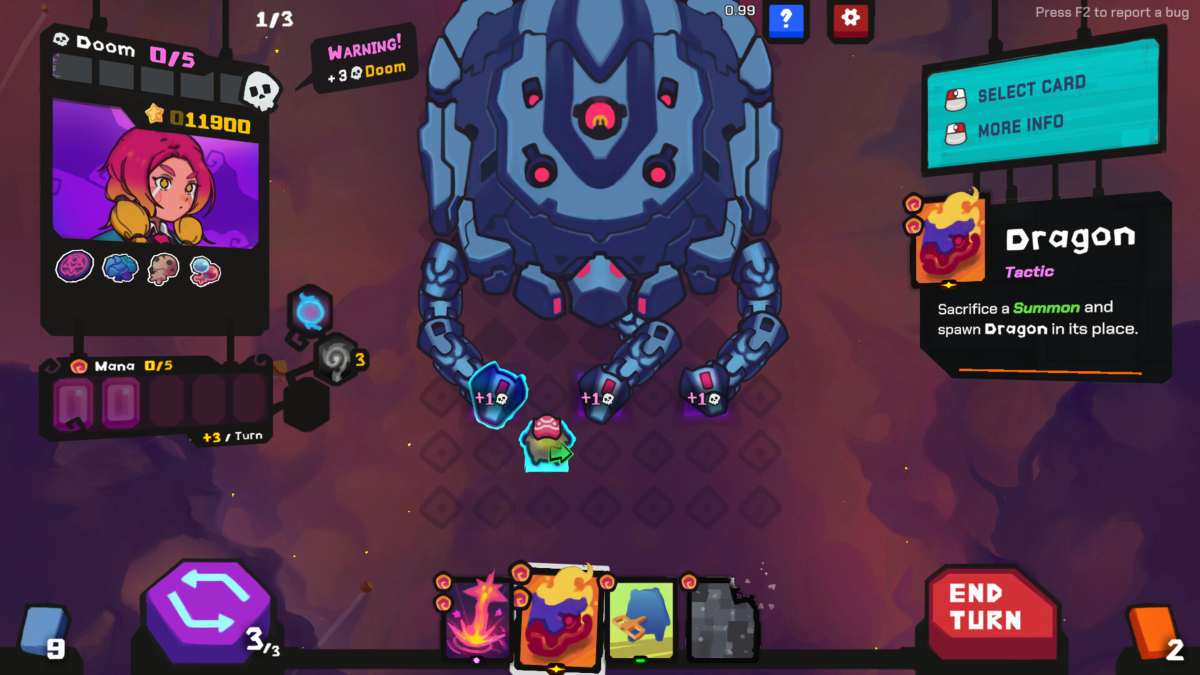
Anyway, once you choose your initial two cards, you’re thrown onto a large, square-spaced level that has you on one side, while the other is populated by enemies. Once the round begins, you must strategically use your cards to eliminate enemies before they cross over to your side and cost you health points (up to 5). This is incredibly simple gameplay that is easy to understand on a basic level.
At the beginning of this review time, getting used to the cards, understanding their purpose, and when to use them, was a small challenge. I was frustrated at the randomness of the card drops, sometimes having too many moving cards and not enough attacking choices. I was also having a tough time trying to understand when I should be using cards and when I shouldn’t. While it was simple to understand at its core, the strategy behind the game felt loose and unorganized. The first hour (or so) of the game felt like wrangling cats. Then, for no good reason, everything started to click.
The game only fails you when you fail it. Looking at the cards, reading the descriptions, and not getting too used to a certain card helped to branch my strategy out in new ways. For example, during one playthrough, I had a level where ships were guarding a large blob mass. When I shot the blob, it divided into a smaller blob. When I shot that blob, it divided into even smaller blobs (a whole group of them). It’s a tough position when you’re trying to clear a level, which is the purpose of the game. In a weird moment of Zen, I began to see how thick the strategy was for this level and how it related to the hand I was dealt. To overcome the blob, I needed to have plenty of movement and plenty of different large explosive attacks. One of my cards was a three-shot card, which had two angled direction shots with one big shot in the middle. What I strategically figured out was that I would need to conserve those cards and shoot single shots at the blob and medium blob, then attack with the three-shot card. Moving and angling to do any of this was also essential, as I could dictate how this large mass was going to be shot up, as well as the location. After about three run-throughs of this level, I finally understood the genius of StarVaders’ gameplay, and I took down this huge blob.
As I continued my journey through the game, failing more than a handful of times, the cards dealt during matches seemed less random and more stackable. I also finally realized that the game never left me out in the cold when it came to options, which was impressive, especially when it felt like the cards sometimes had little purpose for them. What I eventually picked up on was that the game always gave me opportunities to succeed and several avenues to go down for victory in matches. In other words, the game was so beautifully complicated in the card and strategy department that I didn’t initially pick up on it. From that point on, the game became an addiction, and instead of trying to depend on the hands dealt to me at face value, I began to challenge myself with creating the best strategy to get through a level. It was engrossing as it was engaging.
The card variety helped create such an immersive experience, as there are more than enough choices to develop several strategies during a match. There are movement cards, attack cards, cards that require stacking, and/or some cards that will produce several new cards. How those cards work in tandem with each other depends on what your attack strategy is for the game. There are a lot of options to choose from, which means your approach from level to level could be constantly different.
The gameplay structure and execution were just beautiful to behold.
Enemies
Equally as impressive as the cards were the enemies in the game. The devs at Pengonauts must have had a field day designing enemies and bosses for this game. Enemies come in a variety of shapes, sizes, and species. Each enemy has its caveat with how it attacks and functions. For example, in the latter stages of the game, you’ll run into giant space snakes that must be hit twice on the head to take down. When I say take down, I mean just pop its head off and watch the body regenerate a new one, though with a smaller body. That enemy would wiggle its way down, require an insane amount of hits to vanquish, and cause enough trouble with how it fired at my mech (in large single lines). It required cards for moving, dodging, and using the right attack to take the snake out before it could easily take my mech out. A lot of the enemies brought unique attack and approach styles like the snake, which helped to keep the game captivating.
Other enemies in the game could produce smaller enemies, sometimes shoot rockets from afar, and some even have smaller versions of themselves pop out of the initial big body (much like the blob). The variety and design of the enemies helped to keep the game interesting and kept the strategy consistently fresh. The latter of which is probably the most impressive out of the bunch. Going from one level to another will always mean you’re going to have to study an enemy closely and understand its caveats, then create the right set of strategies to defeat it.
Outside of common enemies, the bosses were equally impressive with their design and their function. For example, you’ll have one level where you must take down a three-part mech that is only attackable when you take down its minions around it. This mech is a decent fight that is full of strategic value.
Another mentionable boss is toward the end of the game. You’ll run into a single enemy that reproduces rapidly and fills the level full of lanes you must avoid. It’s small in stature but huge in its reproduction and danger. It’s also creative as hell to see in motion and quite the challenge. This boss kicks up its speed to a higher level than most, which makes it even more strategically delicious to figure out.
All these enemies, and their complicated designs, are in a turn-based card game. That’s nuts. There was a lot of love put into enemy design in StarVaders, and it shows.
Longevity
As the old saying goes, you get what you put into a game. Or was that about life? Doesn’t matter, you get the picture. Anyway, the longevity of this game depends on your dedication to understanding the cards, enemies, and developing a keen strategic plan. It took me about five hours to beat the game. That included trying out different methods and seeing how cards worked. Not a bad amount of time.
What keeps me playing this game is three-fold. The first is that the game is just addictive and fun. Even though I beat the game, I can still find different ways to win against enemies. That’s a big deal for me, although I would prefer the enemies on some of the levels to be a bit more random, just to change the experience on the second go-around. Regardless, the game is just fun and strategically experimental. That last part leads to this first reason I keep playing the game.
The second reason is that there are still cards to be found after five or so hours. I keep finding new cards, better ways to use them, and keep gaining other abilities through artifacts (attributes) and buffs. There is an entire library of ways to improve your deck, and that helps to keep the gameplay super-fresh.
The last reason I keep playing is that the game has unlockable mechs and difficulties. The more you do in the game, the more you unlock on the surface, which means an entirely new and challenging experience when revisiting. It provides good motivation to keep revisiting and pushing forward through the same level types (which there are a variety of when you go from one to the next – you get to choose a path).
All the above means you will come and go from this game, continually be entertained, and find a deeper challenge once you progress enough. There is some good longevity with StarVaders that probably sits in the same category as Ring of Pain or Balatro. The latter of the bunch is not good for efficiency.
On that sweet note, let’s wrap up this review.
Conclusion
StarVaders from developer Pengonauts is an addictive deckbuilding turn-based game with meaningful content and thick strategic gameplay options.