


Sektori is an intense arcade classic that will leave players in a trance-like state. With a splash of modernity, this explosion of particles, color, and skill begs for constant replays once players master its finely-tuned difficulty curve.
Back in 2017 I spent a handful of weeks attached to Housemarque’s Nex Machina. Released a month before the developer’s other game Matterfall, Nex Machina was a culmination of Housemarque’s mission statement of bringing the feel of classic arcades to modern consoles. Housemarque even went so far as to bring Eugene Jarvis–designer behind Defender, Robotron: 2084, and Smash TV–on as a consultant, being considered a hero and inspiration for the studio.
Nex Machina was an intensely brilliant game that was easy to pick up but blisteringly hard to master. It captured the addictive quality of quarter-consuming arcade cabinets but felt modern enough to ensnare players of any era. The game frequently kicked my ass but I couldn’t put it down, I just wanted to be better and would constantly reset runs I knew were under-performing.
Despite their glowing critical reception, Nex Machina and Matterfall weren’t commercially successful. Shortly after Matterfall‘s release, Housemarque’s CEO released a statement entitled “ARCADE IS DEAD“, lamenting that the genre was not proving to be a boon to the studio and they would move on to other genres. And four years later, Returnal dropped to much acclaim, showing that Housemarque had the chops to translate the spirit of arcade classics into a new vessel.
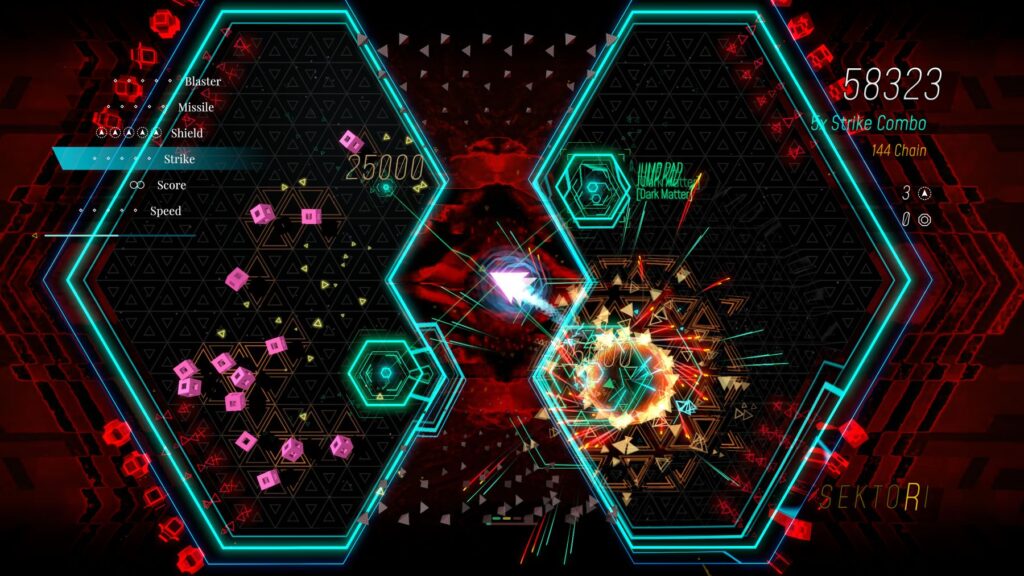
Kimmo Lahtinen was a developer at Housemarque for 13 years working on titles like Dead Nation, Super Stardust, Outland, and Resogun before going independent in 2014. While Lahtinen’s time at the studio ended before the release of Nex Machina, I couldn’t stop comparing its bursts of colors, frantic pace, and addictive quality to Sektori.
Sektori feels pure.
It is a distillation of gaming’s primal instincts. The day I started playing Sektori, I played for five hours. And every day for two weeks I constantly picked it back up. Again and again. Waiting on the oven to preheat? Sektori. On a phone call I’m only half-interested in? Sektori. Not in the mood for a narrative adventure? Sektori.
But was I every actually great at Sektori? Eh… That part doesn’t matter, though.
Ripping through every fresh start of Sektori was done with renewed purpose. Every death seemingly a micro-lesson on how to get better. I began to reset within the first minute or two if I burned through a shield after being caught off guard by an enemy projectile or collision. Why try and stomach the next five rounds if I started off so early with a handicap?

To try and make Sektori seem more complicated than it is would be a detriment to its pick-up-and-play quality and the insistence of Lahtinen that you’ll “figure it out” along the way. Players are given the briefest of tutorials to acclimate themselves with the game’s most important mechanics. Left stick moves, right sticks shoots in a direction. Shoulder button dashes though enemies with a strike attack. Strike attack a bonus pad and your strike attack refreshes instantly. Enemies drop in-round experience. Build up experience to drop upgrade points that can be stacked to amplify ship abilities.
As a twin-stick shooter/shoot ’em up/arcade game that so obviously comes from a person who worked on some of the best ones of the modern era, Sektori is about as well-oiled a machine as one should expect. Fundamentally this is blissful, furious arcade action at its best.
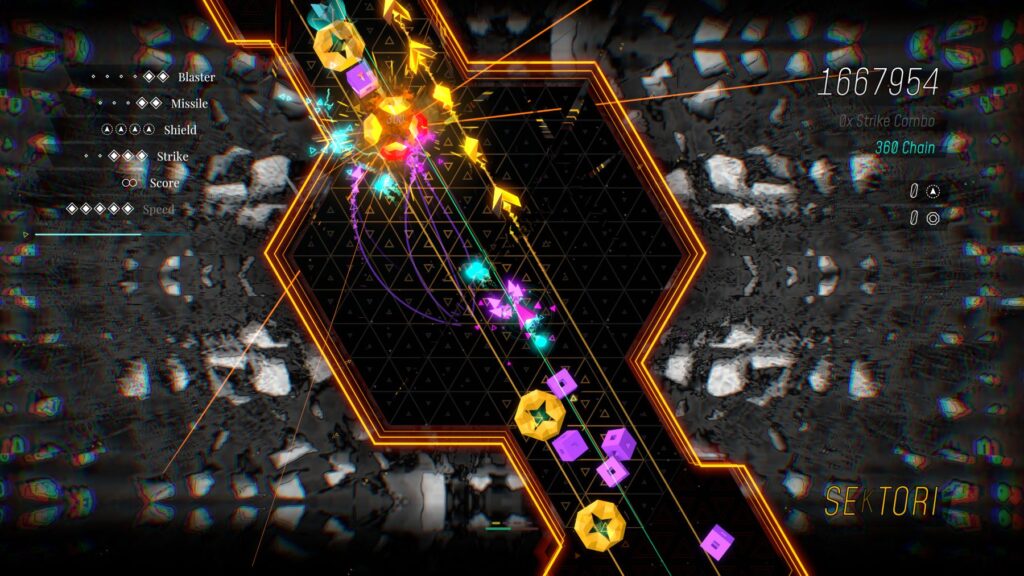
Enemies fill the screen, teleporting in from god knows where, a wireframe shadow appearing right where the enemy is about to land. Players aim their ship’s blaster and fire away. Coming in all shapes and sizes, enemies will swirl along predetermined paths or intentionally dodge away from fire or shoot out a projectile when dying. These voxel-like opponents are colorful, shimmering in patterns that players will grow to recognize over numerous runs.
Knowing what to predict from an enemy based on their aesthetic is always welcome in games. Players may recognize a poison enemy by their acid green flairs or a tank with a large pool of health because they carry an axe and armor. That’s a harder thing to do with shapes. And while players may look at the squares and triangles and orbs and other polygons in Sektori and not know what to expect at first, their patterns become intimately familiar after the sheer number of them begin to flood the playable space.
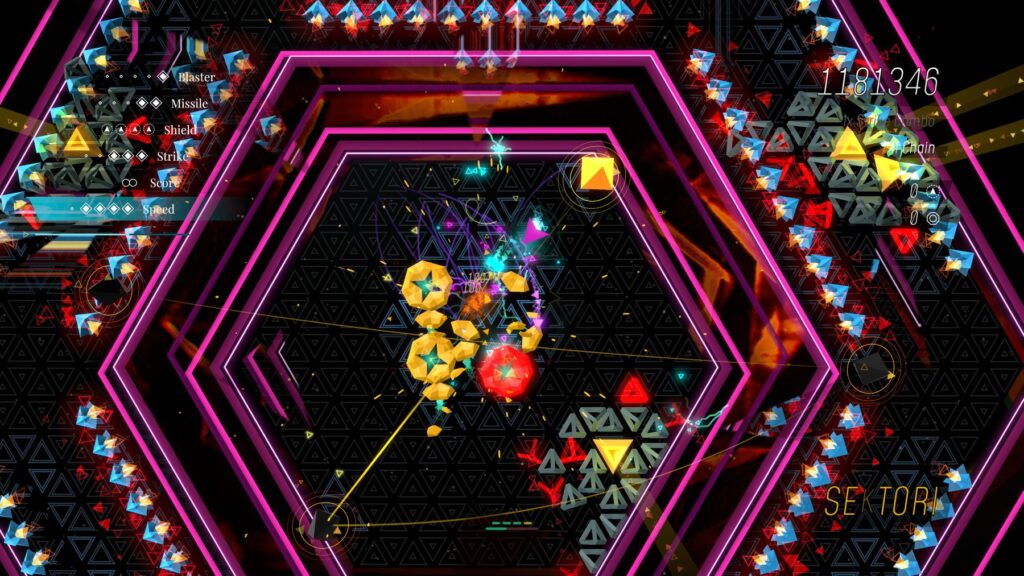
And amidst the chaos, there’s a certain joy in learning how to swoop in between the droves of enemies, scouring for that finite gap to the other side of safety. Telegraphing enemy positioning is an expert way to help players focus their attention but it’s also used to show things like damaging beams of energy, trails special enemies will take that reward upgrade points if you kill the whole fleet, and the path connecting bonus nodes that must be broken in a specific order.
Over the course of Sektori, players will have access to three different ship types with the second and third made available after progressing through the third and fifth bosses in one singular run. While each ship has its own unique quirk, they all can be upgraded the same. Players can choose to upgrade base speed, the effectiveness of the strike attack, the missiles of the ship, and the blaster turret. Depending on the ship, the placement of these upgrades are on a separate hierarchy. By a simple press of the “X” button, players can use an upgrade point to instantly gain a speed boost. But to upgrade their blaster, they need to bank six points. Additionally, players can earn a finite amount of shields by spending upgrade points, or merely sink them into the “points” option, which does have its uses.

A secondary avenue of earning more power to tackle the onslaught are upgrade decks. Before a match starts, players can choose from a list upgrade decks they want to be made available. After grabbing a yellow power-up, players can reveal one of three upgrades they would like to choose from a specific deck. These range from extremely effective to comical. One upgrade literally rewards a singular point, just to show off. But other upgrades give players a magnet that will pull in upgrade points and experience pips, or reward drones that will support the ship by firing off bombs, or grant shields by cashing in a hefty amount of points. Some upgrades have temporary curses that slow down the ship, remove shield, or require a number of enemies killed before being wiped away.

Sektori doesn’t feature any kind of post-run permanence to give players a constant power climb, it’s not that kind of game. Outside of the three difficulty levels which amplify the intensity and frequency of enemies, the only thing players adjust outside of a match are their ship’s cosmetic appearance and which upgrade decks they want to be made available.
When I said that Sektori is pure, I meant it. Twin-stick shooters can certainly thrive off shoving enemies at the player and giving them a handful of tools to survive. But the additions made here are only done in service to add layers of complexity and finesse to the player’s increasing skill cap.
I can’t remember how far I made it on my first go of Sektori but mere minutes passed before I felt that twinge of excitement. Part of it has to do with that thudding techno music that begins pumping into your brain. This is an incredible headphone game because it captures your senses in that horizontal cross-section between your visual and auditory senses, feeding sensations to your brain as your fingers attempt to manipulate the controller.

Sektori‘s soundtrack is, at minimum, a third of the appeal here. This is late-night clubbing beats with echoing bass meant to compliment the flashy colors and instill a sense of urgency with just a bit of sadistic glee. Each track blends effortlessly into the action, letting your ears pool around the sound and get your blood pumping and your feet tapping for what’s to come.
But there truly is a quality in the mechanics here that is meant to put players in that mythical flow state where the outside world melts away. I remember feeling it with Tetris Effect. Just watching those pieces fall and fall and fall while the visuals morphed and swirled all to an indescribable soundtrack. Sektori evokes a more “sinister” version of that flow state where one becomes locked in, hard-wired for survival against hundreds of colorful blips.
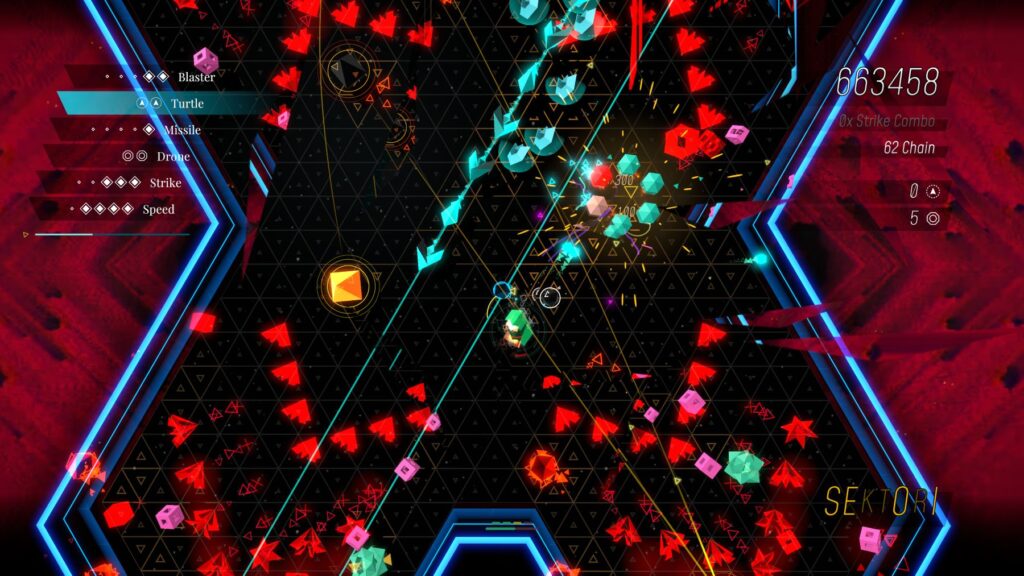
Attempting to describe the quest for mastery in Sektori is difficult. While I never felt fluent in its language, there were moments I felt I was doing amazing. Maintaining constant combos is difficult. Players can chain strike attacks and use the ensuing proximity explosion to clear out a chunk of opposition. But Lahtinen shows his experience in developing these games by the small tricks here and there to provide more feedback and skill for the player.
Learning how to time collecting upgrade nodes because they can emit a killing blast. Knowing when to group certain deck upgrades together. Figuring out which enemies need to be prioritized. Players can collect letters to build the words “Mirage”, “Sektori”, and “Revolution” (harder difficulty means longer words) to temporarily enable a kind of rainbow mode where the colors get trippy and special globules appear that grant upgrade points.
Rhythm can be achieved in Sektori but it is not always guaranteed. There is familiarity to each match but one of the biggest twists is that the levels themselves evolve. At the beginning of a match in Sektori, the playable field is small and compact, potentially a hexagon or similar shape. As the player gets their bearings, the field expands and changes.
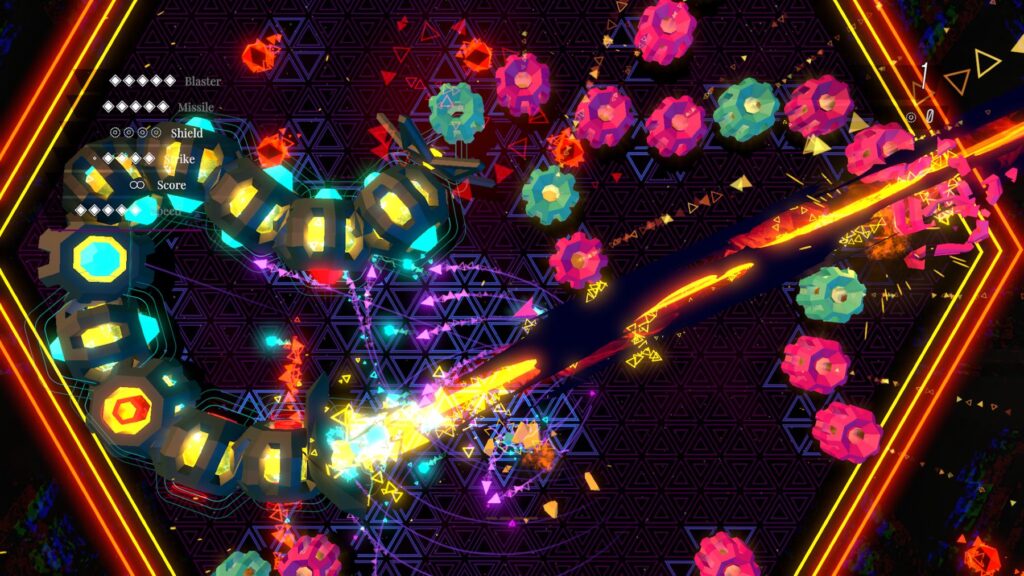
As you may have noticed from all the screenshots that I’ve posted, the game doesn’t take place in a static shape. Segments of the world are shaved off, carved away, tacked on, grown. Though the layouts do become recognizable, there’s seemingly no logic to what shape Sektori will take as players continue to push through.
One of my main critiques of the game, however, is that in tandem with these morphing levels, the sheer amount of stuff happening on screen can amount to some legibility issues. Primarily this comes in the form of the actual level shifts that occur. Usually before the change, the “floor” where sections will disappear will flash red. Often this is meant to break up the action, challenging the player in new ways. They may be grouped up in a tight space with enemies, or they can use jump pads to bounce around and use the ensuing shockwave to kill groups.
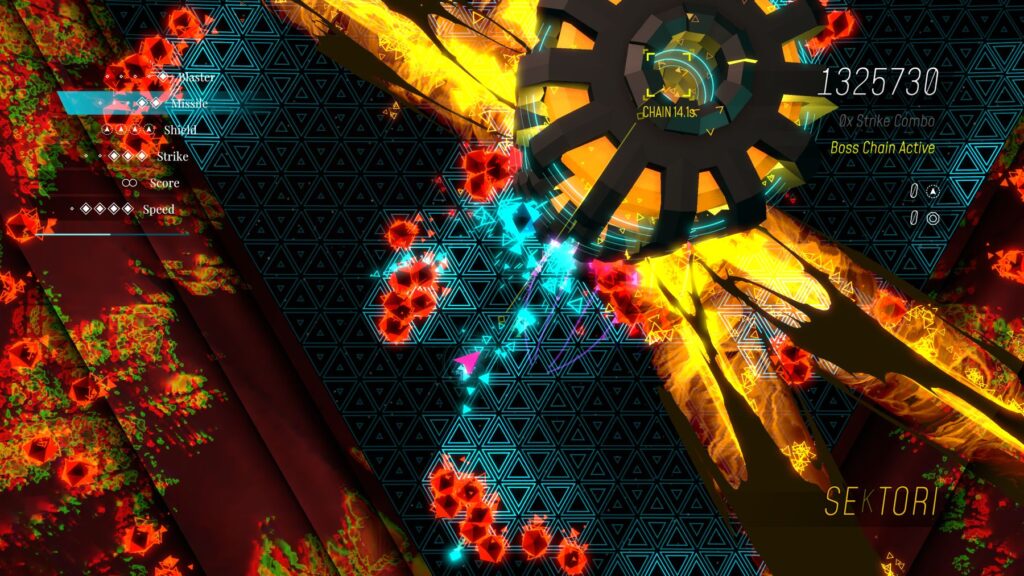
But if a player is caught when these section of the field is removed, it’s game over regardless of how many shields you have. I’ve lost a number of runs because I wasn’t paying attention. But I lost several where the amount of colors–especially in the rainbow mode–obscured safety from me. It’s not the most pleasant thing to happen and it can certain piss you off. But in the grand scheme of Sektori, it’s another lesson.
Each match consists of five boss fights that are randomized. Depending on which round the boss appears in, they can be harder versions with more weak spots to kill and projectiles to avoid. For me, Sektori‘s bosses are fun when their patterns work best for the player. That might seem like an obvious sentiment but there are times where the bosses seem to move or rotate entirely in opposition to the player. Perhaps it’s the snake that never slithers on the side players need to shoot. Or the one boss with rotating rings that can spawn out of sync towards the side players are on, requiring frantic coordination to avoid being hit. Strike attacks and memorization can help with these bosses but expect to sink some unwelcome hits and lives into mastering their demise.
This all amounts to the “Campaign” mode of Sektori but six additional modes are available as players unlock them. “Classic” is basically the same way to play but mutators can applied to provide boons to the player or make the game nearly impossible outside of the most skillful maniacs around. “Surge” has the ship go back and forth between being extremely weak and extremely powerful. “Crash” only lets strike attacks kill enemies. “Assault” has raising stakes and a limited time to kill enemies. “Gates” has enemies only harmed by passing through laser fields. And then there’s the classic Boss Rush.
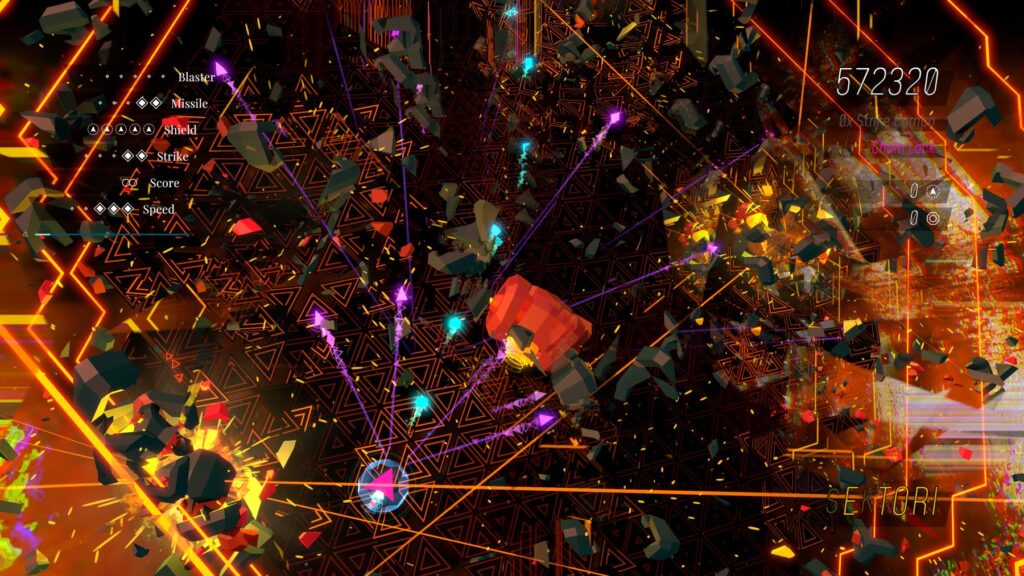
The amount of optimization, variety, and customization that allows players to take the base Sektori experience and expand upon it is definitely appreciated. Those who latch onto the game will be able to do phenomenal things with it and not have to continuously waste quarters experimenting with ruthless runs or having absurd fun. The game has an absurdly simple core that builds out in creative ways meant to amplify the potential challenge.
Sektori is pure. Sektori is addictive. The vibrant chaos amidst heart-pumping techno music will leave players in a trance-like state, lost in an explosion of particles, color and skill. Destined to be an arcade classic, the intense, shifting levels beg for replay after replay to master its finely-tuned difficulty curve. Sektori proves, if anything, arcade is not dead, it merely needs new masters.