
I haven’t played God like this since Electronic Arts released Populous on the Sega Genesis. It’s good to be back to godhood.
Reus 2, from developer Abbey Games and publisher Firesquid Games, allows players to play as a god. Or two. Or more. Players create worlds using different gods that add their own spice to planets (not Dune spice), while cultivating and building civilizations that produce varying degrees of success, demand, and failure.
The game gives players control of shaping a 2D planet while choosing what gods they want to make whatever landscape they feel like they should. Reus 2 has many moving parts to make it go, asking the player to try and choose actions that best suit the worshippers they are taking care of on said planet. The problem with this game isn’t the complication and strategy that goes into it, because, my goodness, there is a lot of that waiting for those who want to jump in. No, the complication for Reus 2 comes with its lack of good controls and information architecture that feels like it was built for PC, but doesn’t translate well to Nintendo Switch.
Of course, don’t let that dissuade you from giving this game a go because it’s smartly built, entertaining, and once you get the controls down, a fun experience in short stints. And the game truly is taken in sips rather than mind-numbing large gulps.
So, get a godly outfit on and let’s go build a planet, loser (I don’t mean that, but it sounded funny).
Losing my religion
Reus 2 brings a fair number of goods with its godly planet building. The game starts with a barren planet, and players must use three separate gods that bring three very distinct powers to help shape the space.
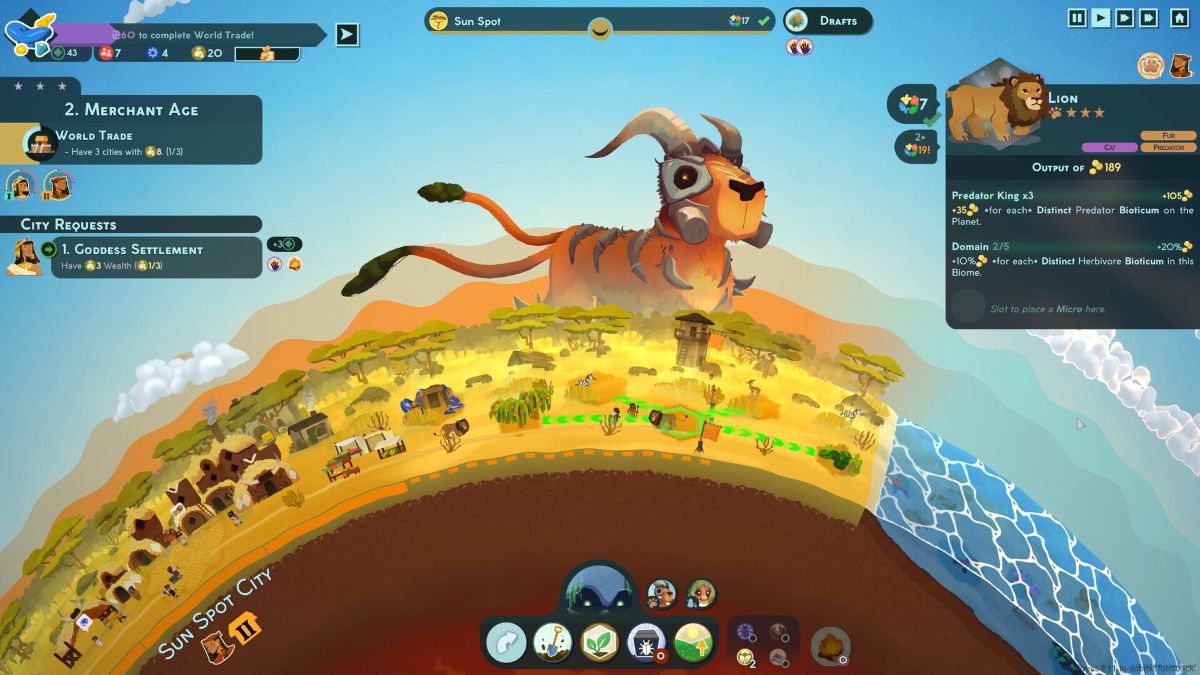
Choosing between the three gods (and just three at the beginning, there are more that unlock) allows for different lands to be created on the planet. At the get-go, there is a god who creates plants, one who produces animals and oceans, and another who concentrates on deserts and rocks/minerals. Combined, they work together to try and produce a self-sustaining planet with good human beings who are happy and thriving. Now, as we all know, being that we are humans, we’re a demanding bunch.
As the gods add lands and humans begin to settle in, two gameplay elements come into effect. The first is the game’s own goals. This could be as simple as creating plants or pairing animals with vegetation, or it could be just finding new land for new settlers to call home. It’s a ‘common sense’ set of challenges that only stand to progress the humans on the planet. And humans will love players for it, and that’s probably something players want as they play gods. The game presents its own set of challenges that will reward the player with unlockables, new gods, and good progression for the humans on the planet. These challenges/goals are just a simple gameplay structure that is easy to understand, which is what gamers would probably want if they are trying to settle into a god simulator. Dipping your toe into a strategically complicated game is the best way to wade into its structure. And it certainly leads players into it through challenges and goals.
One of the hiccups of the challenges and goals featured in Reus 2, which seems easy to solve, is that occasionally the game will throw new terms and requests at players that may not have been explained fully in the initial tutorial. For example, I was going through a brainteaser of a time trying to figure out what the heck an Apex Biome was in the game. Eventually, I found a button called Drafts, which would help me create one to complete a game challenge. It took me two planets before I could figure that out, and the information buttons next to the request really didn’t help one bit. A little frustrating, but fine in the long run. At the very least, it taught me to keep a firm eye on all the onscreen options given to me.
Now, once I figured out the Apex Biomes, the game opened a bit more. I started to settle in with the game’s requests and where I needed to find them. It eventually smoothed out the entire challenges/goals system for the game and had me paying attention/wanting more challenges to make the experience more complicated. And there is quite a bit of complication in this game once players start to get used to its requests and push forward with new gods and goodies to try out on barren worlds.
Speaking of requests, let’s talk about the second gameplay element in motion here.
Humans will occasionally ask players/gods to make decisions they’re having a tough time making or help them out in a pinch. For example, if a new group shows up looking for a place to settle in and call home, the gods will be asked by the pre-existing humans to produce a place for the newbies, while also taking into account who the group represents and if they pose a danger to their civilization/society. The first group I dealt with in the game was a band of pirates. I had to separate the pirates from my original settlers via an ocean, and then build a nice, big plot of land for them with lush berries, trees, and creatures to fry up. Ultimately, this kept the peace between everyone on the planet, and everything seemed to work out.
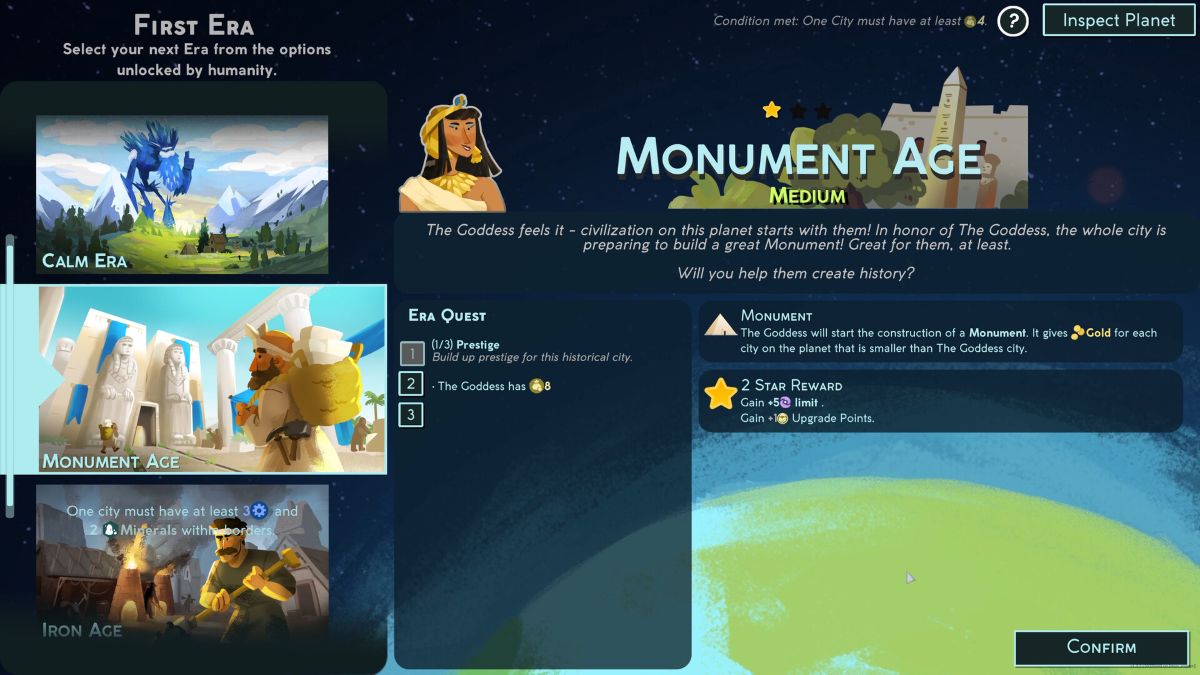
Having an even balance of peace, separation, and plenty of goods to go around to progress everyone’s life positively is a true ultimate goal of the game. But, as things go, sometimes the humans tend not to like the decisions the gods make for them. If players end up ignoring the needs and wants of the many, it will affect how progressive society becomes. This means they might be slow in developing new technologies, keeping their people fed, or other important factors that keep humans going. The less gods do, the more discontent will build with citizens, and at times, it can be tough being a god.
While the gameplay juggling act can get watered down by logically and strategically guessing the right decision to make for humans, the game never feels too overwhelming with what it’s asking players to do. I was expecting the worst with this game, as most games of this type require players to be scholarly, but I ended up figuring out what decisions led to what results. Once that was solved, the game settled in, especially when I finally understood the challenges and human needs in the gameplay. There was a good gameplay flow from that point on.
The gods must be crazy.
They’re crazy cute, but not megalomaniacs. As I stated before, each god comes with their own set of skills and attributes, much like Liam Neeson’s character in Taken. The plant god can put vegetation and fruit on the planet’s table in every type of land and sea. The sea and animal god could put animals on land and sea for humans to harvest and survive through. The desert god could allow for minerals to gather that help progress technology and push society forward into a new era.
Now, once in a while, the game will ask players to purposely make gods work together to complete a challenge/goal. For example, there might be a challenge that asks for symbiotic relationships to begin on the planet. The plant god can add a sea anemone to an ocean, while the animal god can create a clown fish to work with it. The game’s structure that takes the gods and makes sure their attributes can work together in harmony is a genius idea for allowing players to create unique strategies and solutions to potential problems. In other words, the game does a great job of bringing purpose to the trio of gods it allows gamers to play at one time, and that is a fun juggling act at times.
Because of this criss-cross action between gods and what they are capable of doing, unlocking more gods simply brings more attributes and entertainment to Reus 2. New gods mean new capabilities. New capabilities mean new ways for humans to live. New ways of life mean more interesting success and human disruption on the planet. It also means more motivation for the player to keep creating new planets and trying to unlock more goodies to make each planetary experience unique and fun.
Honestly, the devs at Abbey Games did a fantastic job of creating a good reason for players to return once the short experience of completing a planet is over. Once a planet is complete and society is self-sustaining, the player can keep helping that planet or unlock new goodies and start on another planet with fresh ideas and strategy prepped. The more a player can look forward to trying out new ways to play the game, the more they will return to it repeatedly. In this category, Abbey Games really did do a great job of giving players reasons to return.
Overall, the combination of gods, the mix and matching of their powers, combined with human and game goals, means that the devs created a very logical and strategy-driven game design that will certainly keep players engaged and locked in.
Now, a caveat to munch on.
Controls for PC and not for thee
While I was fearing the game’s learning curve and what was going to be thrown at me to memorize at the get-go, the real struggle I had with the entire experience was the controls. And believe me, the struggle is real.
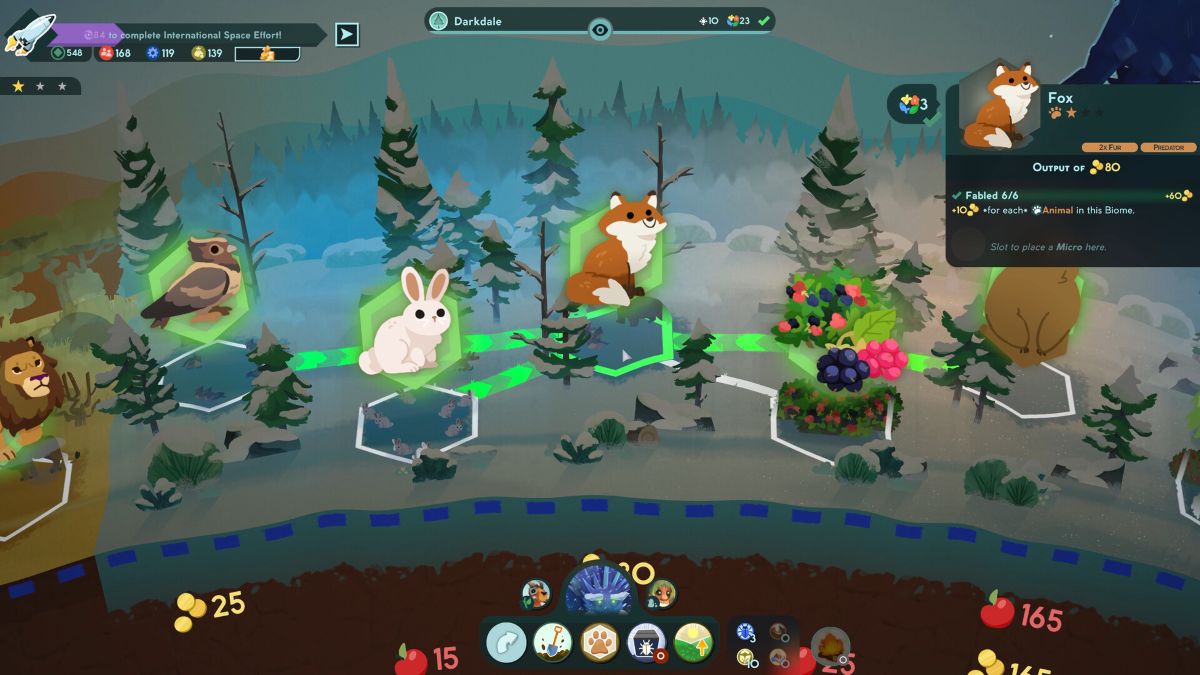
Sometimes, going into a game, I can tell that the controls were not optimized well for console gamers. There are plenty of strategy and game simulators out in the console world that prove that. The Sims will always be that game that just isn’t as good away from PC/Mac. A mouse obviously makes more sense with that series, as does a hotkey-driven keyboard experience. Getting things built and done quickly, mainly so your friends can laugh, is the goal of that series, and a controller just won’t do that.
The same goes for Reus 2. While it’s manageable, the game struggles from trying to figure out how to navigate its menu of options with a Joy-Con. Your brain, like mine, will have to learn to use buttons to access menus quickly, triggers to shuffle through gods, Joy-Con thumbsticks to navigate onscreen information boxes, drafts, and whatnot, and the left Joy-Con’s directional pad to skip through selections for plants, animals, and rocks/minerals. That is a mental juggling act that could be easily solved with a mouse and keyboard. And even though Nintendo touts this thing with mouse capabilities, I’ll never use that option regularly. Yuck.
Anyway, during my entire time with Reus 2, I struggled to train my brain with menu navigation. I don’t know if it’s my age or just the lack of console translated design, but it’s not easy. Controls should always be a non-factor when thinking about gameplay, but going between thumbsticks and directional pads, while trying not to curse Nintendo for having weirdo button configurations, felt like a never-ending challenge. Again, it’s manageable, but the struggle is very present.
In the end, this doesn’t affect the gameplay enjoyment, just its speed. I like my games like I like my lattes, smooth and unimpeded by Joy-Cons.
On that stupid, humorous note, let’s wrap up this review.
Conclusion
Reus 2, from developer Abbey Games and publisher Firesquid Games, is a fun god simulator that is easy to pick up and easier to enjoy. The controls might fight back a bit, as well as the information architecture the game features, but in the end, it’s quite fun and smartly designed.