

ATLUS has outdone itself with RAIDOU Remastered: The Mystery of the Soulless Army. Middling story and wonky camera angles aside, it hits the sweet spot of monster taming and action combat without compromising on the complexities that make JRPGs captivating. Here’s to hoping that ATLUS reinvents and reinvigorates the RAIDOU series, as it’s a breath of fresh air for this Persona fan!
It makes little sense to me as to why the Devil Summoner series has remained under the radar for so long despite Shin Megami Tensei and Persona titles rising to prominence over the past decade or so. It’s not like today’s players can’t handle JRPGs. In fact, the opposite is true, especially in 2025. I mentioned several times last year that now is the best time to be an RPG player, and it remains true as of this morning with the release of RAIDOU Remastered: The Mystery of the Soulless Army.
I don’t expect you to have much knowledge of the Shin Megami Tensei series, nor do I expect you to be up-to-date regarding JRPGs with cult followings here in the West. Instead, I would imagine that you have an inkling of knowledge of the Persona series – you know, the JRPG where you’re pitted against time (take your time!) all the while you’re a high-schooler with some innate power to tame demons unbeknownst to most of your compatriots. That monster-taming archetype is the backbone of ATLUS’ game philosophy, varying in nature across the publishers’ spinoffs.
Imagine, if you will, that you were playing a Persona title without the time-related stress. Monster-taming is core, yes, but you have much more freedom to explore and make choices without feeling like you’re needing to manage your time alongside everything else in the typical JRPG fluff. Oh, and battles are action-packed instead of turn-based. Think Persona meets Pokémon meets Devil May Cry meets Final Fantasy XVI meets…20th century Japan?
That, dear reader, is the core of RAIDOU Remastered, and it’s absolutely glorious.
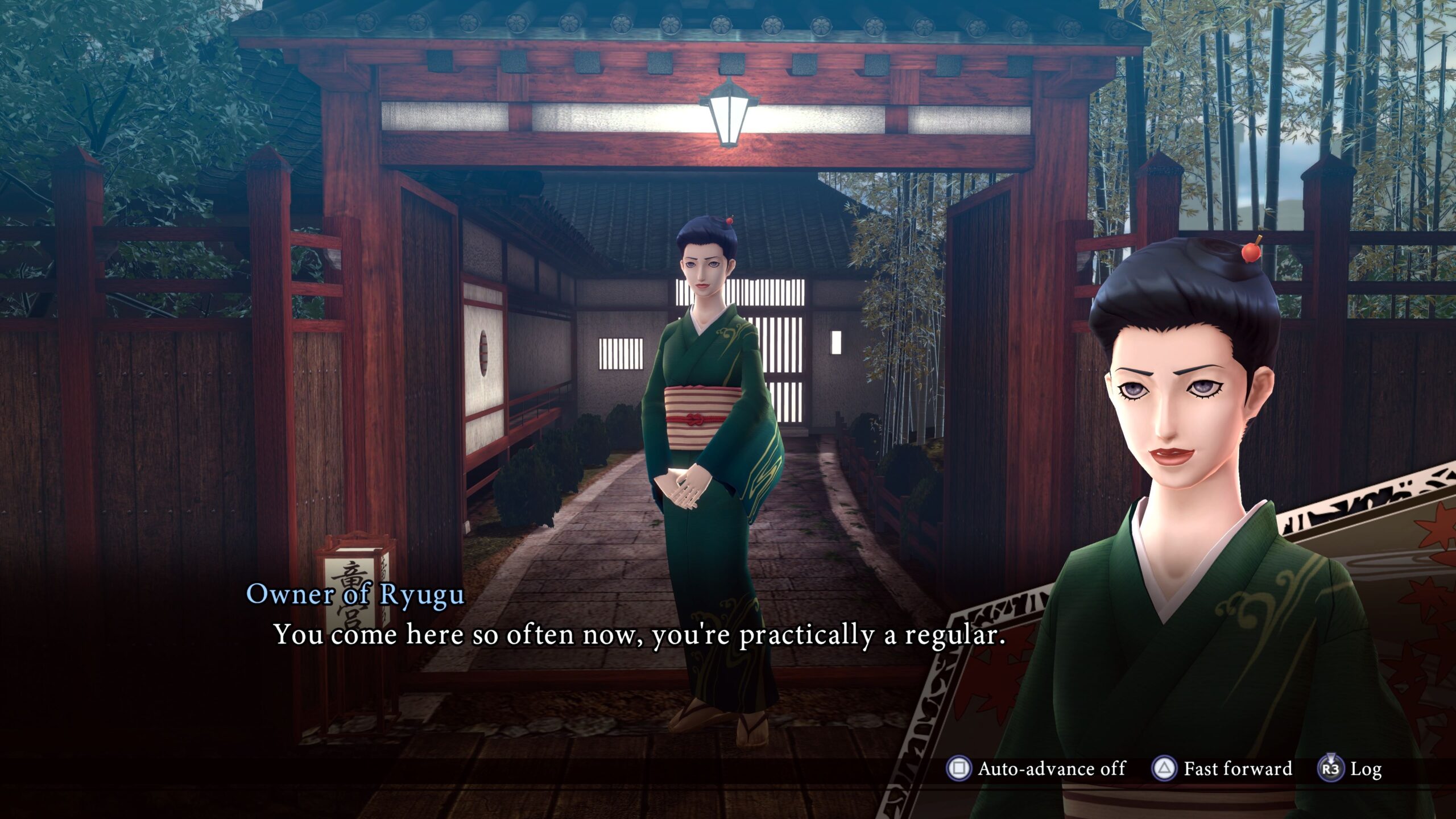 RAIDOU Remastered: The Mystery of the Soulless Army is the remastered version of the 2006 action-RPG known as Devil Summoner: Raidou Kuzonoha vs. the Soulless Army. As Raidou Kuzonoha the XIV, a Devil Summoner, I have to investigate a mysterious kidnapping in 1938 Japan that’s already mired in an industrial revolution of its own. With allied demons and talking cat, Gatou, I face a conspiracy that impacts my world and the demon world.
Sadly, I did not own a PlayStation 2 at the game’s original 2006 release. I owned a PlayStation 3, but I was not privy to the Devil Summoner series until a few years ago when I fell in love with the Persona series on my PlayStation 4. Truth be told, Persona 5 helped me get through COVID with its deep JRPG mechanics. Sure, it was stressful making decisions, but it was hard to feel stressed when I was enjoying every moment in-game.
RAIDOU Remastered retains its source material quite well without compromising on what sets it apart from other ATLUS titles. Here, combat has been overhauled, graphics have been improved similarly to Persona 3 Remastered, saving can be done just about anywhere, and most objectives are easier to access in case you’re lost. This remaster also ups the number of demons to over 120, giving the player a healthy mix of companions to recruit, fuse, and discover in each chapter.
 One major critique of Devil Summoner: Raidou Kuzonoha vs. the Soulless Army is that of its story. Not much has changed on the story front. While recruitable demon side characters ooze personality and silliness, the overarching plot falls short in presenting its stakes. When the core tensions emerge as “good shadow organization vs. bad shadow organization” alongside a handful of minor plot twists, an opportunity is missed in giving the player someone to fight for, or with. A JRPG is often as strong as its storytelling; RAIDOU: Remastered lacks that emotional punch that sticks with the player long after the game’s conclusion.
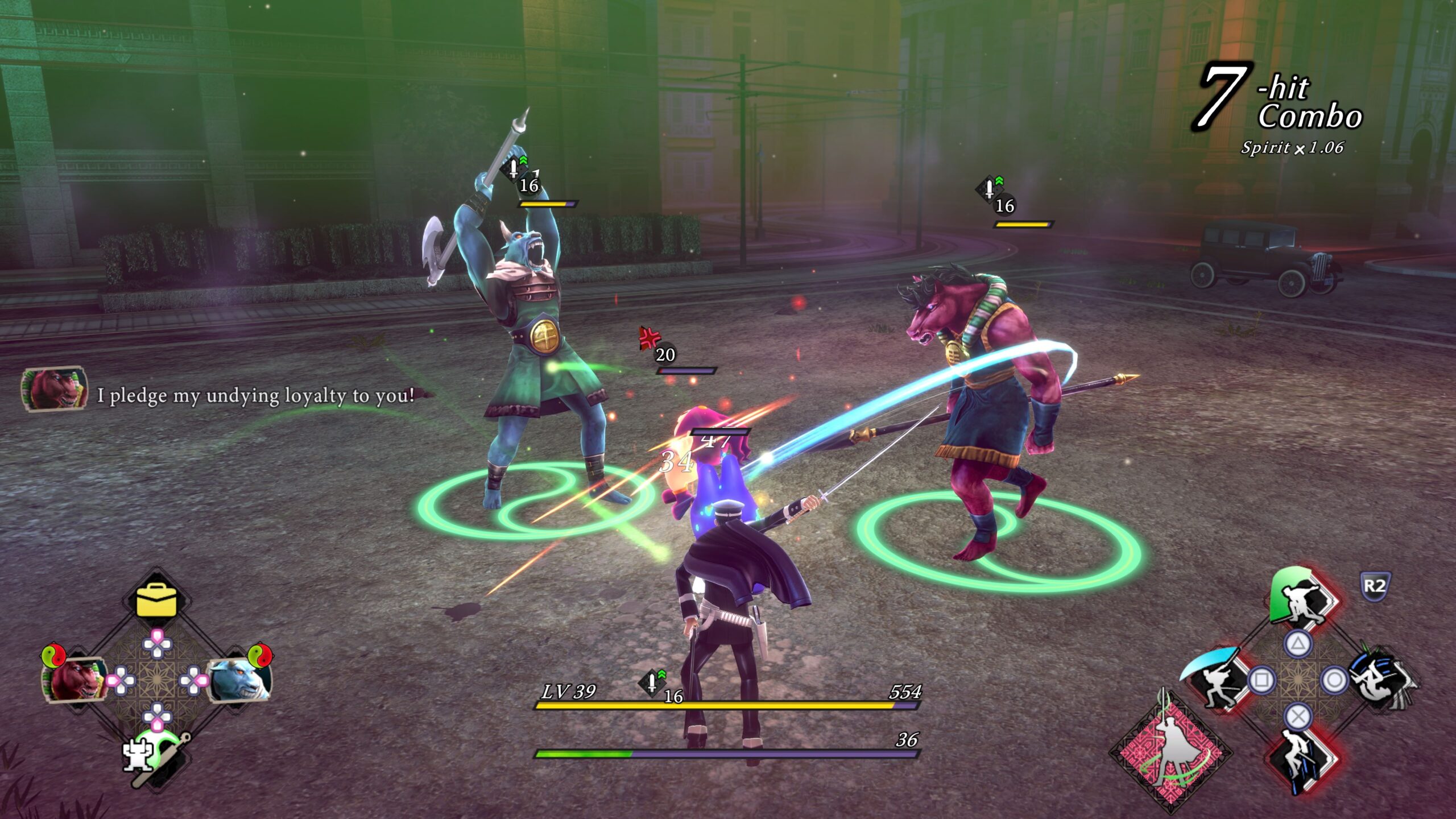
Progression is broken up into episodes, similar to a typical detective novella. Each new episode opens up more of 1930s Tokyo, ensuring that the player’s journey remains confined to the task at hand instead of getting lost in the weeds or down a rabbit hole that leads to nowhere. While exploring the map can be novel in the first few hours, it becomes jarring thanks to inconsistent camera angles that require the player to change their directional input despite walking in the same direction. If a world becomes annoying to explore, immersion is lost by the player opting to use fast travel.
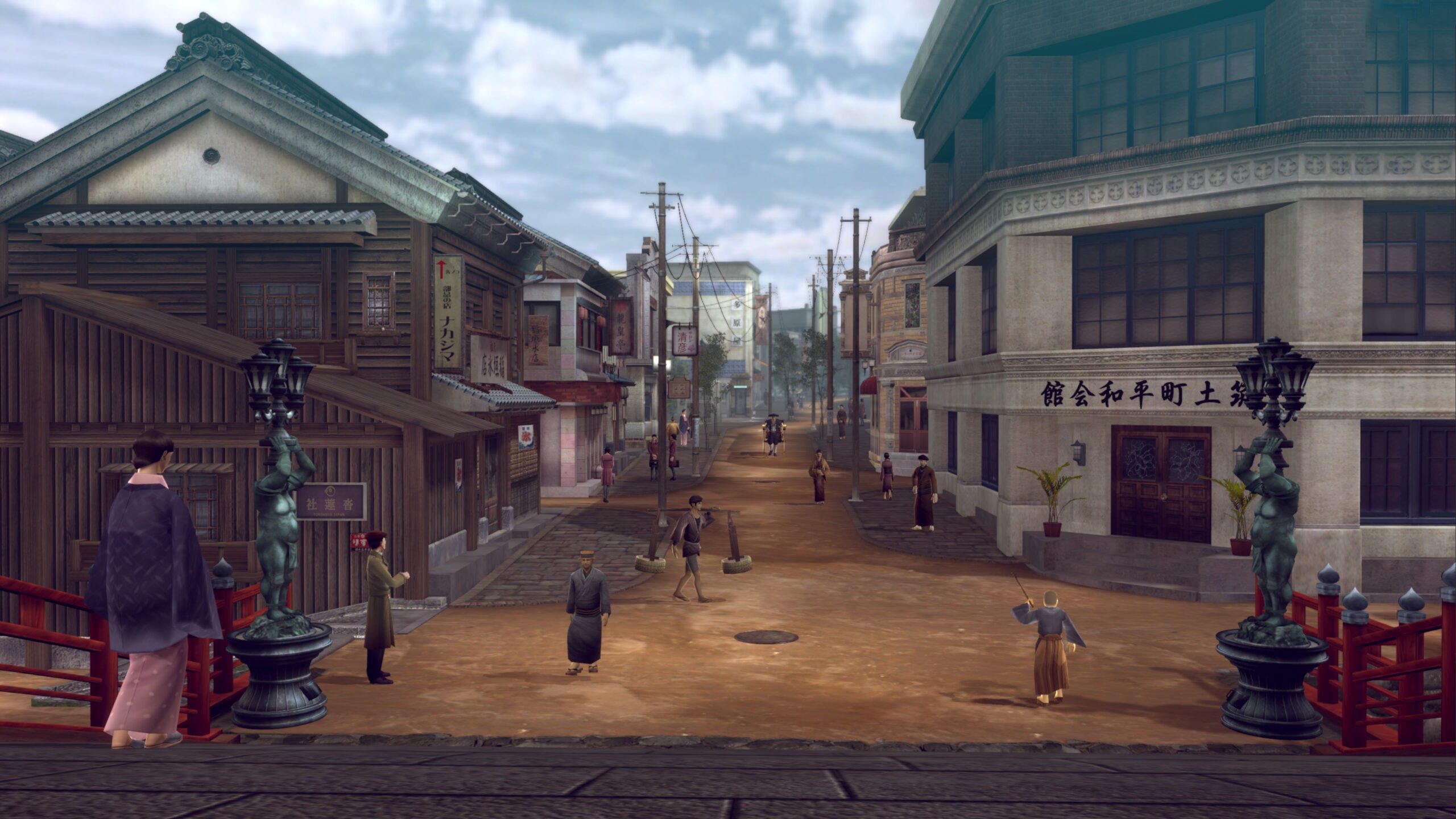 RAIDOU’s combat incorporates some of the best elements of RPG action, feeling relatively similar to Devil May Cry or 2023’s Final Fantasy XVI. Enemies can be seen in the overworld – no random encounters! The battles play out in small arenas, having the player control Raidou while his two demon companions are AI-controlled. Raidou is equipped with a sword, some magic-infused sword abilities (perfect for targeting enemy weaknesses), and a pistol to utilize simple ranged attacks via aiming down the sights with L2 and firing with R2. Melee attacks feel intuitive and can be chained together with your demons’ attacks, but ranged attacks feel out of place, especially when they interrupt long strings of attacks.
Further into the story pits Raidou against more deadly and unpredictable enemies who better utilize the arenas to their advantage. Boss battles become tests of dodging/jumping, protecting demon allies, and timing attack combinations when enemies’ defenses are down. Episode 1’s final boss will prove to be challenging, as it teaches the player how to “defend” allied demons all the while dodging massive area-of-effect attacks that can defeat Raidou in two hits. Beyond that difficulty spike, combat retains its action well into the late game, often requiring the player to stay abreast of enemies’ weaknesses.
Targeting weaknesses is easy thanks to an always-accessible scan function and being able to swap out abilities mid-battle with no penalty. If I had fire and ice abilities, but the enemy was weak to lightning, I could pause the battle and effortlessly swap my demon companions/Raidou’s attacks and carry on. This player-friendly approach to keeps combat accessible and fluid without bordering on overly punishing.
Core to RAIDOU Remastered is its demon recruitment, companionship, and fusion. Persona fans will find this gameplay loop to feel intuitive while surprised as to its depth. While in battle, enemy demons can be recruited by walking up to them and using an ability, assuming you’re appropriately leveled and you have the space in your party. Once recruited, Raidou can select two demons to fight alongside him in combat and another to assist him when exploring the overworld, like asking a demon to “cool down” an angry NPC to extract crucial information related to the current case. If your party is full or underleveled, you can visit an NPC who can fuse your demons together to create stronger demons in later chapters.
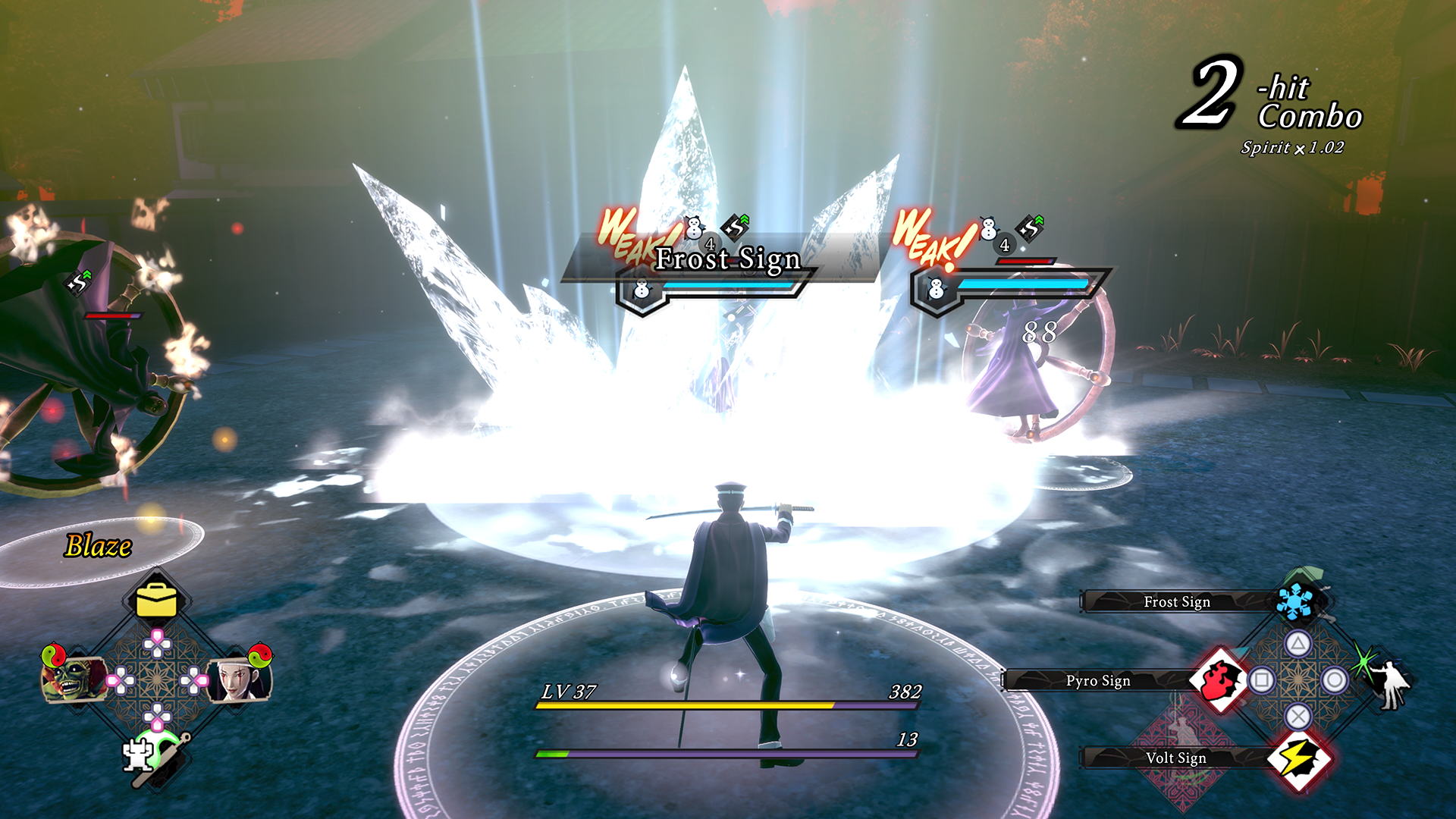 Compared to Persona titles, I appreciate how demons are utilized and portrayed in RAIDOU Remastered. Their personalities and actions feel fully realized rather than blink-and-you-miss-it moments that result from dismissal just as quickly as they’re summoned. Here, a demon is always following me similar to my favorite Pokémon following me in SoulSilver or HeartGold. In battle, two of the demons I’ve recruited are alongside me, attacking/healing on their own all the while I’m whittling enemies to dust with my own weapons.
RAIDOU Remastered better utilizes Shin Megami Tensei’s seemingly endless compendium of demons better than Persona by far. By positioning demons as companions and giving them voices, ATLUS brings these demons to life and capitalizes on their IP’s uniqueness instead of relegating the demons to a mostly-voiceless supporting role.
For instance, every so often my demons would find something and give it to me, claiming that it was from Istanbul or that it would help my…odor? Apparently a book that teaches another demon how to cast Zio (a basic lightning spell) is a form of 1930s deodorant. I digress – the demons I recruited fully embodied their role as my companions in-and-out-of-battle, proving their usefulness in saving my life and helping me solve mysteries. When I was essentially forced to fuse my demons together to create stronger demons, I couldn’t help but feel guilty for changing them into something else.
Demon recruitment ensures that battles remain fresh throughout the story. My demons would level up as I grew stronger, acquiring new abilities that could help me target enemies’ weaknesses. Thus, party management and weakness targeting added a healthy degree of complexity to an otherwise simple, yet action-packed, gameplay loop.
RAIDOU Remastered walks a very fine line between grindy (typical for the JRPG journey) and straightforward. Keeping a team that’s properly leveled and equipped with the right tools (combat and investigatory) can be as simple as the player wants, but it ultimately rewards those who dare to experiment and stress test the game’s boundaries. I was able to proceed just fine with a handful of demons, occasionally fusing them once or twice per chapter, but unlocking a secret demon and leveling it up felt rewarding when I needed it for a difficult boss battle.
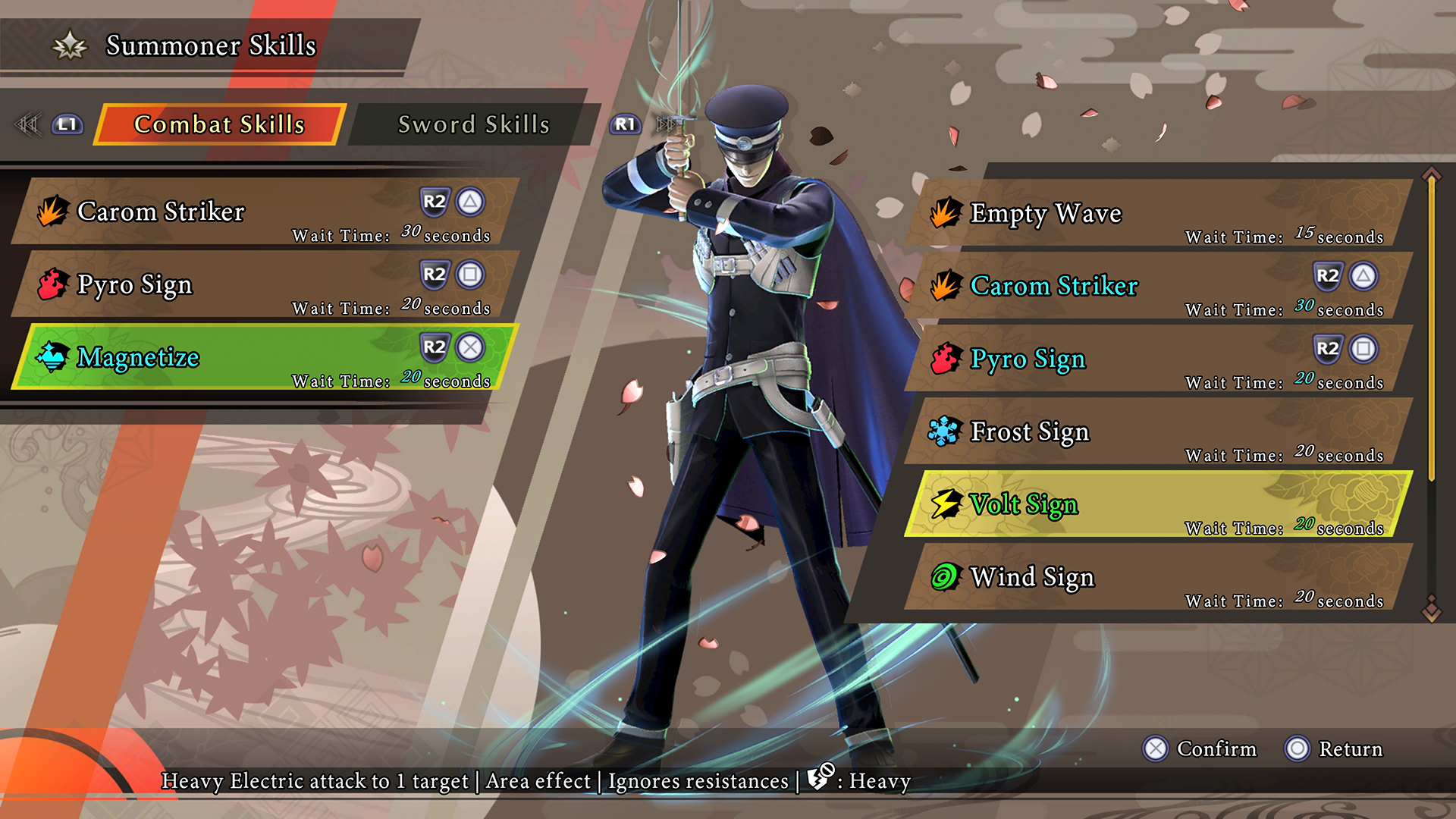 Should you level up your demons and fine tune their skills, it will feel like the sky is the limit when it comes to customizing your team and taking advantage of RAIDOU’s flexibility.
Part of the joy of playing modern ATLUS titles is becoming fully immersed in the vibe put forth by the game’s atmosphere. By that, I mean its art design and soundtrack. Persona 3 features some of the best tracks from ATLUS, fusing J-Pop, jazz, and hip-hop. Likewise for Persona 5, but heavier on the youthful poppy side. RAIDOU Remastered retains the core of Devil Summoner’s original soundtrack, but with modern jazziness and old-school mystery scores. Even during the cutscenes (with fully updated voiceover!), it was so easy to tap along to the beat and enjoy every audible moment.
As far as remasters go, RAIDOU Remastered retains the core identity of the Devil Summoner series while also reminding the player of some of its rough edges, namely its story and inconsistent exploration. There’s part of me that wished that Devil Summoner: Raidou Kuzonoha vs. The Soulless Army got the Persona 3 Reload treatment in terms of visuals, but I’ll take what I can get as far as engaging JRPGs go. RAIDOU Remastered kept me fully engaged for its 30-or-so hours, and I could see myself going back for more later this year.
ATLUS has outdone itself with RAIDOU Remastered: The Mystery of the Soulless Army. Middling story and wonky camera angles aside, it hits the sweet spot of monster taming and action combat without compromising on the complexities that make JRPGs captivating. Here’s to hoping that ATLUS reinvents and reinvigorates the RAIDOU series, as it’s a breath of fresh air for this Persona fan!