


Once Upon a Puppet plucks from a familiar tree of whimsical, inspired platformers.
Players only need to spend a few brief moments to recognize a game they have likely played in the last few generations. When seeing Once Upon a Puppet for the first time, the obvious invocation for me was Puppeteer, the brilliantly creative platformer that has been marooned on PlayStation 3 for over a decade. I also think of another PlayStation 3 game, Black Knight Sword.
But Once Upon a Puppet isn’t purely siphoning imagery from its theater aesthetic. I was reminded of the darker tones of Tim Burton claymation. Or of Little Nightmares and Limbo.
Developer Flatter Than Earth does not suffer an identity crisis with Once Upon a Puppet. Thankfully, familiarity is merely a tool implemented when translating work into one of gaming’s most primal genres. The game proudly identifies as a platformer, one splitting the difference between two- and three-dimensional action. And I think the choice to straddle that divide is one of the more grating issues with Once Upon a Puppet. But due to the charm bubbling at the surface, permeating through its numerous levels, the game manages to overcome some of its stage fright.

In the fantastical world that occupies Once Upon a Puppet, the world is seemingly a stage. And in it, the King of the land has gone somewhat mad with the notion of perfection. Anything he does not deem to be perfect is cast away to the Understage. Having not produced an outfit meeting these impossible standards, one of the King’s royal weavers known as Nieve is exiled through the trapdoor of the main stage to the Understage.
Nieve is a disembodied hand, one capable not only of speech but of floating in mid-air. The fairy tale quality of Once Upon a Puppet won’t be lost on many. Rather than the pages of a book, stories are framed in stained glass. Characters that are seemingly magical don’t have their rules explained, merely existing as fact in the fiction. But, more curious, is the Understage that is the focus of Once Upon a Puppet.

One might think of Super Mario Bros. 2, Puppeteer, or–one of my all-time favorites–Dynamite Headdy as games meant to be seen as unfolding as a play. The spotlight on the character selection screen in Mario or its red curtains were blatant. In something like Dynamite Headdy, Treasure implied an audience was watching the action unfold on the most grandiose production of all time. But much of Once Upon a Puppet emphasizes that the magical world of the Understage isn’t actually a play with actors. Instead, it’s the remnants of everything the King has discarded.
In his delusions partially caused by the Prince going missing, the King tosses everyone and everything into the Understage that he deems imperfect. So yes, the clouds and platforms and buildings might be dangling from wires as they would in a play on our Earth. Yet here it is merely a byproduct of a monarch’s obsession. In the Understage, Nieve runs into Drev, a young puppet with a half-melted candle on his head just trying to grow as an actor. The two form an unlikely bond when a magical thread called the Spiritbound Spool tangles them up.
Drev is now entangled in the magical thread that is attached to Nieve. Over the course of Once Upon a Puppet, players watch Nieve grow from standoffish and hurt at her plight, to wanting to aid the Understage. Drev’s innocence and curiosity allows him to be funnier but also an ideal for the player to protect.

The world-building done in Once Upon a Puppet is quite impressive. The Understage is populated with towns and slums and technology and environments that work to make sense in the confines of magic and practicality. Players can speak to a baffling amount of NPCs who serve up surprisingly well-written text about their personal history or the state of the world. Honestly, the amount of non-spoken dialog in the game is unexpected and seems almost superfluous. It isn’t often that these types of platformers focus on actual storytelling rather than things a player might glean from the environment or other implied concepts.
For pacing, it might throw completionists off. Running into a random character only to have them claim they were employed by the King until they did something to displease him is a delight for a lore hunter like me. But in the middle of jumping around and solving puzzles it can cause some friction. To be fair, a handful of levels that center around key towns in the Understage feature the most people to talk to. But Once Upon a Puppet is not only chatty, it’s confident in the world it has created.

And I think that confidence would have been better served by creating more coherent and tighter levels to engage with. Many of the faults I found with Once Upon a Puppet stemmed from the tendency of its platforming to simply not feel that great. Being in a 2.5D space, the player is able to toward and away from the front of the screen. Boxes, ramps, secrets, and progression are all housed in that three-dimensional space but seen from a two-dimensional perspective.
At times, the camera can betray not only the player but the game. Perhaps the action is too zoomed out and finer details are lost or the player can already see a destination or puzzle in advance. Or the camera can awkwardly zoom in or obscure something of importance. More unfortunate, however, is that unshakable notion that jumping lacked accuracy and satisfaction.

Most of the levels of Once Upon a Puppet introduce a new power granted to the magical thread tying Nieve and Drev together. Whether its a double jump, a slingshot ability, a bow and arrow, or a grappling hook, all these abilities are incorporated into challenges and puzzles found in their particular level. And after acquiring a new suite of abilities, the duo certainly becomes more agile. But many times I felt like jumping and landing, rushing between moving platforms, timing a switch press with a slingshot… it all was mildly sluggish or imprecise.
Some of this I blame on Once Upon a Puppet‘s technical issues. A few times I clipped through solid floors but numerous times I would jump through objects or not be able to land on platforms properly. The game’s perspective can be at fault because the camera does try to acclimate by zooming in slightly when the player moves deeper into the background. But sometimes I couldn’t tell if a spot just wasn’t meant to be landed on or if I was that bad at jumping.
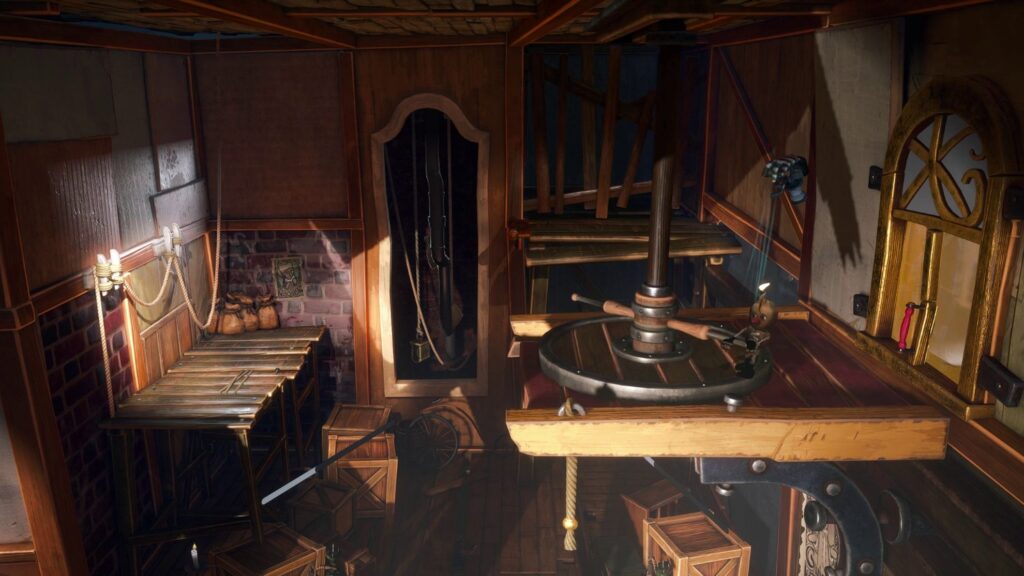
Really, though, the player’s actions could feel snappier. Both Nieve and Drev are technically independent of each other. The L2 and R2 triggers and the left and right sticks can be used to have the two grab levers and switches and move them separately. This is implemented relatively well throughout the game. But again, there’s something about the way grabbing an upward zipline doesn’t feel kinetic or accurate that causes it to loose that tasty “oomph” players look for in the most responsive of games.
This lack of flow also hinders the overall pace of Once Upon a Puppet. Only a handful of times did I feel like Flatter Than Earth used every tool that had given me to truly test my skills. Even combat is sparingly used throughout the game, making players avoid enemies or risk a one-hit death. Collectibles are sprinkled throughout the game to offer a twinge of replayability but what I really yearned for were some truly challenging moments of precise skill. And I’m not really sure that’s the kind of game this is.
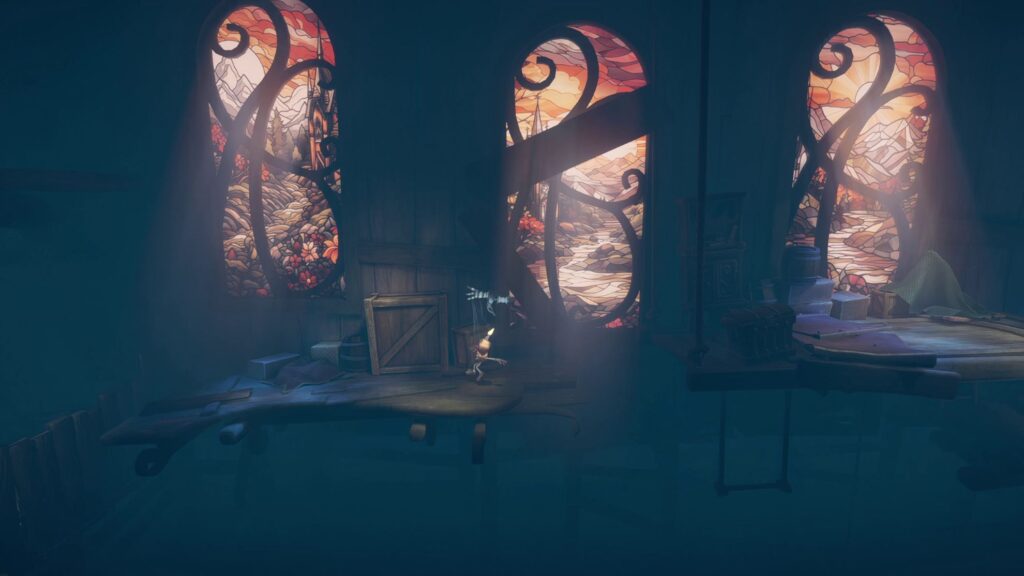
Despite my problems with one of Once Upon a Puppet‘s core tenets, I ultimately found myself still charmed by the game. Its characters and world truly do strive for their own personality and there’s creativity in spades.
The game has some impressive visual language that it manages to keep relevant throughout the 8- to 10-hour experience. And for a world filled with such whimsy, it’s surprisingly grounded and dark. Often, the tone leans towards grim, especially with its environments. After all, the Understage is literally built on the fallen detritus of the world above. But backgrounds are often deep reds and purples and shadows are cast everywhere.
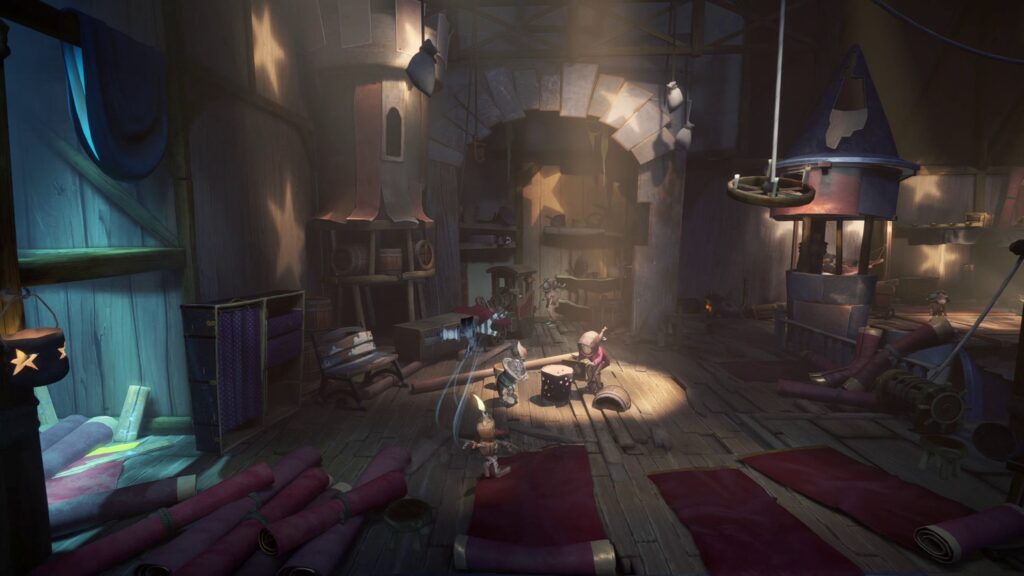
This stylistic choice is relatively bold. Certainly I could have used a few more prominent “bright” levels just to break up the visual pace. But as storybook as this tale may be, it’s not often that players are given a platformer that leans towards this style without it being more horror-oriented.
Once Upon a Puppet excels in its ability to build a fantastical world cobbled together from the dilapidated remains of opulence. As a 2.5D platformer, the game’s attempts to use the genre’s foundations are often mixed. Clever puzzles and bursts of action go hand-in-hand with movement that can often not feel fluid and satisfying enough. But players open to the game’s charm should be able to ignore the blemishes and enjoy the moments that truly shine.