


Once Upon a KATAMARI is a Katamari game at its best, rolling, rolling, and rolling through time collecting items and constructing new planets. The 10+ year wait has been worth it, as it introduces just enough novelty all the while preserving the best bits of the series. Its uniqueness aside, it’s the most approachable Katamari yet.
As of this minute, my kitchen is in utter disarray. I made dinner, meal prepped for later this week, and got ready for a birthday that is taking place over the weekend. It’s times like these where I had The Prince to clean up my mess with a Katamari ball while I take a quick snooze. Maybe then my kitchen will be pristine as I wish it to be. But alas, I am writing this review instead of being a house husband.
Truth be told, I did not expect a new Katamari title to grace our presence. The last Katamari console game was released in 2009 (Katamari Forever) on the PlayStation 3. Beyond that, there were small blips in the form of an iOS game, a Vita title, and several remakes in the 2010s.
Then, July 2025’s Nintendo Direct came around, surprising Katamari fans with the imminent release of Once Upon a KATAMARI, the first new Katamari game in over a decade. Our prayers have been answered!
Katamari games are delightfully simple and follow a consistent gameplay loop. Starting with a small little Katamari ball, The Prince is to roll the ball around and collect items. The more items collected, the bigger the ball gets, meaning that the Prince can collect bigger and bigger items until the ball is large enough to be turned into a planet by the King of All Cosmos himself.
Knowing the simplicity of the series, I feared that there was little room for innovation in Once Upon a KATAMARI, resulting in a stale and derivative title. This was not the case. Once Upon a KATAMARI has incorporated collectibles, power-ups, rank-chasing, and missions to deepen the game’s difficulty curve. Oh, and there’s a multiplayer competitive mode called KatamariBall.
The King of All Cosmos took me through a brief tutorial on how to control The Prince (along with his 60+ cousins) and roll the Katamari ball. The original control scheme involving the dual analog sticks returns, along with some additional controls like quickly swapping views, speed boosts, and other advanced rotation techniques. Once Upon a Katamari also offered me a simpler control scheme that only needed one analog stick; it made the game slightly easier, but I preferred the classic control scheme.
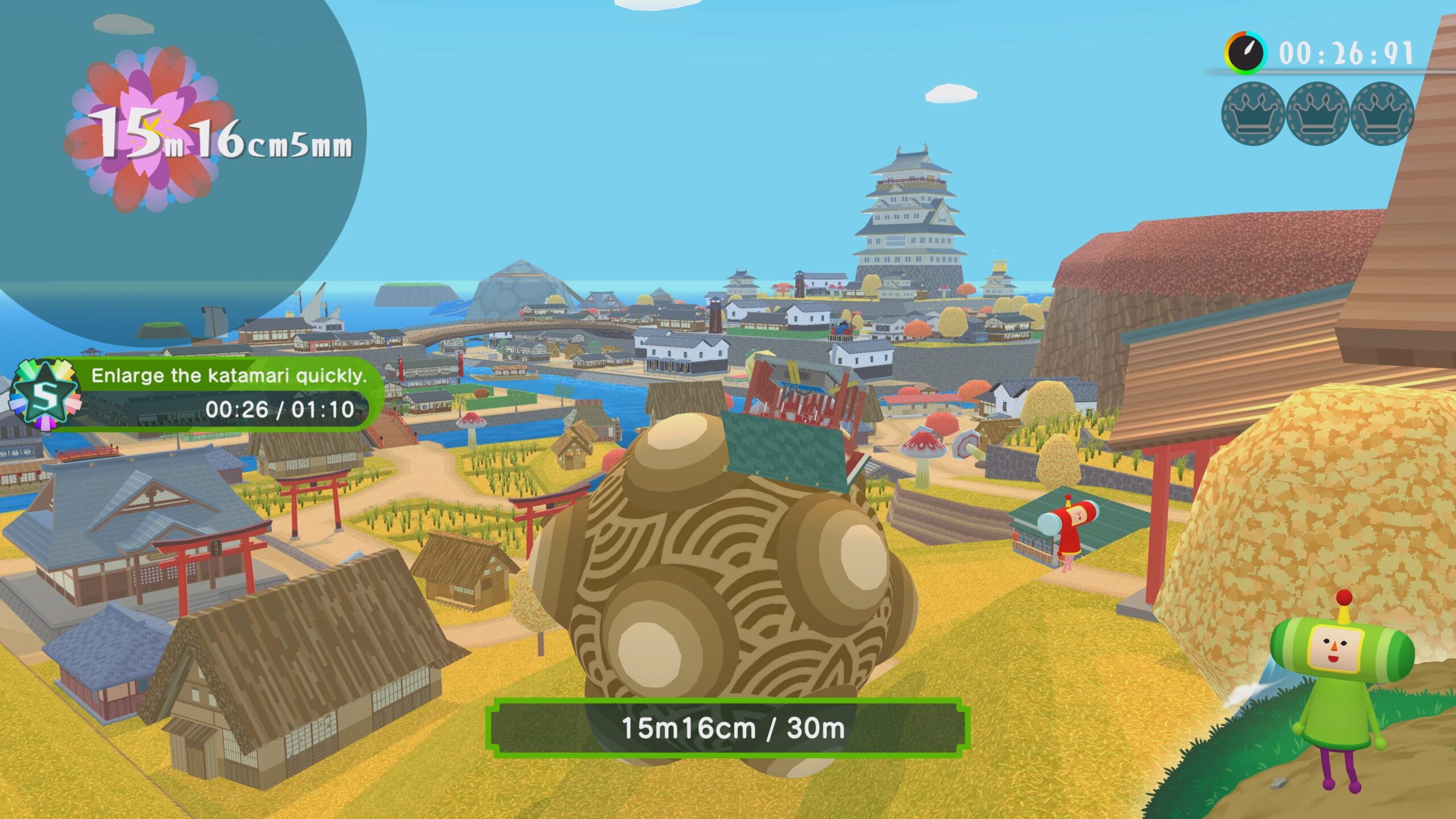
 The first few levels felt like a return to form: I had to collect as many items as I could within a time limit and then attempt to race the clock to collect a set number of items. Then, I got weirder asks, like collecting as many of one type as possible or creating the largest Katamari possible while only picking up 50 (and ONLY 50) items! It surprised me how quickly the difficulty curve got steep.
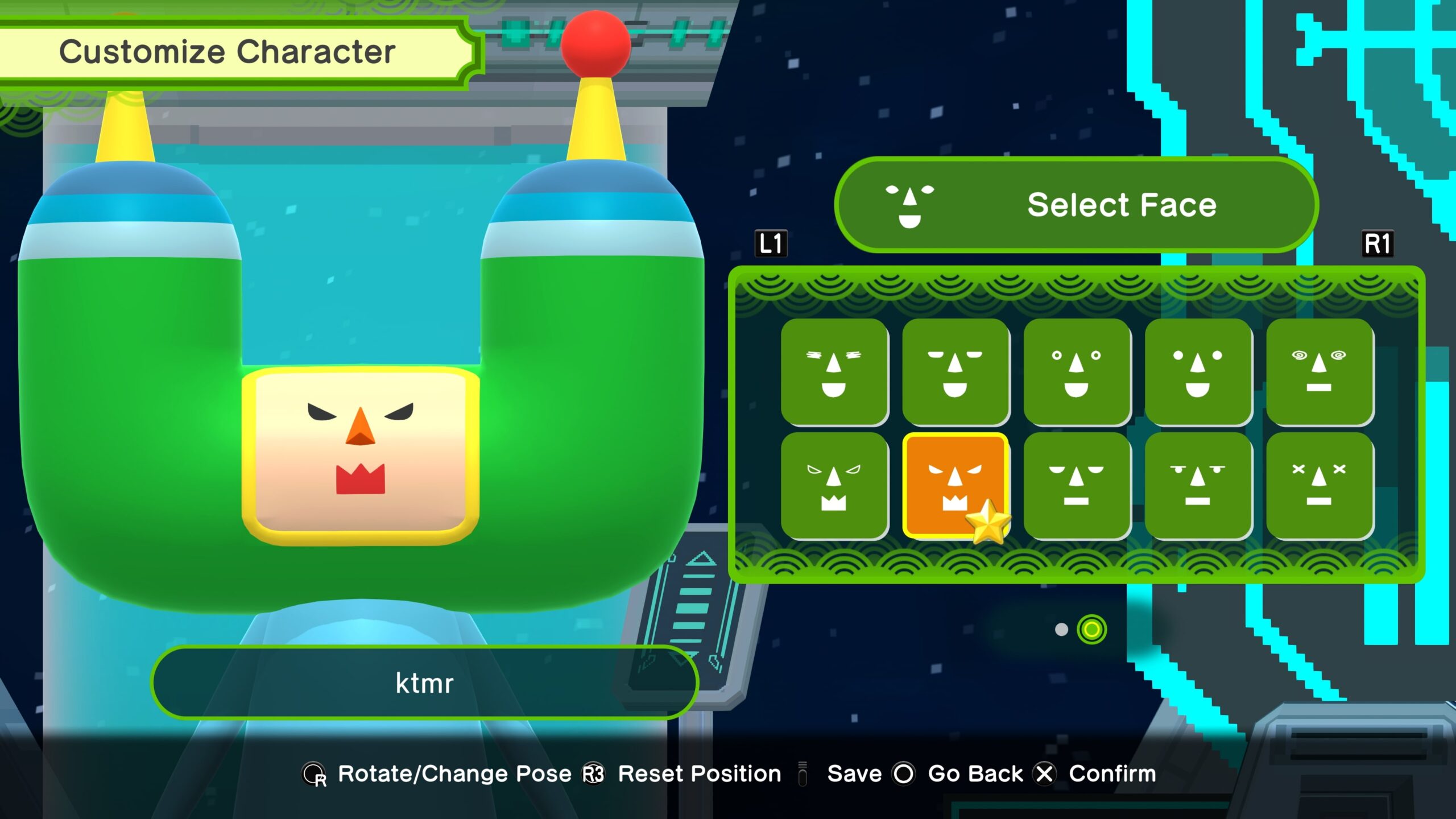
Once Upon a Katamari wasn’t too difficult, though. It incorporated a ranking system, making it so that I could inch by on those difficult levels with just enough while also rewarding me in the rare instances where I was going above and beyond the goal. I was more than happy to secure a D-rank in those hard levels, as some of the goals were quite difficult. Either way, completing a level gave me tokens I could spend on unlocking additional cosmetics for me to use on my Prince character.
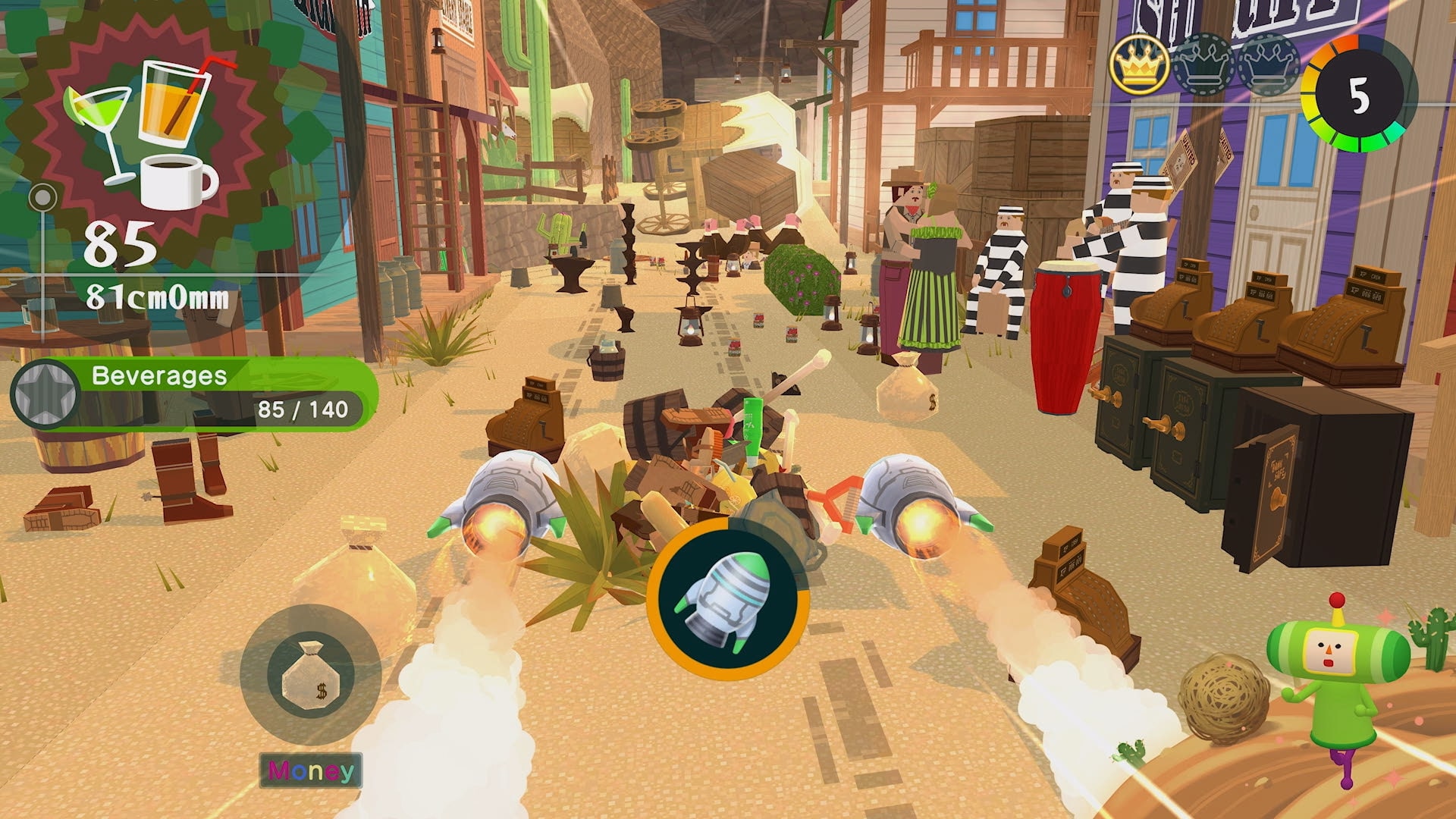
The in-level items increased the frenetic silliness of the gameplay and are a refreshing addition to the game. I would occasionally see a magnet that would vacuum up available items around me, helping me get closer to the goal and filling the screen with floating items. The rocketship item made me quite fast and hard-to-control, but I could move across the 3D plane and get to other parts of the map without wasting time.
All of this takes place alongside the traditional Katamari means of discovering small Easter Eggs, unlocking one of the 60+ additional characters who are hiding in the levels, and chasing other secrets. The levels encourage vertical and horizontal exploration, too, with some that dramatically open up as the katamari ball expands.
 It’s relieving that Once Upon a KATAMARI sticks to its roots without compromising the original experience. It feels as though the newest part of the game is the in-engine cutscenes that tell short stories of the Prince, the King, and the silly cousins rebuilding Earth. The series is not known for its worldbuilding, I know.
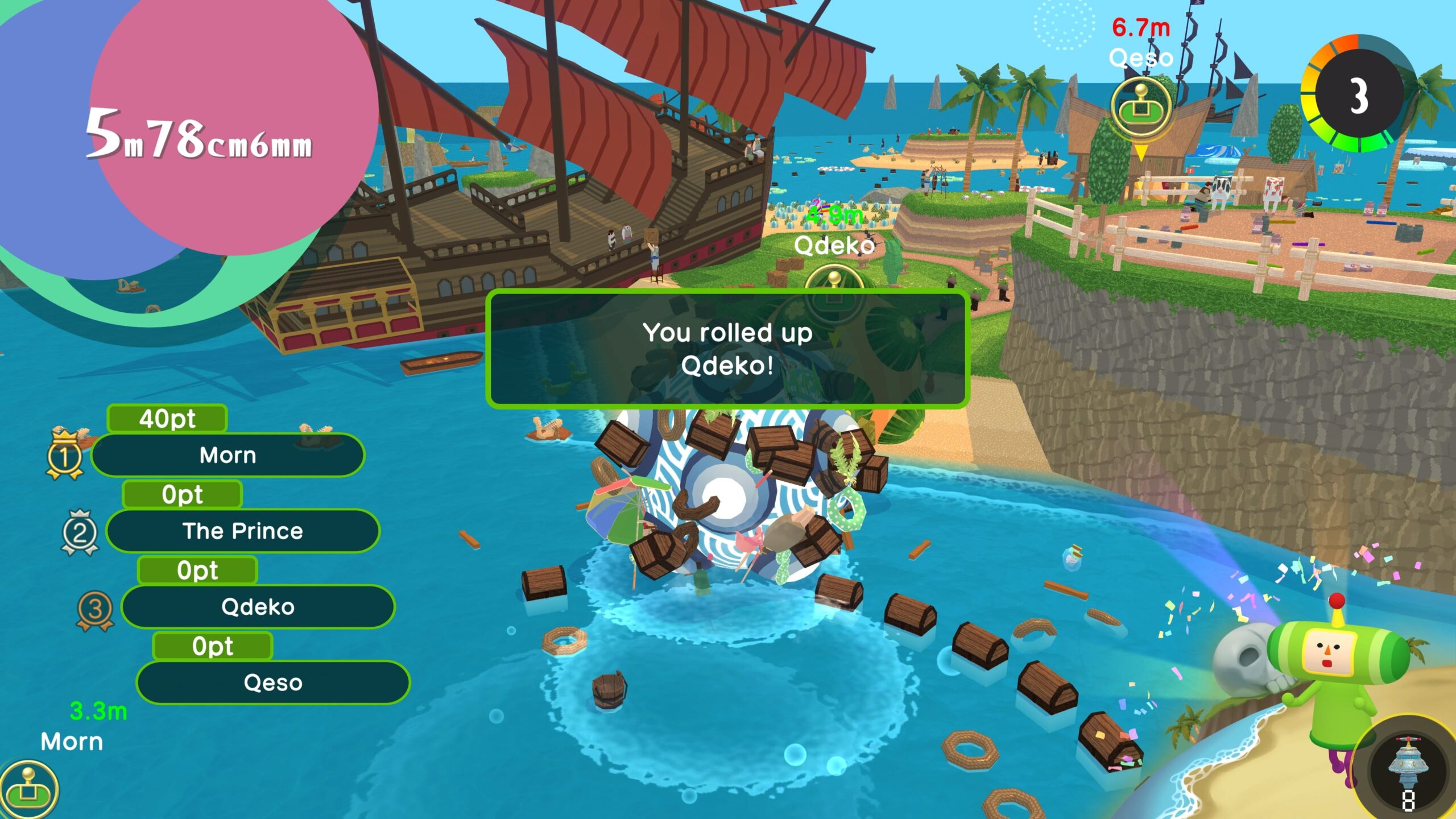
During my review period, I wasn’t able to try out KatamariBall against other players. Instead, I played it against the CPU as I proceeded through the story. The concept here is just as simple as you would expect: Roll the Katamari through an arena, make it as big as possible, and deposit the items you find at the Prince’s Ship. If your ball is bigger than your opponent’s, you can roll them up; if your ball is too small (especially after depositing items for points), you’ll get rolled up. Thus, it feels like a timed trial run of Agar.io but with Katamari silliness.
It’s relatively fun, but the matches end far too quickly to fully appreciate them. The ship was often too far away at the start for me to consider depositing items, meaning that I would stick to rolling and collecting as much as I could for the first 90% of the match while hoping that the ship would spawn near me before the time ran out. Part of the thrill of playing a Katamari game is slowly creating a goofy and gigantic amalgamation of stuff, so missing that point of silliness feels counterintuitive. Deciding on whether or not to deposit items adds competitive thought in the form of “roll or be rolled over,” sure, but it would feel better for players to have more opportunities to do so before the time runs out.
I’m curious to see how it functions at release, though. That will tell us more about the potential multiplayer competitiveness of Once Upon a Katamari.
 Deep down, I’m thrilled that RENGAME invested time and energy into the Katamari series with Once Upon a KATAMARI. Its premise and designs are trippy beyond all get out, heavily leaning into the low-poly whimsical wackiness of modern Japanese art. The hammer-shaped heads of the series’ characters, ridiculousness of the potentially collectable items, and eccentricity of the level designs come together into an amalgamation of uniqueness that defies traditional gameplay design.
There’s nothing like a Katamari game, for better or for worse. Once Upon a Katamari is consistent in its design in that it aligns with the designs and concepts of its predecessors, pushing The Prince down a time-traveling wormhole to rebuild reality as we know it. That consistency comes at a cost, though, with twin-stick controls that are arguably archaic and clunky. This is especially true when attempting to navigate The Prince through tight corners and across narrow paths.
It’s that clunkiness that gives me a degree of pause when recommending it for new players, especially those unaware of the series’ existence until now. Even though Once Upon a KATAMARI introduces a simpler control scheme involving a single analog stick, it’s still a stark departure from traditional control schemes that many players have become accustomed to as of late. Adding timed trials, occasionally arbitrary rule sets, and some competitiveness may push some new players away.
 I would prefer that clunkiness, though. It’s that same clunkiness of the PlayStation 2 era where I and many other fans fell in love with Keita Takahashi’s critique of excess merged with psychedelic mascots. Once Upon a Katamari successfully navigates that clunkiness with just enough nuance to set it apart from its predecessors. It’s the most refreshing Katamari game to date.
I plan on returning to Once Upon a KATAMARI in a few months when I am in need of novel silliness in between reviewing mechanical keyboards, playing roguelikes, and getting lost in metroidvanias. Each of its levels contain just enough puzzling fun that acts as a palate cleanser to refresh the noggin. Its simplicity makes it a game that can be picked up right where I left off without needing to brush up on my skills, catching up on available quests, or rediscovering a storyline.
Once Upon a KATAMARI is a Katamari game at its best, rolling, rolling, and rolling through time collecting items and constructing new planets. The 10+ year wait has been worth it, as it introduces just enough novelty all the while preserving the best bits of the series. Its uniqueness aside, it’s the most approachable Katamari yet.