

Minishoot' Adventures avoids being a shameless ripoff of classic Zelda by incorporating twin-stick shooter elements into its fluid gameplay. The result is a brisk adventure that constantly feeds rewards and surprises to the player.
Imitation being the sincerest form of flattery is a crutch many would happily lean on.
When you can rely on an established or classic formula, you’re guaranteed a modicum of spiritual success, right?
Minishoot’ Adventures is undeniably a game inspired by classic The Legend of Zelda, whether that be Link’s original adventure or the countless derivatives that have followed in its stead. Developer SoulGame Studio is using a tried and true thesis, one iterated upon across decades of console generations and technological advancements.
And you know what? It absolutely works.
Often, an imitator can get by on pure flattery alone. I’ve played numerous top-down adventure games where the main character wields a sword, quests around the world, and earns items to help them in their journey. Sometimes they are rescuing the princess. Other times they are saving the world. They’ve been grim and dark and colorful and jovial. In the immortal words of Bethesda’s Todd Howard, “It just works.” Why stray too far from something players have enjoyed for over 40 years?
In recent years the Metroidvania formula has blown up in quantity–not necessarily quality. I’ve played a ton of games where progression has been blocked by acquiring some item or power that lets me jump higher or blow past a certain door or gate. But it’s kind of like a late-night snack. It’s there, you’re hungry, why not indulge? And just like the countless Zelda-likes, I can have a lot of fun on an evening or weekend for a few hours, even if most of them never speak to me again.
Minishoot’ Adventures makes me think of Tunic, a brilliant game that owes its existence to Zelda as well. But like the best games that aren’t wholly original, Tunic expressed brilliance in its devotion. The unfolding manual, the gorgeous visuals, and engaging secrets, those are all things that can be replicated in one way or another. Yet that unbridled sense of adventure felt so special and key to Tunic‘s magic that one could recognize inspiration without it casting too dark a shadow.
So how does Minishoot’ Adventures do it?
“What if Zelda, but make it twin-stick shooter.”
“Oh… okay?”
The tired expression of “I can’t believe no one thought of it yet” truly applies here. Searching my brain for a reference point, I can’t think of any instance in which another developer has conjured up what SoulGame has.
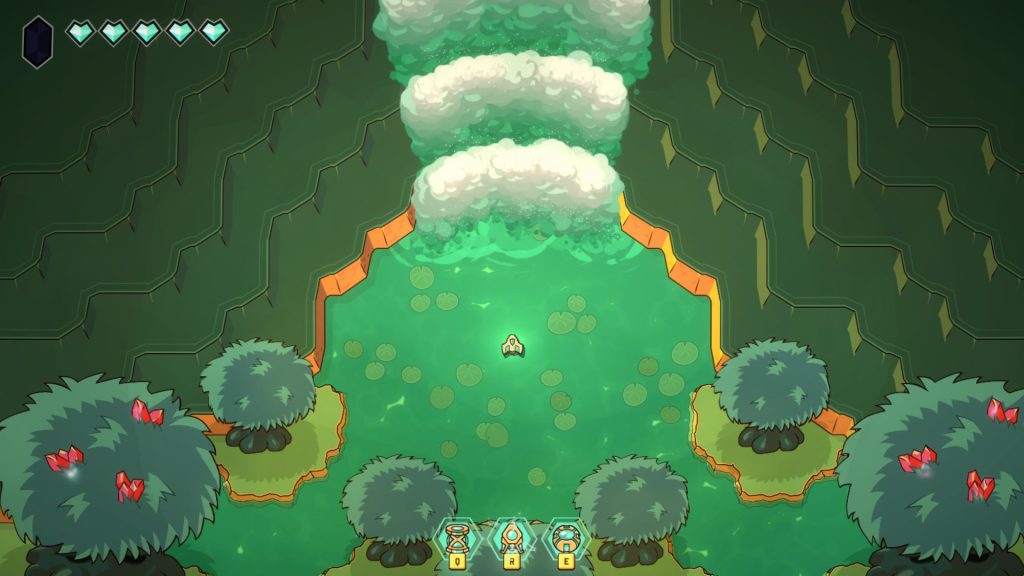
Instead of a scrappy, young lad, we have a scrappy ship. That scrappy–and perhaps young–ship is destined to save the land after its village was destroyed by an evil force. Shockingly, Minishoot’ Adventures does have a bit of lore behind it. Something about a Primordial Scarab and The Unchosen and powerful blue crystals and corrupted red ones. There’s fascinating environmental hints at an ancient world buried in the details of the game but I mostly know these lore bits because I read about them in advance.
Story isn’t an essential factor here. More important is the colorful and personable cast of ships and enemies that populate this world. The player-controlled “shipling” whirs and chirps with excitement and joy upon felling a particularly dastardly boss or acquiring a new ability; sometimes after landing a jump off a ramp it makes a noise that will attach a personality to it. As a wordless game, Minishoot’ Adventures does translate a good amount to the player. When freeing fellow villagers, there’s a sense of relief that washes over, knowing that they will return to the village to deliver assistance.
A simple color palette bathes friendlies and enemies in cream colors, whites, sky blues, and dark purples. Readability is never a problem with the game because the player is usually the only friendly on the screen, while everything else attempts to riddle you with bullets.
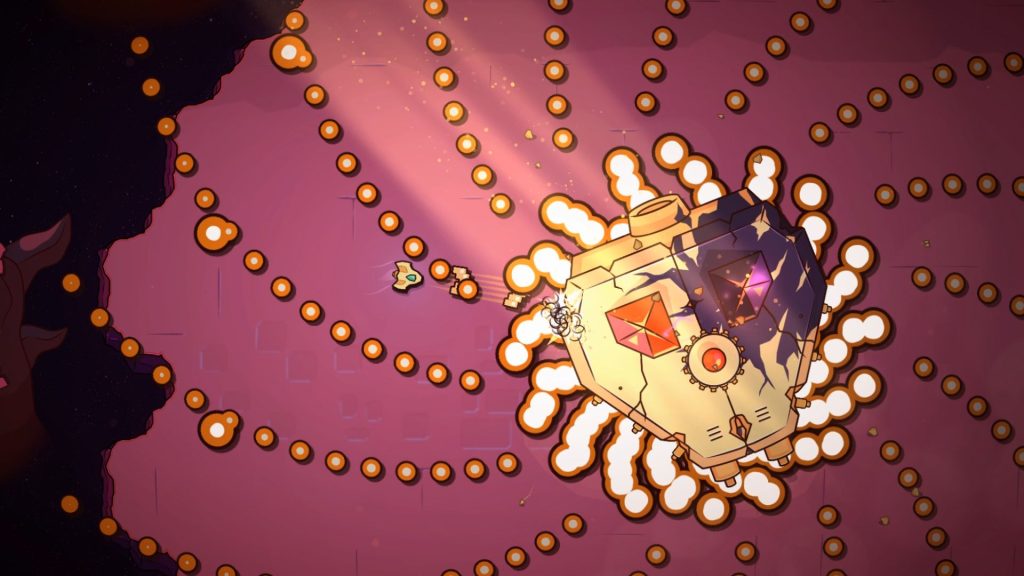
For a massive amount of context, I played Minishoot’ Adventures on the hardest difficulty out of the gate. Being fairly confident in my ability to play games, I figured if the challenge was too daunting I could switch to Normal at anytime. With that in mind, a large part of my “frustration” with the game’s combat stemmed from the faster and more frequent onslaught of bullets that were a part of the harder difficulty. Even then, the game has a sturdy challenge for players really seeking to test their mettle. And for those wishing for a more accessible game, numerous options can be enabled to smooth out the difficulty.
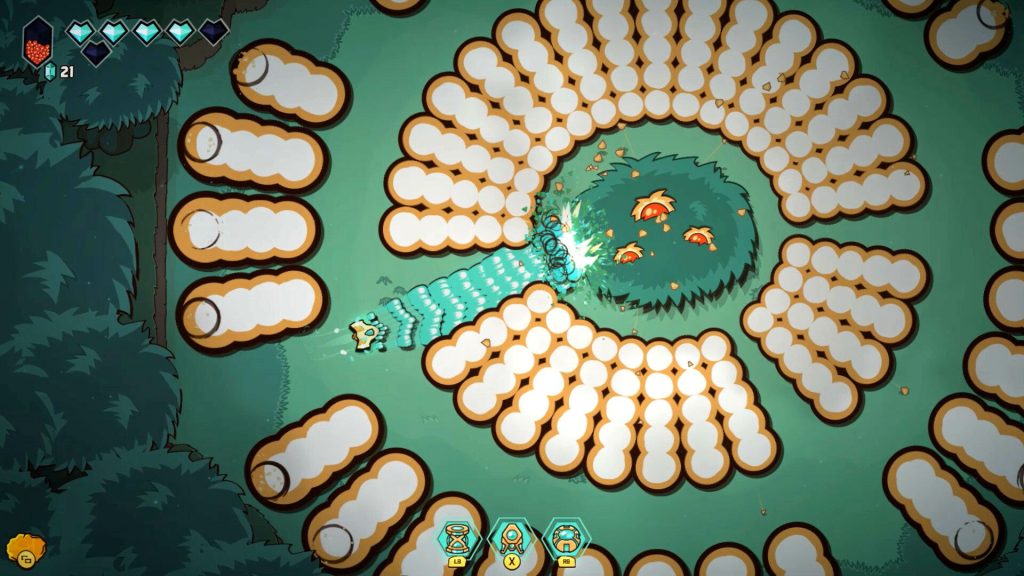
SoulGame fused the most natural parts of twin-stick shooters and bullet hell games together, making for generous combat that still attempts to keep players on their toes. The controlled ship zooms around the map from screen to screen using the left stick, while the direction of bullets is dictated by the right stick. Over the course of the game, the copious amount of enemy types will find ways to flood the screen with gargantuan projectiles, homing shots, and intricate spreads all in hopes of depleting health.
Honestly, it doesn’t get more simple than that.
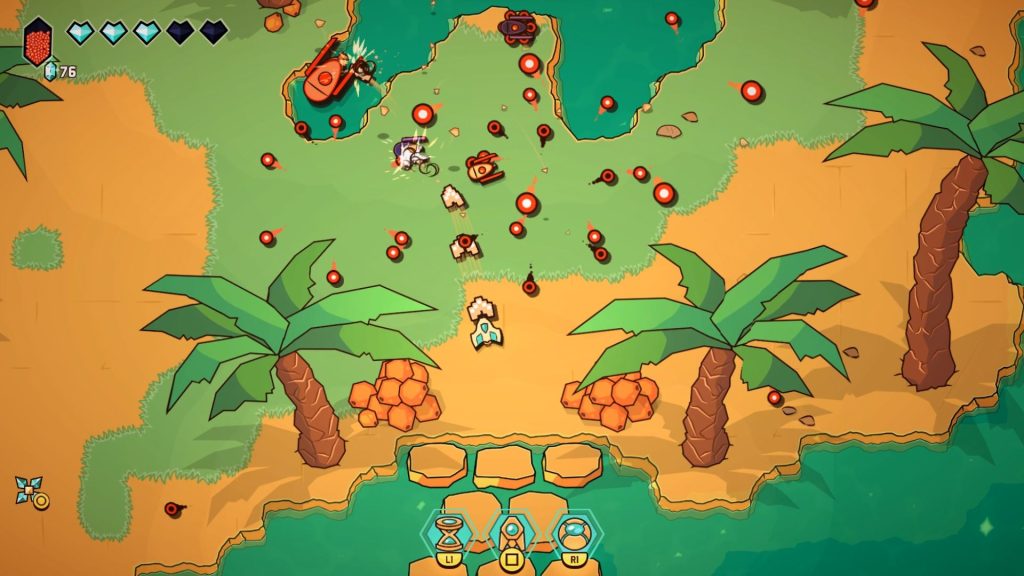
Progression is dictated in the form of dungeons that reward new powers and end with complex bosses that have mechanical twists that ask the player to do more than just point the gun in a direction. The ship can use explosives to break fractured walls and rocks, it can learn to glide across water, and it can engage in boosts to speed past danger. These tools are then used to earn more heart pieces that increase maximum health. Killing enemies and breaking open stashes of red crystals slowly build up experience which are then condensed into upgrades. Players can increase the damage of bullets, extend the length of shots, have the gun fire faster, raise the critical chance, and more. Each subsequent upgrade costs more crystals but players can upgrade and downgrade whenever they want if a specific upgrade isn’t working out.
The simplicity of the formula not only makes Minishoot’ Adventures approachable, it makes it fun. The game doesn’t get bogged down in random elements and upgrade trees. It is purely a game about fighting enemies and exploring. The special sauce is how players are continuously asked to engage in combat. Many screens lock the player in for a gauntlet of wave-based enemies. These encounters usually throw complex patterns at players to avoid as they also attempt to clear out enemies. Who do you focus on? When can you move in for a shot and then retreat?
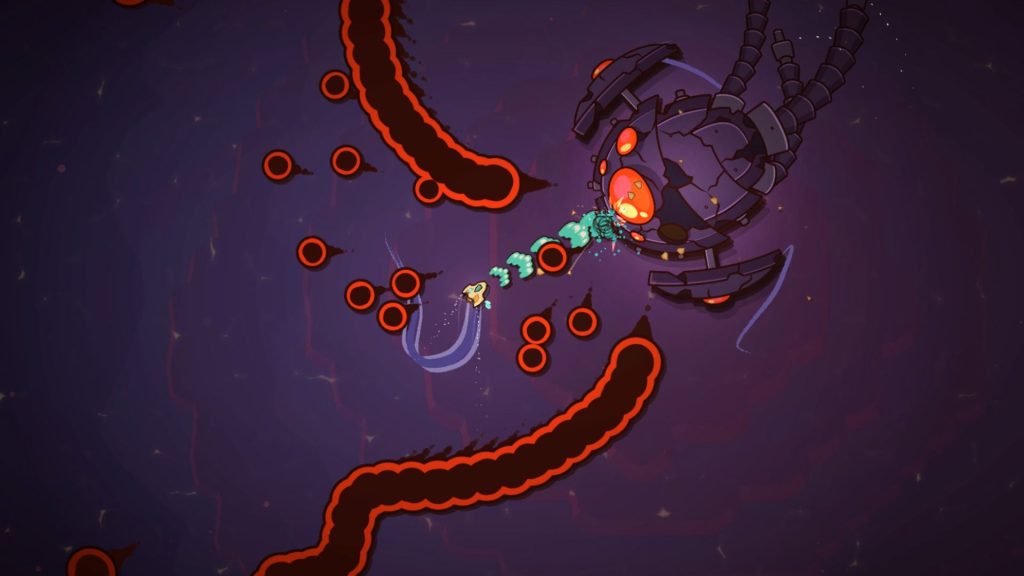
Over the years I’ve watched those impossibly absurd bullet hell games that fill the screen with 99% danger while the player, almost a pixel by comparison, nudges the bits of safety they are granted. Minishoot’ Adventures does not tax the player’s sanity in such ways but it does reach challenging highs where the screen is riddled with dangerous blobs of harm. And while there are hints of frustration, fights are so often thrilling that the palpable sense of relief that hits you is intoxicating.
Minishoot’ Adventures gives the player numerous tools to guide them towards success and they all feel rewarding. The guns can be upgraded to fire more bullets. A tool can identify what locations have items yet to be discovered. Map fragments are found to give the player a clearer picture of the world. All of these elements instill progression into the adventure, pushing the players towards the ultimate goal.
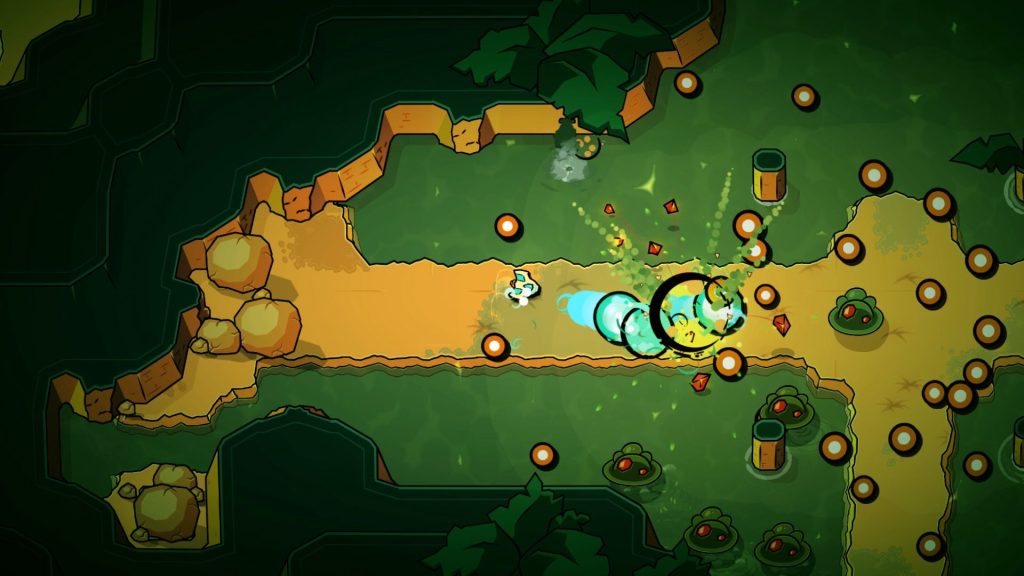
While I praise the unique fusion that Minishoot’ Adventures has accomplished, I can’t deny that it is a work completely informed and inspired by Zelda. For some, it’s going to feel derivative in ways both good and bad. Personally, I couldn’t shake that one piece of the overworld music was culling from Disasterpeace’s “Adventure” from the Fez soundtrack–one of my favorite pieces of music–which definitely hammered in that this world could be neighbors with Hyrule.
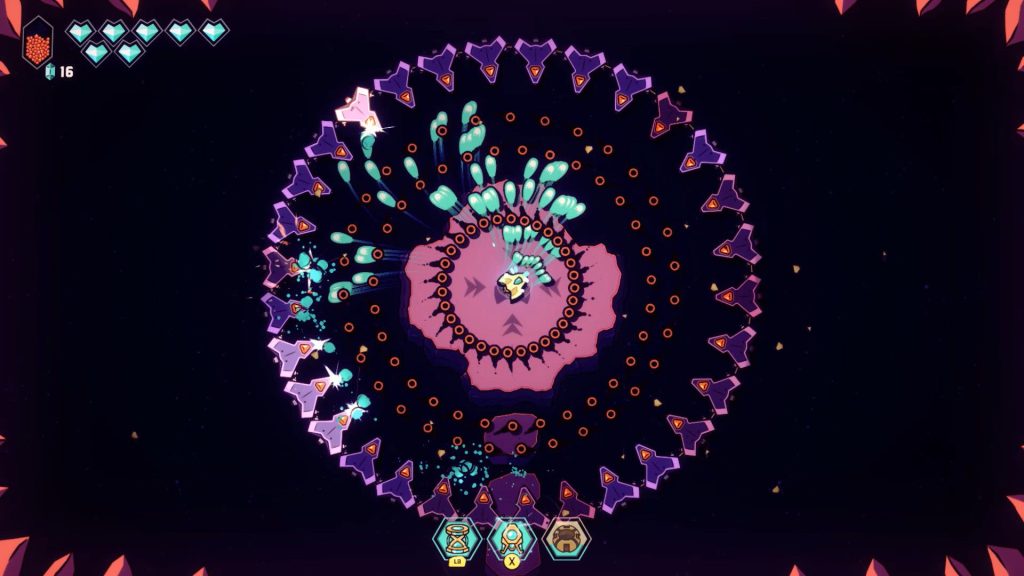
On top of that, I found myself mystified by a few objectives and paths towards the next thing, often running into harder areas but not having the required item to progress. And–perhaps related to the Hard difficulty–I was frustrated by the lack of being able to heal back at town. This was especially pervasive knowing I would have to traverse long parts of the map to get back to where I was at a previous death, usually making me kill myself so I could travel to the destination with full health. But for a game with such highs, these gripes felt quite isolated.
Minishoot’ Adventures avoids being a shameless ripoff of classic Zelda by incorporating twin-stick shooter elements into its fluid gameplay. Tackling friendly bullet hell enemies is made more exciting through a colorful world packed with a flood of rewards and a constant feeling of discovery, making this brisk adventure enticingly unique.