


Though Little Nightmares III is not a drastic evolution over Tarsier Studios' vision, Supermassive Games excels at crafting their own warped horrors rife with tense chases and puzzles.
When Tarsier Studios introduced a second protagonist to Little Nightmares II, they laid the foundation for what would come.
Little Nightmares III, like its predecessor, clings to inspiration. Tarsier’s original 2017 puzzle-platformer could have gotten lost in the mire of Playdead inspiration but instead differentiated itself from the likes of Inside.
When it comes time for a sequel, the inclination towards making a game bigger can often lead to unnecessary bloat, where charm loses out to improved scope or excess. Little Nightmares II was certainly a bigger game but it didn’t stray from the path, merely emboldened it. There was a lingering sense that Tarsier had the confidence to make a cooperative game but didn’t want to take it too far.
Tarsier has passed the Little Nightmares torch on to Supermassive Games, a studio steeped in horror games. Aligning games like Until Dawn and The Quarry with a puzzle platformer is not a move many would make. But I think Supermassive’s last decade of realistic horror narratives lends itself to a series like Little Nightmares. Much of the horror and grotesque mood are left unspoken, sinister in their ability to permeate the mood of the world. Little Nightmares‘ shambling, gargantuan humanoids leave lingering questions. Whereas a star-studded cast fending off wendigos and werewolves can be fraught with scares but was also done with a certain degree of camp.
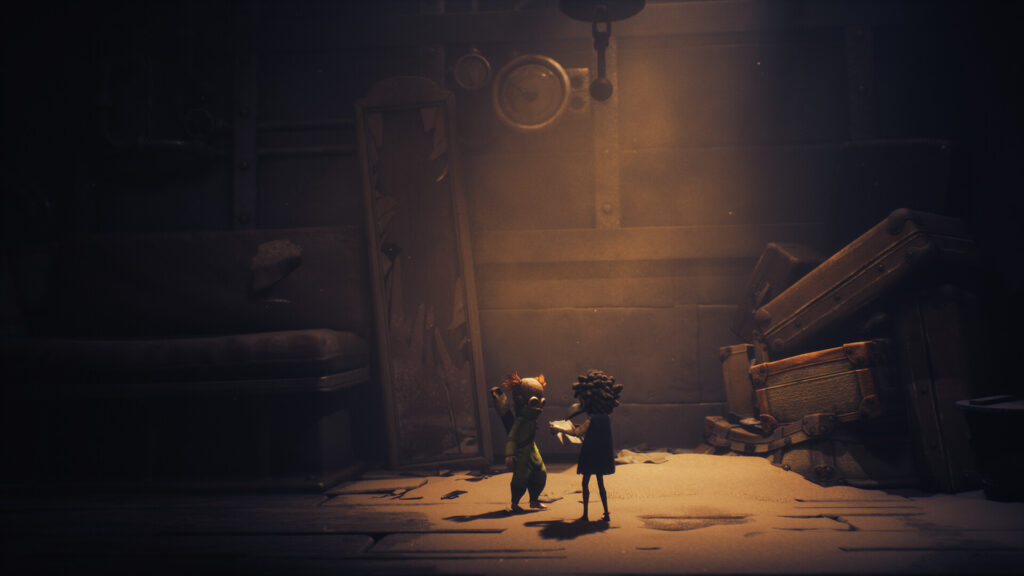
Little Nightmares III is an attempt for Supermassive to show its ability to craft genuine environmental unease. Worlds with unspoken mystique, where the answers to any questions may not be as terrifying as the ones players concoct in their own head. I come to a game like this to allow weird worlds to envelop me, to feel tension festering as I’m led to the next chunk of unease.
So why not share the experience with someone else?
Without the addition of true, multiplayer co-op Little Nightmares III would, more or less, be the same game as Little Nightmares II. But that ability to have a second player tag along for the scares and unceremonious deaths can be a comfort. Worry not, though, as solo players won’t be left wanting.
Little Nightmares II danced around the borders of cooperative play. The protagonist Mono–a little boy with a bag over his head–was joined by Six–the raincoat-clad girl from the first game, shortly into the action. Throughout the experience Mono could call to Six to perform a simple action and at times she would carry around objects to prevent the player from making excess trips. But the whole time Six was controlled by AI, following code and script to help the player out. There were even moments where Mono and Six became separated, allowing their reuniting to feel like a sigh of relief.

Having a second player be able to fulfill the role of cooperative partner instills the overbearing, dangerous world of the Spiral with a modicum of safety. A friend or a stranger online can provide camaraderie, assistance with a puzzle, or merely a soothing presence.
The somewhat ghastly proceedings across four separate environs of the Spiral find our two characters–Low and Alone–desperately trying to escape this twisted world. Low is a boy with a blue cape and a raven mask, Alone has red pigtails and a green jumpsuit. Low has a bow, capable of shooting arrows that can harm enemies or potentially break targets. Alone carries a large wrench that can break objects and walls or be used to operate certain mechanisms.
Outside of their unique pieces of equipment, Low and Alone function identically. Little Nightmares III is about clambering over surfaces, jumping unsafe distances, sneaking around unsuspecting enemies, and running from danger. The items the two carry allow for a number of clever instances of puzzle solving and combat.

So as not to punish the solo player, very few puzzles in the game require strict timing. And in a game centered around sudden, unexpected deaths, I think that’s okay. In one scene, beetles surround the two and Low must shoot them down while Alone rushes to smash them. In another, Alone lowers a platform, exposing a rope holding a gear down so Low can shoot the rope, keeping the platform from retracting.
But there are also certain benefits to playing the game by yourself. On my solo venture, I decided to pick Alone. I would argue this is the perhaps the “good” choice. While Low’s bow doesn’t require precise aiming, the AI is an expert marksman and merely requires the player to press the “call” button to shoot. Smashing objects during a daring escape is a less frequent occurrence and solo Alone players don’t have to feel much pressure during those intense moments.
In a game about trying to figure out solutions, Little Nightmares III doesn’t completely strip the feeling of discovery away from the player. That being said, there’s a handful of occasions where the AI-controlled character may shout “hey” a little too soon to express that “hey here’s the thing to do” or to properly trigger an enemy to react.

Perhaps the most “egregious” way the AI can impact the solo experience is when Low and Alone are being chased or must hide. Because the AI knows where it needs to go to survive, it will take the initiative and as soon as it’s allowed. Once or twice I was able to keep up with the AI and save myself when I otherwise wouldn’t have. The same logic applies to hiding spots too.
Though it might be slightly deflating due to the nature of Little Nightmares III being a puzzle-platformer where death teaches a lesson, these are the adjustments that need to be made to enable solo players to enjoy the experience as well. Once or twice I was annoyed that I couldn’t swap over control from Alone to Low, which does feel prohibitive in a way. I wanted to experiment with Low’s bow to see if I could shoot at a target. In one moment, I became frustrated he wouldn’t drop an item, seemingly breaking a puzzle. But where I thought I knew the right solution, I was in fact doing it wrong and Low’s sticky fingers were merely a way of informing me that I was doing it wrong.

Playing online or with a friend does require a certain amount of grace. How do you and another person cooperate together to avoid what are meant to be slightly tricky deaths due to shocking enemy appearances or ill-timed jumps? There is a sense of despair when you make a jump and your friend falls to their doom but it certainly fits the narrative if that were to actually happen in the game.
Little Nightmares III can have a handful of awkward moments where it feels like climbing or jumping doesn’t work the way it should. And this can also make for one grumpy moment here and there for players. But overall, Supermassive Games works to telegraph things smartly, not overtly. Dying usually only serves to send players back a screen or two and frustration might occur having to revisit the same few seconds of Low and Alone opening a grate to enter a room, only to die and have to repeat the process multiple times. In the final chapter of the game, I hit a few moments where the checkpointing made me annoyed because I both couldn’t figure out what I was supposed to do and thought maybe I was hitting a bug.
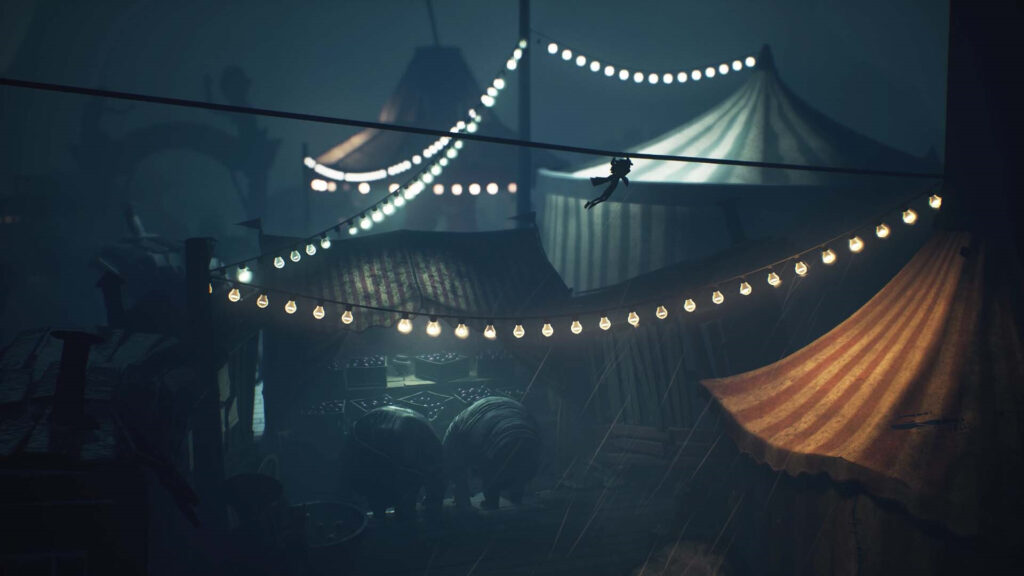
All these qualms and quirks in no way strip much enjoyment from Little Nightmares III‘s excellent puzzles, action, and environmental storytelling.
Set in the same ghoulish, distorted world of The Nowhere–the overarching world of the series–Low and Alone are merely trying to escape. Unlike the Maw or the Pale City from their respective games, the Spiral is somewhat more disjointed.
Over the course of its 6 to 8 hours (depending on how thorough you are), players will visit four distinct locations of the Spiral. Whether it is the barren Necropolis, the industrial Candy Factory, the slovenly Carnevale, or the dilapidated Institute, players will be victim to countless excited, horrid sights.
As a person who grew up watching bizarre cartoons like Ren & Stimpy, Aeon Flux, and Rocko’s Modern Life and then going on to watch weird internet things like Salad Fingers and Don’t Hug Me I’m Scared, Little Nightmares‘ style nestles into my brain quite well. Here, the world is recognizable and features objects and concepts familiar to our world. But stemming from Tarsier Studios, Supermassive Games continues this nightmarish, corrupted concept.

In spite of its Teen rating, Little Nightmares III straddles the line between disturbing maturity and child-like playfulness. These are meant to be haunted versions of what a child may see or feel. Spidery old women scuttling around filing cabinets, candy potential made of humanoid paste, a Godzilla-sized baby doll eerily humming just out of sight.
Just enough context is fed to the player and I cannot commend Supermassive Games for that. A title like Little Nightmares III thrives on its ability to be scary, weird, and obtuse. But there should always be questions on the minds of players. What is the purpose of this room? Why are all these oafish people gathered here? Why are these bodies frozen in time? What’s with all the raven skulls?
For as many questions as the player should have, only a few answers should be provided. It’s more fun to infer meaning, analyze the world. Players can go back again and play to see if they missed anything or can discover any new answers.

There does seem to be an effort by Supermassive Games to find a way to string the implied lore of the Little Nightmares universe together with this third game. Because of that, there may be a large sense of familiarity to those who enjoy the first and second ones. Fans who deeply enjoy these games will likely love any opportunity to scurry around the Nowhere. Those who wanted something fresher may only delight at a few of the game’s sections.
Attempts were made to incorporate tools a few times to spice up the puzzles and the platforming. In the first level an umbrella is introduced that can be used to brace falls and float upwards. Later on a flashlight is earned but, unlike Little Nightmares II, doesn’t seem to serve a gameplay purpose. It would have been nice to see a unique mechanic in each new part of the Spiral, especially with some of the monsters and situations feeling familiar. And while that may be expected by the third game, I do think Supermassive Games was able to make Little Nightmares III their own, showing an ability to be unique and stray from their own studio’s path.
Little Nightmares III is an eerie return to this beloved, haunted universe, captained by a developer with plenty of experience in scares. Though much of this third entry may strike a familiar chord with players, the opportunity to engage in harrowing chases and solve grotesque puzzles together makes for a tantalizing offering that you shouldn’t be frightened of.